Simple circuits
Apprends en jouant
Réponds à ces questions pour gagner de l'énergie, puis pêche et explore. Sans compte.
Notes de leçon
Big idea: a loop that lets energy flow
- Big idea. Key concept: Systems. A circuit is a system: a cell, wires and components that work together.
- Related concept: Function. Every part has a job. The cell pushes, the wires carry, the lamp lights and the switch controls.
- Global context: Scientific and technical innovation. Almost every machine you use, from torches to tablets, depends on circuits.
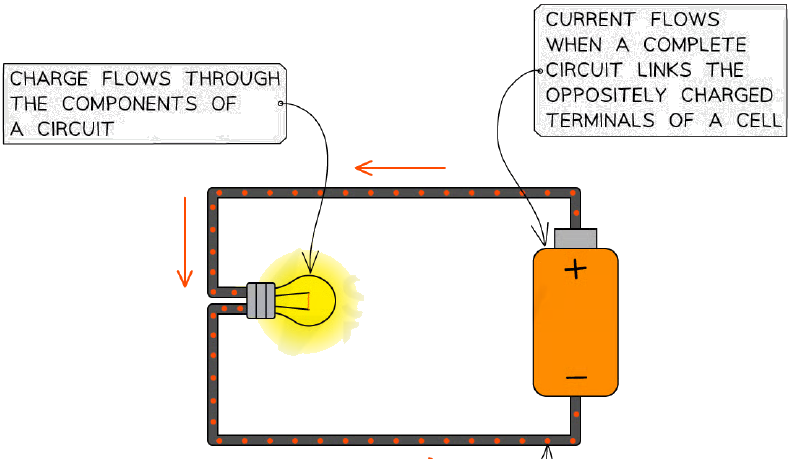
- A circuit is a path that charge can travel round. The charge carries energy from the cell to a component such as a lamp, where it is transferred as light and heat.
- A circuit must be a complete loop with no gaps, joined to both ends of the cell. If there is a gap, the charge cannot flow and the lamp stays off.
- A switch is a deliberate gap you can open and close. Open means there is a gap (no current). Closed means the loop is complete (current flows).
- A single cell is one unit. A battery is two or more cells joined together.
A complete circuit with a cell and a lamp
Drawing circuits with symbols
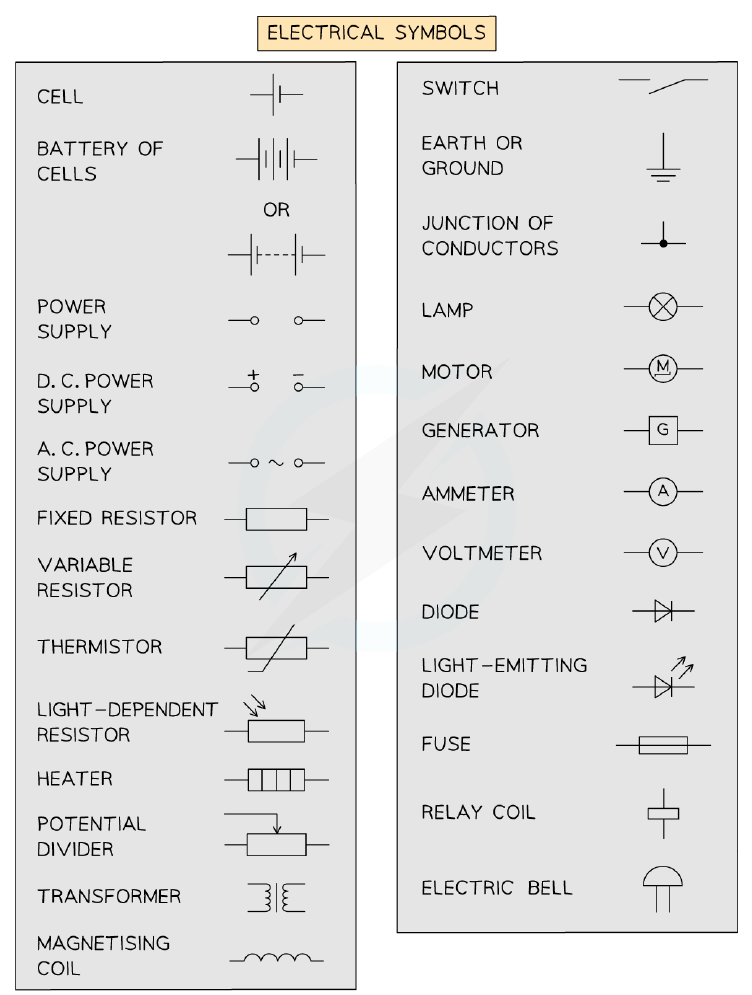
- Scientists draw circuits using circuit symbols joined by straight lines for the wires. Anyone in the world can read the diagram.
- A cell is drawn as one long line and one short line. The long line is the positive end. A battery is drawn with several pairs of lines.
- A lamp is a circle with a cross inside. A switch is a gap in the line with a small lever.
- An ammeter is a circle with the letter A. A voltmeter is a circle with the letter V.
- Draw the wires as straight lines with square corners, and leave no gaps in the loop unless there is a switch.
- Always check your diagram by tracing a finger from one end of the cell, round the loop, back to the other end. If you have to jump a gap, the circuit is not complete.
Circuit symbols
Current, voltage and resistance
- Current is the flow of electric charge round a circuit. In a metal wire the charge is carried by tiny particles called electrons. Current is measured in amperes (A), often called amps.
- By agreement, we draw conventional current flowing from the positive terminal of the cell round to the negative terminal. The electrons actually move the other way round.
- The cell does not use up the current. The same current that leaves the cell comes back to it. What is transferred to the lamp is energy.
- Voltage is the push the cell gives to the charge. It is measured in volts (V). A bigger voltage gives a bigger push, so more current flows. One cell is about 1.5 V. Two cells in series (the same way round) give 1.5 V + 1.5 V = 3.0 V.
- Resistance tells us how hard it is for current to flow. It is measured in ohms (Ω). A longer or thinner wire has more resistance. For the same cell, more resistance means less current.
- A simple rule links them: voltage = current × resistance. A 6 V cell across a 12 Ω lamp pushes a current of 6 ÷ 12 = 0.5 A.
Conductors, insulators and staying safe
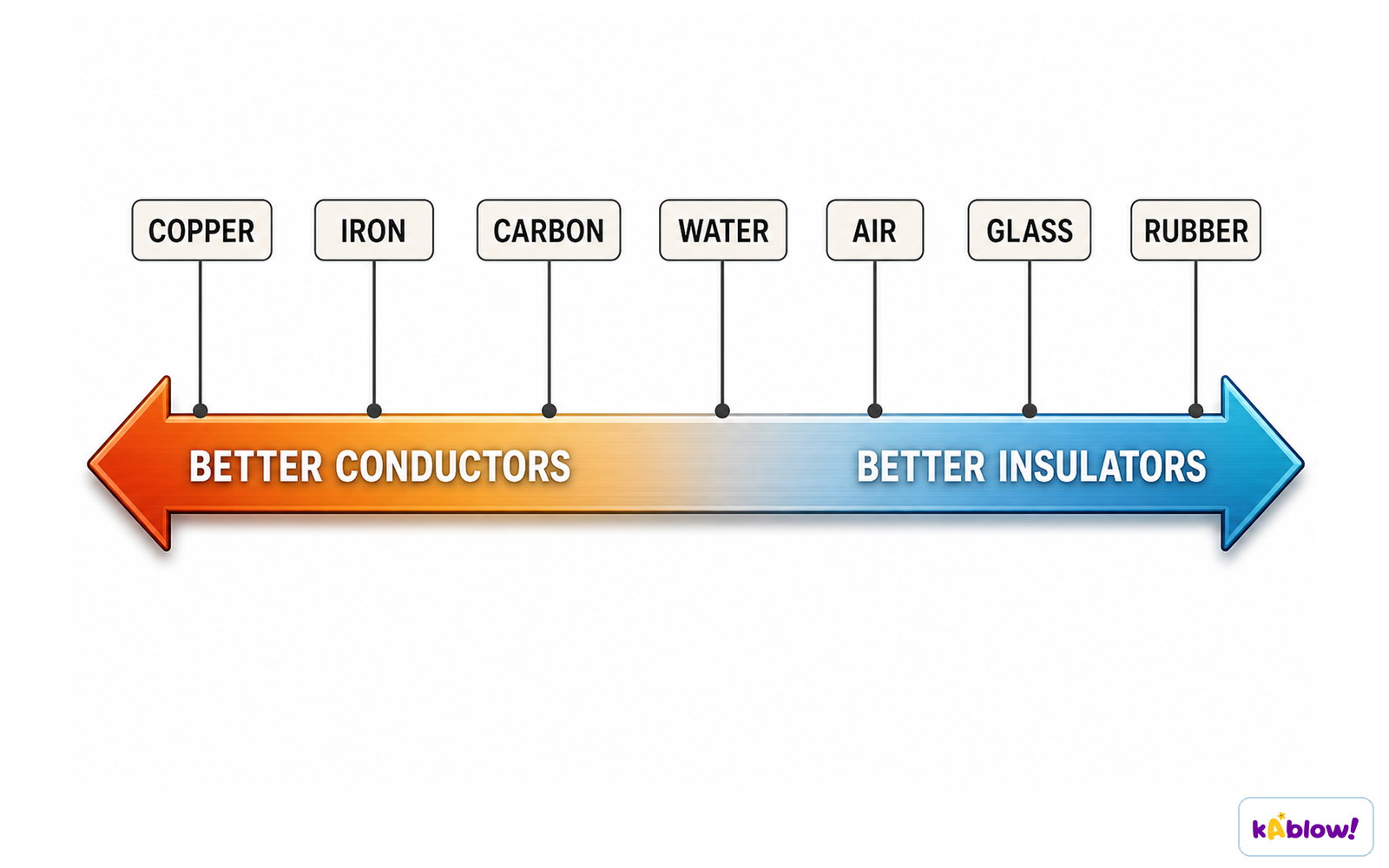
- A conductor lets current flow easily. Metals such as copper, iron and aluminium are good conductors, and so is carbon (in pencil lead).
- An insulator does not let current flow easily. Plastic, rubber, glass and dry wood are insulators. Wires are made of copper (a conductor) covered in plastic (an insulator).
- Switches, wires and components are joined so that the metal parts touch and the plastic keeps the current where it should be.
- In school we use low-voltage cells and bulbs only. These are safe to handle.
- Never touch a mains socket or plug, never put anything into a socket, and never mix water and electricity. Mains electricity can be deadly.
- Do not join a wire straight across a cell with nothing else in the loop. This is a short circuit: a large current flows and the wire and cell can get hot.
Conductors and insulators
Series and parallel circuits
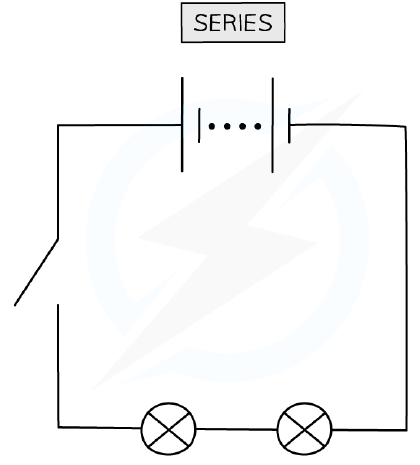
- In a series circuit all the components are in one loop. There is only one path for the current.
- In series, the current is the same everywhere in the loop. The cell's voltage is shared between the components, so each of two identical lamps is dimmer than a lamp on its own.
- If one component in a series circuit breaks, or you unscrew one lamp, the loop is broken and everything goes off.
- In a parallel circuit the current has more than one path: the circuit splits into branches.
- In parallel, each branch has the same voltage as the cell, so each lamp is as bright as it would be on its own. The current from the cell is the sum of the branch currents. If 0.30 A flows in one branch and 0.20 A in the other, the cell supplies 0.50 A.
- If one lamp in a parallel circuit goes out, the other branches still have a complete loop and stay on. This is why household lighting is wired in parallel.
A series circuit
Think like a scientist: what changes the brightness of a lamp?
- Question: does the number of cells in series change how bright a lamp is?
- The independent variable is the number of cells. The dependent variable is the current, measured with an ammeter in series (this is better than saying "bright" or "dim", which depends on opinion).
- Control variables include the same lamp, the same wires and the same type of cell.
- Measure the current for 1, 2, 3 and 4 cells. Repeat each one and work out a mean, because one reading could be a mistake.
- To evaluate your results, ask what could be wrong. Did the cells run down as you worked? Were the connections loose? Did the lamp heat up and change its resistance?
- Inquiry task: plan a fair test to find out whether the length of a wire changes the current. Use low-voltage cells only. List your independent, dependent and control variables, say how you will measure the current and explain how you will make your results reliable.
Diapos
Sign up free to view the lesson slides
Step through every slide for this topic — plus flashcards and revision notes — with a free account.
Questions d'entraînement
Aperçu gratuit — 8 sur 53 questions. Inscris-toi pour toutes les voir.
1.A lamp is joined to a cell by two wires, but one wire is not touching the cell. What happens?
Easy- AThe lamp lights dimly because some current still gets through
- BThe lamp lights for a short time and then goes out
- CThe lamp stays off because the loop is not complete
- DThe lamp lights because the cell is still pushing the charge
2.In a circuit diagram, a cell is drawn as…
Easy- Aone long line and one short line
- Ba circle with a cross inside it
- Ca circle with the letter A inside it
- Da small rectangle on the wire
3.What does a circle with a cross inside it show in a circuit diagram?
Easy- AA switch
- BA cell
- CA voltmeter
- DA lamp
4.What is the job of a switch in a circuit?
Easy- ATo push the charge round the loop with much more force
- BTo open or close the loop so current stops or flows
- CTo store up energy until the lamp needs to use it
- DTo measure how much current is flowing through the loop
5.Which unit is used to measure electric current?
Easy- AVolt (V)
- BAmpere (A)
- COhm (Ω)
- DNewton (N)
6.Which meter measures electric current?
Easy- AA voltmeter
- BA thermometer
- CA newton meter
- DAn ammeter
7.How should an ammeter be connected to measure the current through a lamp?
Medium- AIn series, so the current flows through the meter
- BIn parallel, across the two ends of the lamp itself
- CNext to the lamp but not joined to any of the wires
- DAcross the two ends of the cell and nowhere else
8.How should a voltmeter be connected to measure the voltage across a lamp?
Medium- AIn series, as part of the main loop of the circuit
- BIn series, placed between the cell and the switch
- CIn parallel, across the two ends of the lamp
- DAnywhere at all, as long as it touches a wire
Unlock all 53 questions, flashcards & more
Crée un compte gratuit pour voir toutes les questions, les diapos, les cartes mémo et les notes de révision de ce thème.