Wave properties
Apprends en jouant
Réponds à ces questions pour gagner de l'énergie, puis pêche et explore. Sans compte.
Notes de leçon
Big idea: waves carry energy
- Big idea. Key concept: Systems. A wave system has a source that vibrates, a medium the vibration passes through and a receiver that detects it, such as an ear or an eye.
- Related concept: Models. We cannot see sound or light travelling, so scientists use models such as a rope, a spring and a ripple tank to picture how waves behave.
- Global context: Scientific and technical innovation. Mobile phones, Wi-Fi, ultrasound scans, musical instruments and satellites all depend on our understanding of waves.
- A wave is a vibration that transfers energy from one place to another without transferring matter.
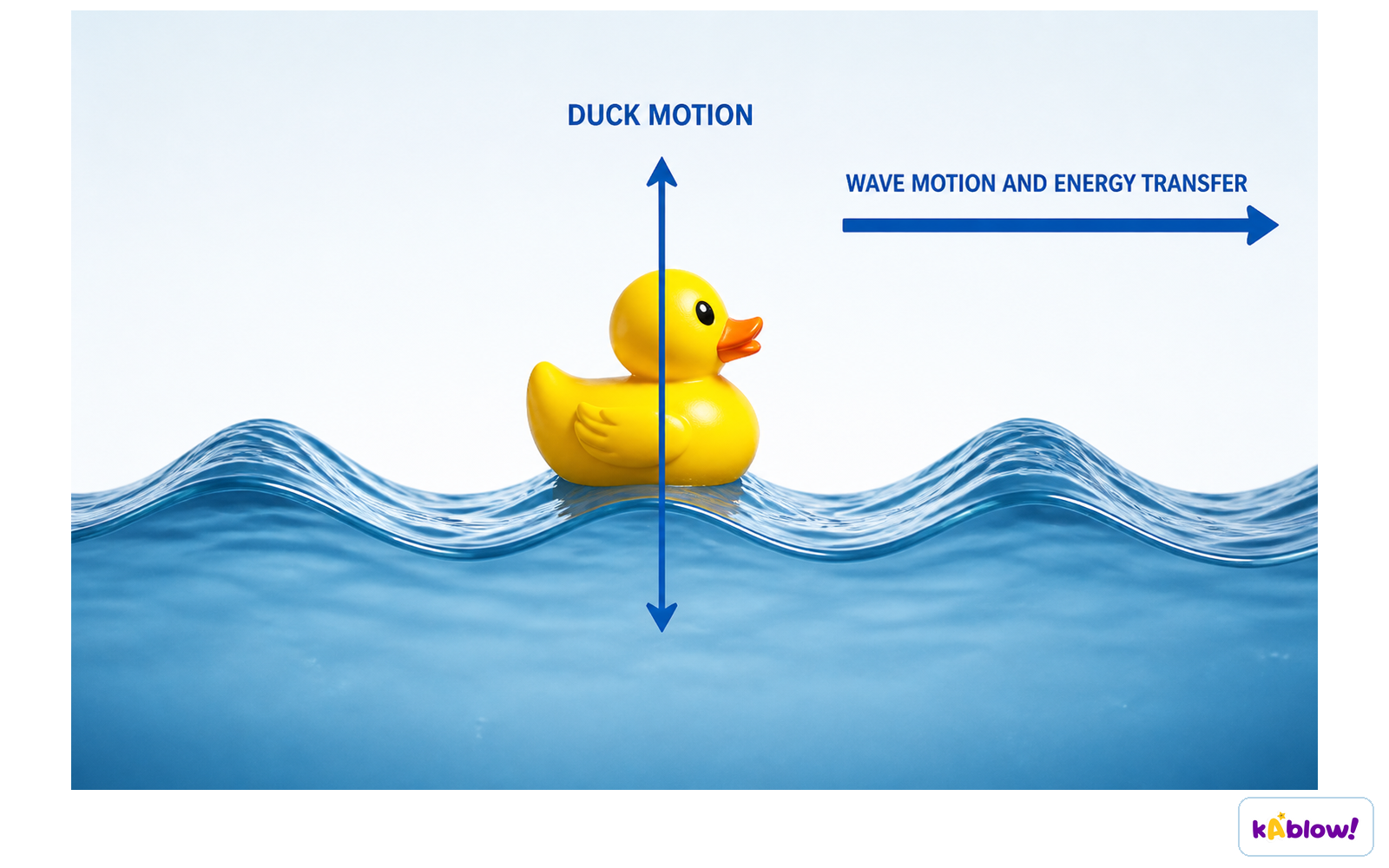
- When a wave crosses a pond, the water moves up and down on the spot. A floating duck bobs up and down but is not carried across the pond.
- The energy is carried along by the wave, which is why waves can make things move or heat things up when they arrive.
A duck bobbing as waves pass
Transverse and longitudinal waves
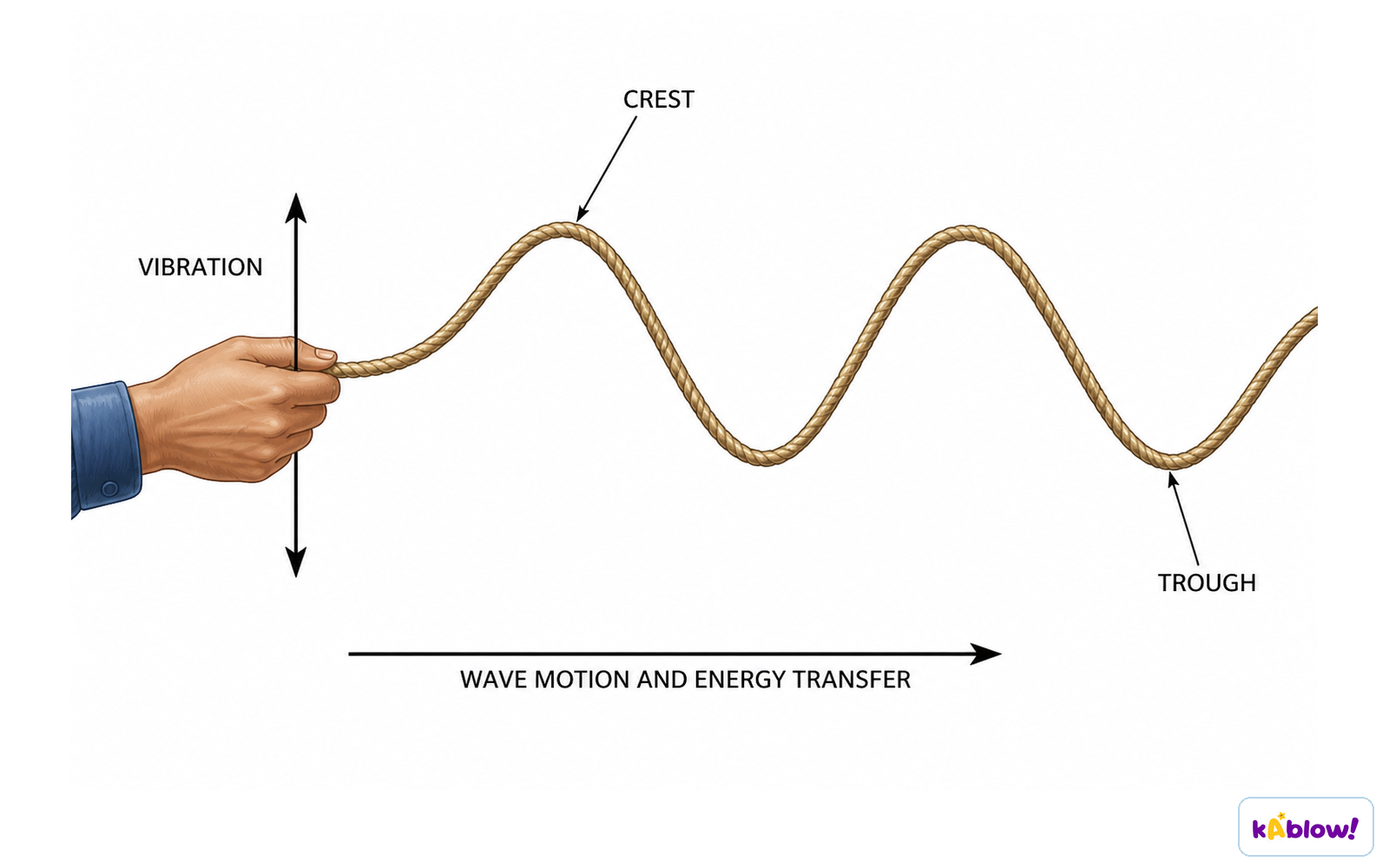
- In a transverse wave the vibrations are at right angles to the direction in which the wave travels. A wave on a rope, ripples on water and all light waves are transverse.
- The highest points of a transverse wave are crests and the lowest points are troughs.
- In a longitudinal wave the vibrations are parallel to the direction of travel. Push and pull a spring along its length and a longitudinal wave moves along it.
- A longitudinal wave is made of compressions, where the coils are squashed together, and rarefactions, where they are spread out.
- Sound is a longitudinal wave. It must have a medium, such as air, water or a solid, to travel through, so it cannot travel through a vacuum.
- Light and the other electromagnetic waves are transverse and can travel through a vacuum, which is how sunlight reaches us across space.
A transverse wave on a rope
Describing a wave: amplitude and wavelength
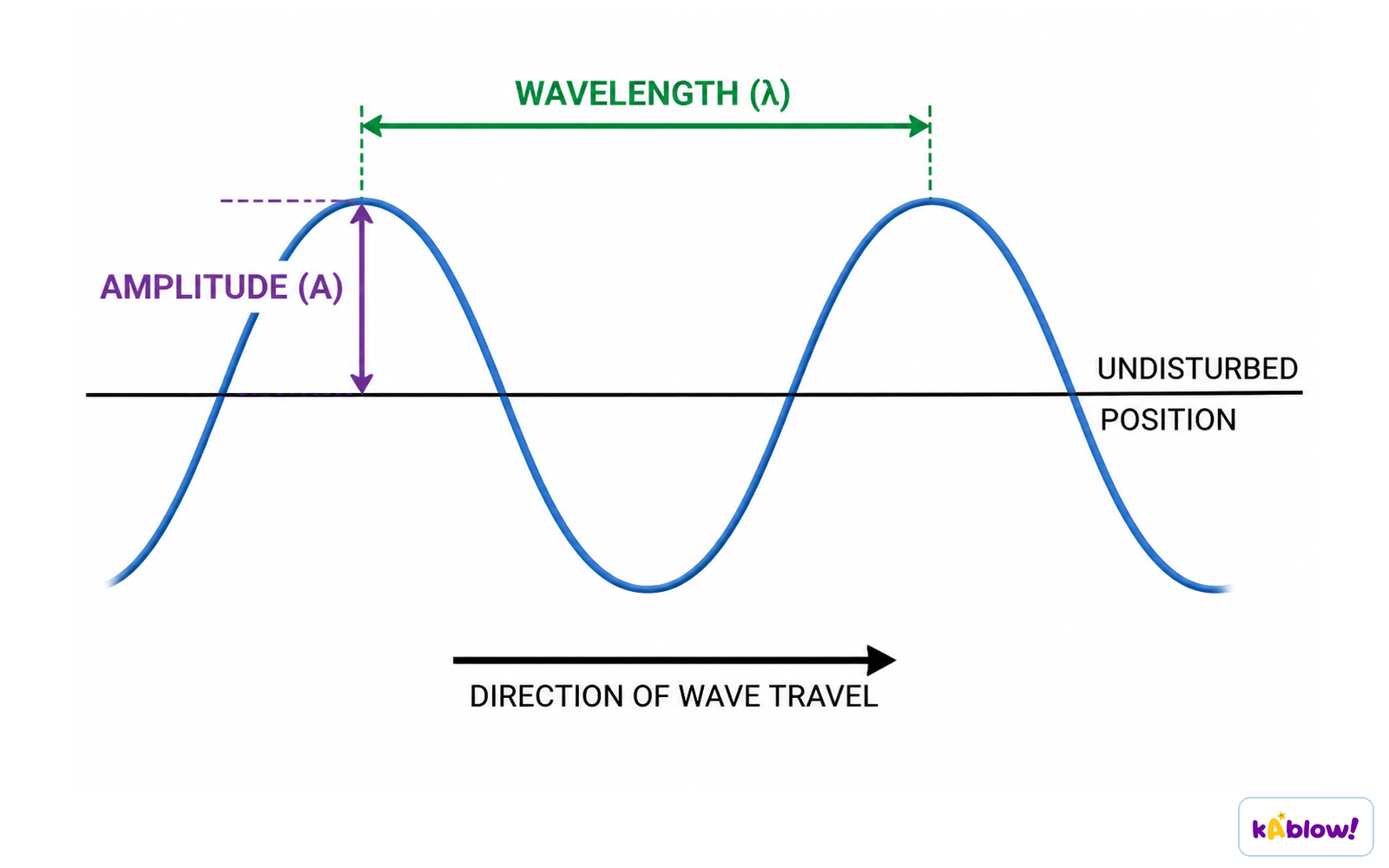
- The rest position (or undisturbed position) is where the medium would be if there were no wave.
- The amplitude is the maximum distance a point on the wave moves from its rest position. It is measured from the rest position to a crest (or to a trough), not from trough to crest.
- If a wave rises 3 cm above the rest position and falls 3 cm below it, its amplitude is 3 cm, not 6 cm.
- The wavelength, symbol λ, is the distance from one point on a wave to the same point on the next wave, for example from crest to crest. It is measured in metres (m).
- In a longitudinal wave, wavelength is the distance from one compression to the next compression.
- A larger amplitude means the wave carries more energy: a louder sound, a brighter light, a bigger water wave.
Amplitude and wavelength of a wave
Frequency, period and wave speed
- The frequency is the number of complete waves that pass a point each second. It is measured in hertz (Hz). 1 Hz is one wave per second.
- The period, T, is the time for one complete wave to pass. It is measured in seconds (s). Period = 1 / frequency, so a 4 Hz wave has a period of 1 / 4 = 0.25 s.
- The wave speed, v, is how far a wave travels each second, measured in metres per second (m/s).
- Wave speed = frequency x wavelength (v = f x λ). It can be rearranged to f = v / λ and λ = v / f.
- Worked example. A water wave has a frequency of 5 Hz and a wavelength of 0.30 m. Wave speed = 5 Hz x 0.30 m = 1.5 m/s.
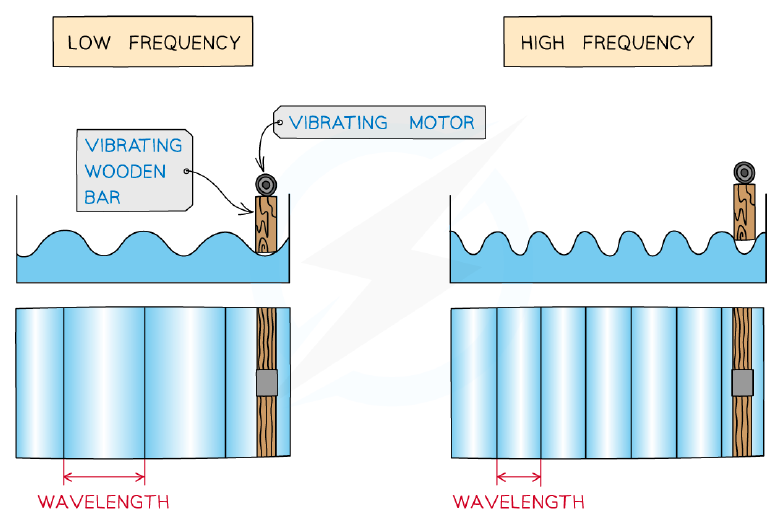
- In one material the wave speed stays the same, so a higher frequency means a shorter wavelength. You can see this in a ripple tank when the dipper vibrates faster.
Low and high frequency water waves
Reflection, refraction and the electromagnetic spectrum
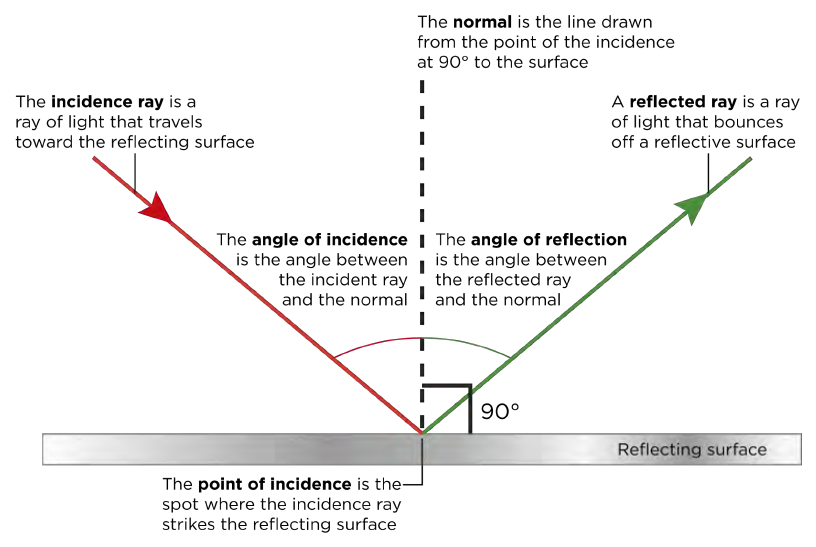
- Reflection is when a wave bounces off a surface. The angle of incidence equals the angle of reflection, with both angles measured from the normal, a line at 90° to the surface. An echo is a reflected sound wave.
- Refraction is the change in direction of a wave when it passes into a material where its speed changes. Water waves slow down and their wavelength shortens when they move from deep water into shallow water.
- The frequency of a wave does not change when it refracts. Only the speed and wavelength change.
- The electromagnetic spectrum is a family of transverse waves. In order of decreasing wavelength they are: radio waves, microwaves, infrared, visible light, ultraviolet, X-rays and gamma rays.
- All electromagnetic waves travel at the same speed in a vacuum, about 300 000 000 m/s. They differ in wavelength and frequency.
- Uses include radio and TV (radio waves), cooking and phone signals (microwaves), remote controls (infrared), seeing (visible light) and hospital imaging (X-rays). High-frequency waves such as ultraviolet, X-rays and gamma rays can damage living cells.
Angles of incidence and reflection
Think like a scientist: how does frequency affect wavelength?
- Question. In a ripple tank, what happens to the wavelength of the water waves when the frequency of the vibrating dipper is increased?
- The independent variable is the frequency of the dipper. The dependent variable is the wavelength of the waves, measured in centimetres.
- To make it a fair test, keep the depth of the water, the size of the tank and the shape of the dipper the same. Use only the low-voltage motor supplied by your teacher.
- To measure wavelength more accurately, measure the distance across several waves (for example 5) on a ruler and divide by the number of waves. This reduces the effect of a small reading error.
- Repeat the measurement for each frequency and calculate a mean.
- Inquiry task. Plan an investigation into whether the depth of the water changes the speed of the waves. State the variable you change, the variable you measure, three variables you control, and how you would reduce measurement error.
Diapos
Sign up free to view the lesson slides
Step through every slide for this topic — plus flashcards and revision notes — with a free account.
Questions d'entraînement
Aperçu gratuit — 8 sur 52 questions. Inscris-toi pour toutes les voir.
1.What does a wave transfer from one place to another?
Easy- AMatter
- BEnergy
- CParticles of the medium
- DMass and energy equally
2.A duck floats on a pond while waves pass underneath it. What happens to the duck?
Easy- AIt is carried across the pond at the speed of the waves
- BIt spins around on the spot without any up and down motion
- CIt sinks a little lower after each wave passes
- DIt bobs up and down and stays in about the same place
3.In a transverse wave, how do the vibrations move compared with the direction the wave travels?
Easy- AAt right angles to it
- BIn the same direction as it
- CBackwards and forwards along it
- DOnly in the direction opposite to it
4.Which of these is a longitudinal wave?
Easy- ALight
- BRadio waves
- CSound in air
- DA wave on a rope
5.What is the amplitude of a wave?
Easy- AThe distance between two crests next to each other
- BThe number of waves that pass a point each second
- CThe maximum distance of a point from its rest position
- DThe time taken for one complete wave to pass
6.What is the wavelength of a transverse wave?
Easy- AThe distance from one crest to the next crest
- BThe distance from a crest down to the next trough
- CThe distance from the rest position up to a crest
- DThe number of crests passing a point each second
7.In which unit is frequency measured?
Easy- AMetres (m)
- BSeconds (s)
- CMetres per second (m/s)
- DHertz (Hz)
8.Which equation correctly gives wave speed?
Easy- AWave speed = frequency / wavelength
- BWave speed = frequency x wavelength
- CWave speed = wavelength / frequency
- DWave speed = frequency + wavelength
Unlock all 52 questions, flashcards & more
Crée un compte gratuit pour voir toutes les questions, les diapos, les cartes mémo et les notes de révision de ce thème.