Momentum and collision evidence
Apprends en jouant
Réponds à ces questions pour gagner de l'énergie, puis pêche et explore. Sans compte.
Notes de leçon
Big idea: momentum and collision evidence
- Key concept: Systems. Momentum equals mass times velocity and includes direction. Total momentum is conserved in a system with no resultant external force.
- Related concepts: Models and evidence. Use a scientific explanation to make predictions, then test it against observations.
- Global context: Scientific and technical innovation. Longer stopping times reduce average collision force for a given momentum change.
Momentum
- Momentum = mass × velocity; p = mv
- Units: kg m/s (mass in kg, velocity in m/s)
- An object at rest (v = 0) has zero momentum
- Momentum is a vector quantity – direction matters; can be positive or negative
- Large momentum makes it difficult to change an object's direction
Conservation of Momentum
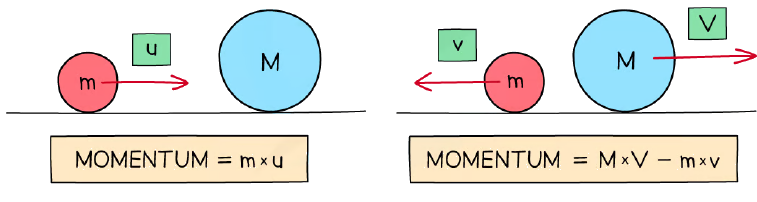
- In a closed system (no external forces), total momentum before an event equals total momentum after
- Total momentum before = Total momentum after
- Total momentum is conserved in a system with no resultant external force.
- For objects moving in opposite directions, momenta cancel (vector sum)
Conservation of momentum in a collision between two objects
Impulse
- Impulse = force × time for which it acts; impulse = FΔt
- Units: N s (newton seconds)
- Impulse equals change in momentum: FΔt = Δp = mv – mu
- Impulse is a vector – direction same as change in momentum
Force and Momentum
- Newton's second law in terms of momentum: F = Δp / Δt
- Force = rate of change of momentum (change in momentum per unit time)
- A larger force or shorter contact time gives a larger change in momentum
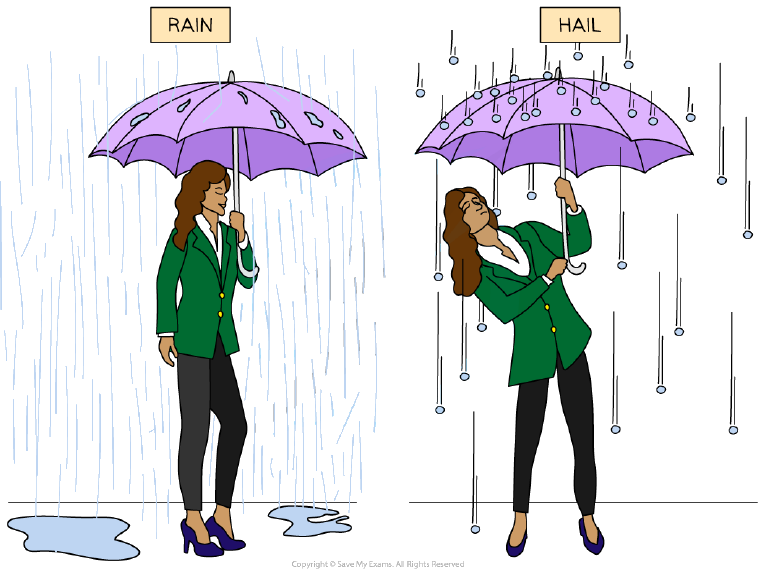
A person holding an umbrella in rain versus hail, illustrating the difference in force and momentum change.
Worked Examples
- Example 1: Tennis ball (0.06 kg) at 75 m/s has p = 4.5 kg m/s; brick (3 kg) at 1.5 m/s has same momentum
- Example 2: Car (990 kg, 10 m/s) hits stationary van (4200 kg); after collision car moves at 2 m/s, van velocity = 1.9 m/s (conservation)
- Example 3: Tennis ball (58 g) from 30 m/s left to 20 m/s right; impulse = –2.9 N s (to the right)
- Example 4: Same Δp = 0.5 kg m/s; shorter contact time (0.1 s) gives larger force (5 N) than longer time (2 s gives 0.25 N)
Think like a scientist
- Use a teacher-approved simulation to compare two-cart collisions with different initial speeds.
- Comparison: the first cart's initial velocity. Outcome: the total momentum before and after collision.
- Control: keep both cart masses constant. Explain why this makes the comparison fairer.
- Evidence: Use a consistent method, repeated observations where appropriate and a table with labelled quantities and units. Keep unexpected results and investigate their cause.
- Safety: Practical activities need teacher supervision and an appropriate risk assessment. Use the provided data or simulation where the investigation specifies it.
- Inquiry task: State a testable question, predict the outcome using the science, then explain how your observations would support or challenge the prediction.
Evaluate the science
- Longer stopping times reduce average collision force for a given momentum change.
- Momentum conservation does not imply conservation of kinetic energy; some collisions transfer kinetic energy to other stores.
- Evaluation task: Link your conclusion to evidence, identify a limitation and suggest a specific improvement. Distinguish a measured result from an explanation of its cause.
Diapos
Sign up free to view the lesson slides
Step through every slide for this topic — plus flashcards and revision notes — with a free account.
Questions d'entraînement
Aperçu gratuit — 8 sur 52 questions. Inscris-toi pour toutes les voir.
1.What is the equation for momentum?
Easy- Amomentum = mass × velocity
- Bmomentum = mass × acceleration
- Cmomentum = force × time
- Dmomentum = mass × speed
2.What are the units of momentum?
Easy- Akg m/s
- Bkg m/s²
- CN s
- DN/m
3.What is the momentum of an object at rest?
Easy- A0 kg m/s
- B1 kg m/s
- CIts mass in kg m/s
- DCannot be determined
4.A 5.0 kg ball is moving at 10 m/s. What is its momentum?
Easy- A50 kg m/s
- B0.5 kg m/s
- C15 kg m/s
- D5 kg m/s
5.A 0.025 kg squash ball hits a wall at 44 m/s and rebounds at 42 m/s. What is the change in momentum? (Take initial direction as positive.)
Medium- A-2.15 kg m/s
- B2.15 kg m/s
- C0.05 kg m/s
- D-0.05 kg m/s
6.What is the impulse on an object equal to?
Easy- AThe change in momentum of the object
- BThe force multiplied by the distance moved
- CThe mass multiplied by the acceleration
- DThe velocity multiplied by the time
7.A 0.046 kg golf ball is hit, leaving the club at 65 m/s. The contact time is 5.0 × 10⁻⁴ s. What is the average force on the ball?
Medium- A5980 N
- B2990 N
- C598 N
- D0.598 N
8.Which word best completes the sentence: 'Momentum is a property of a moving object making it difficult for it to change its ______.'
Easy- Adirection
- Bmass
- Cspeed
- Dweight
Unlock all 52 questions, flashcards & more
Crée un compte gratuit pour voir toutes les questions, les diapos, les cartes mémo et les notes de révision de ce thème.