Classification & Cladistics
Apprends en jouant
Réponds à ces questions pour gagner de l'énergie, puis pêche et explore. Sans compte.
Notes de leçon
Why Biological Classification Matters
- Global biodiversity is vast and only estimated; many species are likely still undiscovered.
- Classification is the process of putting organisms into logical groups; the science of classification is taxonomy, and its scientists are taxonomists.
- Classification allows scientists to accurately determine the number of known species, avoiding double-recording or incorrectly merging species.
- It reveals evolutionary relationships, showing which species share common ancestry and how recently.
- It supports conservation: a species cannot be conserved if it is not known to exist.
- It speeds up medical research, e.g. finding medicinal plants by studying close relatives of a known medicinal species.
- It helps identify and treat new diseases quickly, e.g. classifying the COVID-19 virus as a coronavirus informed treatment and vaccine development.
The taxonomic hierarchy
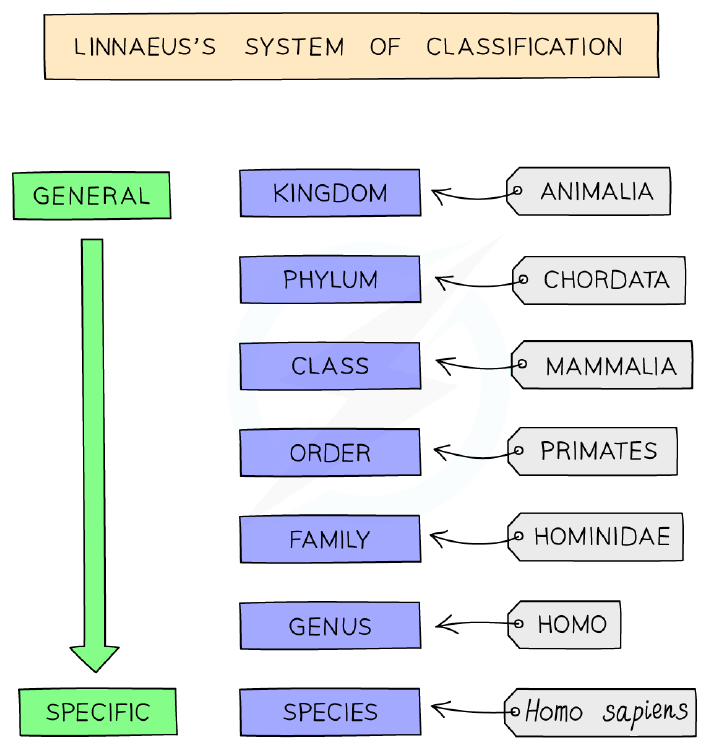
The Taxonomic Hierarchy
- Organisms are placed into groups called taxa (singular taxon), which form a hierarchy.
- A hierarchical system means larger groups contain smaller groups with no overlap between groups.
- The taxonomic groups in descending order of size are: Domain, Kingdom, Phylum, Class, Order, Family, Genus, Species.
- Example: a wolf is Eukaryote, Animalia, Chordata, Mammalia, Carnivora, Canidae, Canis, lupus.
- Example: a Hibiscus is Eukaryote, Plantae, Angiospermae, Dicotyledonae, Malvales, Malvaceae, Hibiscus, rosa-sinensis.
- A mnemonic for the order is: Dear King Phillip Came Over For Great Soup.
Difficulties with Classification
- Morphology can mislead: similar observable characteristics do not always mean a recent common ancestor, e.g. dolphins (mammals) and sharks (fish) share a streamlined body shape evolved separately.
- Taxonomic rank causes problems when a group falls across taxa or must be moved between taxa, potentially requiring other groups to be shunted to different ranks.
- Plant species in distant taxa can sometimes breed to produce fertile hybrids, which are technically new species but very difficult to classify.
- The point at which two populations are classified as different species can be highly subjective.
- Introgression occurs when fertile offspring of a cross between two species breed only with members of one parent species; after several generations the offspring fit neither species neatly, nor form a new species.
- Example of introgression: early humans interbred with Neanderthals, so some modern human groups carry Neanderthal genes.
Nature of Science: Classification Systems Are Human-Made
- The fixed ranking of taxa is arbitrary because it does not reflect the gradation of variation seen in nature.
- The hierarchy was set up by humans as a neat way of organising life, not because it matches natural patterns.
- Species must be clearly distinct and obey reproduction rules (no interbreeding, no fertile offspring) to fit the ranks neatly, but in reality differences are on a gradual scale and breeding rules do not always apply.
- A successful classification system must follow the evidence rather than forcing the natural world into a human-designed system.
- New evidence from genome sequencing often leads to reclassification of species.
- The newer system of cladistics uses unranked groups based on evolutionary relationships alone to produce evolutionary trees.
Cladistics and Clades
- Cladistics is the branch of science in which organisms are put into clades.
- A clade is a group of organisms that have all descended from a common ancestor.
- Clades are monophyletic groups, meaning they contain all of the descendants of a common ancestor.
- Clades can include both living and extinct species; some descendants, or the common ancestor itself, may have gone extinct.
- Clades can be large or small depending on the common ancestor being studied.
- Taxonomy is about classifying and naming organisms, while cladistics is about identifying evolutionary relationships between organisms.
- A taxon is a group given a name by taxonomists based on shared features; a clade is a group classified together based on shared descent from a common ancestor.
- If taxonomy is done correctly, all members of a taxon should form a clade, but historical errors mean this is not always the case.
Identifying Members of a Clade
- The most objective method for grouping species into clades uses sequence data from DNA bases, mRNA bases, or amino acids in polypeptides.
- For all sequence data, the more similar the sequences, the more closely related the species.
- Two groups with very similar sequences separated into separate species more recently than two groups with less similarity.
- Species separated for longer have had more time to accumulate mutations in their DNA, mRNA, and amino acid sequences.
- Morphology can sometimes identify clade members, but it is more subjective and has led to classification errors.
- Similar morphology can indicate convergent evolution rather than recent common ancestry.
- Primitive traits evolve early in a clade's lineage and are found in all clade members, e.g. all vertebrates have spinal cords, all insects have six legs.
- Derived traits evolve later and can differ between clade members, e.g. birds have feathers while mammals have fur; more closely related species share more derived traits.
- A derived trait in one clade can be an ancestral trait in another, e.g. fur is primitive within mammals but derived within vertebrates.
The Molecular Clock
- The number of differences between sets of sequence data shows how closely related two species are: more differences means they diverged longer ago.
- Differences between sequences can be determined using DNA hybridisation: single-stranded DNA from corresponding genome parts of two species is allowed to bind (hybridise), and unbound points show where bases differ.
- Differences in sequence data arise from mutations in DNA.
- Evidence suggests mutations occur at a constant rate, so the number of mutations indicates the time since two species diverged; this constant rate is the molecular clock.
- The molecular clock provides estimates rather than exact time periods, because the assumed mutation rate does not always match the actual rate.
- The rate at which mutations accumulate can be affected by generation time, population size, and selection pressures.
Constructing and Analysing Cladograms
- A cladogram is an evolutionary tree showing the probable order of divergence from ancestral species and probable relationships between species.
- The point at which two branches separate is a node, representing a common ancestor species.
- Cladograms are most often built from base or amino acid sequence data because observable characteristics can be misleading.
- Computers build the most likely cladogram using the principle of parsimony: the simplest explanation is preferred, so the shortest cladogram with the fewest divergence events is chosen.
- Cladograms show probable divergence times and relationships, forming a hypothesis that may change if new evidence comes to light.
- A node immediately adjacent to a pair of clades indicates they share a recent common ancestor and are more closely related to each other than to any other clade in the cladogram.
- If several nodes must be traced back before two clades join, the relationship is more distant.
- The root at the base of a cladogram represents the common ancestor of all organisms in the cladogram, present long ago in evolutionary history.
- The terminal branch represents the most recent species in an evolutionary lineage.
- Numbers along branches indicate the number of base or amino acid changes between nodes or between a node and an emerging clade; these can act as a molecular clock, and some cladograms include a time scale.
Reclassification: The Figwort Family
- DNA sequencing has revealed classification errors, leading to reclassification: some species moved to different groups, some groups split, and some merged.
- The figwort family (Scrophulariaceae) was once the 8th largest family in the angiosperm phylum, originally classified in the late 1700s with 16 genera, later expanding to 275 genera.
- Its classification was based on observable traits such as a tube-shaped flower structure; examples include foxgloves and yellow rattle.
- Analysis of three chloroplast genes showed the shared features were not evidence of shared ancestry.
- The original figwort family was not a true clade; it was paraphyletic, meaning it did not contain all descendants of a common ancestor and contained species that should be on separate branches.
- The figworts were found to contain several separate plant families; new families were created and several genera moved into existing families.
- The remaining genera, plus two previously missed genera, formed the new figwort family, still called Scrophulariaceae, now less than half its original size.
Nature of Science: Theories Can Be Falsified
- A theory is an explanation of observed phenomena supported by evidence; when new evidence no longer supports it, the theory must change.
- Reclassification based on DNA sequencing is a good example of this process.
- Scientists theorised plants should be classified together based on observable traits such as flower shape.
- New DNA evidence showed these groups were not true clades and were not descendants of a common ancestor; their similarities were due to convergent evolution.
- The historical classification theory was falsified and replaced using DNA and computer analysis to calculate the most likely evolutionary relationships.
- As new DNA data is analysed, further falsification and reclassification will take place if evidence does not fit current theories.
The Three Domain System
- Taxonomy has changed with new discoveries: originally the largest groups were plant and animal kingdoms, then fungi were added (incorrectly) to plants.
- Microscopes revealed prokaryotes and eukaryotes, leading to five kingdoms: plants, animals, fungi, protoctists, and prokaryotes.
- rRNA analysis showed two distinct groups of prokaryotes, leading to the three domain system.
- The largest taxonomic group is now the domain; the three domains are Archaea (prokaryotes), Eubacteria (prokaryotes), and Eukaryotes (eukaryotes).
- The Archaea are thought to be more closely related to the eukaryotes than to the other prokaryotes.
- The Archaea were originally classified with other bacteria because they share prokaryotic cell structure, a circular chromosome, a cell wall, and 70S ribosomes.
- Carl Woese's work in 1977 showed archaeal features distinct from other prokaryotes: different cell wall material, distinct cell membrane lipids, a small ribosomal subunit more similar to eukaryotic ribosomes, and DNA sequences present in bacteria but absent in methanogenic archaeans.
- These discoveries led to the Archaea becoming their own domain.
Comparing the Three Domains
- Cell type: Archaea and Eubacteria are prokaryotic; Eukaryotes are eukaryotic.
- Chromosome: Archaea and Eubacteria have circular chromosomes; Eukaryotes have linear chromosomes plus circular mitochondrial and chloroplast DNA.
- Cell membrane lipids: Archaea have glycerol-ether lipids; Eubacteria and Eukaryotes have glycerol-ester lipids.
- Ribosomes: Archaea have 70S ribosomes with a small subunit more similar to eukaryotic ribosomes; Eubacteria have 70S ribosomes; Eukaryotes have 80S in the cytoplasm and 70S in mitochondria and chloroplasts.
- Cell walls: Archaea always have cell walls without peptidoglycan; Eubacteria always have cell walls with peptidoglycan; Eukaryotes sometimes have cell walls without peptidoglycan.
- Histones: present in Archaea and Eukaryotes, absent in Eubacteria.
- Introns: sometimes present in Archaea, rarely in Eubacteria, and present in Eukaryotes.
Diapos
Sign up free to view the lesson slides
Step through every slide for this topic — plus flashcards and revision notes — with a free account.
Questions d'entraînement
Aperçu gratuit — 8 sur 60 questions. Inscris-toi pour toutes les voir.
1.Which of the following is used by biologists around the world to name living organisms at the species level?
Easy- ACladistics
- BPhylogenetics
- CThe binomial system
- DThe three domain system
2.The onion plant, Allium cepa, and wild garlic, Allium ursinum, are flowering plants. Which of the following statements about onions and wild garlic are correct?
Medium- AOnions and wild garlic are in the same class and the same genus.
- BOnions and wild garlic are in the same class and a different genus.
- COnions are in the order cepa and wild garlic is in the order ursinum.
- DOnions and wild garlic both belong to the Allium family.
3.The diagram shows a cladogram for part of the order Artiodactyla.×denotes a now extinct group. To which group in the cladogram are the Cetacea most closely related?
Medium- AHippopotamidae
- BRaoellidae
- CRuminantia
- DMesonychia
4.Theories can change when new evidence emerges. Evidence relating to the evolutionary relationships between organisms can lead to their reclassification. What led to the reclassification of the figwort plant family?
Medium- AObservations about flower shape.
- BThe figwort family was too large.
- CThe figwort family formed a clade.
- DAnalysis of chloroplast DNA
5.Which of the following is not an important reason for the binomial system of naming organisms?
Medium- AScientists need to be able to communicate clearly with each other about their work.
- BThe common names of many species are outdated and should no longer be used.
- CDifferent countries may use the same common name for different species.
- DWoodlice are known by more than 50 different common names.
6.Which of the following are reasons for the development of the three domain system of classification? (select all that apply)
Hard- AThe prokaryote group was too large and needed to be divided into smaller taxa.
- BThe ribosomes of the archaea are distinct from those of the rest of the prokaryotes.
- CThe archaea share a similar cell structure to the rest of the prokaryotes.
- DThe cell walls of archaea lack peptidoglycan, unlike eubacteria.
- EThe cell membranes of archaea contain glycerol-ether lipids.
7.Which of the following species are most closely related? 1. Marsh tit (Poecile palustris) 2. Coal tit (Periparus ater) 3. Marsh warbler (Acrocephalus palustris) 4. Willow tit (Poecile montanus)
Hard- AI and II
- BI and III
- CI and IV
- DII and IV
8.The data below shows the number of DNA base sequence matches found between four species of marine mammal when a short section of their DNA is sequenced. Humpback whale vs Sperm whale: 62; Humpback whale vs Harbour porpoise: 59; Humpback whale vs Bottlenose dolphin: 56; Sperm whale vs Harbour porpoise: 59; Sperm whale vs Bottlenose dolphin: 53; Harbour porpoise vs Bottlenose dolphin: 62. What can be concluded from the data?
Hard- ASperm whales are more closely related to humpback whales than they are to harbour porpoises or bottlenose dolphins.
- BHarbour porpoises are more closely related to humpback whales than they are to sperm whales.
- CAll four species are more closely related to each other than they are to other marine mammals.
- DAll four species together form a clade.
Unlock all 60 questions & more
Crée un compte gratuit pour voir toutes les questions, les diapos, les cartes mémo et les notes de révision de ce thème.