Evolution & Speciation
Apprends en jouant
Réponds à ces questions pour gagner de l'énergie, puis pêche et explore. Sans compte.
Notes de leçon
Evolution
- Evolution is defined as changes in the heritable characteristics of organisms over generations.
- Heritable characteristics are determined by alleles of genes and can be passed to offspring; non-inherited changes (e.g. leaves eaten) do not cause evolution.
- Random mutation can create new alleles that are more or less advantageous.
- Advantageous heritable characteristics are more likely to be passed on, leading to gradual change in a species over time — this is natural selection.
- Evolution can lead to the development of completely new species, increasing diversity; theoretically all life originated from a single species.
Evolution of the horse
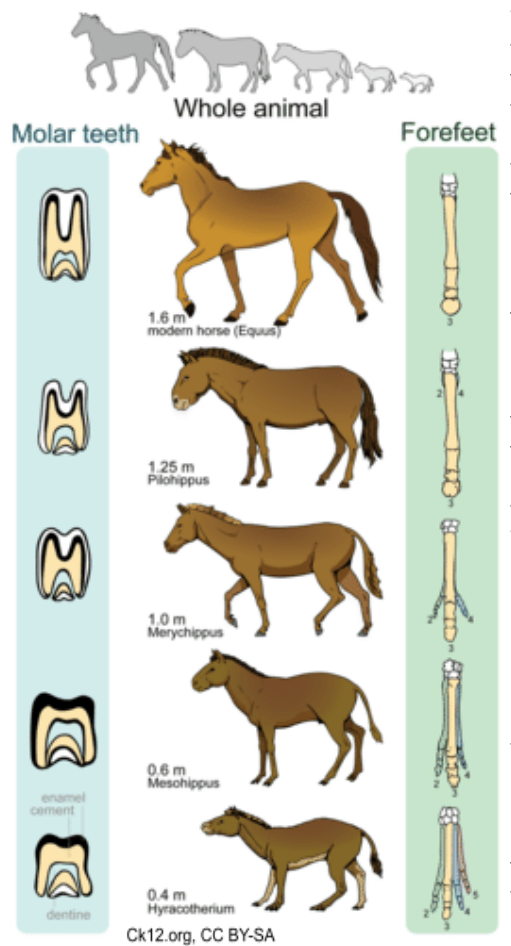
Theories of Evolution: Darwin and Lamarck
- Darwin's theory of evolution by natural selection states: individuals show variation due to random mutations; they compete for survival due to selection pressures; those with advantageous characteristics survive and reproduce more; advantageous alleles become more frequent over generations.
- Darwinian evolution requires that characteristics are heritable.
- Lamarck's theory proposed that changes acquired during an organism's lifetime (acquired characteristics) can be inherited, e.g. giraffes stretching their necks.
- Lamarck's ideas were incorrect because acquired characteristics are not passed on to offspring; the new science of epigenetics may provide a minor exception.
- Darwin's theory has been updated: evolution is not always slow (e.g. antibiotic resistance in bacteria) and the fossil record does provide evidence (e.g. intermediate species).
Evidence of Evolution: Sequence Data
- Sequence data can be obtained from DNA (nuclear, mitochondrial, chloroplast), RNA, and proteins.
- Similarities in sequence data between species suggest they share a common ancestor.
- Comparisons must use the same part of the DNA, often from highly conserved regions that change very little over time (e.g. genes for haemoglobin or respiratory enzymes).
- DNA is extracted from blood, skin, or fossilised remains, then sequenced and compared; more similarities mean closer evolutionary relationship.
- Example: humans and chimpanzees share almost 99% of their DNA sequences, making them our closest living relatives.
- Data from multiple sources (e.g. several genes) increases certainty and can be used to build an evolutionary tree.
Evidence of Evolution: Selective Breeding
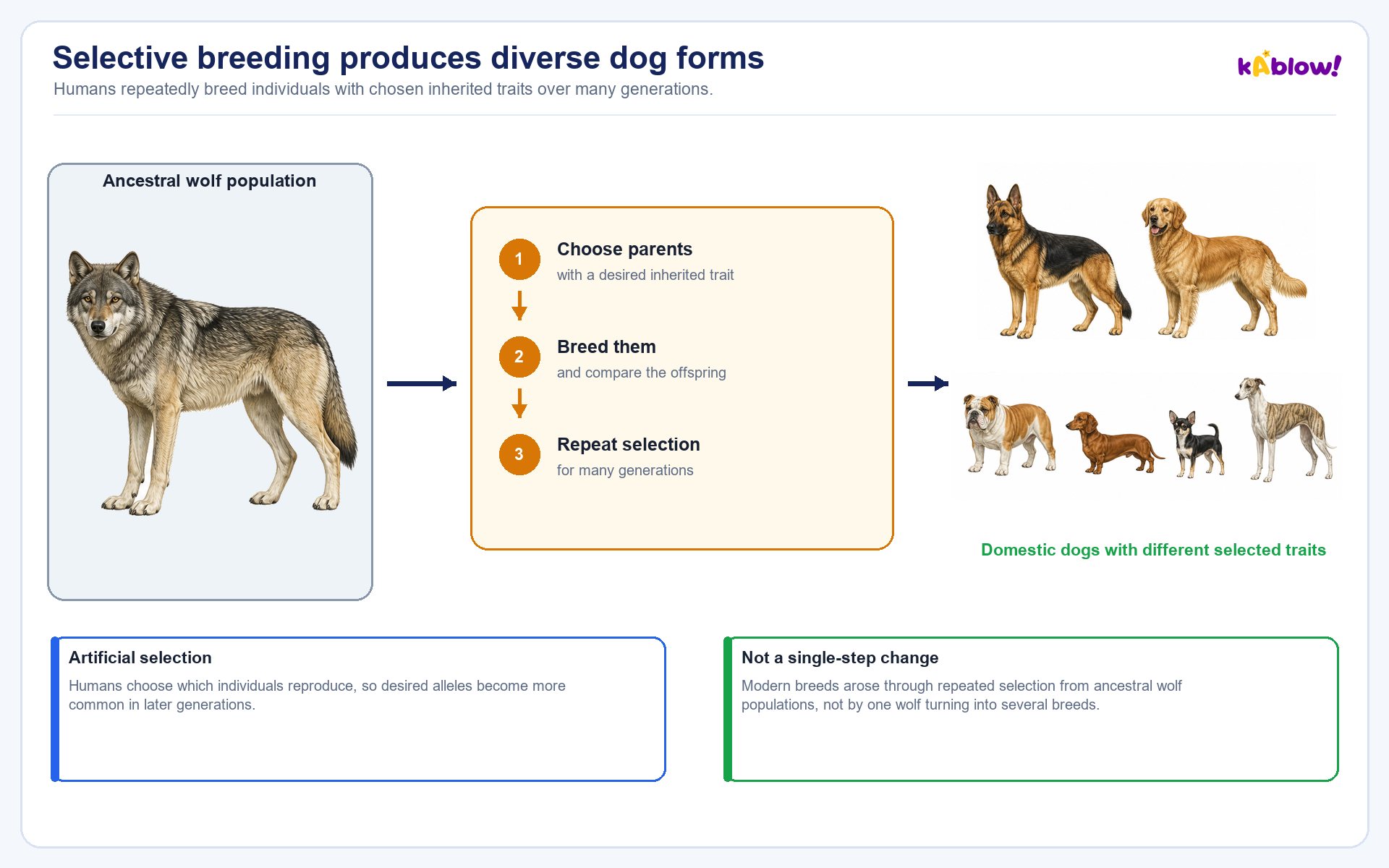
- Selective breeding (artificial selection) is when humans choose organisms with desirable characteristics and breed them together repeatedly over many generations.
- It takes advantage of naturally occurring variation, e.g. higher food yield or disease resistance in plants, or heavy wool or high milk production in animals.
- In artificial selection, desirable alleles are passed on because humans decide which individuals breed; in natural selection, advantageous alleles increase survival.
- Selective breeding leads to faster change than natural selection because only selected individuals breed together.
- It provides evidence that evolution occurs due to accumulation of small changes to DNA over time.
- Process: (1) population shows variation; (2) breeders select desired individuals; (3) breed them together; (4) test offspring and select best; (5) repeat over many generations until all offspring show desired characteristics.
Selective breeding in dogs
Evidence of Evolution: Homologous Structures
- Homologous structures are body parts that may look and function differently but share structural similarities, e.g. limbs of birds, bats, crocodiles, whales, horses, and monkeys.
- One explanation is adaptive radiation: organisms with homologous structures evolved from a shared common ancestor and adapted to different environments.
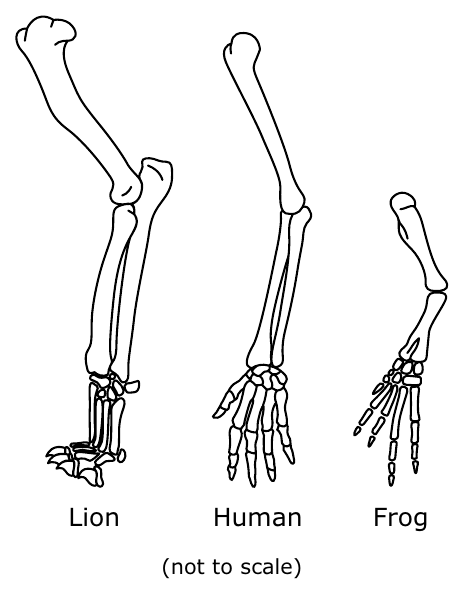
- A pentadactyl limb has five digits (fingers or toes) and is found in many mammals, birds, amphibians, and reptiles.
- In different species, the pentadactyl limb has a similar bone layout but enables different modes of movement, e.g. human foot for upright walking, whale flipper for swimming, bird wing for flight.
- The individual bones may differ in shape and size, but their layout is almost exactly the same.
Homologous limb structures
Convergent Evolution
- Analogous structures have similar form and function but different evolutionary origins.
- They arise from convergent evolution, which occurs when distantly related species live in habitats with similar selection pressures.
- Analogous structures provide evidence for the passing on of advantageous characteristics during natural selection.
- Example: dolphins (mammals) and sharks (fish) share a streamlined body shape, but evolved separately.
- Example: cacti (Americas) and euphorbias (Africa) are desert plants with spiny leaves and succulent stems, but belong to different orders and evolved separately.
Speciation
- Speciation is the development of new species from pre-existing species over time.
- Speciation increases diversity; extinction reduces it (e.g. passenger pigeon, woolly mammoth).
- Speciation occurs when gene flow between populations is prevented, e.g. by separation on different islands.
- When gene flow stops, genetic differences accumulate, especially if different selection pressures act on the populations.
- Speciation has occurred when the two populations can no longer interbreed to produce fertile offspring; they are reproductively isolated.
- Reproductive isolation alone is not enough for speciation; gradual evolutionary change must also occur.
Reproductive Isolation and Differential Selection
- Reproductive isolation occurs when changes in alleles and phenotypes prevent individuals from successfully breeding with others.
- Examples of changes leading to reproductive isolation: seasonal changes (different mating or flowering seasons) and behavioural changes (altered courtship behaviours).
- Geographical isolation occurs when populations are separated by barriers such as bodies of water, mountain ranges, or man-made barriers like motorways.
- Geographical isolation prevents gene exchange; the two populations may experience different selection pressures — this is differential selection.
- Over time, the populations may become so different that they are reproductively isolated, and speciation has occurred.
- Example: bonobos (south of Congo river) and chimpanzees (north) became geographically isolated, experienced differential selection, and eventually became separate species.
Types of Speciation
- Allopatric speciation occurs as a result of geographical isolation and is the most common type.
- In allopatric speciation, barriers (natural or man-made) prevent gene flow; allele frequencies change due to different selection pressures and genetic drift.
- If enough allele frequency differences arise, the populations become reproductively isolated and are separate species.
- Sympatric speciation takes place with no geographical barrier; isolation occurs when random changes in alleles/phenotypes prevent breeding within the same area.
- Examples of sympatric isolation: temporal isolation (different mating/flowering seasons) and behavioural isolation (changed courtship behaviours).
- Example: sympatric speciation in fruit flies — a random mutation changes food preference, preventing interbreeding and leading to separate species.
Preventing Hybridisation
- A species is a group of organisms with similar characteristics that can interbreed to produce fertile offspring.
- A hybrid is the offspring of individuals of two different species; hybrids are rare and usually infertile.
- Incompatible chromosome numbers can prevent hybridisation: gametes with different chromosome numbers fuse, producing zygotes with uneven chromosomes that cannot pair during meiosis, causing infertility.
- Example: mating a horse and donkey produces a mule, which has an odd number of chromosomes and cannot carry out meiosis, so is sterile.
- Incompatible courtship behaviours prevent mating and thus hybridisation, e.g. intricate courtship rituals in birds of paradise.
Adaptive Radiation
- Adaptive radiation is the rapid evolution of multiple species from a common ancestor due to natural selection.
- New species may have similar features due to shared ancestry but differ in ways that allow them to fill different ecological niches.
- An organism's ecological niche is its role in the ecosystem, e.g. food eaten, environmental conditions required, predators it feeds.
- Examples: Darwin's finches in the Galapagos islands and Hawaiian honeycreepers (more than 50 species).
- Some Hawaiian honeycreepers can co-exist on the same island because they fill different niches.
Speciation in Plants
- In most cases speciation is slow, but in some plants it can happen within a single generation — abrupt (instant) speciation.
- This is possible because plant cells can remain viable when polyploid (more than two sets of chromosomes), e.g. 3n triploid, 4n tetraploid.
- Autopolyploidy arises within a single species when chromosomes fail to separate during meiosis (nondisjunction), producing diploid gametes that can fuse to form 3n or 4n zygotes.
- Allopolyploidy arises when diploid gametes from two different species fuse, producing a polyploid hybrid.
- Polyploidy can be advantageous: it may allow otherwise infertile hybrids to carry out meiosis, polyploid plants are often larger and more vigorous, and extra gene copies mask harmful mutations.
- A 4n individual produces 2n gametes and cannot breed with 2n individuals to produce fertile offspring (a 2n gamete + n gamete = infertile 3n zygote), so it is a new species.
- Examples: Persicaria species include diploid, tetraploid, and hexaploid types; Fallopia includes octoploid (Japanese knotweed), tetraploid (giant knotweed), and hexaploid (Bohemian knotweed, a hybrid).
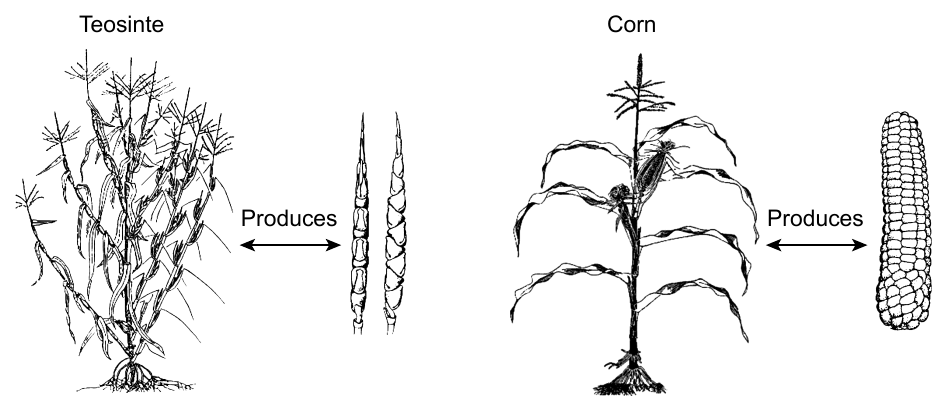
Teosinte and modern corn
Diapos
Sign up free to view the lesson slides
Step through every slide for this topic — plus flashcards and revision notes — with a free account.
Questions d'entraînement
Aperçu gratuit — 8 sur 60 questions. Inscris-toi pour toutes les voir.
1.Which of the following best defines evolution?
Easy- AChanges in the heritable characteristics of organisms over generations
- BChanges in the non-heritable characteristics of organisms during their lifetime
- CThe development of new species from pre-existing species over time
- DThe process by which organisms become better adapted to their environment during their lifetime
2.Which of the following is the mechanism that drives evolution?
Easy- ANatural selection
- BMutation
- CGenetic drift
- DSelective breeding
3.Which of the following are sources of evidence for evolution? (select all that apply)
Medium- ASelective breeding
- BSequence data
- CHomologous structures
- DAcquired characteristics
- EAnalogous structures
4.Evolution can be defined as changes in the heritable characteristics of organisms over generations.
EasyTrue or false?
5.Lamarck's theory of evolution by acquired characteristics is supported by modern evidence.
EasyTrue or false?
6.Which of the following is an example of a homologous structure?
Medium- AThe pentadactyl limb of a human and the flipper of a whale
- BThe wing of a butterfly and the wing of a bat
- CThe streamlined body shape of a dolphin and a shark
- DThe spines of a cactus and the spines of a euphorbia
7.Which of the following is an example of an analogous structure?
Medium- AThe wing of a butterfly and the wing of a bat
- BThe pentadactyl limb of a human and the flipper of a whale
- CThe bone structure of a bird wing and a crocodile limb
- DThe leaves of a cactus and the leaves of a euphorbia
8.Which of the following best defines speciation?
Medium- AThe development of new species from pre-existing species over time
- BThe formation of hybrids between two different species
- CThe gradual change in allele frequencies within a population
- DThe extinction of a species due to environmental changes
Unlock all 60 questions & more
Crée un compte gratuit pour voir toutes les questions, les diapos, les cartes mémo et les notes de révision de ce thème.