Transfer Of Energy & Matter
Apprends en jouant
Réponds à ces questions pour gagner de l'énergie, puis pêche et explore. Sans compte.
Notes de leçon
Ecosystems as Open Systems
- An ecosystem is a group of organisms interacting with each other and with the non-living parts of their environment.
- Ecosystems contain both biotic (living) and abiotic (non-living) components; abiotic factors include salinity, pH, temperature, light intensity and mineral availability.
- Ecosystems are open systems: both energy and matter can enter and exit.
- Energy enters mainly as sunlight and flows through the ecosystem as stored chemical energy; it can also enter in the tissues of migrating organisms.
- Matter enters when organisms arrive and leaves when organisms or dead matter are removed, e.g. timber being cut and taken away.
- Most organisms remain in the ecosystem their whole lives, so matter and energy are largely recycled within it; ecosystems are largely self-contained.
- Earth is a closed system: energy can enter and leave, but matter is recycled and cannot enter or leave.
A food chain
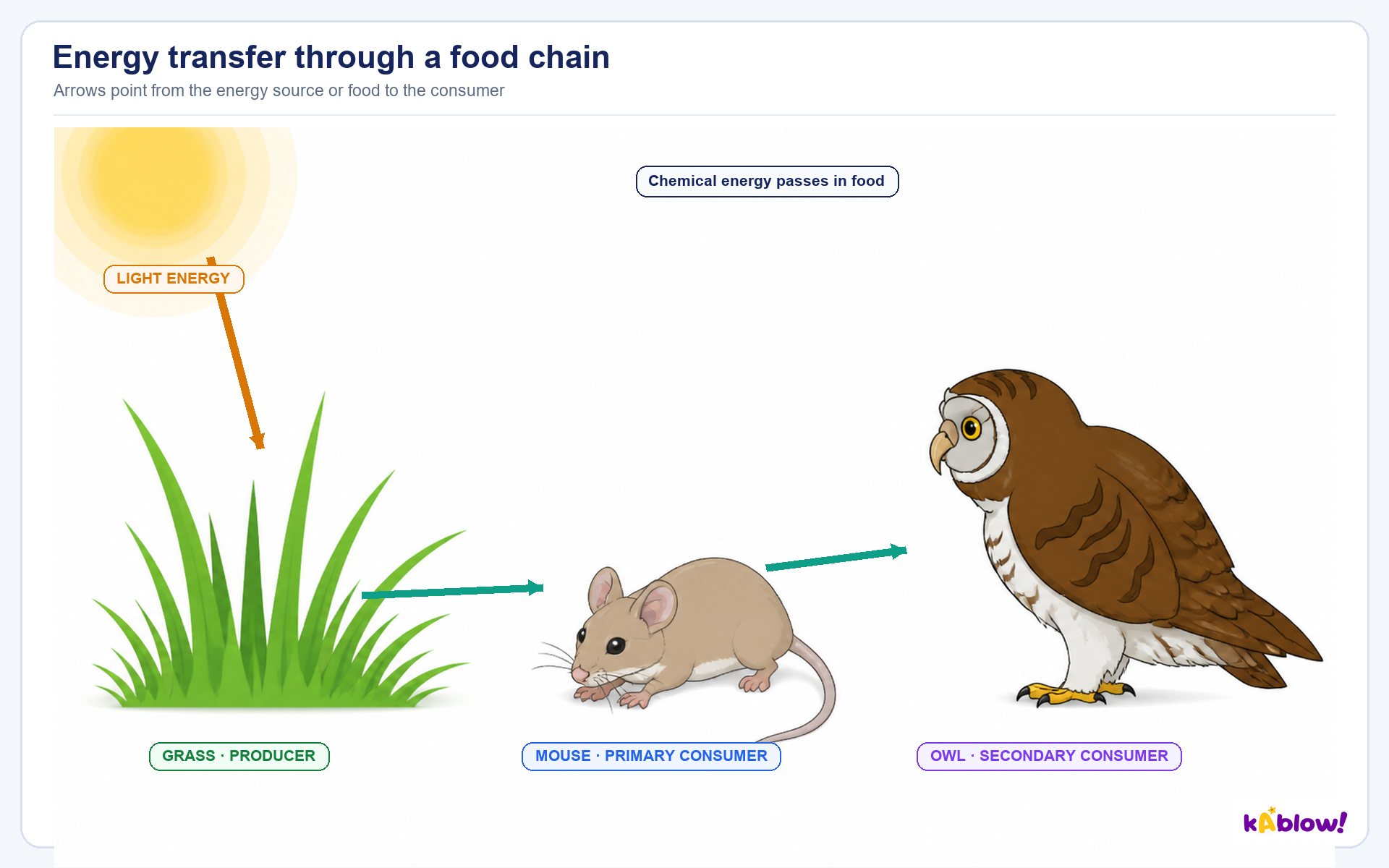
Energy Flow in Ecosystems
- The sun is the initial source of energy for most food chains; light energy is converted to chemical energy by producers during photosynthesis.
- Photosynthesis produces organic molecules (carbon compounds) including glucose, lipids and amino acids.
- Chemical energy stored in plant tissues passes to the primary consumer when the plant is ingested, and on to secondary consumers when the primary consumer is eaten.
- When an organism dies, the chemical energy in its tissues passes to detritivores and saprotrophs.
- In food chains and food webs, arrows represent the transfer of energy (as stored chemical energy in carbon compounds) and biomass from one trophic level to the next by feeding.
- A food web shows how several food chains in an ecosystem are connected; most species have more than one food source and are food for more than one consumer.
- Some food chains do not rely directly on sunlight, e.g. those at deep sea volcanic vents and in caves, where bacteria gain energy from chemical processes.
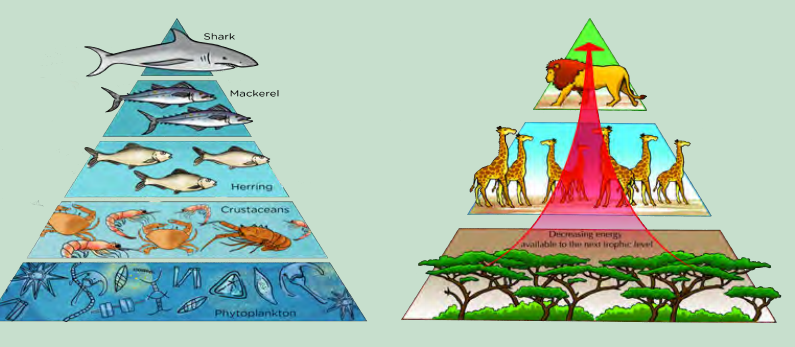
Energy pyramids for a marine ecosystem and a savanna ecosystem
Obtaining Carbon Compounds: Autotrophs and Heterotrophs
- An organism's mode of nutrition is how it gains organic molecules to fuel respiration.
- Autotrophs synthesise their own organic molecules from simple inorganic substances; because they do not rely on other organisms they are called producers.
- Photoautotrophs use light energy to fix carbon dioxide into organic molecules; examples include green plants, algae and cyanobacteria.
- Chemoautotrophs obtain energy by oxidising inorganic chemicals, e.g. some bacteria oxidise Fe²⁺ to Fe³⁺; they act as producers in habitats without light, such as deep sea vents.
- Heterotrophs gain carbon compounds by ingesting the tissues of other organisms, then digest and assimilate them into new molecules.
- Types of heterotroph include consumers, detritivores and saprotrophs.
- Respiration releases energy by the oxidation of carbon compounds such as glucose; it occurs in both autotrophs and heterotrophs and releases heat as a by-product.
Decomposers and Nutrient Cycling
- Inorganic nutrients enter the food chain and are converted into carbon compounds locked inside the tissues of living organisms.
- Because the supply of inorganic nutrients is finite, they must be released when organisms die.
- Decomposition breaks down dead organisms, dead parts of organisms and waste products, converting carbon compounds back into inorganic nutrients.
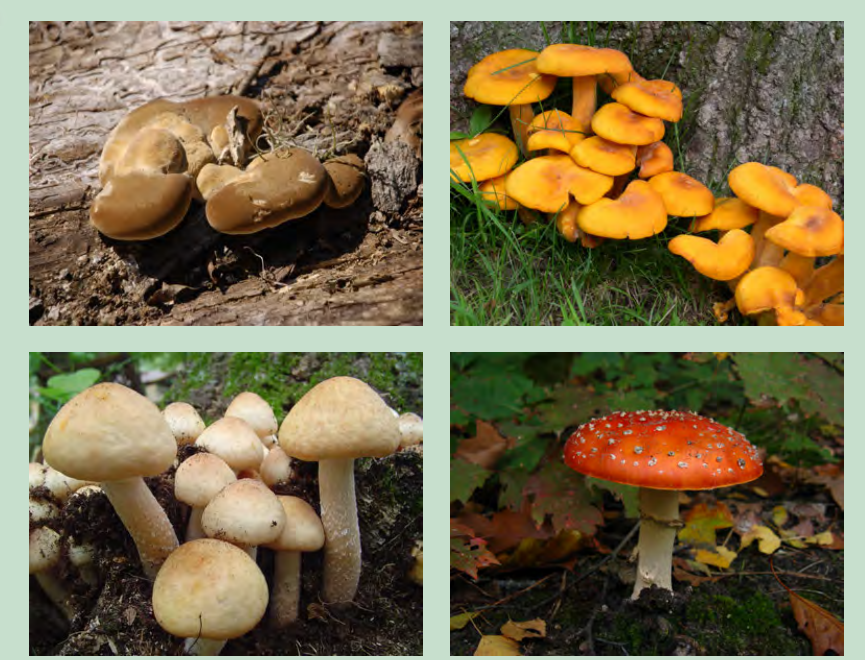
- Detritivores begin decomposition by breaking apart tissues; saprotrophs release enzymes that break down organic molecules, releasing inorganic nutrients.
- Saprotrophs absorb some nutrients themselves, and the rest becomes available to other organisms such as producers.
- In a functioning ecosystem the elements organisms need are constantly recycled: producers take in inorganic nutrients, consumers gain organic nutrients by ingestion, and decomposers return nutrients to the environment.
- Elements cycled through ecosystems include carbon, nitrogen, calcium, phosphorus, sulfur and potassium.
Fungi as decomposers
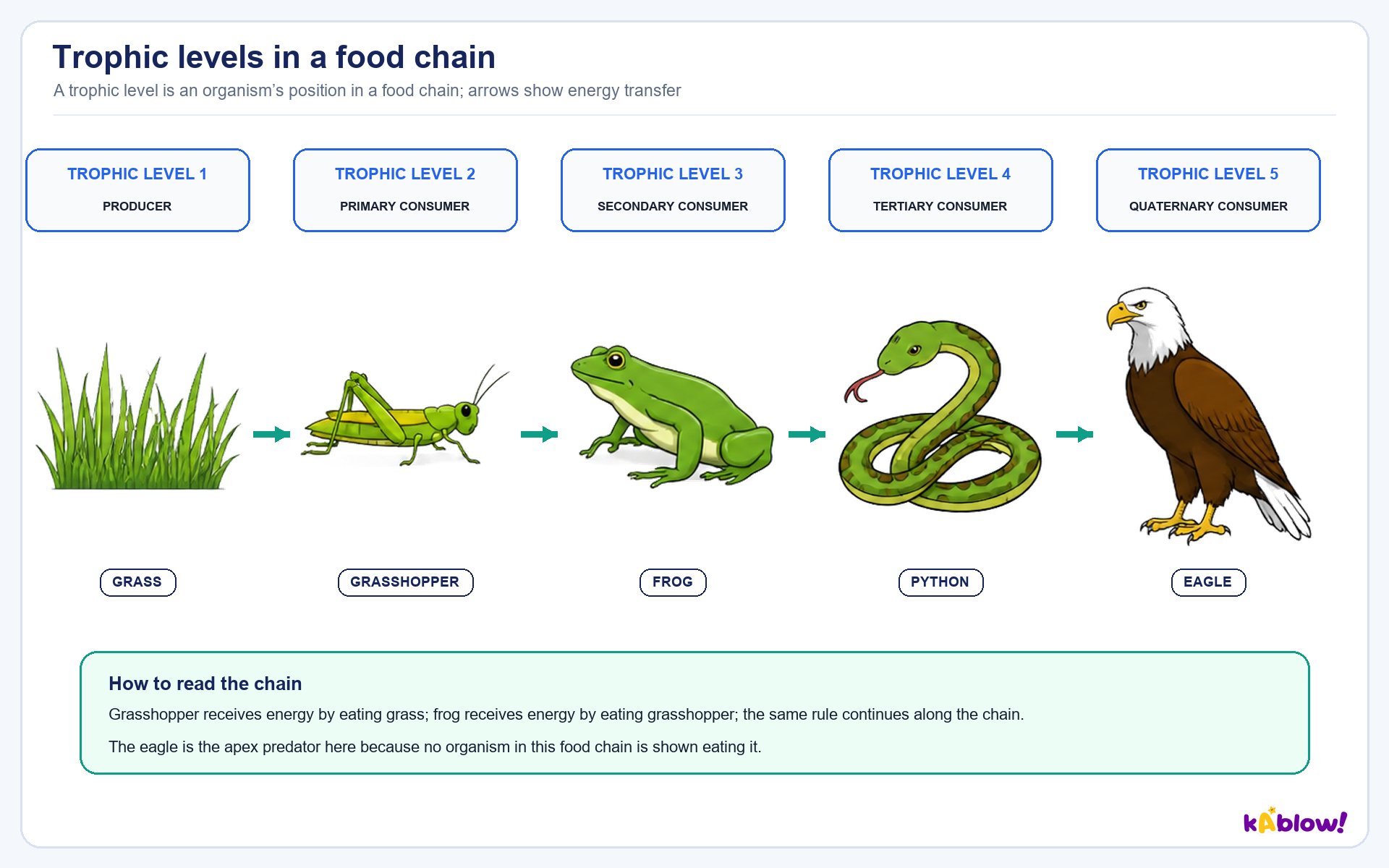
Trophic Levels
- Trophic levels describe an organism's position in a food chain and indicate how many organisms energy has passed through.
- Level 1 = producers; level 2 = primary consumers (herbivores); level 3 = secondary consumers (carnivores); level 4 = tertiary consumers; level 5 = quaternary consumers.
- Energy from sunlight enters the food chain at the first trophic level, where producers convert light energy into chemical energy.
- Apex predators are at the top of the food chain and have no predators; their stored chemical energy can pass to decomposers when they die.
- Some species occupy more than one trophic level because they have a varied diet, e.g. sparrowhawks can be at the third, fourth and fifth trophic levels in different food chains.
Trophic levels
Pyramids of Energy and Energy Losses
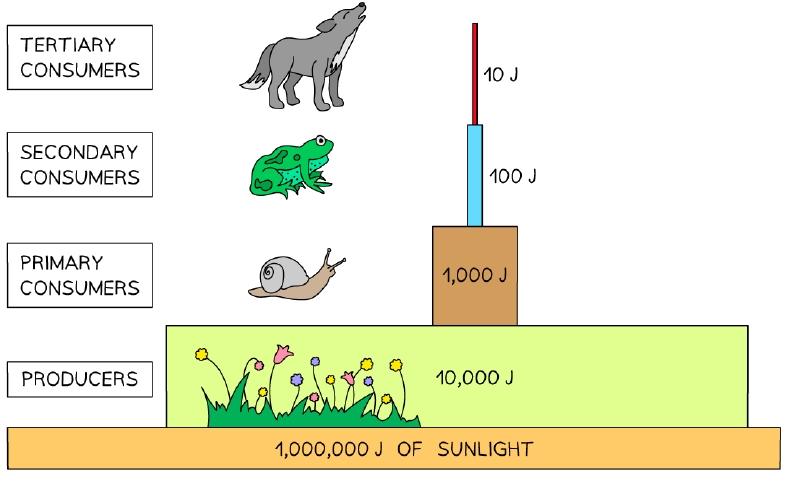
- Pyramids of energy show the energy contained in the biomass at each trophic level; the length of each bar represents the energy present.
- They should be drawn to scale, are always widest at the base, and show a stepped decrease at each level; units are energy per unit area per year, e.g. kJ m⁻² yr⁻¹.
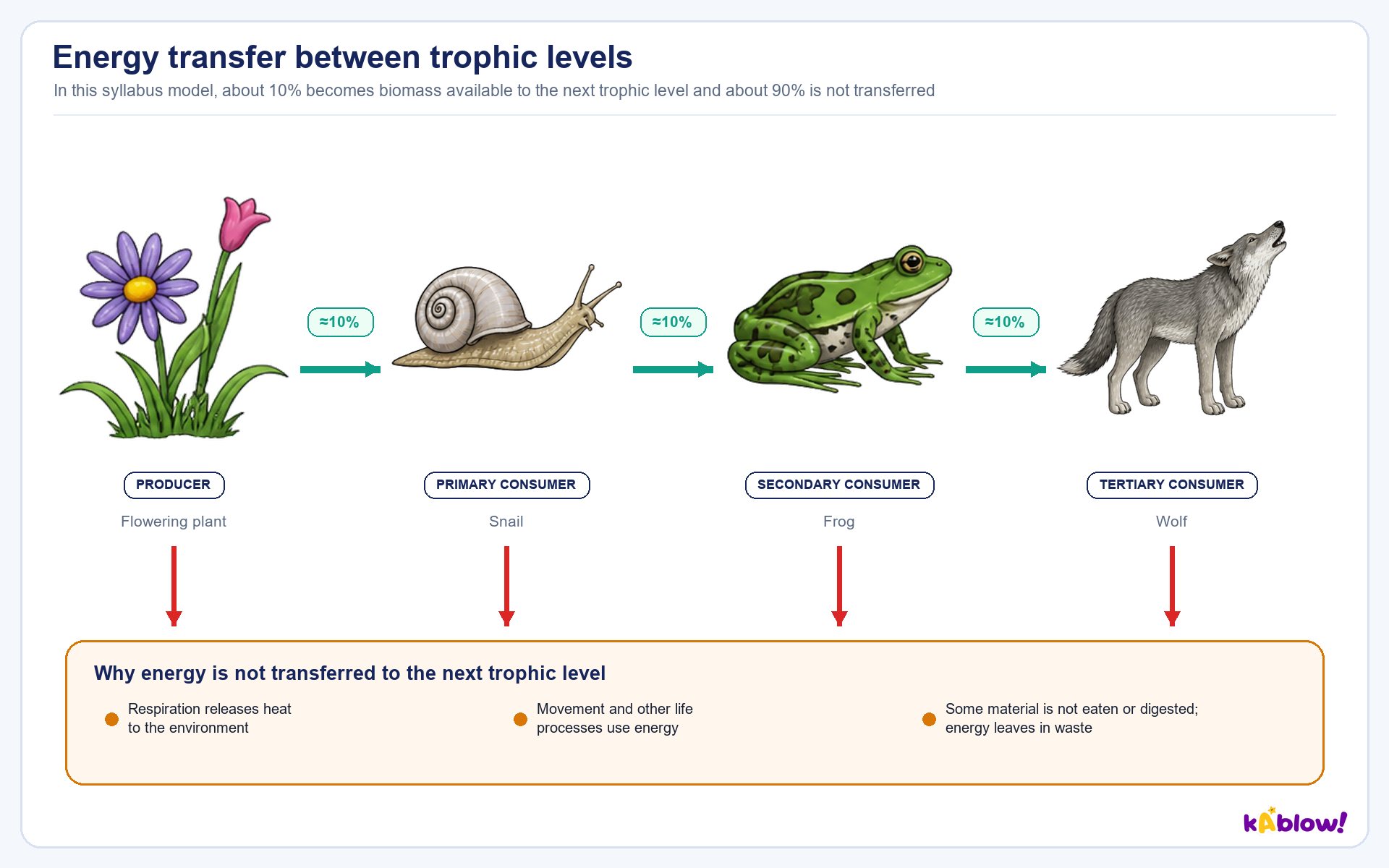
- Roughly 10% of the energy is passed on at each trophic level; around 90% is lost to the environment.
- Energy is lost through incomplete consumption (e.g. roots, bones), incomplete digestion (e.g. cellulose, fur egested as faeces), heat loss during respiration, and excretion of metabolic waste such as urea.
- Some organisms die without being consumed, so their energy is lost to the environment; detritivores and saprotrophs decompose uneaten parts and undigested waste.
- Heat is lost to the environment by radiation at every trophic level and during decomposition.
- Food chains rarely have more than four or five trophic levels because too little energy remains to support a predator higher up.
- Biomass decreases at each trophic level, producing a pyramid shape, but the energy stored per unit mass does not change.
Energy loss along a food chain
Primary and Secondary Production
- Primary production is the accumulation of carbon compounds in the biomass of autotrophs (producers) during photosynthesis.
- Primary production is faster in biomes with more sunlight, optimum temperatures and higher rainfall, e.g. tropical forests.
- The rate of primary production is expressed as biomass per unit area (or volume) per unit time, e.g. g m⁻² yr⁻¹ or g m⁻³ yr⁻¹ for aquatic habitats.
- Secondary production is the accumulation of biomass in the tissues of heterotrophs after they ingest other organisms.
- Not all ingested energy becomes new biomass; carbon is lost as carbon dioxide during respiration and energy is lost in metabolic waste such as water and urea.
- The rate of secondary production is calculated by subtracting respiratory losses from the stored energy ingested, so it is always lower than primary production.
Pyramid of energy
The Carbon Cycle
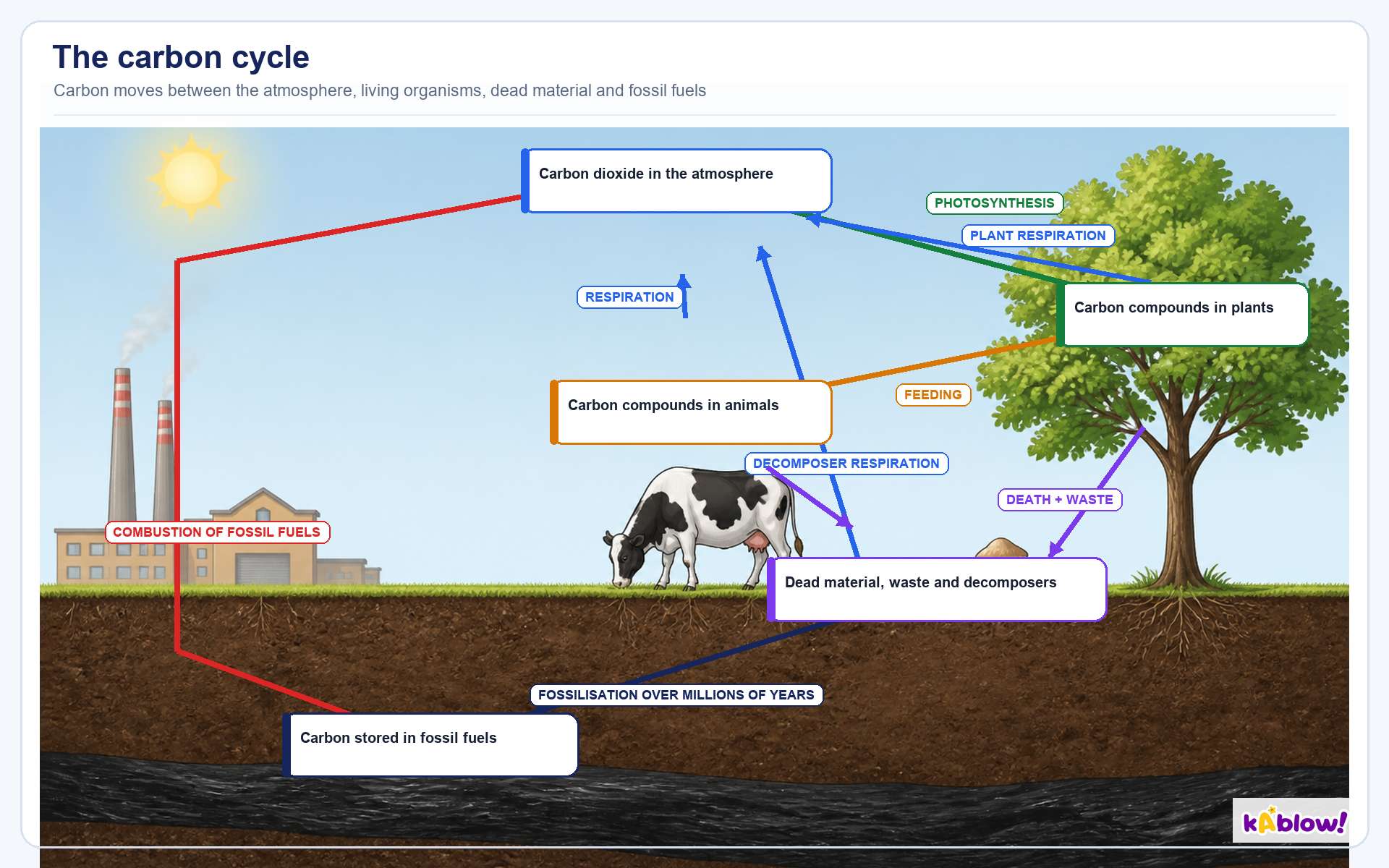
- The carbon cycle is the collection of processes by which carbon is transferred between stores.
- Carbon exists in organic forms (e.g. carbohydrates and proteins in biomass) and inorganic forms (e.g. carbon dioxide in the atmosphere and hydrogen carbonate ions in the oceans).
- Carbon stores are called pools or sinks (e.g. oceans, fossil fuels, living organisms); processes of transfer are called fluxes (e.g. dissolving, combustion, photosynthesis).
- A carbon sink takes up and stores carbon, e.g. plants photosynthesising, oceans dissolving carbon dioxide, and fossil fuels or peat forming over long periods.
- A carbon source releases carbon, e.g. burning plant material or the decay of dead or waste material.
- If photosynthesis exceeds respiration there is a net uptake of carbon dioxide (the organism acts as a sink); if respiration exceeds photosynthesis there is a net release (the organism acts as a source).
- Combustion of fossil fuels (coal, oil, natural gas), peat and biomass releases carbon dioxide and water; burning fossil fuels and peat releases carbon locked up for millions or thousands of years.
The carbon cycle
The Keeling Curve and Atmospheric Carbon Dioxide
- The Mauna Loa Observatory, Hawaii, has recorded atmospheric carbon dioxide levels since 1958; the dataset is named after Charles Keeling.
- The Keeling curve shows seasonal fluctuations in carbon dioxide concentration.
- Levels decrease in whichever hemisphere is in spring and summer because photosynthesis removes carbon dioxide from the atmosphere.
- Levels rise again in autumn and winter when photosynthesis rates decrease and respiration, decomposition and combustion dominate.
- The overall upward trend is caused by human activities, especially the combustion of fossil fuels, which releases carbon dioxide faster than photosynthesis can remove it.
Interaction Between Autotrophs and Heterotrophs
- Photosynthesis takes in carbon dioxide and produces carbon compounds and oxygen, which is the source of atmospheric oxygen on Earth.
- Aerobic respiration uses oxygen and releases carbon dioxide as a waste product, which can be used in photosynthesis.
- Both autotrophs and heterotrophs respire aerobically.
- The combined photosynthesis of all photosynthetic organisms removes huge volumes of carbon dioxide and releases huge volumes of oxygen, while combined respiration does the reverse.
- This exchange is a major interaction between autotrophs and heterotrophs and creates huge annual carbon fluxes on Earth.
Diapos
Sign up free to view the lesson slides
Step through every slide for this topic — plus flashcards and revision notes — with a free account.
Questions d'entraînement
Aperçu gratuit — 8 sur 61 questions. Inscris-toi pour toutes les voir.
1.What is the initial source of energy for most food chains?
Easy- ASunlight
- BHeat from the Earth's core
- CChemical energy in detritus
- DATP stored in producers
2.Which row correctly identifies the mode of nutrition of an autotroph and a heterotroph?
Easy- AAutotroph: synthesises organic molecules from inorganic substances; Heterotroph: ingests carbon compounds from other organisms
- BAutotroph: ingests carbon compounds from other organisms; Heterotroph: synthesises organic molecules from inorganic substances
- CAutotroph: uses light energy to produce ATP only; Heterotroph: uses chemical energy to produce ATP only
- DAutotroph: obtains carbon compounds from dead organisms; Heterotroph: obtains carbon compounds from living organisms
3.In a functioning ecosystem, organisms are constantly recycled.
EasyTrue or false?
4.Which of the following is an example of a chemoautotroph?
Medium- AA bacterium that oxidises iron to produce ATP
- BA green plant that carries out photosynthesis
- CA fungus that absorbs nutrients from dead wood
- DA herbivore that eats grass
5.The arrows in a food chain represent the transfer of:
Medium- AEnergy in the form of stored chemical energy in carbon compounds
- BBiomass only, not energy
- CInorganic nutrients from the abiotic environment
- DHeat energy from one trophic level to the next
6.Which of the following are reasons why energy is lost between trophic levels? (select all that apply)
Medium- ANot all parts of the food organism are eaten
- BNot all ingested food is digested, so some is egested as faeces
- CHeat is lost to the environment during respiration
- DEnergy is lost when organisms excrete waste products such as urea
- EEnergy is converted into matter during photosynthesis
7.Which of the following correctly defines an ecosystem?
Easy- AA group of organisms interacting with each other and with the non-living parts of the environment
- BAll the organisms of the same species living in a given area
- CThe non-living components of an environment only
- DA community of organisms and its interactions with other communities only
8.In a pyramid of energy, what do the units typically represent?
Medium- AEnergy per unit area per year (e.g. kJ m⁻² year⁻¹)
- BBiomass per unit area (e.g. g m⁻²)
- CNumber of individuals per trophic level
- DEnergy per individual organism (e.g. kJ per organism)
Unlock all 61 questions & more
Crée un compte gratuit pour voir toutes les questions, les diapos, les cartes mémo et les notes de révision de ce thème.