Viruses
Apprends en jouant
Réponds à ces questions pour gagner de l'énergie, puis pêche et explore. Sans compte.
Notes de leçon
What Viruses Are
- Viruses are non-cellular infectious particles; they are not considered to be alive.
- They possess none of the characteristic features used to classify organisms, so they sit outside the three-domain classification system.
- They are acellular — they have no cellular structures and therefore no metabolism.
- They are much smaller than prokaryotic cells, with diameters between 20 and 300 nm, and can only be seen with an electron microscope.
- All viruses are parasitic: they can only reproduce by infecting living cells and using the host's protein-building machinery (ribosomes).
- The energy viruses need for replication is released by the host cell; viruses do not respire.
A virus particle
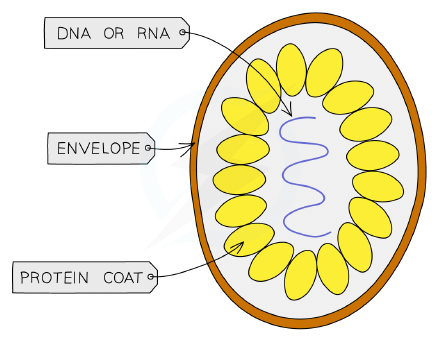
Structural Features Common to All Viruses
- Small, fixed size — viruses contain few molecules, do not form large structures and do not grow.
- A nucleic acid core: the genome is made of either DNA or RNA, which can be single- or double-stranded and linear or circular.
- A protein coat called a capsid, with attachment proteins on its outer surface that allow the virus to bind to and enter host cells.
- No cytoplasm and very few, or no, enzymes.
- Some viruses have an additional outer lipid envelope, usually formed from the membrane phospholipids of the cell they were made in; envelope structures can be involved in cell recognition.
Structural Diversity of Viruses
- Despite their simplicity, viruses show huge variety in structure and shape.
- Genetic material can be RNA or DNA, and either double- or single-stranded.
- Some viruses are enveloped, others are not.
- Viral shapes can be threadlike, polyhedral or spherical.
- Each virus attaches to and infects a specific type of host cell, determined by its attachment proteins — e.g. HIV infects white blood cells, hepatitis infects liver cells.
Examples of Virus Structure
- Bacteriophage lambda is a bacterial virus that infects×Escherichia coli×; it has a double-stranded DNA genome contained within its capsid head.
- Its tail and fibrils attach to the host and insert the DNA; the tail proteins contract to move the tail through the bacterial cell wall, and DNA is injected through the tail.
- Coronaviruses cause respiratory diseases in mammals and birds and are transmitted via respiratory fluids; they have single-stranded RNA, a spherical shape, and an envelope outside the capsid.
- Coronaviruses have many glycoproteins projecting from their surface, producing a 'corona'; examples include SARS-CoV-2 (COVID-19), MERS and SARS.
- HIV contains two RNA strands, proteins including the enzyme reverse transcriptase, a protein capsid, and a viral envelope of lipid bilayer and glycoproteins.
- Reverse transcriptase makes DNA from viral RNA, so HIV is a retrovirus; its lipid bilayer is derived from the cell membrane of the host helper T cell it escaped from.
- HIV is spread by direct exchange of body fluids — e.g. sexual intercourse, blood donation, shared needles, across the placenta, during birth, and through breast milk.
Replication in Viruses: The Lytic Cycle
- Being non-living, viruses do not undergo cell division; all viruses are parasitic and can only reproduce by infecting host cells.
- To replicate, all viruses must: attach to a specific attachment site, inject their nucleic acid into the host cytoplasm, use the host's protein synthesis machinery to make viral proteins, assemble new viral particles, and release them.
- The lytic pathway is named because new virus particles are released during lysis (bursting) of the host cell, caused by the enzyme lysozyme, coded for by the viral genetic material.
- Lysis occurs after production of fully functional virus particles called virions.
- Steps of the lytic pathway: 1 attach to the host cell membrane using attachment proteins → 2 inject DNA into the cytoplasm → 3 biosynthesis using host proteins and enzymes → 4 assemble and mature virions → 5 host cell lysis releases virions to infect more cells.
The Lysogenic Cycle
- In the lysogenic pathway, new virus particles are not immediately released and do not immediately cause disease.
- Viral nucleic acid combines with the host DNA.
- A viral gene coding for a repressor protein prevents the viral nucleic acid from being transcribed and translated.
- This is called latency, and the time during which it occurs is a period of lysogeny.
- The host cell continues to function normally, including reproduction and cell division, so subsequent cells contain the viral nucleic acid within the host genome — this can continue until a lytic event is triggered.
- The viral DNA is inactive/dormant until a change in the cell's environment triggers entry into the lytic pathway; triggers include UV rays and certain chemicals.
Origin of Viruses
- Viruses can infect nearly all living species and are estimated to have been on Earth 3.5 billion years before humans evolved.
- There is evidence that viruses evolved alongside other species — a process known as coevolution.
- Around 8 % of the human genome contains small segments of viral DNA, thought to be left over from ancient infections; these fragments are called endogenous retroviruses (ERVs).
- The origin of viruses is still debated, partly because viruses are not found in fossils, so there is limited evidence for their evolution.
- Escape theory: viruses arose from genetic elements (DNA/RNA) that gained the ability to move between cells and became surrounded by an outer boundary.
- Regressive/reduction theory: viruses are remnants of cellular organisms, or once-small cells that became parasites of larger cells and shed unneeded cellular structures.
- Virus-first theory: viruses predate their current cellular hosts; the simple nature of virus particles could indicate that viruses evolved first.
Convergent Evolution and Viral Evolution
- The diversity of viruses suggests there may have been different origins for different viruses; it is possible that all, none, or a different process explains their origin.
- Features common among many viruses — a capsid protein outer boundary, no cytoplasm, genetic material of DNA or RNA, the same genetic code as other organisms, and a parasitic nature — indicate that convergent evolution may have occurred.
- Viruses can evolve extremely rapidly; influenza viruses and HIV are two examples.
- Both have high mutation rates (largely because their genetic material is RNA, so mutations occur when viral RNA is converted to DNA during replication), large population sizes, and short generation times.
- These features let them quickly evolve to evade the immune systems of their hosts.
Antigenic Drift and Antigenic Shift
- Antigenic drift is the accumulation of small changes to viral genetic material over time; variation in surface proteins appears slowly until the host's immune system can no longer recognise the virus. HIV undergoes antigenic drift.
- Antigenic shift is a major change in viral genetic material over a short time period: two or more virus types infect the same cell, combine their genetic material, and produce rapid variation in surface proteins, creating a new virus unrecognised by the host's immune system. Influenza undergoes antigenic shift.
Treating Diseases Caused by Rapidly Evolving Viruses
- For rapidly evolving viruses, vaccines need to be changed and updated yearly to remain effective.
- This is a successful approach for viruses that undergo antigenic drift, because the changes are small and not hugely rapid.
- Although HIV undergoes antigenic drift, it does so at an unusually rapid rate, so a vaccine has not yet been successful.
- For viruses undergoing antigenic shift, vaccines are less successful because the changes are rapid and unpredictable.
- Fast-evolving viruses may need to be dealt with by the isolation of infected individuals to stop the spread of infection.
Diapos
Sign up free to view the lesson slides
Step through every slide for this topic — plus flashcards and revision notes — with a free account.
Questions d'entraînement
Aperçu gratuit — 8 sur 61 questions. Inscris-toi pour toutes les voir.
1.Which of the following is not a feature that can be found in viruses?
Easy- AEnzymes
- BDNA or RNA genetic material
- CCapsid made of protein
- DCytoplasm
2.The lytic pathway allows viruses to replicate. Which of the following statements best describes the lytic pathway?
Easy- AInjection of genetic material → protein synthesis → replication of host → release
- BEntry → assembly → release
- CAttachment → entry → replication → assembly → release
- DAttachment → entry → lysogeny → replication → release
3.What feature of the escape theory differentiates it from the other theories about the origin of viruses?
Medium- AIt suggests that viruses arose from genetic material capable of moving between cells.
- BIt suggests that viruses predate cellular life and represent an early step in the evolution of life.
- CIt proposes that viruses are remnants of cellular organisms that became parasites.
- DIt states that viruses evolved simultaneously alongside their hosts through coevolution.
4.Which of the following statements correctly distinguishes antigenic drift from antigenic shift in viral evolution?
Medium- AAntigenic drift involves rapid, unpredictable genetic changes, while antigenic shift involves slow, gradual accumulation of mutations.
- BAntigenic drift occurs when two viruses combine their genetic material in a single host cell, while antigenic shift results from small mutations over time.
- CAntigenic drift involves the gradual accumulation of small genetic changes, while antigenic shift occurs when two or more viruses combine their genetic material, leading to a major change.
- DAntigenic drift leads to new virus types unrecognisable to the immune system, while antigenic shift creates only minor changes in viral surface proteins.
5.In the lysogenic pathway, which of the following is the most likely cause of a period of lysogeny?
Medium- AThe viral DNA produces proteins that suppress the immune response, resulting in persistent virion production.
- BA repressor protein, coded by the viral DNA, prevents transcription and translation of viral proteins.
- CThe host cell lacks the necessary enzymes for viral replication, forcing the virus to remain dormant until external factors activate its DNA.
- DViral nucleic acid disrupts host cell reproduction, preventing cell division until lytic triggers occur.
6.Which of the following is a structural feature common to all viruses?
Easy- AA lipid envelope
- BA protein capsid
- CDouble-stranded DNA
- DPresence of ribosomes
7.Which of the following statements about virus size is correct?
Medium- AViruses are larger than prokaryotic cells but smaller than eukaryotic cells.
- BViruses have diameters between 20 and 300 nm and can only be seen with an electron microscope.
- CViruses have diameters between 20 and 300 µm and can be seen with a light microscope.
- DViruses are the same size as bacteria and can be seen with a light microscope.
8.Which of the following are structural features of bacteriophage lambda? (Select all that apply.)
Medium- ADouble-stranded DNA genome
- BTail and fibrils
- CLipid envelope
- DCapsid head
- ESingle-stranded RNA
Unlock all 61 questions & more
Crée un compte gratuit pour voir toutes les questions, les diapos, les cartes mémo et les notes de révision de ce thème.