Inheritance
Apprends en jouant
Réponds à ces questions pour gagner de l'énergie, puis pêche et explore. Sans compte.
Notes de leçon
Gametes and Fertilisation
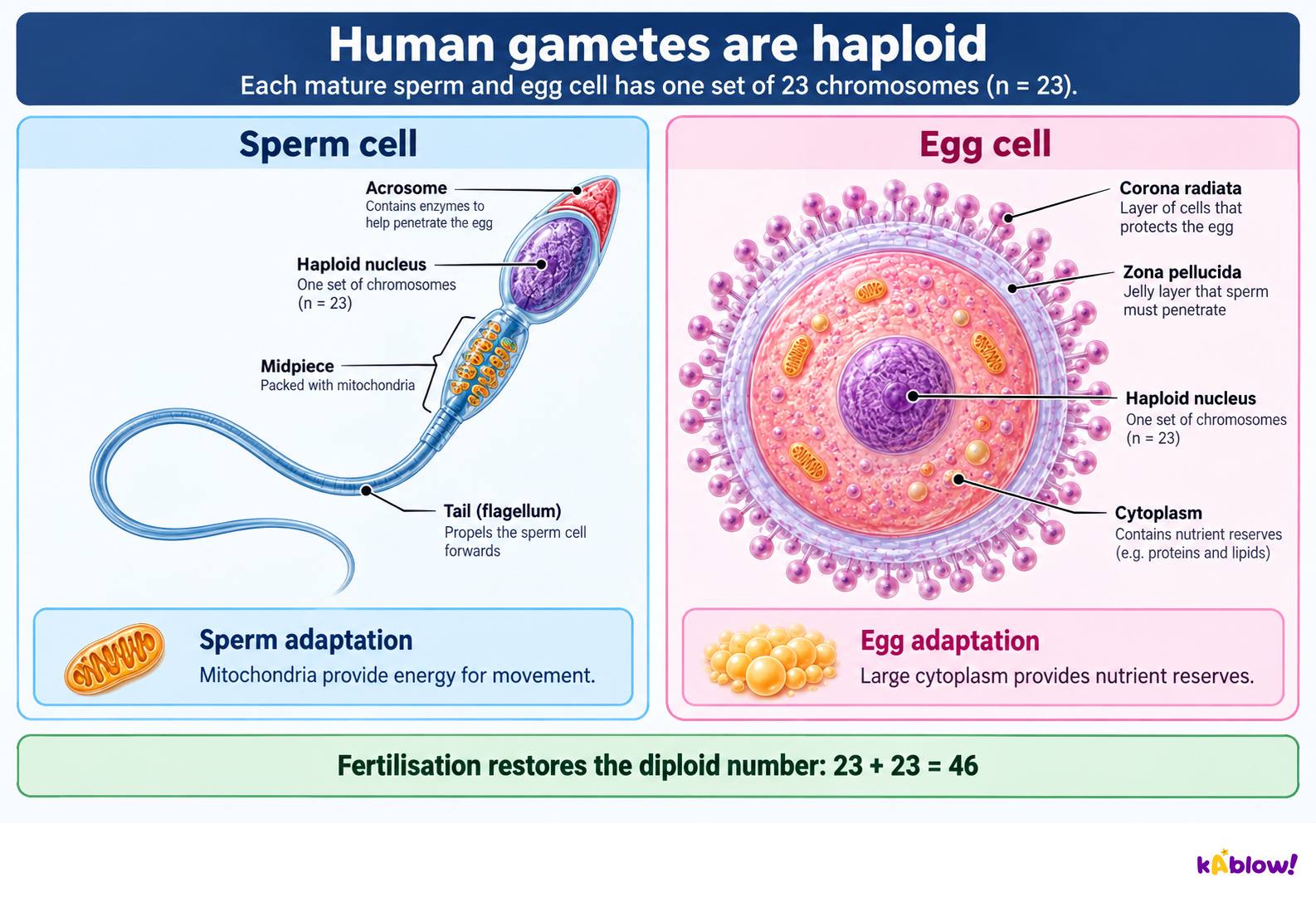
- Gametes are the sex cells of an organism, such as sperm and egg cells in humans.
- The egg cell is larger than the sperm because most of its space contains food to nourish a growing embryo.
- The sperm cell contains many mitochondria to release energy for its motion.
- Gametes are formed during meiosis and are haploid, meaning they have one copy of each chromosome (23 single chromosomes in humans).
- Fertilisation is the fusion of gamete nuclei to form a zygote (fertilised egg cell).
- The zygote is diploid, containing two chromosomes of each type (46 chromosomes in humans) and therefore two alleles of each gene.
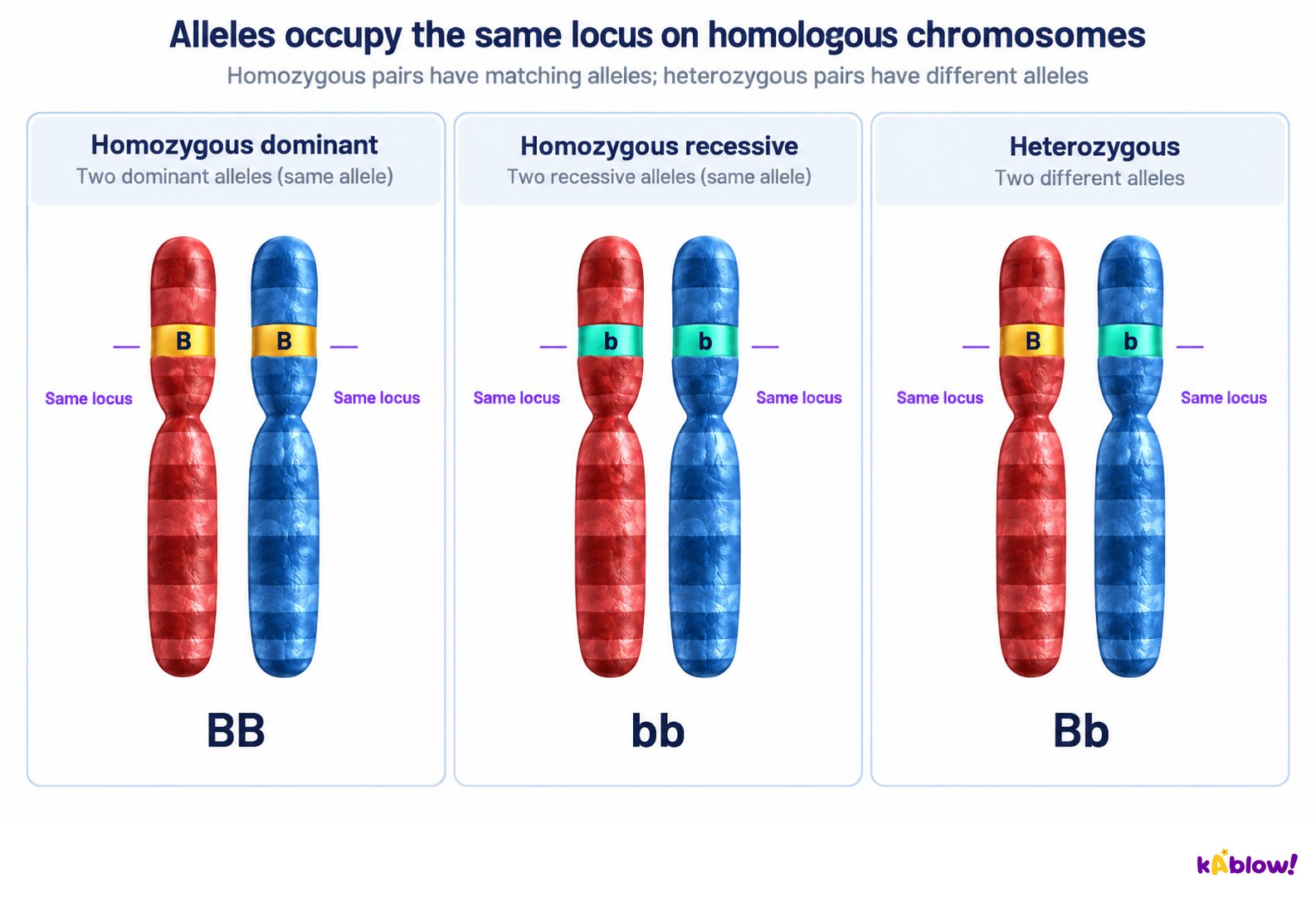
- If the two alleles for a gene are the same, the genotype is homozygous; if different, it is heterozygous.
Genetic Crosses and Mendel
- Gregor Mendel was an Austrian monk who carried out breeding experiments on pea plants in the mid-19th century.
- Mendel transferred pollen from one pea plant to another, eliminating uncertainty about which pollen fertilised each plant.
- He studied characteristics such as plant height, flower colour, and seed coat smoothness.
- Mendel found that characteristics were inherited in predictable patterns: the first generation all showed one parental characteristic, and the second generation showed both in a 3:1 ratio.
- Mendel discovered 'units of inheritance' (now called genes) and that some genes are dominant and some recessive.
- A monohybrid cross starts with pure-breeding (homozygous) parents displaying different phenotypes; this is the P generation.
- A Punnett grid predicts the probability of offspring displaying a certain genotype or phenotype.
A Punnett square

Inheritance Terminology
- A gene is a short length of DNA on a chromosome that codes for a particular characteristic by coding for a specific protein.
- Alleles are different forms of the same gene; individuals inherit two alleles for each gene, one from each parent.
- The genotype is the combination of alleles an organism inherits.
- The phenotype is the observable characteristics of an organism.
- Phenotype can be determined by genotype only (e.g., blood group), environment only (e.g., scars, accent), or an interaction of both (e.g., height, skin colour).
- A dominant allele only needs to be inherited from one parent to be expressed in the phenotype.
- A recessive allele must be inherited from both parents to be expressed; if only one copy is present, it remains hidden.
Codominance and Incomplete Dominance
- Codominant alleles both have an equal effect on the phenotype and are both expressed.
- In speckled chickens, the alleles for white (CW) and black (CB) feather colour are codominant; CW CB chickens have both white and black feathers.
- Incomplete dominance occurs when both alleles are partially expressed, producing an intermediate phenotype.
- In the marvel of Peru (Mirabilis jalapa), a cross between white (CW CW) and red (CR CR) flowers produces pink (CW CR) flowers.
- In incomplete dominance, the heterozygote shows a blend of the two parental phenotypes.
Phenotypic Plasticity and Recessive Inheritance
- Phenotypic plasticity is the idea that although genotype remains fixed, phenotype can vary during an organism's lifetime due to environmental influences.
- Environmental stimuli such as light, chemicals, drugs, and hormones can affect gene expression patterns.
- In the Himalayan rabbit, the gene for fur pigmentation is inactive above 35°C but active between 15°C and 25°C, causing black fur on cooler body parts (ears, feet, nose).
- Phenylketonuria (PKU) is an inherited condition caused by a recessive allele on an autosome.
- PKU is caused by a mutation in the PAH gene, leading to a non-functional enzyme (phenylalanine hydroxylase) and a build-up of phenylalanine.
- Two heterozygous carriers of the PKU allele have a 25% chance of having a child with PKU and a 75% chance of having a child without PKU.
- This pattern of inheritance is the same for other autosomal recessive conditions, such as cystic fibrosis.
Multiple Alleles and Blood Groups
- Many genes have more than two alleles, but a diploid individual still only inherits two of the possible alleles.
- Alleles differ from each other by one or a few bases; these positions are called Single Nucleotide Polymorphisms (SNPs).
- The ABO blood group system is controlled by a single gene with three alleles: IA, IB, and i.
- IA and IB are codominant, and both are dominant to the recessive allele i.
- IA produces antigen A, IB produces antigen B, and i produces no antigens on red blood cells.
- Genotypes and phenotypes: IA IA or IA i = blood group A; IB IB or IB i = blood group B; IA IB = blood group AB; ii = blood group O.
- Blood transfusions require matching blood groups to avoid immune responses that can cause clotting and serious illness.
Sex Determination
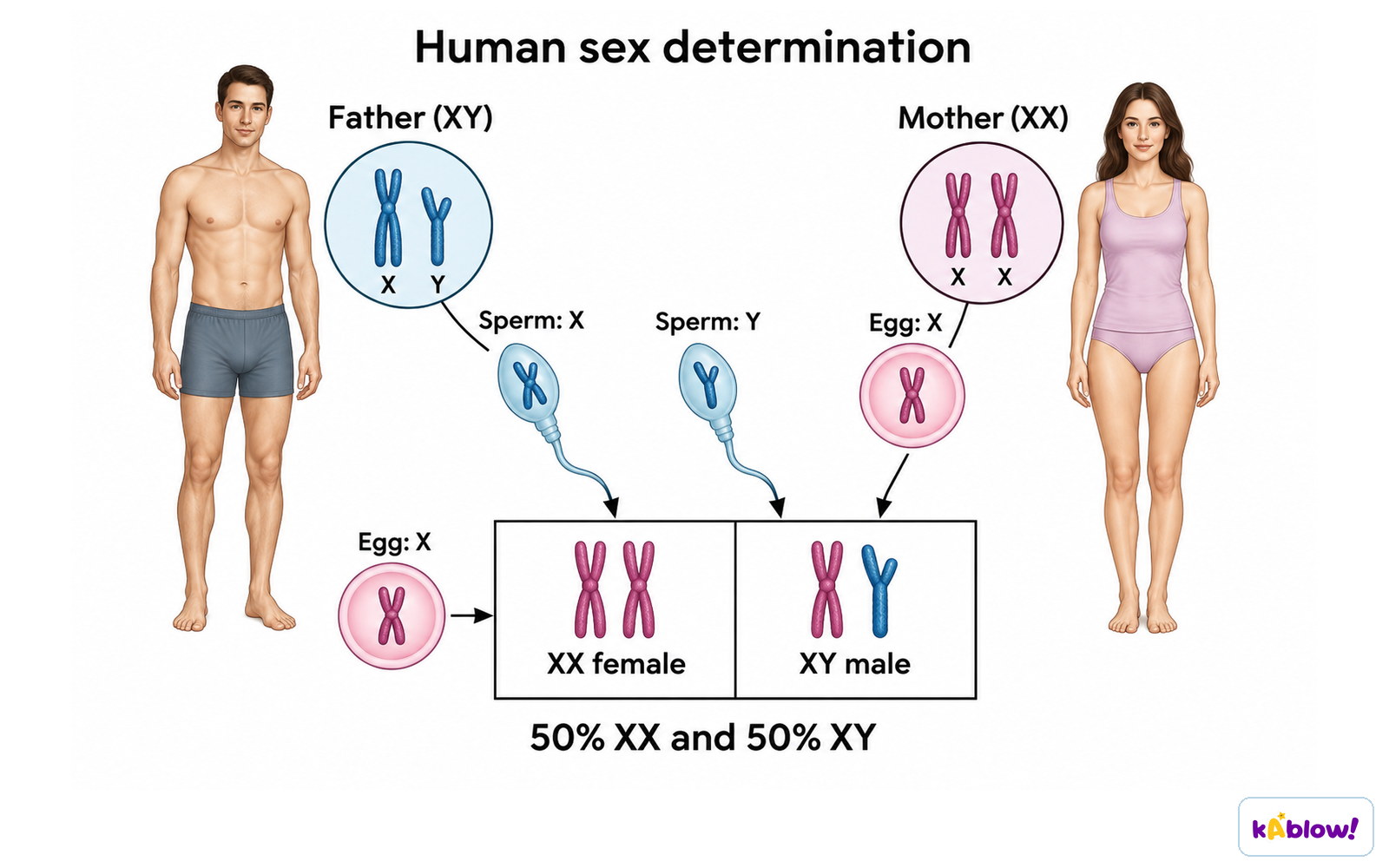
- Sex is determined by an entire chromosome pair: females have XX and males have XY (pair 23 in humans).
- All other chromosomes (pairs 1–22) are autosomes and do not determine sex.
- The father determines the sex of the child because only he can pass on a Y chromosome.
- Half of a father's sperm carry an X chromosome and half carry a Y chromosome.
- The chromosome carried by the sperm that fertilises the egg determines the sex of the child.
- The X chromosome is larger than the Y and carries around 16 times more genes; the Y chromosome carries the SRY gene involved in testes development and testosterone production.
Sex-Linked Disorders: Haemophilia
- Sex-linked genes are present on one sex chromosome but not the other; if on the X chromosome, males (XY) have one copy and females (XX) have two.
- Females can be normal, carriers, or have the disease; males can only be normal or have the disease.
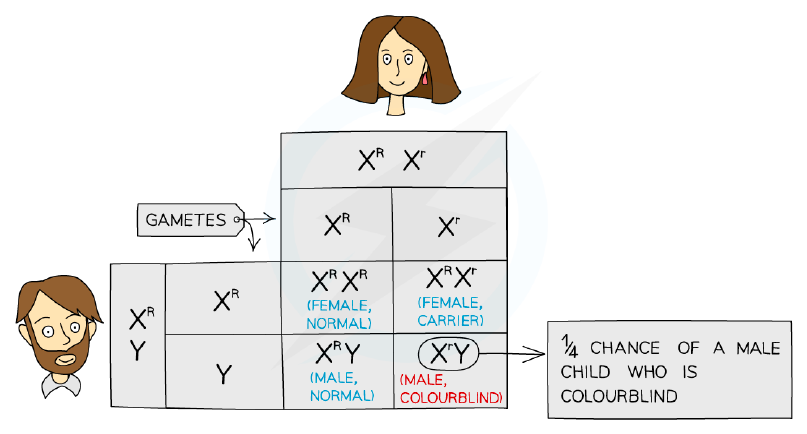
- Haemophilia is a sex-linked disease caused by a recessive allele (f) on the X chromosome that results in a lack of factor VIII, a protein needed for blood clotting.
- Males with the recessive allele f will have haemophilia because they have only one copy of the gene.
- Females can be heterozygous (XF Xf) and act as carriers without having the condition.
- A cross between a carrier female (XF Xf) and a normal male (XF Y) gives a 1:1:1:1 ratio of normal female : carrier female : normal male : male with haemophilia.
Punnett square for a sex-linked condition
Pedigree Charts
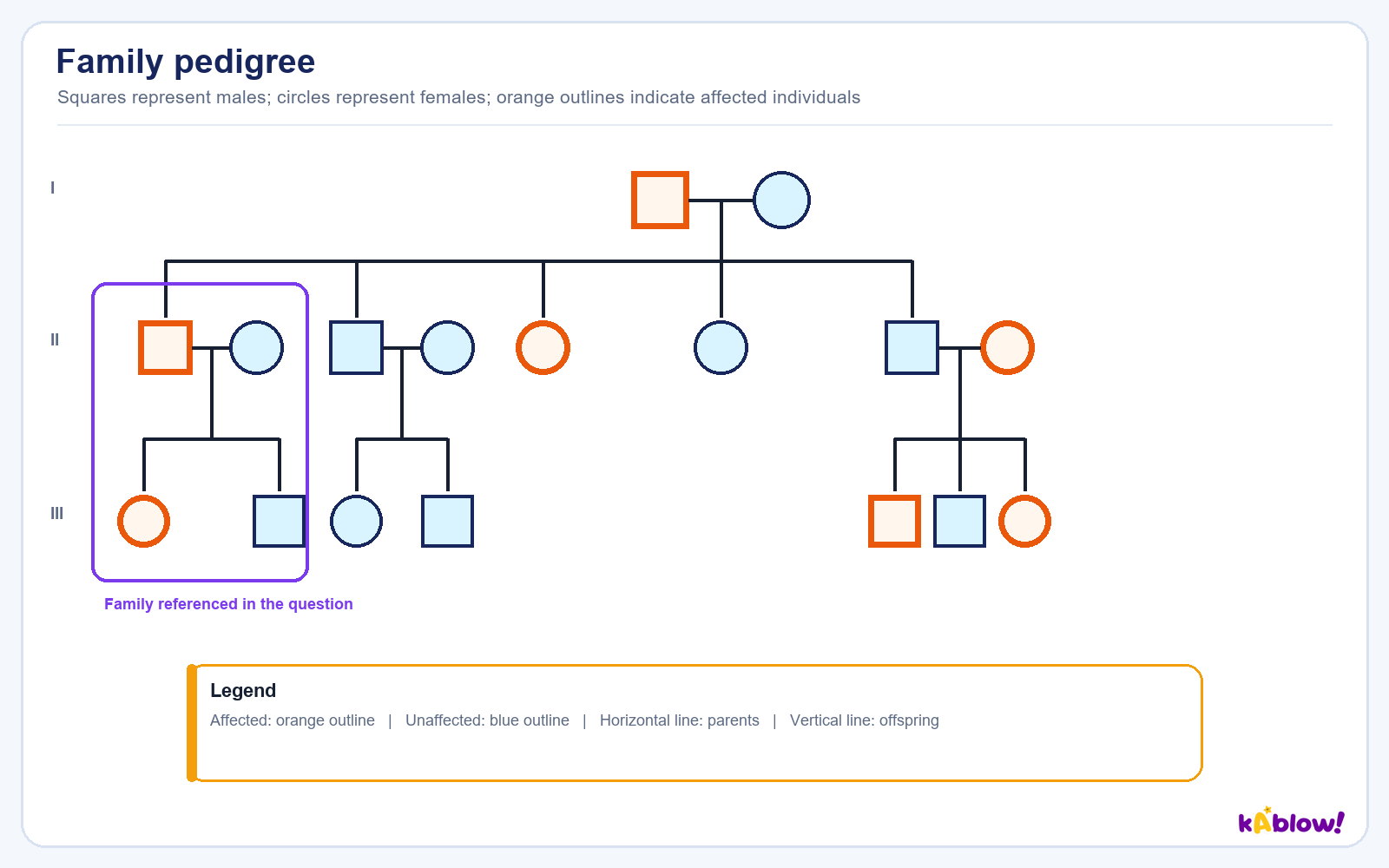
- Pedigree charts trace the inheritance of a characteristic through generations of a family.
- Males are represented by squares and females by circles; affected individuals are shaded or cross-hatched.
- Horizontal lines between males and females indicate they have produced children, who are linked underneath.
- Roman numerals may indicate generations, and the eldest child is on the left in each generation.
- If two unaffected parents have an affected child, the condition must be caused by a recessive allele, and both parents are carriers.
- If both males and females are affected, the condition is unlikely to be sex-linked.
- Marriage between close relatives is discouraged because it increases the chance that both parents carry harmful recessive alleles, raising the risk of genetic disorders in offspring.
A family pedigree chart
Continuous Variation
- Discrete variation falls into clear-cut categories with no overlap, such as blood group (8 distinct groups with Rhesus factor).
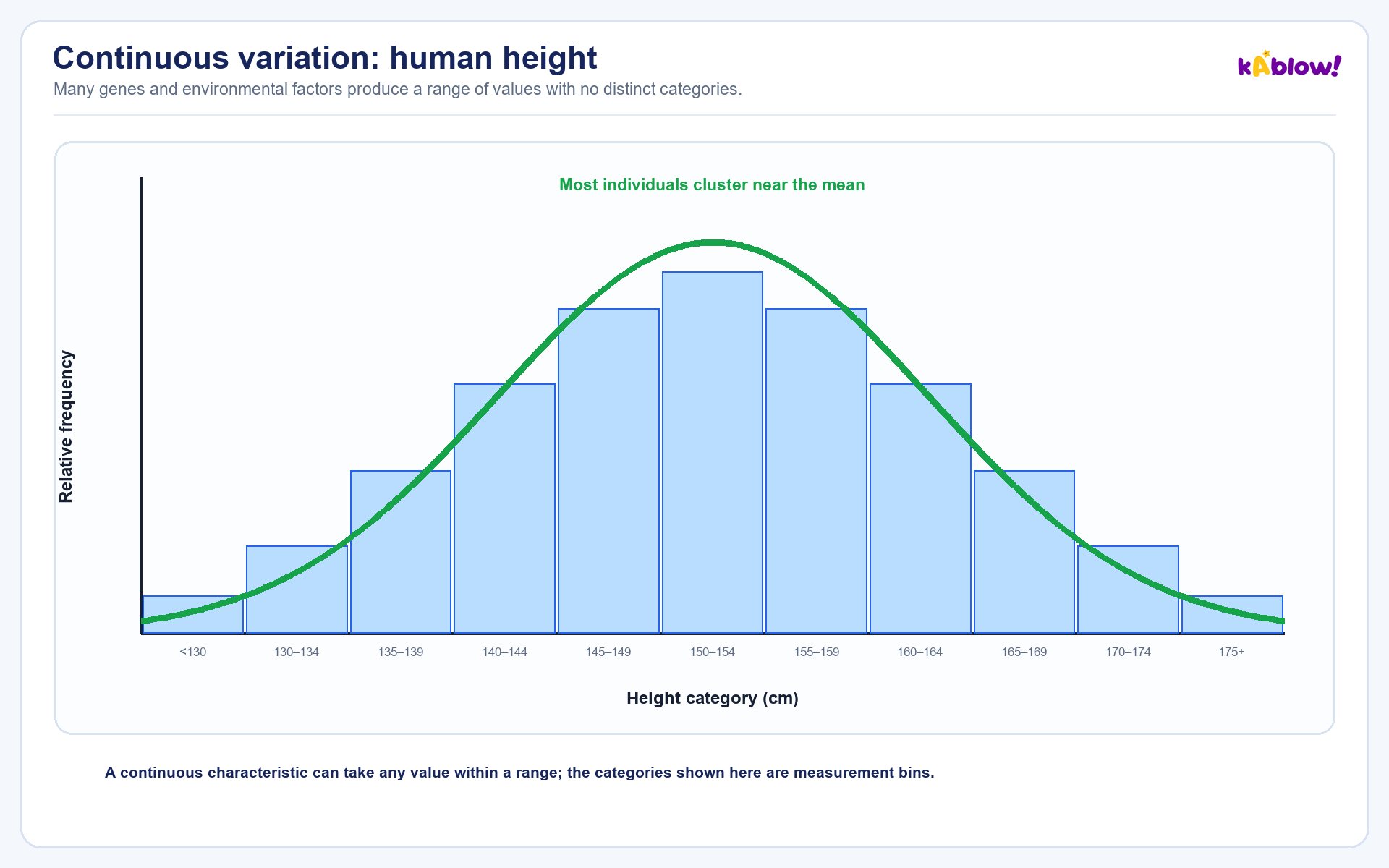
- Continuous variation occurs when two or more genes affect the final characteristic, producing a range of values between two extremes.
- Examples include human height, birth mass, and skin colour.
- Continuous variation is caused by an interaction between genetics and the environment: phenotype = genotype + environment.
- At the genetic level, different alleles at a single locus have small effects, and different genes can have additive effects; many genes with a combined effect are called polygenes.
- Continuous variation in a population often displays a normal distribution (bell-shaped curve).
- Box plots (box-and-whisker diagrams) display the lowest value, first quartile, median, third quartile, and highest value; the box represents the interquartile range (middle 50% of data).
- Outliers are data points more than 1.5 × the interquartile range above the third quartile or below the first quartile.
Continuous variation
Diapos
Sign up free to view the lesson slides
Step through every slide for this topic — plus flashcards and revision notes — with a free account.
Questions d'entraînement
Aperçu gratuit — 8 sur 67 questions. Inscris-toi pour toutes les voir.
1.What is the role of factor VIII in humans?
Easy- AIt helps blood to clot.
- BIt carries oxygen in the blood.
- CIt digests proteins in the stomach.
- DIt regulates blood sugar levels.
2.State the scientific term used for a characteristic coded for by several genes that work in combination to produce the phenotype.
Easy- APolygenic
- BCodominant
- CHomozygous
- DSex-linked
3.What is meant by the term 'dominant' in the context of alleles?
Easy- AAn allele that is expressed in the phenotype even if only one copy is present.
- BAn allele that is only expressed when two copies are present.
- CAn allele that is always inherited from the mother.
- DAn allele that is located on the Y chromosome.
4.In snapdragon plants, a cross between a red and white flowered plant results in pink flowered offspring due to codominance. In Mendel's pea plants, a cross between a red-flowered plant and a white-flowered plant did not result in any pink flowered plants. Suggest why.
Medium- AIn pea plants, the red allele is completely dominant over the white allele.
- BIn pea plants, the red and white alleles are codominant.
- CIn pea plants, flower colour is determined by multiple alleles.
- DIn pea plants, flower colour is a polygenic trait.
5.In a genetic diagram where H denotes the dominant allele for Huntington's disease and h denotes the recessive allele, what is the meaning of the genotype Hh?
Easy- AThe individual has one dominant and one recessive allele (heterozygous).
- BThe individual has two dominant alleles (homozygous dominant).
- CThe individual has two recessive alleles (homozygous recessive).
- DThe individual has no alleles for the gene.
6.What phenotype will an individual with genotype Hh display for Huntington's disease?
Easy- AThey will have Huntington's disease.
- BThey will not have Huntington's disease.
- CThey will be a carrier but not affected.
- DThey will have a mild form of the disease.
7.Which of the following statements about gametes are correct? (select all that apply)
Medium- AGametes are haploid.
- BGametes are produced by meiosis.
- CGametes contain two copies of each chromosome.
- DThe sperm cell contains many mitochondria.
- EThe egg cell is smaller than the sperm cell.
8.A recessive allele needs to be inherited from both parents in order for the characteristic to be expressed in the phenotype.
EasyTrue or false?
Unlock all 67 questions & more
Crée un compte gratuit pour voir toutes les questions, les diapos, les cartes mémo et les notes de révision de ce thème.