How Far? The Extent Of Chemical Change
Apprends en jouant
Réponds à ces questions pour gagner de l'énergie, puis pêche et explore. Sans compte.
Notes de leçon
Dynamic Equilibrium
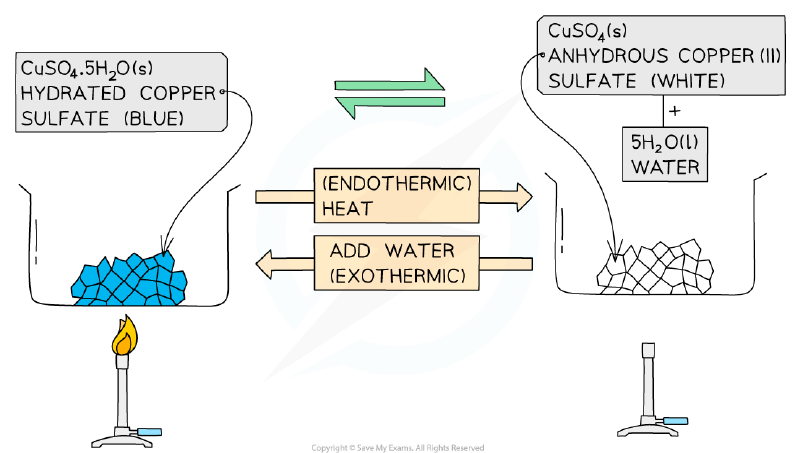
- In a reversible reaction, products can react to reform the original reactants; shown by the ⇌ symbol.
- Dynamic equilibrium is reached in a closed system when the rate of the forward reaction equals the rate of the backward reaction.
- At equilibrium, the concentrations of reactants and products remain constant, but they are not necessarily equal.
- Macroscopic properties such as colour and density remain constant because they depend on concentration.
- Equilibrium can be reached starting from either reactants or products.
- For reactions involving gases, equilibrium can only be reached in a closed system; reactions entirely in solution can reach equilibrium in open flasks.
- Physical equilibria also exist, e.g. C₂H₅OH(l) ⇌ C₂H₅OH(g) in a sealed bottle.
A reversible reaction at equilibrium
The Equilibrium Law and Kc Expression
- For the general reaction aA + bB ⇌ cC + dD, the equilibrium constant expression is: Kc = [C]c[D]d / [A]a[B]b.
- Square brackets represent equilibrium concentrations in mol dm⁻³; round brackets are incorrect and lose marks.
- Solids are ignored in equilibrium constant expressions (e.g. Ag(s) is omitted).
- The equilibrium constant, Kc, is specific to a given equation and depends on temperature.
- For the reverse reaction, K' = 1/Kc (the reciprocal).
- If an equation is multiplied by a factor n, the equilibrium constant is raised to the power n.
- Example: N₂(g) + 3H₂(g) ⇌ 2NH₃(g) gives Kc = [NH₃]² / ([N₂][H₂]³).
Interpreting the Magnitude of K
- If K << 1, the reaction hardly proceeds; equilibrium lies far to the left and the mixture contains mostly reactants.
- If K < 1, the reaction favours the reactants; equilibrium lies to the left.
- If K = 1, there are significant amounts of both reactants and products; equilibrium is balanced.
- If K > 1, the reaction favours the products; equilibrium lies to the right.
- If K >> 1, the reaction goes almost to completion; equilibrium lies far to the right with mostly products present.
- Stronger acids have a higher K value because they dissociate more, shifting equilibrium towards products.
Le Chatelier's Principle
- Le Chatelier's principle: if a change is made to a system at dynamic equilibrium, the position of equilibrium moves to minimise the change.
- The position of equilibrium refers to the relative amounts of products and reactants in the mixture.
- Changes that can affect equilibrium include temperature, pressure, and concentration.
- A catalyst increases the rate of both forward and reverse reactions equally; it has no effect on the position of equilibrium or the value of Kc.
- Concentration changes: increasing a reactant shifts equilibrium right; decreasing a reactant shifts it left; increasing a product shifts it left; decreasing a product shifts it right.
- Changes in concentration do not change the value of Kc, provided temperature remains constant.
Equilibrium and the Haber process
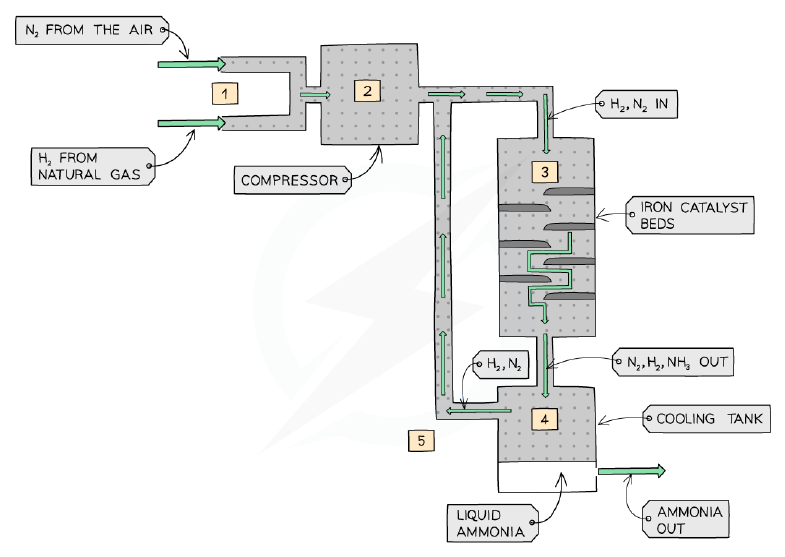
Effects of Pressure and Temperature on Equilibrium
- Pressure changes only affect reactions involving gases; if the number of gas molecules is the same on both sides, pressure has no effect.
- Increasing pressure shifts equilibrium towards the side with fewer gas molecules to reduce the pressure.
- Decreasing pressure shifts equilibrium towards the side with more gas molecules to increase the pressure.
- Changes in pressure do not change the value of Kc.
- Increasing temperature shifts equilibrium in the endothermic direction (absorbs energy).
- Decreasing temperature shifts equilibrium in the exothermic direction (releases energy).
- Temperature changes do change the value of Kc: for an endothermic reaction, Kc increases with increasing temperature; for an exothermic reaction, Kc decreases with increasing temperature.
The Reaction Quotient, Q (HL)
- The reaction quotient, Q, uses the same expression as Kc but with concentrations that may not be at equilibrium.
- If Q = Kc, the reaction is at equilibrium and no net reaction occurs.
- If Q < Kc, the reaction proceeds to the right, favouring products.
- If Q > Kc, the reaction proceeds to the left, favouring reactants.
- Q is not a fixed value; it can be measured at any time, whereas Kc is constant at a given temperature.
- Comparing Q and Kc allows prediction of the direction in which a reaction will shift to reach equilibrium.
Equilibrium Calculations (HL)
- Concentration is calculated using: concentration (mol dm⁻³) = amount (mol) / volume (dm³).
- ICE tables (Initial, Change, Equilibrium) are used when initial and equilibrium concentrations of all species are not given.
- Use the stoichiometric ratios from the balanced equation to determine changes in moles or concentration.
- For reactions with the same number of concentration terms in numerator and denominator, volume cancels and Kc can be calculated directly from moles.
- When Kc < 10⁻³, the reaction lies far to the left; assume the equilibrium concentration of reactant ≈ initial concentration.
- In such cases, state the approximation and justify it because Kc is small.
- Always give the final answer to the appropriate number of significant figures.
Equilibrium Constant and Gibbs Energy (HL)
- The equilibrium constant is related to Gibbs energy change by: ΔG° = –RT lnK.
- R = 8.31 J K⁻¹ mol⁻¹; T is in Kelvin; ΔG° is usually in kJ mol⁻¹ (convert to J mol⁻¹ for calculations).
- If K > 1, ΔG° < 0 (negative); products are favoured and the reaction is feasible/spontaneous.
- If K = 1, ΔG° = 0; neither side is favoured.
- If K < 1, ΔG° > 0 (positive); reactants are favoured.
- As ΔG° becomes more negative, the forward reaction is favoured more and K increases.
- The equation can be rearranged to: ln K = –ΔG° / RT, allowing calculation of K from ΔG°.
Diapos
Sign up free to view the lesson slides
Step through every slide for this topic — plus flashcards and revision notes — with a free account.
Questions d'entraînement
Aperçu gratuit — 8 sur 60 questions. Inscris-toi pour toutes les voir.
1.Which statement correctly describes the concentrations of reactants and products in a system at dynamic equilibrium?
Easy- AThe concentrations of reactants and products are constant.
- BThe concentrations of reactants and products are equal.
- CThe concentration of reactants is always greater than that of products.
- DThe concentrations of reactants and products are zero.
2.For the reaction N2(g) + 3H2(g) ⇌ 2NH3(g), which is the correct equilibrium constant expression?
Easy- AKc = [NH3]2 / ([N2][H2]3)
- BKc = ([N2][H2]3) / [NH3]2
- CKc = [NH3]2 / ([N2] + [H2]3)
- DKc = [NH3] / ([N2][H2])
3.For the reaction 2SO2(g) + O2(g) ⇌ 2SO3(g), the equilibrium constant Kc is 0.282 at temperature T. If the reaction quotient Q is calculated to be 0.5, in which direction will the reaction proceed?
Medium- ATo the left, towards reactants.
- BTo the right, towards products.
- CThe reaction is already at equilibrium.
- DThe direction cannot be determined without more information.
4.For the reaction 2NH3(g) + CO2(g) ⇌ CO(NH2)2(g) + H2O(g), ΔH < 0. What is the effect of increasing the temperature on the equilibrium constant Kc?
Medium- AKc decreases.
- BKc increases.
- CKc remains the same.
- DKc becomes zero.
5.For the reaction H2(g) + I2(g) ⇌ 2HI(g) with ΔH < 0, what happens to the value of Kc when the temperature is increased from 761 K?
Medium- AKc decreases.
- BKc increases.
- CKc remains unchanged.
- DKc becomes zero.
6.For the reaction H2(g) + I2(g) ⇌ 2HI(g), the equilibrium constant Kc is 48.52. What is the value of Kc for the reaction ½H2(g) + ½I2(g) ⇌ HI(g) at the same temperature?
Medium- A6.97
- B48.52
- C97.04
- D24.26
7.What is the effect of adding a catalyst to a reaction at equilibrium?
Easy- AIt increases the rate of both forward and reverse reactions equally, so the position of equilibrium remains unchanged.
- BIt shifts the equilibrium to the right, increasing the yield of products.
- CIt shifts the equilibrium to the left, increasing the yield of reactants.
- DIt increases the value of the equilibrium constant Kc.
8.For the reaction 2SO3(g) ⇌ 2SO2(g) + O2(g) with ΔH = +196 kJ mol⁻¹, what is the effect on the yield of SO2 if the concentration of SO3 is increased?
Medium- AThe yield of SO2 increases.
- BThe yield of SO2 decreases.
- CThe yield of SO2 remains the same.
- DThe equilibrium shifts to the left.
Unlock all 60 questions & more
Crée un compte gratuit pour voir toutes les questions, les diapos, les cartes mémo et les notes de révision de ce thème.