Proton Transfer Reactions
Apprends en jouant
Réponds à ces questions pour gagner de l'énergie, puis pêche et explore. Sans compte.
Notes de leçon
Brønsted–Lowry Acids & Bases
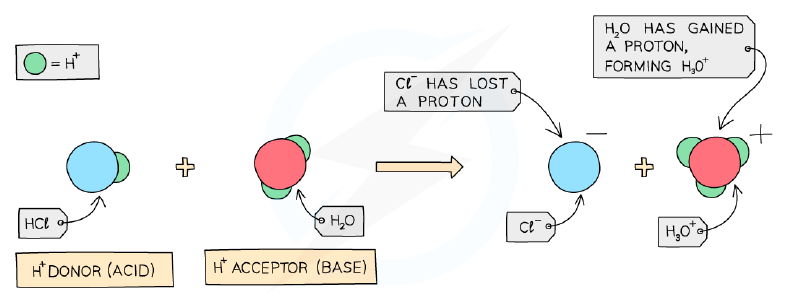
- A Brønsted–Lowry acid is a species that donates a proton (H⁺).
- A Brønsted–Lowry base is a species that accepts a proton using a lone pair of electrons.
- The theory applies to proton transfer and is not limited to aqueous solutions; it also applies to gas-phase reactions.
- In HCl(g) + H₂O(l) → H₃O⁺(aq) + Cl⁻(aq), HCl acts as the acid and water acts as the base.
- The formation of ions in this way is called dissociation or ionisation.
- A hydrogen ion (H⁺) is simply a proton because a hydrogen atom that loses its electron leaves only a proton.
Proton transfer between an acid and a base
Conjugate Acids & Bases
- A conjugate acid–base pair consists of two species that differ by one H⁺ ion.
- In CH₃COOH(aq) + H₂O(l) ⇌ CH₃COO⁻(aq) + H₃O⁺(aq), CH₃COOH and CH₃COO⁻ form one conjugate pair, and H₂O and H₃O⁺ form the other.
- The acid and its conjugate base are related by the loss of a proton; the base and its conjugate acid are related by the gain of a proton.
- Strong acids produce weak conjugate bases; weak acids produce strong conjugate bases.
- The chloride ion, Cl⁻, is the conjugate base of HCl and is a very weak base because the reverse reaction is virtually non-existent.
- The hydroxide ion, OH⁻, is a strong base; its conjugate acid is water, which is a weak conjugate acid.
Amphiprotic Species
- An amphiprotic species can act as both a proton donor and a proton acceptor.
- Water is amphiprotic: it donates a proton to ammonia (acting as an acid) and accepts a proton from hydrochloric acid (acting as a base).
- An amphoteric substance can react as both an acid and a base, but it does not necessarily transfer protons.
- All amphiprotic substances are amphoteric, but not all amphoteric substances are amphiprotic.
- Aluminium oxide, Al₂O₃, is amphoteric because it reacts with both HCl and NaOH, but it is not amphiprotic.
- The anion C₃H₃O₄⁻ can be classified as amphiprotic because it can both donate and accept a proton.
The pH Scale
- pH is defined as pH = –log[H⁺], where [H⁺] is the concentration of hydrogen ions in mol dm⁻³.
- The hydrogen ion concentration can be found from pH using [H⁺] = 10^(–pH).
- The pH scale is logarithmic with base 10, so a change of one pH unit corresponds to a tenfold change in [H⁺].
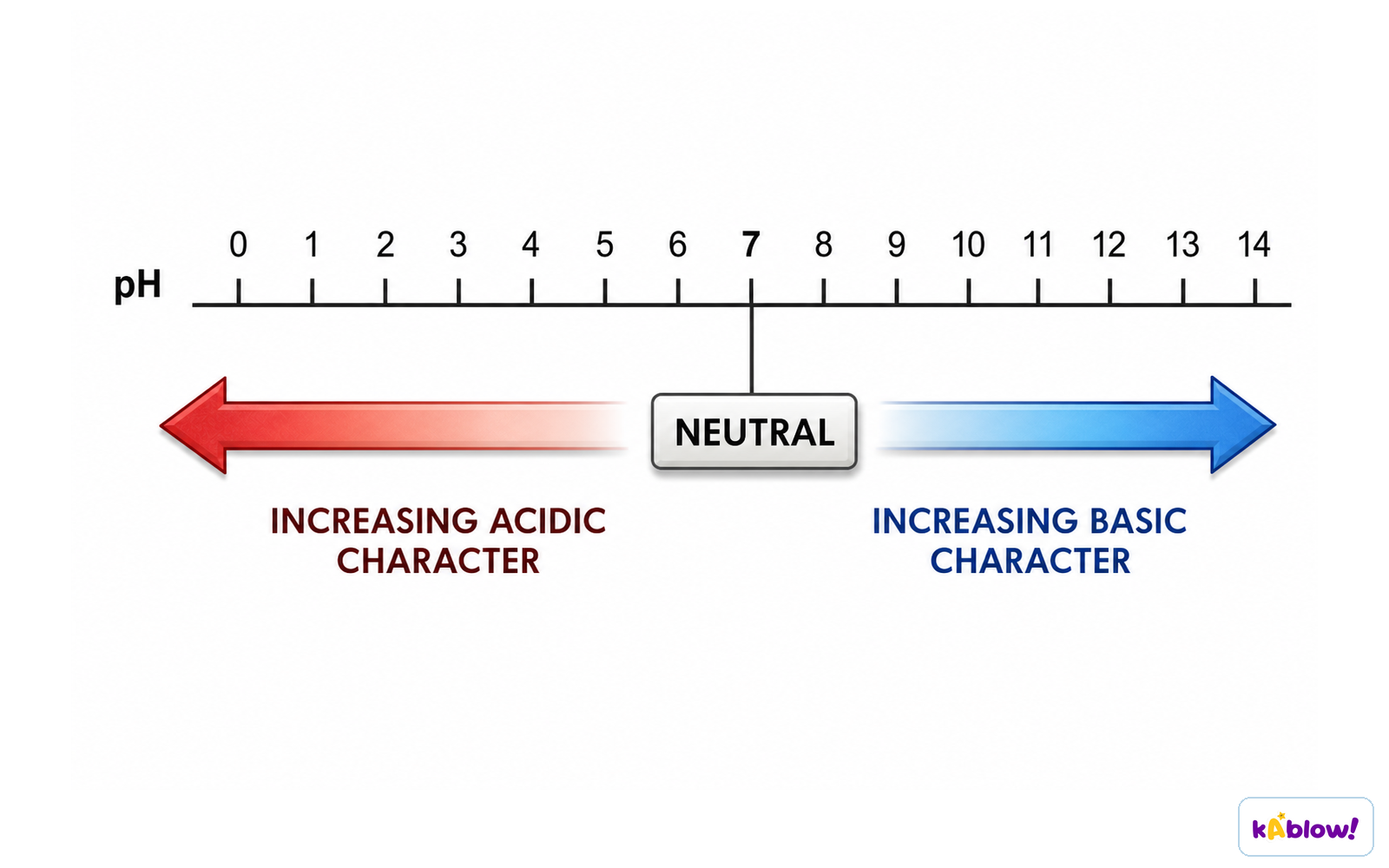
- Acidic solutions have pH below 7; basic solutions have pH above 7; pure water at 298 K has pH 7.
- The higher the [H⁺], the lower the pH; the higher the [OH⁻], the higher the pH.
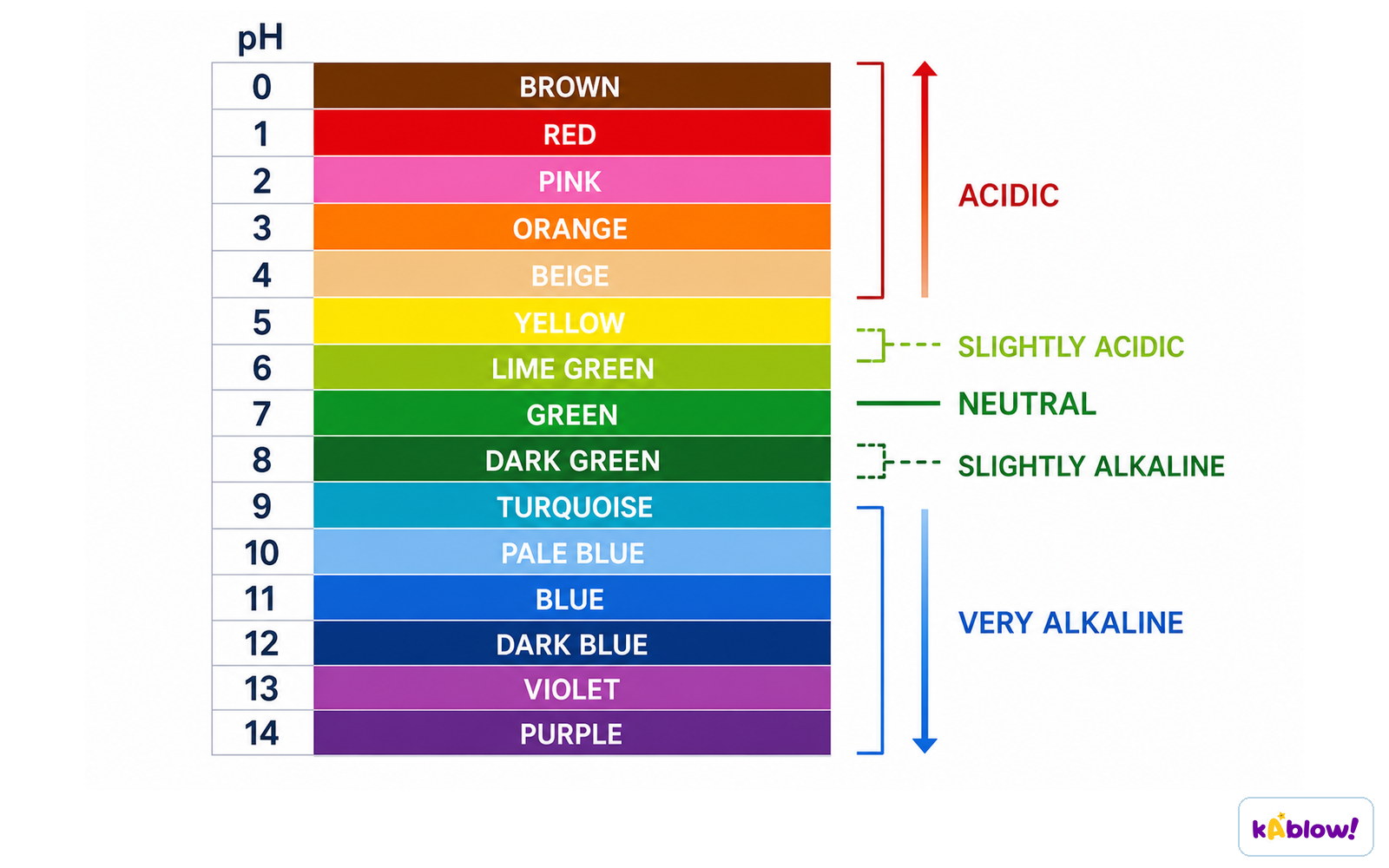
- A pH meter gives the most accurate pH reading; universal indicator paper is less accurate and is compared to a colour chart.
The pH scale
The Ion Product of Water
- Water dissociates slightly: H₂O(l) ⇌ H⁺(aq) + OH⁻(aq).
- The ion product of water is Kw = [H⁺][OH⁻] = 1.00 × 10⁻¹⁴ at 298 K.
- The product [H⁺][OH⁻] is always 1.00 × 10⁻¹⁴ at 298 K, so if one concentration increases, the other must decrease.
- In neutral water at 298 K, [H⁺] = [OH⁻] = 1 × 10⁻⁷ mol dm⁻³, giving pH 7.
- The ionisation of water is endothermic; increasing temperature shifts the equilibrium to the right, increasing Kw and decreasing the pH of pure water.
- Even when the pH of pure water is below 7 at higher temperatures, it is still neutral because [H⁺] = [OH⁻].
Strong & Weak Acids
- A strong acid dissociates almost completely in aqueous solution; the equilibrium lies far to the right and the reaction can be shown as irreversible.
- Examples of strong acids include HCl, HNO₃ and H₂SO₄ (first ionisation).
- A weak acid dissociates only partially in aqueous solution; an equilibrium is established and the equilibrium lies to the left.
- Examples of weak acids include organic acids such as ethanoic acid, HCN, H₂S and H₂CO₃.
- For a strong acid, pH can be calculated directly from the acid concentration; for a weak acid, Ka is needed to find [H⁺].
- Acid strength down Group 17 increases as HF < HCl < HBr < HI because the H–X bond becomes longer and weaker, making H⁺ easier to release.
- Strong and weak acids can be distinguished by pH, electrical conductivity and reactivity with metals.
Neutralisation Reactions
- A neutralisation reaction occurs when an acid and a base react to form water and a salt: acid + base → salt + water.
- The essential reaction is H⁺(aq) + OH⁻(aq) → H₂O(l); spectator ions form the salt.
- The salt produced depends on the acid used: hydrochloric acid forms chlorides, nitric acid forms nitrates, sulfuric acid forms sulfates, ethanoic acid forms ethanoates.
- Acid + metal → salt + hydrogen; acid + metal oxide → salt + water; acid + metal hydroxide → salt + water.
- Acid + metal carbonate → salt + water + carbon dioxide; acid + metal hydrogencarbonate → salt + water + carbon dioxide.
- The enthalpy of neutralisation for a strong acid and strong base is approximately –57 kJ mol⁻¹ because the reaction is essentially the same in each case.
Universal indicator across the pH scale
pH Curves
- A pH curve shows how the pH of a solution changes as acid or base is gradually added during a titration.
- All pH curves have an S-shape; the midpoint of the vertical section is the equivalence point.
- From a pH curve you can identify the initial pH, the pH at the equivalence point, the volume of base added at the equivalence point, and the pH range of the sharp change.
- For a strong acid–strong base titration, the pH at the equivalence point is 7.0.
- During a strong acid–strong base titration, pH changes slowly at first, then sharply near the equivalence point, then slowly again.
- Calculating pH during a titration involves determining the moles of excess H⁺ or OH⁻ and dividing by the total volume.
Diapos
Sign up free to view the lesson slides
Step through every slide for this topic — plus flashcards and revision notes — with a free account.
Questions d'entraînement
Aperçu gratuit — 8 sur 62 questions. Inscris-toi pour toutes les voir.
1.Which statement defines a Brønsted–Lowry acid?
Easy- AA species that donates a proton (H⁺)
- BA species that accepts a proton (H⁺)
- CA species that releases hydroxide ions (OH⁻) in water
- DA species that accepts a lone pair of electrons
2.In the reaction HSO₄⁻(aq) + H₂O(l) ⇌ H₂SO₄(aq) + OH⁻(aq), which species acts as a Brønsted–Lowry base?
Easy- AHSO₄⁻
- BH₂O
- CH₂SO₄
- DOH⁻
3.In the reaction CO₃²⁻(aq) + H⁺(aq) ⇌ HCO₃⁻(aq), which species acts as a Brønsted–Lowry acid?
Easy- ACO₃²⁻
- BH⁺
- CHCO₃⁻
- DNone of these
4.Which statement correctly describes the difference between an amphiprotic and an amphoteric species?
Medium- AAll amphoteric species are amphiprotic
- BAmphiprotic species can donate and accept protons, while amphoteric species can act as both an acid and a base but not necessarily by proton transfer
- CAmphoteric species can donate and accept protons, while amphiprotic species can act as both an acid and a base but not necessarily by proton transfer
- DThere is no difference; the terms are interchangeable
5.Which of the following is the conjugate base of the hydroxide ion, OH⁻?
Medium- AO²⁻
- BH₂O
- CH₃O⁺
- DOH⁻
6.In the equilibrium CH₃COOH(aq) + H₂O(l) ⇌ CH₃COO⁻(aq) + H₃O⁺(aq), which pair is a conjugate acid–base pair?
Medium- ACH₃COOH and H₂O
- BH₂O and H₃O⁺
- CH₂O and CH₃COO⁻
- DCH₃COO⁻ and H₃O⁺
7.Which species in the following reaction is acting as a Brønsted–Lowry base? H₂PO₄⁻(aq) + H₂O(l) → HPO₄²⁻(aq) + H₃O⁺(aq)
Medium- AH₂PO₄⁻
- BH₂O
- CHPO₄²⁻
- DH₃O⁺
8.Which of the following is a strong acid?
Medium- ACH₃COOH
- BHCN
- CHNO₃
- DH₂CO₃
Unlock all 62 questions & more
Crée un compte gratuit pour voir toutes les questions, les diapos, les cartes mémo et les notes de révision de ce thème.