Gas Laws
Apprends en jouant
Réponds à ces questions pour gagner de l'énergie, puis pêche et explore. Sans compte.
Notes de leçon
Gas Pressure
- Pressure is defined as the force applied per unit area: P = \frac{F}{A}.
- The SI unit of pressure is the pascal (Pa), where 1 Pa = 1 N m⁻².
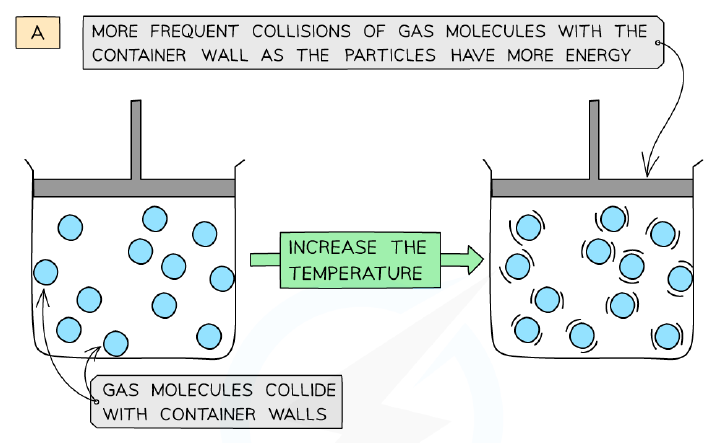
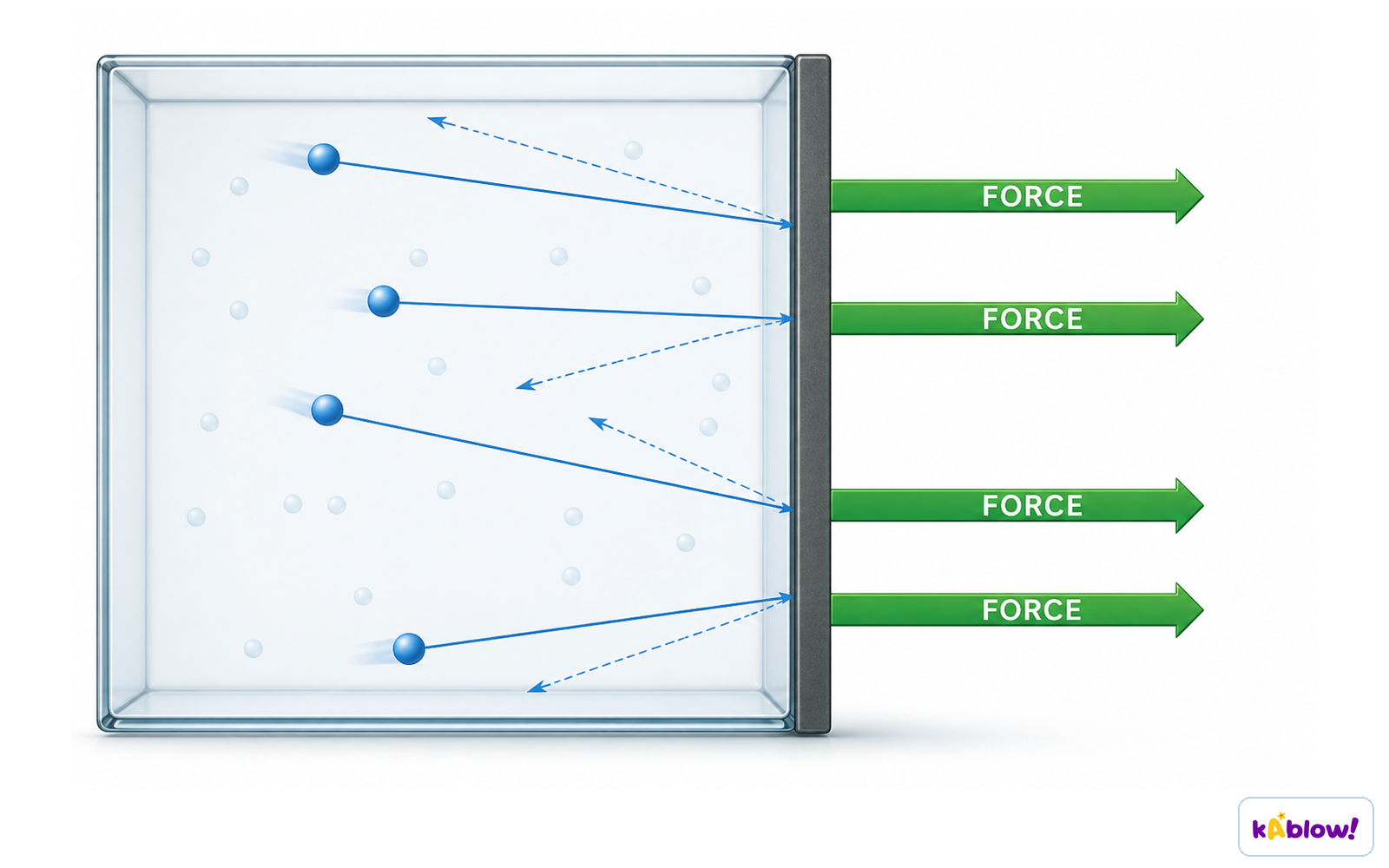
- Gas pressure arises from the collisions of gas molecules with the walls of their container.
- The force exerted by a gas on a surface acts perpendicular (at right angles) to that surface.
- For a given force, a smaller area produces a larger pressure (e.g., a drawing pin or high heels).
- When using P = \frac{F}{A}, ensure A is the cross-sectional area perpendicular to the force.
Diagram showing how increasing the temperature of a gas at constant volume leads to more frequent and energetic collisions with the container walls, thus increasing pressure.
Amount of Substance
- The mole is the SI base unit for the amount of substance.
- One mole is the amount of substance that contains as many elementary entities as there are atoms in 12 g of carbon-12.
- This number is the Avogadro constant, NA = 6.02 \times 1023 mol⁻¹ (rounded to 3 s.f.).
- The number of moles is given by n = \frac{N}{NA}, where N is the number of particles.
- The molar mass mr is the mass of one mole of a substance, in g mol⁻¹: mr = \frac{m}{n}.
- For an element, the molar mass in grams is numerically equal to its relative atomic mass.
- For a compound, add the relative atomic masses of all atoms in the formula to find the molar mass.
Gas Laws
- An ideal gas obeys the relation PV \propto T, or equivalently \frac{PV}{T} = \text{constant}.
- Boyle's law (constant temperature): P \propto \frac{1}{V}, so P1V1 = P2V2.
- Charles's law (constant pressure): V \propto T, so \frac{V1}{T1} = \frac{V2}{T2}.
- Gay-Lussac's (pressure) law (constant volume): P \propto T, so \frac{P1}{T1} = \frac{P2}{T2}.
- For all gas law experiments, the mass and number of molecules of the gas are assumed constant.
- On a P-V diagram: a horizontal line is constant pressure, a vertical line is constant volume, and a curve along an isotherm is constant temperature.
- Always convert temperature to kelvin before using any gas law equation: T(\text{K}) = \θ(\text{°C}) + 273.
Gas particles and pressure
Ideal Gas Equation
- The ideal gas equation combines the empirical gas laws: PV = nRT.
- R is the molar gas constant, R = 8.31\ \text{J K}-1\text{mol}-1.
- An alternative form using the number of molecules is PV = NkBT.
- The Boltzmann constant is kB = 1.38 \times 10-23\ \text{J K}-1, defined as kB = \frac{R}{NA}.
- R relates to macroscopic quantities (volume, temperature), while kB relates to the thermal energy of microscopic particles.
- In PV = nRT, P is in Pa, V in m³, n in mol, and T in K.
Kinetic Theory of Gases
- The kinetic theory models a gas as many identical molecules in continuous random motion at high speeds.
- Assumptions include: molecular volume is negligible, collisions are elastic, and there are no intermolecular forces except during collisions.
- Other assumptions: molecules obey Newton's laws, collision time is negligible, and external forces (e.g. gravity) are ignored.
- Gas pressure is the average force per unit area from molecules colliding with the container walls.
- A real gas approximates an ideal gas at low pressure, low density, and high temperature (well above its boiling point).
- At high pressure or low temperature, real gases deviate from ideal behaviour because intermolecular forces and molecular volume become significant.
Derivation of the Kinetic Theory Equation
- For one molecule in a cube of side l, the change in momentum per collision with a wall is \Delta p = -2mv.
- The time between collisions with the same wall is \frac{2l}{v}, giving a force on the wall of F = \frac{mv2}{l}.
- The pressure from one molecule is P = \frac{mv2}{l3}; for N molecules, P = \frac{Nmv2}{l3}.
- In three dimensions, vx2 = \frac{1}{3}v2, leading to P = \frac{Nmv2}{3V}.
- Using density \rho = \frac{Nm}{V}, the equation becomes P = \frac{1}{3}\rho \overline{v2}.
- This is the kinetic theory of gases equation, where \overline{v2} is the mean square speed.
Average Kinetic Energy of a Molecule
- For an ideal monatomic gas, internal energy is entirely kinetic (no potential energy).
- The average kinetic energy of one molecule is Ek = \frac{1}{2}m\overline{v2} = \frac{3}{2}kBT.
- A higher temperature means a greater average kinetic energy of the molecules.
- The total internal energy of a monatomic gas is U = \frac{3}{2}NkBT or U = \frac{3}{2}nRT.
- For a fixed volume, supplying heat increases internal energy and therefore temperature: U \propto T.
- These equations apply only to monatomic gases (e.g. helium, neon, argon); diatomic molecules also have rotational energy.
Diapos
Sign up free to view the lesson slides
Step through every slide for this topic — plus flashcards and revision notes — with a free account.
Questions d'entraînement
Aperçu gratuit — 8 sur 65 questions. Inscris-toi pour toutes les voir.
1.Which of the following is the correct definition of pressure?
Easy- AThe force applied per unit area
- BThe force applied per unit volume
- CThe energy transferred per unit area
- DThe force applied per unit mass
2.Which of the following is the correct definition of the mole?
Easy- AThe amount of substance that contains as many elementary entities as there are atoms in 12 g of carbon-12
- BThe mass of a substance that contains 6.02 × 10²³ atoms
- CThe volume occupied by one gram of a gas at room temperature and pressure
- DThe number of particles in one gram of any substance
3.An ideal gas is one that obeys the relation pV ∝ T at all pressures, volumes and temperatures.
EasyTrue or false?
4.Which of the following is a correct assumption of the kinetic theory of gases?
Easy- AThe molecules collide elastically with each other and the walls of the container
- BThe molecules exert strong attractive forces on each other at all times
- CThe volume of the molecules is a significant fraction of the container volume
- DThe molecules move in ordered, parallel paths
5.Which of the following are assumptions of the kinetic model of an ideal gas? (Select all that apply)
Medium- AThe molecules are in continuous random motion
- BThere are no intermolecular forces between molecules except during collisions
- CThe molecules have a range of different masses
- DThe volume of the molecules is negligible compared to the volume of the container
- EThe molecules collide inelastically with the walls
6.According to Charles's law, for a fixed mass of gas at constant pressure, the volume is directly proportional to which of the following?
Medium- AThe thermodynamic temperature in kelvin
- BThe temperature in degrees Celsius
- CThe pressure of the gas
- DThe number of moles of gas
7.Gay-Lussac's law (the pressure law) states that for a fixed mass of gas at constant volume, the pressure is directly proportional to the thermodynamic temperature.
EasyTrue or false?
8.Under which of the following conditions does a real gas best approximate an ideal gas?
Medium- ALow pressure, low density, and temperature well above its boiling point
- BHigh pressure, high density, and temperature close to its boiling point
- CLow pressure, high density, and temperature close to its boiling point
- DHigh pressure, low density, and temperature well above its boiling point
Unlock all 65 questions & more
Crée un compte gratuit pour voir toutes les questions, les diapos, les cartes mémo et les notes de révision de ce thème.