Scalars & Vectors
Apprends en jouant
Réponds à ces questions pour gagner de l'énergie, puis pêche et explore. Sans compte.
Notes de leçon
Scalar & Vector Quantities
- A scalar is a quantity that has only a magnitude (size).
- A vector is a quantity that has both a magnitude and a direction.
- Distance is a scalar because it describes how far an object has travelled overall, but not the direction.
- Displacement is a vector because it describes how far an object is from its starting point and in what direction.
- For example, a hiker's displacement is the straight-line distance from start to finish, while the distance walked is the total path length.
Representing Vectors
- Vectors are represented by an arrow.
- The arrowhead indicates the direction of the vector.
- The length of the arrow represents the magnitude of the vector.
- Component vectors are sometimes drawn with a dotted line and a subscript indicating horizontal or vertical (e.g., Fx for horizontal component, Fy for vertical component).
Examiner Tips and Tricks
- To decide if a quantity is a vector or scalar, ask: can it have a minus sign?
- If a negative value is possible (e.g., negative displacement), it is a vector.
- If a negative value is not possible (e.g., negative energy), it is a scalar.
Combining Vectors
- Vectors can be combined by adding or subtracting them to produce the resultant vector.
- The resultant vector is sometimes called the 'net' vector (e.g., net force).
- Triangle method: link vectors head-to-tail; the resultant is formed by connecting the tail of the first vector to the head of the second.
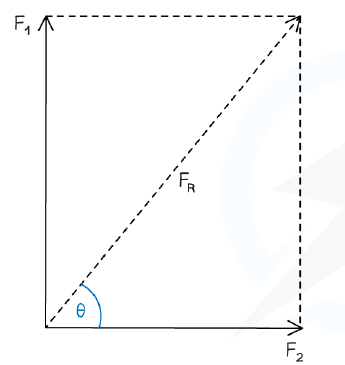
- Parallelogram method: link vectors tail-to-tail; complete the parallelogram; the resultant is the diagonal.
Vector Multiplication
- The product of a scalar and a vector is always a vector.
- For example, mass (scalar) × acceleration (vector) = force (vector): F = m × a.
- Another example: mass (scalar) × velocity (vector) = momentum (vector): p = m × v.
Resolving Vectors
- Resolving a vector is the opposite of adding vectors: a single resultant vector is represented by two vectors that have the same combined effect.
- The magnitude of the resultant vector can be found using Pythagoras' Theorem if the components are perpendicular.
- When a vector is broken down, the parts are called components.
- For a force vector of magnitude F at an angle θ to the horizontal, the horizontal component is Fx = F cos θ and the vertical component is Fy = F sin θ.
- The direction of the resultant vector is found from the angle it makes with the horizontal or vertical, using trigonometry (sine, cosine, or tangent).
Force as a Vector
- Vectors are used in many areas of physics, especially motion, forces, and momentum.
- Forces are often represented by free-body force diagrams.
- Rules for free-body diagrams: draw a point at the centre of mass; draw the body free from contact; draw forces as vectors with length proportional to magnitude; draw the tail from the centre of mass and use the tip to indicate direction.
- On an inclined plane, the weight vector (W = mg) can be split into components parallel and perpendicular to the slope.
- Perpendicular component of weight: W = mg cos θ; parallel component: W = mg sin θ.
- The normal (reaction) force R is perpendicular to the surface; if the object is not moving perpendicular to the slope, R = mg cos θ.
- If there is no friction, the parallel component mg sin θ causes the object to move down the slope.
Vector diagram of two perpendicular forces resolved into a resultant force
Equilibrium
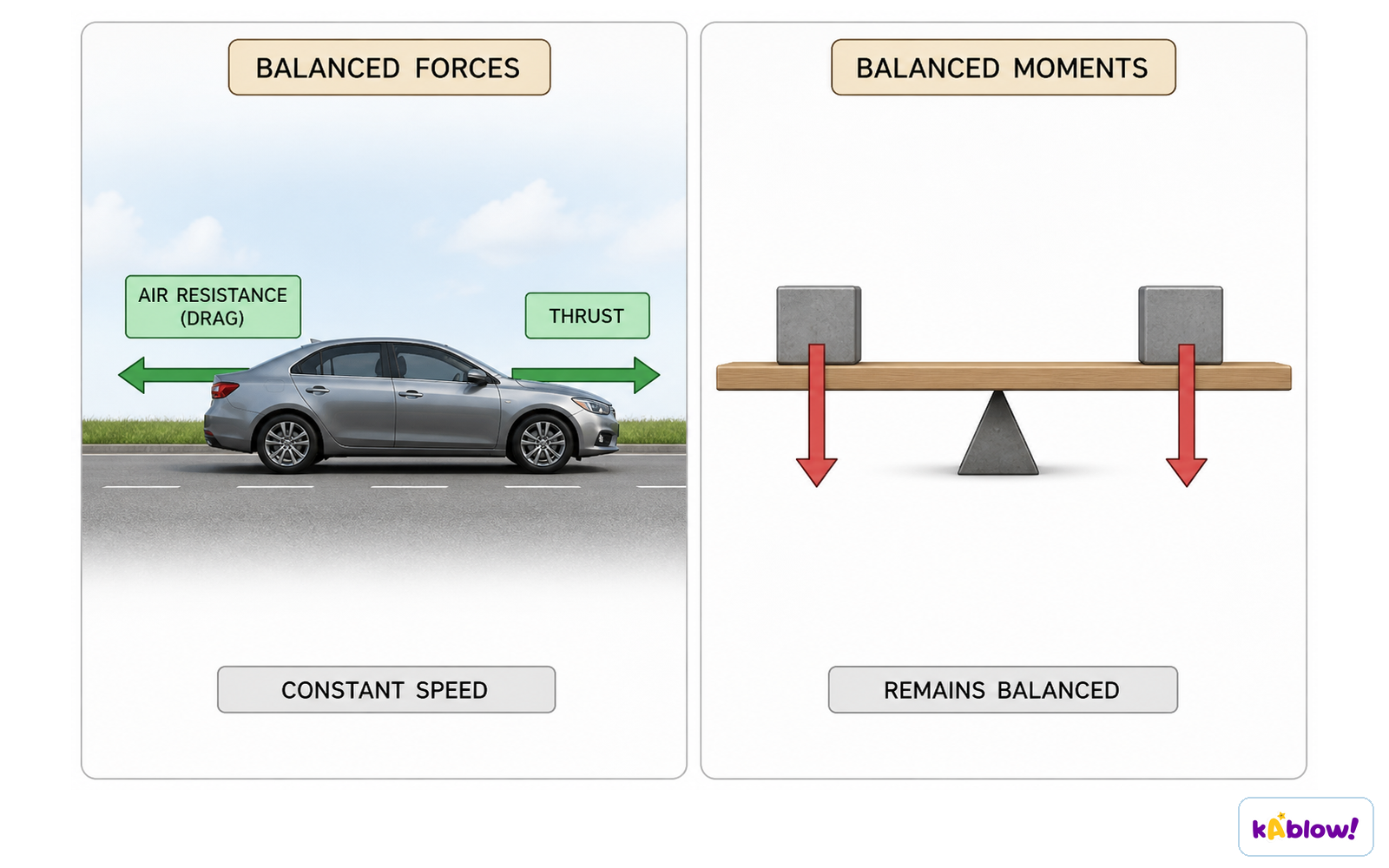
- Forces are in equilibrium if an object is at rest or moving at constant velocity.
- In equilibrium, coplanar forces can be represented by a closed vector triangle.
- The vectors, when joined together, form a closed path.
- Common forces on objects include weight, normal reaction force, tension, and friction.
- When labelling force vectors, use conventional symbols such as w or mg for weight, and N or R for normal reaction force.
Systems in equilibrium
Scale Diagrams
- Vectors can be combined or resolved by calculation (if perpendicular) or by scale drawing (if not perpendicular).
- Scale drawing involves accurately drawing lengths and angles using a sharp pencil, ruler, and protractor.
- Steps for scale drawing: link vectors head-to-tail; draw the resultant using triangle or parallelogram method; measure the length with a ruler; measure the angle with a protractor.
- A scale may be given (e.g., 1 cm = 1 km); convert measured lengths back to real units.
- Scale diagram questions typically involve vector triangles that do not contain a right angle.
Diapos
Sign up free to view the lesson slides
Step through every slide for this topic — plus flashcards and revision notes — with a free account.
Questions d'entraînement
Aperçu gratuit — 8 sur 67 questions. Inscris-toi pour toutes les voir.
1.Which of the following is the correct definition of a vector quantity?
Easy- AA quantity that has both magnitude and direction
- BA quantity that has only magnitude
- CA quantity that has only direction
- DA quantity that has magnitude, direction, and a unit
2.Which of the following is a scalar quantity?
Easy- ADisplacement
- BVelocity
- CDistance
- DForce
3.Displacement is a vector quantity.
EasyTrue or false?
4.A hiker walks a distance of 6 km due east and then 10 km due north. What is the magnitude of the hiker's displacement?
Easy- A4 km
- B8 km
- C11.7 km
- D16 km
5.A hiker walks 6 km due east and then 10 km due north. What is the direction of the hiker's displacement from the horizontal (east direction)?
Easy- A31°
- B45°
- C59°
- D72°
6.A helicopter provides a lift of 250 kN when the blades are tilted at 15° from the vertical. What is the horizontal component of the lift force?
Medium- A64.7 kN
- B242 kN
- C250 kN
- D15 kN
7.Which of the following quantities are vectors? (Select all that apply.)
Medium- ADisplacement
- BDistance
- CVelocity
- DSpeed
- EForce
8.Match each quantity to its correct type (scalar or vector).
Medium- Mass
- Velocity
- Energy
- Force
- Scalar
- Vector
Unlock all 67 questions, flashcards & more
Crée un compte gratuit pour voir toutes les questions, les diapos, les cartes mémo et les notes de révision de ce thème.