The Mole & The Avogadro Constant
Apprends en jouant
Réponds à ces questions pour gagner de l'énergie, puis pêche et explore. Sans compte.
Notes de leçon
The Mole & Avogadro Constant
- The mole (mol) is the SI unit for amount of substance.
- One mole contains 6.02 × 10²³ particles (atoms, molecules, or ions) – the Avogadro constant.
- One mole of sodium (Na) contains 6.02 × 10²³ Na atoms; one mole of H₂ contains 6.02 × 10²³ H₂ molecules.
- Molar mass of an element = relative atomic mass in grams; for a compound = relative formula mass in grams.
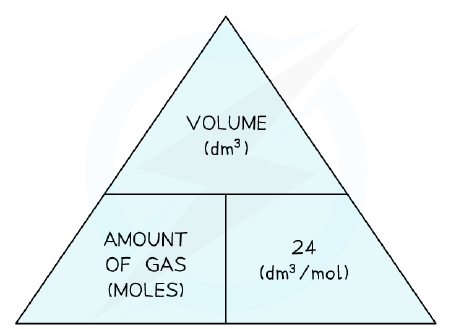
- At RTP (20 °C, 1 atm), one mole of any gas occupies 24 dm³ (or 24 000 cm³) – the molar gas volume.
- Gas volume (dm³) = moles × 24; moles = volume (dm³) ÷ 24.
Molar gas volume formula triangle
Linking Moles, Mass & Mr
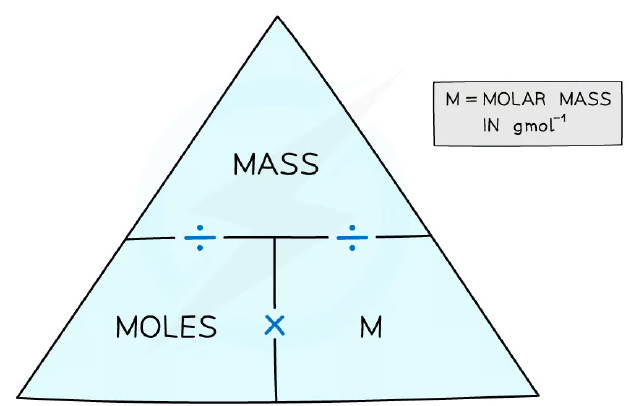
- Moles = mass (g) ÷ Mᵣ (or Aᵣ for elements).
- Mass = moles × Mᵣ.
- Example: 0.250 mol Zn (Aᵣ=65) has mass = 0.250 × 65 = 16.25 g.
- Example: 2.64 g sucrose (Mᵣ=342) gives moles = 2.64 ÷ 342 = 7.72 × 10⁻³ mol.
- Use the formula triangle: cover the quantity you want to find.
Moles, mass and molar mass formula triangle
Reacting Masses & Limiting Reactants
- Use balanced equation to find molar ratio between reactants and products.
- Convert given mass to moles, then use ratio to find moles of required substance, then convert back to mass.
- Limiting reactant is the one used up first; it determines the amount of product.
- To identify limiting reactant: calculate moles of each reactant, compare with the molar ratio from the equation.
- Example: 2Mg + O₂ → 2MgO; 6.0 g Mg (0.25 mol) gives 0.25 mol MgO (mass = 10 g).
Calculating Concentration
- Concentration in g/dm³ = mass of solute (g) ÷ volume (dm³).
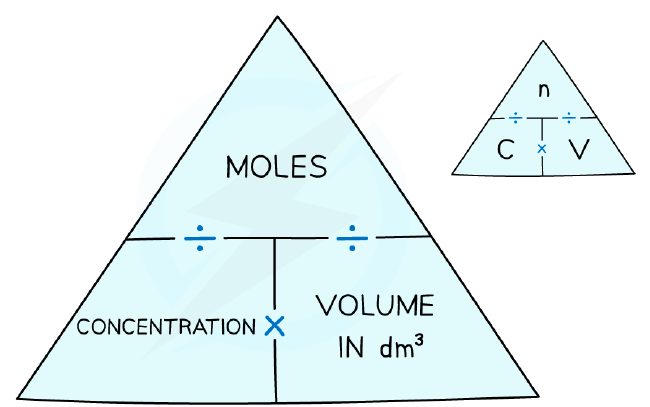
- Concentration in mol/dm³ = moles of solute ÷ volume (dm³).
- To convert g/dm³ to mol/dm³, divide by molar mass; to convert mol/dm³ to g/dm³, multiply by molar mass.
- Always convert cm³ to dm³ by dividing by 1000.
- Example: 10 g NaOH in 2 dm³ gives 5 g/dm³.
Concentration, moles and volume formula triangle
Titration Calculations
- Use the balanced equation to find the mole ratio between acid and base.
- Calculate moles of known solution: moles = concentration × volume (dm³).
- Use ratio to find moles of unknown, then concentration = moles ÷ volume (dm³).
- Example: 25.0 cm³ HCl titrated with 12.1 cm³ 0.100 mol/dm³ NaOH (1:1 ratio) gives [HCl] = 0.0484 mol/dm³.
Concentration, moles and volume formula triangle
Empirical & Molecular Formula
- Empirical formula is the simplest whole‑number ratio of atoms in a compound.
- To find empirical formula: divide each element's mass (or % mass) by its Aᵣ, then divide by the smallest result to get a ratio; multiply to get whole numbers if needed.
- Molecular formula = (empirical formula)ₙ, where n = Mᵣ(compound) ÷ Mᵣ(empirical formula).
- Example: empirical formula CH₂O (Mᵣ=30); if Mᵣ=60, n=2, so molecular formula = C₂H₄O₂.
- Water of crystallisation: use similar method to find x in hydrated salt formula (e.g., CuSO₄·xH₂O).
Percentage Yield & Purity
- Percentage yield = (actual yield ÷ theoretical yield) × 100%.
- Actual yield is the mass obtained; theoretical yield is calculated from the balanced equation.
- Percentage purity = (mass of pure substance ÷ total mass of sample) × 100%.
- Percentage composition by mass = (total mass of element in compound ÷ Mᵣ of compound) × 100%.
- Example: Fe₂O₃ (Mᵣ=160) contains 112 g Fe → %Fe = (112÷160)×100 = 70%.
Diapos
Sign up free to view the lesson slides
Step through every slide for this topic — plus flashcards and revision notes — with a free account.
Questions d'entraînement
Aperçu gratuit — 8 sur 44 questions. Inscris-toi pour toutes les voir.
1.Which row correctly describes the mole and the value of Avogadro's constant?
Easy- Aone mole of a substance is equal to the substance's relative atomic or molecular mass in grams; one mole of a substance contains 6.02 × 10²³ atoms, molecules or formula units
- Bone mole of a substance is equal to the substance's atomic number in grams; one mole of a substance contains 6.02 × 10²³ atoms, molecules or formula units
- Cone mole of a substance is equal to the substance's relative atomic or molecular mass in grams; one mole of a substance contains 12.04 × 10²³ atoms, molecules or formula units
- Done mole of a substance is equal to the substance's atomic number in grams; one mole of a substance contains 12.04 × 10²³ atoms, molecules or formula units
2.What is the mass of one mole of carbon dioxide (CO₂)? (Ar: C = 12, O = 16)
Easy- A28 g
- B44 g
- C32 g
- D12 g
3.How many molecules are there in one mole of hydrogen gas (H₂)?
Easy- A6.02 × 1023 molecules
- B1.204 × 1024 molecules
- C3.01 × 1023 molecules
- D12.04 × 1023 molecules
4.The complete combustion of methane produces carbon dioxide and steam. CH₄(g) + 2O₂(g) → 2H₂O(g) + CO₂(g). Which statements about the reaction are correct? 1. The empirical formula of methane is CH₄ 2. The number of atoms in 1 mole of methane is 4 × Avogadro's constant 3. 1 mole of methane produces 72 dm³ of gaseous products at r.t.p. 4. 1 mole of methane occupies a volume of 12 dm³ at r.t.p.
Medium- A1, 2 and 3
- B1 and 2
- C1 and 3
- D2 and 4
5.Magnesium carbonate and hydrochloric acid react: MgCO₃(s) + 2HCl(aq) → MgCl₂(aq) + H₂O(l) + CO₂(g). What is the volume of CO₂ produced when 21 g of magnesium carbonate (Mr = 84) reacts completely with excess hydrochloric acid? (One mole of gas occupies 24.0 dm³ at r.t.p.)
Medium- A4 dm³
- B8 dm³
- C6 dm³
- D2 dm³
6.Calcium carbonate undergoes thermal decomposition: CaCO₃ → CaO + CO₂. What mass of calcium oxide (Mr = 56) is formed when 60 g of calcium carbonate (Mr = 100) is completely decomposed?
Medium- A28 g
- B18.5 g
- C60 g
- D33.6 g
7.Substance X was analysed and found to contain 40.00% carbon, 6.67% hydrogen and 53.33% oxygen by mass. What is the empirical formula of X?
Medium- AC₄H₈O₄
- BC₆H₁₂O₈
- CC₂H₄O₂
- DCH₂O
8.What is the concentration in mol dm⁻³ of a solution of sodium hydroxide that contains 16 g of NaOH in 200 cm³ of distilled water? (Mr NaOH = 40)
Medium- A2 mol dm⁻³
- B2.5 mol cm⁻³
- C0.2 mol dm⁻³
- D1 mol cm⁻³
Unlock all 44 questions & more
Crée un compte gratuit pour voir toutes les questions, les diapos, les cartes mémo et les notes de révision de ce thème.