Redox
Apprends en jouant
Réponds à ces questions pour gagner de l'énergie, puis pêche et explore. Sans compte.
Notes de leçon
Oxidation & Reduction in Terms of Oxygen
- Oxidation is the addition of oxygen to an element or compound.
- Reduction is the removal of oxygen from an element or compound.
- A redox reaction involves both oxidation and reduction occurring simultaneously.
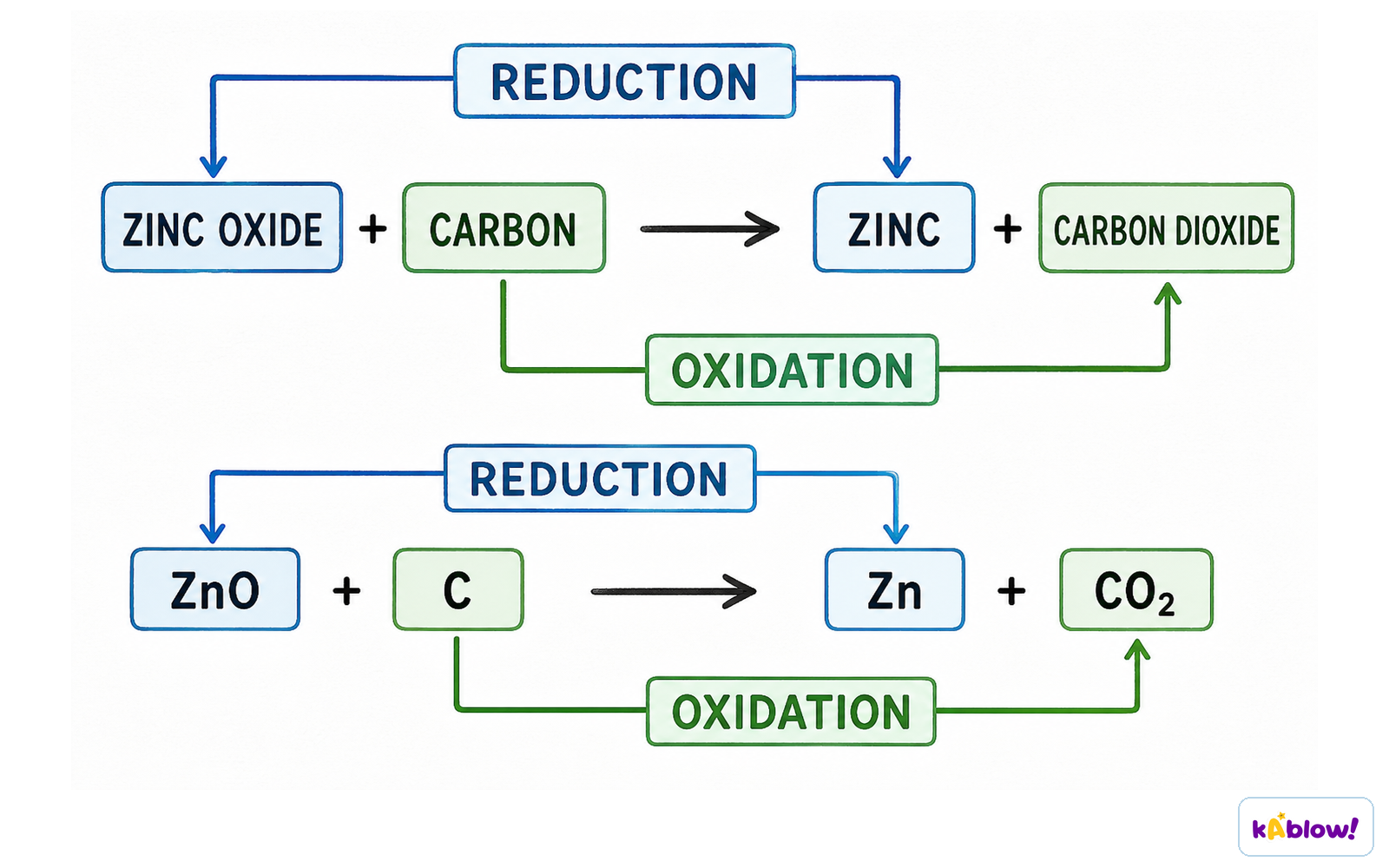
- Example: ZnO + C → Zn + CO – zinc oxide is reduced (loses oxygen), carbon is oxidised (gains oxygen).
Oxidation and reduction shown for zinc oxide + carbon
Oxidation & Reduction in Terms of Electrons (Extended)
- Oxidation is the loss of electrons; the oxidation number increases.
- Reduction is the gain of electrons; the oxidation number decreases.
- Mnemonic: OIL RIG – Oxidation Is Loss, Reduction Is Gain.
- Half-equations show electron transfer, e.g. Ag → Ag⁺ + e⁻ (oxidation) and O₂ + 4e⁻ → 2O²⁻ (reduction).
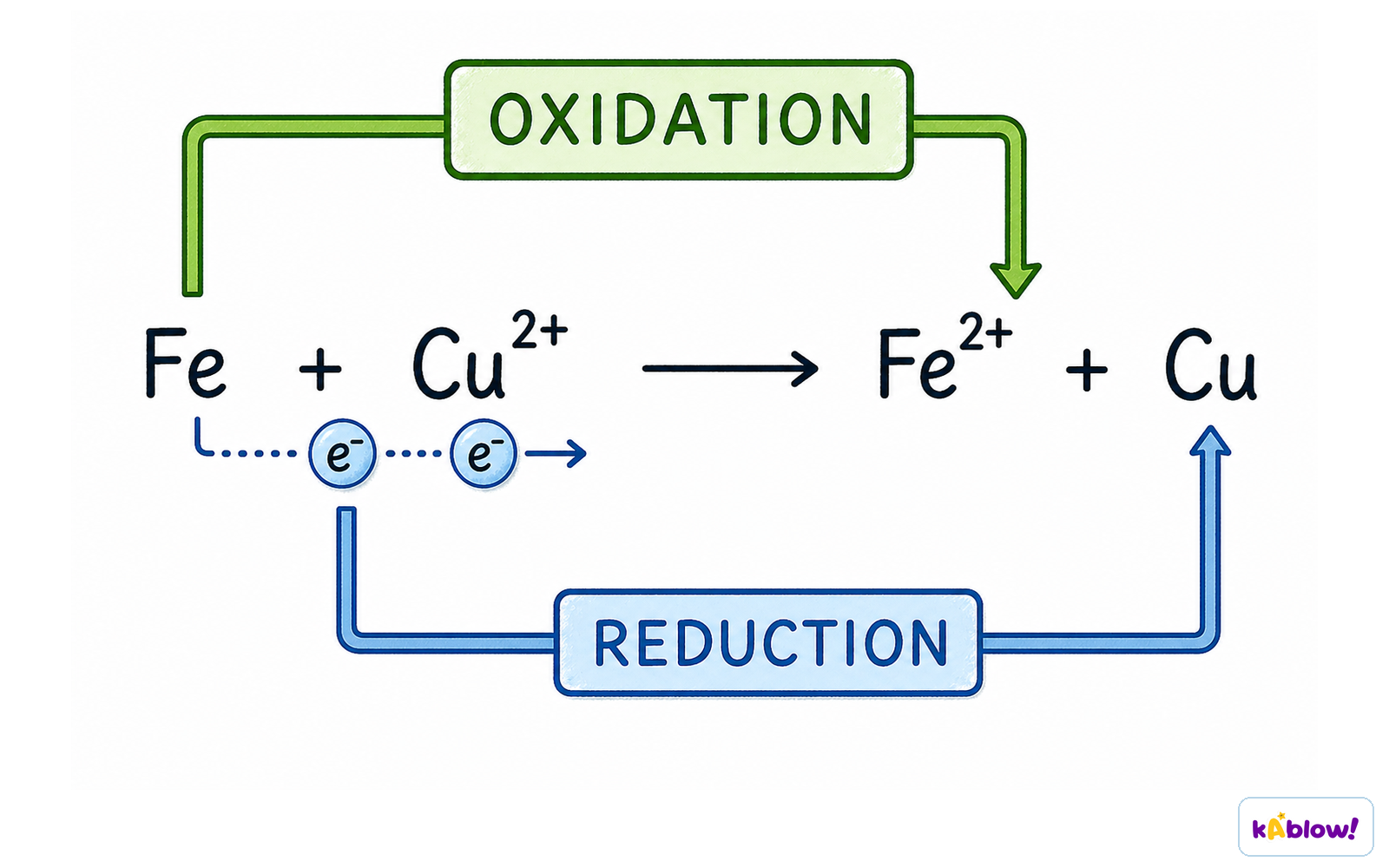
- Example: when iron reacts with copper sulfate, Fe + Cu²⁺ → Fe²⁺ + Cu – iron loses electrons (oxidised), copper(II) ions gain electrons (reduced).
Redox reaction between Fe and Cu²⁺ shown by electron transfer
Oxidation Numbers & Roman Numerals
- Transition metals can form ions with different charges; the charge is shown by a Roman numeral in the name.
- The Roman numeral equals the oxidation number of the metal ion.
- Example: Fe²⁺ is iron(II); Fe³⁺ is iron(III).
- Example: FeO is iron(II) oxide; Fe₂O₃ is iron(III) oxide.
- In CoCl₂, chloride ions are each 1−, so cobalt is 2+ → cobalt(II) chloride.
Bohr model of iron atom showing electron shells
Identifying Redox Reactions
- In a redox reaction, one species is oxidised and another is reduced.
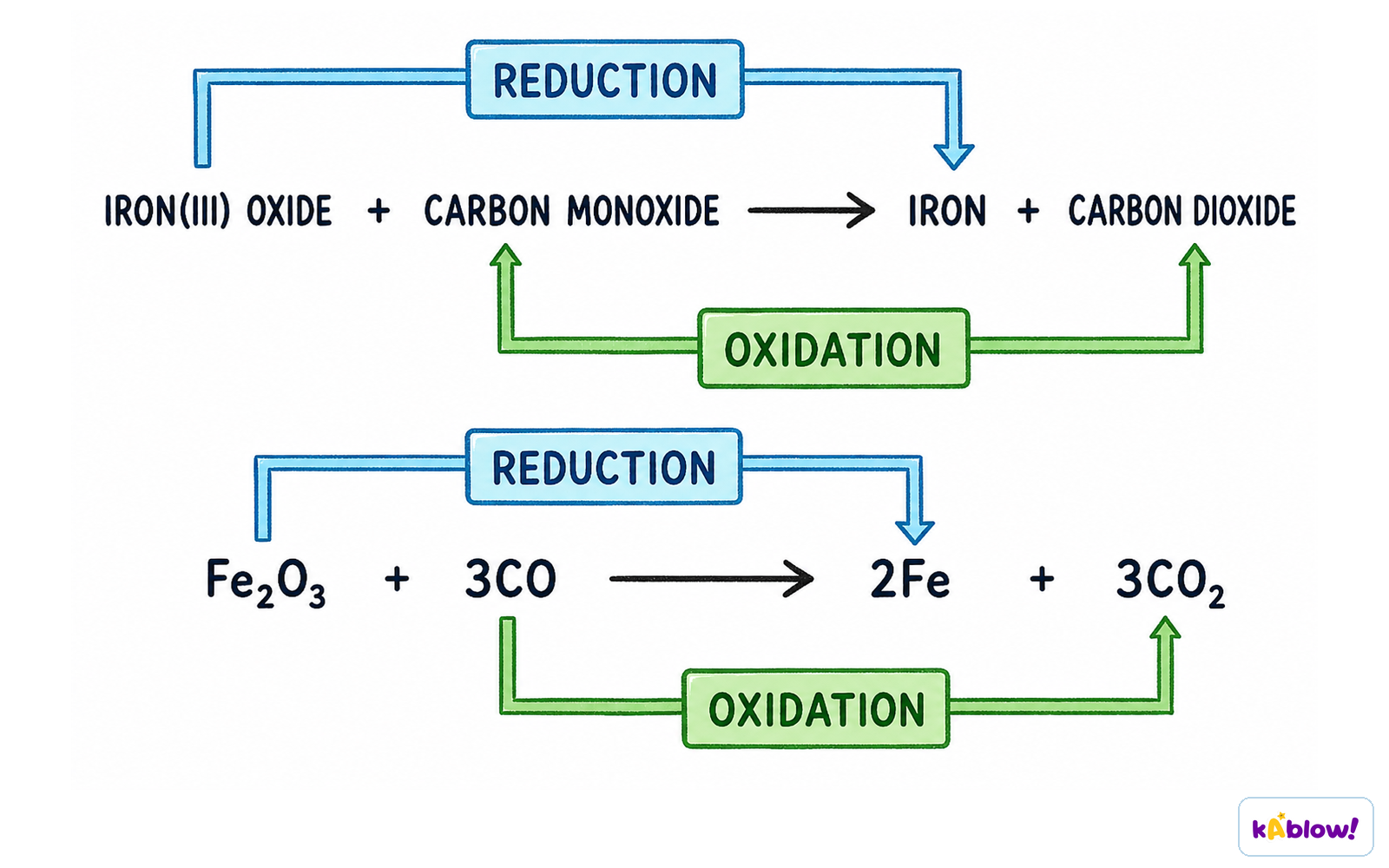
- Example: Fe₂O₃ + 3CO → 2Fe + 3CO₂ – Fe₂O₃ is reduced (loses oxygen), CO is oxidised (gains oxygen).
- In ionic equations, spectator ions are removed to show the redox change.
- Example: Fe + Cu²⁺ → Fe²⁺ + Cu – Fe is oxidised (loses electrons), Cu²⁺ is reduced (gains electrons).
- The reducing agent is the species that is oxidised (it loses electrons); the oxidising agent is the species that is reduced (it gains electrons).
Oxidation and reduction shown for iron(III) oxide + carbon monoxide
Diapos
Sign up free to view the lesson slides
Step through every slide for this topic — plus flashcards and revision notes — with a free account.
Questions d'entraînement
Aperçu gratuit — 8 sur 49 questions. Inscris-toi pour toutes les voir.
1.State the meaning of the mnemonic OIL-RIG in terms of electron transfer.
Easy2.In the reaction between zinc oxide and carbon, which substance is reduced?
Medium- Azinc oxide
- Bcarbon
- Czinc
- Dcarbon dioxide
3.Complete the sentence using the words 'oxidation' or 'reduction'.
EasyIn terms of oxygen, ____ is the gain of oxygen and ____ is the loss of oxygen.
4.What is the oxidation number of the transition metal in silver(I) chloride, AgCl?
Easy5.In the reaction V3+ + Fe3+ → V4+ + Fe2+, which species is oxidised?
Medium6.Which half-equation represents reduction?
Medium- AAg → Ag+ + e-
- BO2 + 4e- → 2O2-
- CFe → Fe2+ + 2e-
- DCu → Cu2+ + 2e-
7.Match each term with its correct definition in terms of oxygen.
Easy- Oxidation
- Reduction
- Gain of oxygen
- Loss of oxygen
8.Arrange the following steps in the correct order to show the process of identifying oxidation in the reaction V3+ + Fe3+ → V4+ + Fe2+.
Medium- Identify changes for each species
- Determine oxidation or reduction
- Identify species that loses electrons
- Write the overall equation
Unlock all 49 questions, flashcards & more
Crée un compte gratuit pour voir toutes les questions, les diapos, les cartes mémo et les notes de révision de ce thème.