Separation And Purification
Apprends en jouant
Réponds à ces questions pour gagner de l'énergie, puis pêche et explore. Sans compte.
Notes de leçon
Paper Chromatography
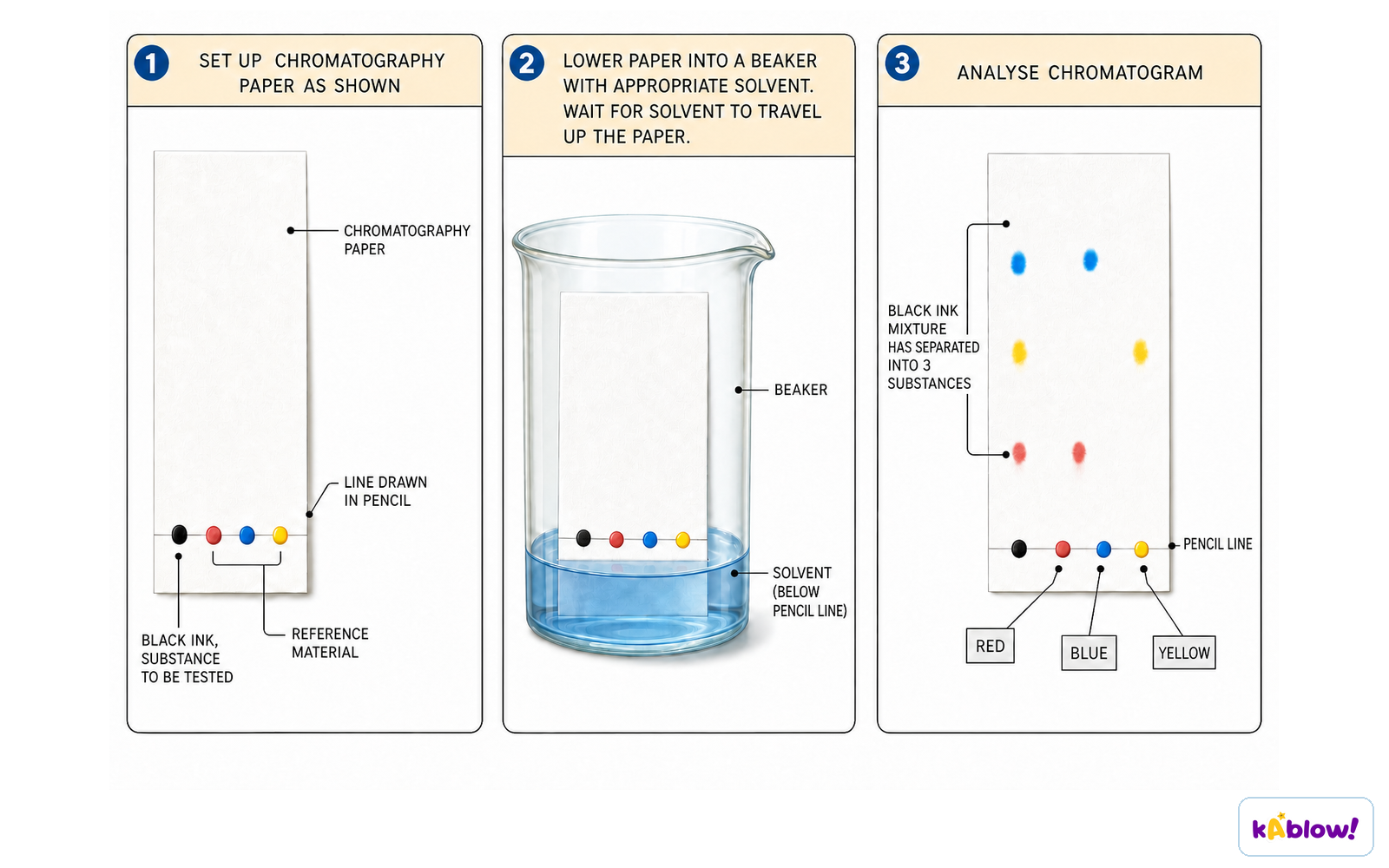
- Chromatography separates mixtures of soluble coloured substances based on differences in solubility in a solvent.
- A pencil line is drawn on chromatography paper; spots of sample are placed on it. Pencil is used because ink would run.
- The paper is lowered into solvent so the pencil line is above the solvent level to prevent samples washing off.
- Solvent travels up by capillary action, carrying substances at different rates depending on solubility.
- More soluble substances travel further up the paper.
- A chromatogram shows separated spots; pure substances give one spot, mixtures give multiple spots.
- Substances are identified by comparing spot positions with known reference samples.
Setting up and running paper chromatography
Retention Factor (Rf) Values (Extended Tier Only)
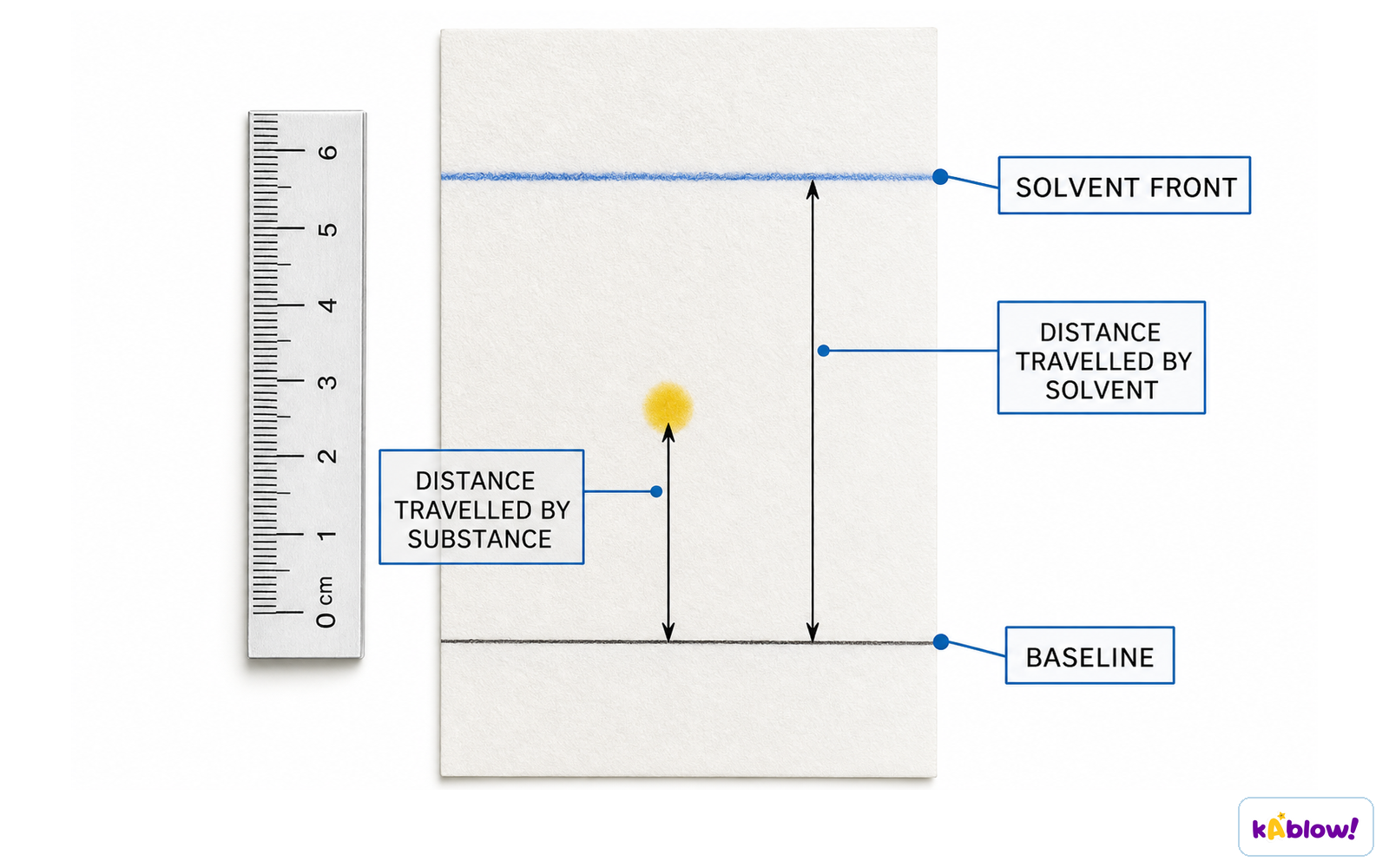
- Rf value = distance moved by substance ÷ distance moved by solvent.
- Rf is a ratio with no units and is always less than 1.
- Rf values are constant for a given compound under the same solvent conditions.
- Rf values help identify unknown substances by comparison with known values.
Measuring distances on a chromatogram
Filtration
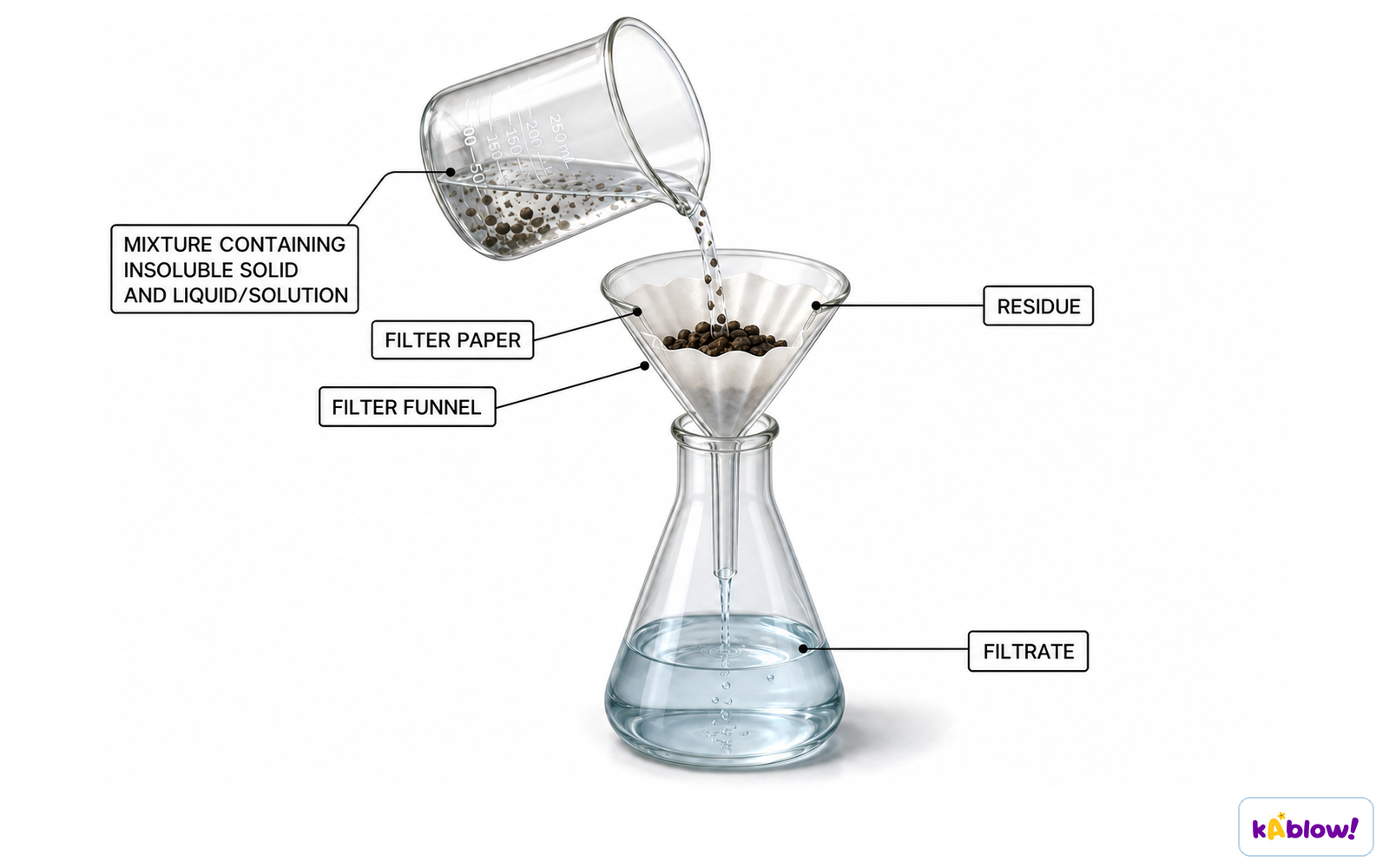
- Separates an insoluble solid from a liquid (e.g., sand from sand–water mixture).
- Mixture is poured through filter paper in a funnel; liquid passes as filtrate, solid remains as residue.
- Relies on difference in particle size – solid particles are too large to pass through filter paper.
Filtration apparatus
Crystallisation
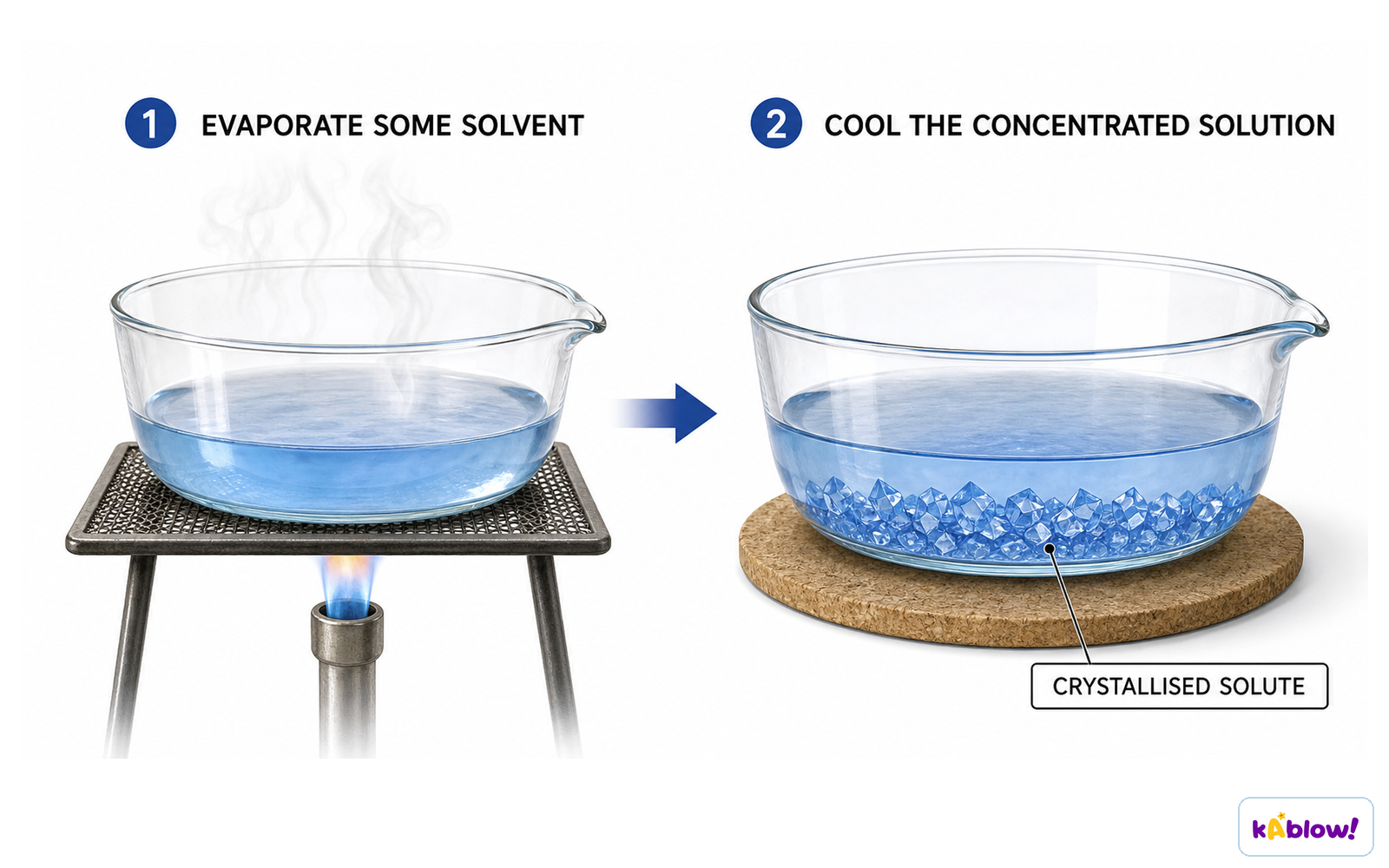
- Separates a dissolved solid from a solution by evaporating the solvent.
- Solution is heated to evaporate solvent until saturated (test with a cold glass rod – crystals form on it).
- Saturated solution is cooled slowly; crystals form as solubility decreases.
- Crystals are collected by filtration, washed with distilled water, and dried (e.g., between filter paper or in a drying oven).
Crystallisation by evaporation and cooling
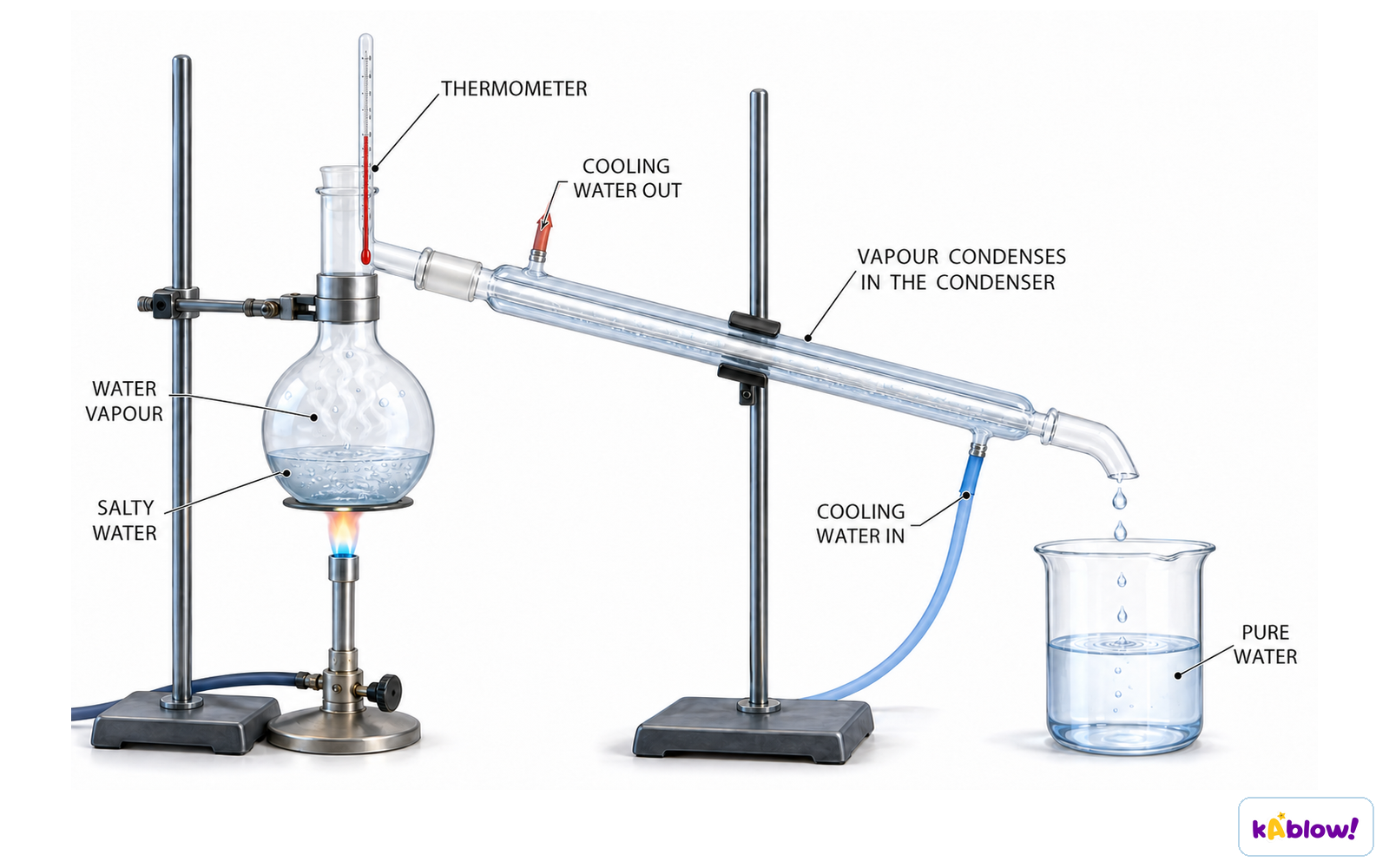
Simple Distillation
- Separates a liquid from a solution (e.g., water from saltwater) or a pure liquid from a mixture of liquids.
- Solution is heated; liquid with lower boiling point evaporates, passes through a condenser where it cools and condenses.
- The condensed liquid (distillate) is collected; the solid solute remains in the flask.
Simple distillation apparatus
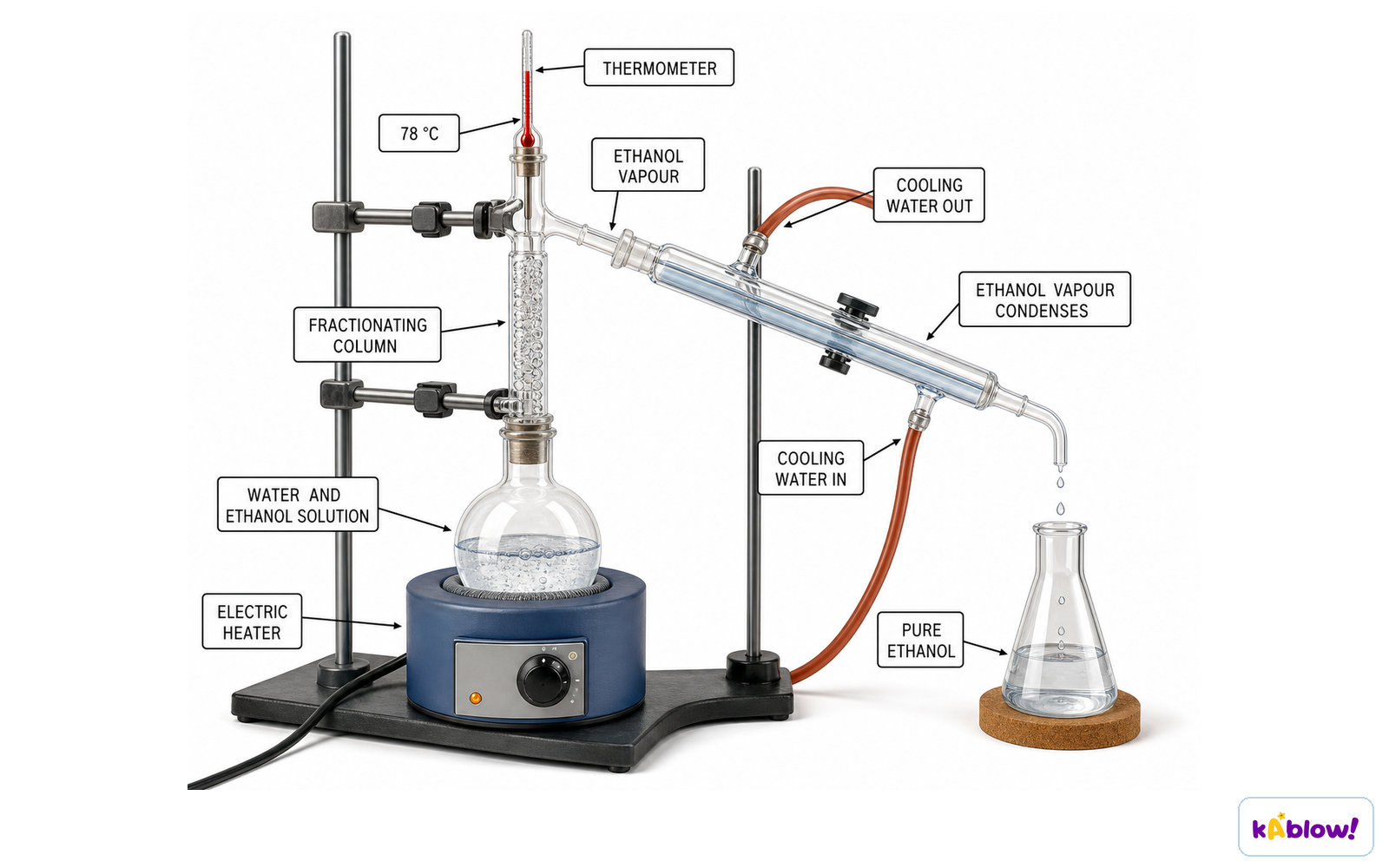
Fractional Distillation
- Separates two or more miscible liquids with different boiling points (e.g., ethanol and water).
- Mixture is heated to the boiling point of the substance with the lowest boiling point; it evaporates first.
- Vapours pass through a condenser and are collected; the other component(s) remain.
- For ethanol/water: ethanol boils at 78°C, water at 100°C; heating stops when temperature rises above 78°C.
Fractional distillation apparatus
Assessing Purity
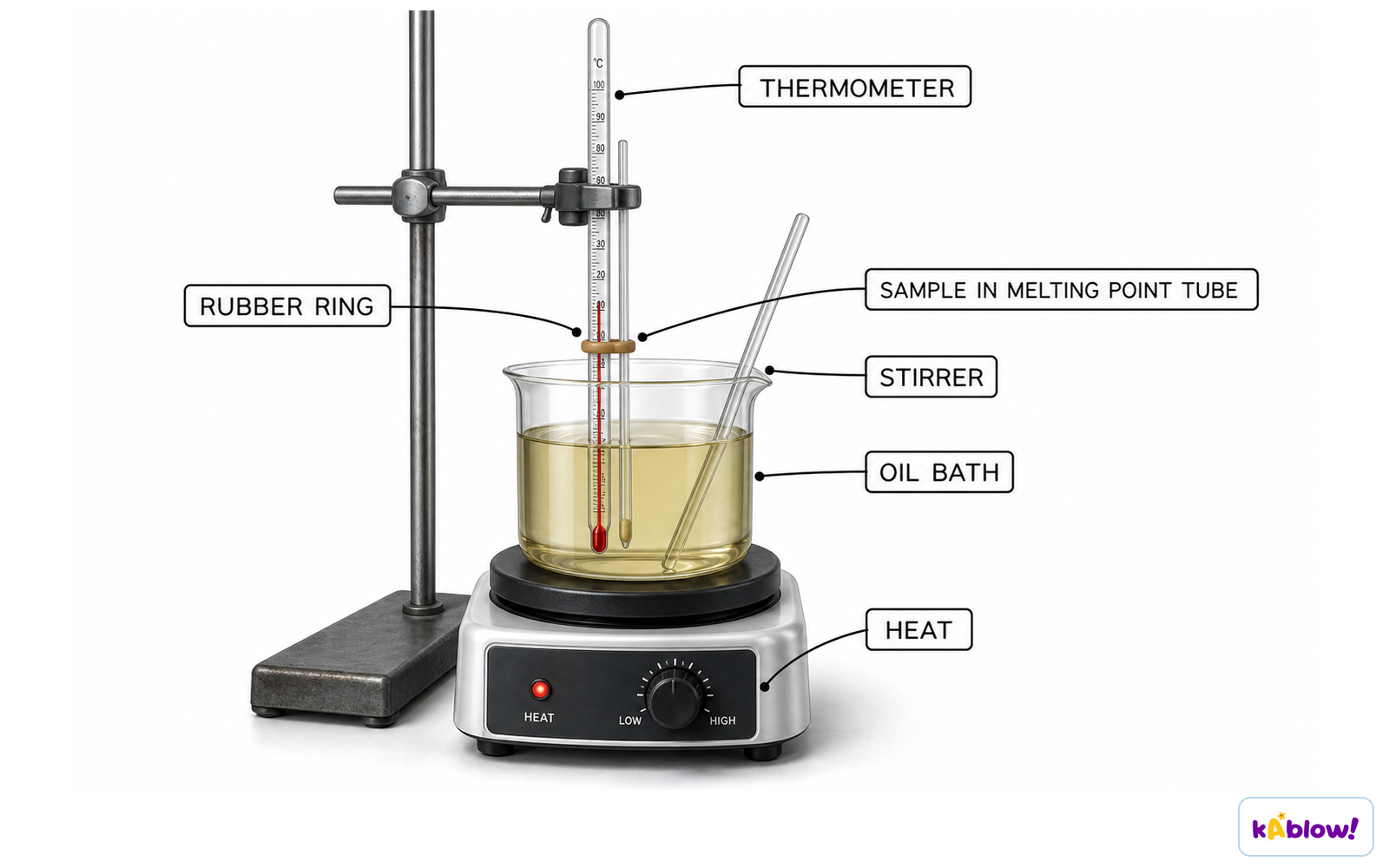
- Pure substances melt and boil at sharp, specific temperatures (e.g., water: 0°C melting, 100°C boiling).
- Mixtures have a range of melting and boiling points.
- Melting/boiling point data can identify a pure substance by comparison with literature values.
- Impurities lower the melting point and may raise the boiling point of a sample.
Melting point apparatus
Diapos
Sign up free to view the lesson slides
Step through every slide for this topic — plus flashcards and revision notes — with a free account.
Questions d'entraînement
Aperçu gratuit — 8 sur 54 questions. Inscris-toi pour toutes les voir.
1.In paper chromatography, where should the sample spots be placed?
Easy- AOn the pencil line
- BBelow the pencil line in the solvent
- CExactly 1 cm above the pencil line
- DExactly 1 cm below the pencil line
2.In the diagram of simple distillation, cooling water is fed into the condenser at the end nearest the collecting beaker and flows out at the end nearest the flask. Why is the condenser used this way round (counter-current), rather than the water flowing the same direction as the vapour?
Easy- AIt keeps the water flowing in the opposite direction to the vapour, so the condenser stays effectively cool along its whole length and condenses the vapour more efficiently
- BIt allows the water to boil before it reaches the flask
- CIt stops the vapour condensing until it reaches the beaker
- DIt has no effect on cooling; the direction of water flow does not matter
3.Rocksalt contains sodium chloride and sand. What is the correct order of physical changes and separation techniques to separate sodium chloride and sand?
Medium- AMelting, filtering, crystallising
- BMelting, filtering
- CDissolving, filtering, crystallising
- DDissolving, crystallising
4.A substance was analysed and found to have a boiling point of 450 °C. At room temperature it is a soft grey solid. Which temperature could be the melting point of a pure sample of the substance?
Medium- A-12 °C
- B56 °C to 72 °C
- C250 °C to 275 °C
- D142 °C
5.Solid P melts at exactly 60 °C and boils at exactly 310 °C. Solid Q dissolves in ethanol and shows a green colour and a yellow colour when analysed using paper chromatography. Which row is correct?
Medium- AP contains only one substance, Q contains more than one substance
- BP contains more than one substance, Q contains only one substance
- CBoth P and Q contain only one substance
- DBoth P and Q contain more than one substance
6.Pure water boils at 100 °C and freezes at 0 °C. What is the melting point and boiling point of water after the addition of potassium chloride?
Medium- ABoiling point 103 °C, freezing point -3 °C
- BBoiling point 103 °C, freezing point 3 °C
- CBoiling point 97 °C, freezing point -3 °C
- DBoiling point 97 °C, freezing point no change
7.A student wants to filter a mixture quickly. Which way of folding the filter paper increases the rate of filtration compared with folding it into a simple cone?
Medium- AFluted (concertina) folding, because it increases the surface area of filter paper in contact with the mixture
- BFolding it into a smaller cone, because less paper is in contact with the mixture
- CNot folding the paper at all, because flat paper filters fastest
- DFolding it into a tight cylinder, because it holds more liquid
8.A student separated a reaction mixture into two immiscible liquid layers using a separating funnel, then ran off the bottom layer. What did the mixture most likely contain?
Medium- AAqueous sodium chloride and unreacted solid catalyst
- BWater and ethanol
- CWater and oil
- DAqueous sodium chloride and oil
Unlock all 54 questions, flashcards & more
Crée un compte gratuit pour voir toutes les questions, les diapos, les cartes mémo et les notes de révision de ce thème.