Compound Measures
Apprends en jouant
Réponds à ces questions pour gagner de l'énergie, puis pêche et explore. Sans compte.
Notes de leçon
Compound Measures Overview
- A compound measure uses more than one measurement (e.g., speed = distance ÷ time).
- Compound measures often describe rates – how one quantity changes per unit of another.
- Examples: speed, density, pressure, flow rate, population density, fuel consumption.
- Units are derived from the formula, e.g., km/h means distance (km) per time (h).
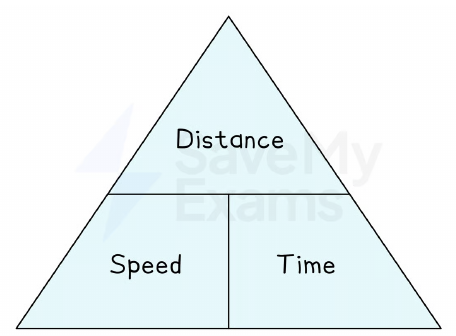
- Use formula triangles to rearrange: cover the variable you need, then multiply or divide the other two.
Speed, Distance & Time
- Speed = distance ÷ time (average speed over a journey).
- Common units: m/s or km/h.
- Distance = speed × time; Time = distance ÷ speed.
- Check units: if distance is in km and time in minutes, speed is km/min.
- For mixed units (e.g., minutes and hours), convert to consistent units before calculating.
- In multi‑part journeys, treat each part separately or combine total distance and total time.
Speed, Distance, Time Formula Triangle
Density, Mass & Volume
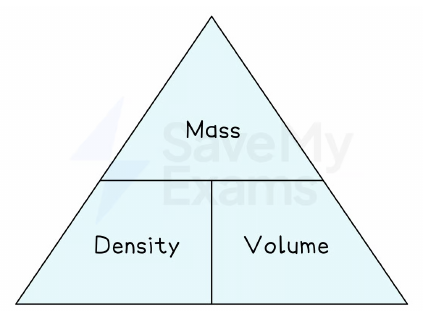
- Density = mass ÷ volume.
- Common units: g/cm³ or kg/m³.
- Mass = density × volume; Volume = mass ÷ density.
- An object floats if its density is less than the density of water (1 g/cm³).
- Ensure consistent units: convert kg to g or m to cm as needed.
Density, Mass, Volume Formula Triangle
Pressure, Force & Area
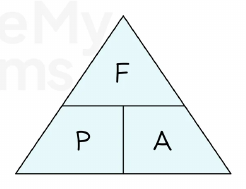
- Pressure = force ÷ area.
- Common units: N/m² (also called Pascals, Pa).
- Force = pressure × area; Area = force ÷ pressure.
- Remember: weight is a force (measured in newtons), not mass.
- Area units must match: if force is in N and area in m², pressure is N/m².
Pressure, Force, Area Formula Triangle
Unit Conversions
- Always check if the answer requires different units (e.g., m/s to km/h).
- To convert km/h to m/s: multiply by 1000/3600 (or divide by 3.6).
- To convert m/s to km/h: multiply by 3600/1000 (or multiply by 3.6).
- For time: 1 hour = 60 minutes = 3600 seconds.
- For mass: 1 kg = 1000 g; for length: 1 km = 1000 m; for volume: 1 m³ = 1 000 000 cm³.
Worked Examples – Speed
- Example: George drives 315 km in 3 h 30 min. Average speed = 315 ÷ 3.5 = 90 km/h.
- Example: A speedboat travels 84 km/h. Convert to m/min: 84 × 1000 ÷ 60 = 1400 m/min.
- Example: Ivan walks 1.5 km in 20 min. Speed = 1.5 ÷ (20/60) = 4.5 km/h.
- Example: A car travels at 20 m/s for 10 km. Time = 10 000 ÷ 20 = 500 s = 8 min 20 s.
Worked Examples – Density & Pressure
- Density example: Wood block 8 × 20 × 10 cm, mass 1360 g. Volume = 1600 cm³, density = 1360/1600 = 0.85 g/cm³ (floats).
- Pressure example: Force 300 N on area 5 m². Pressure = 300/5 = 60 N/m².
- Pressure example: Force 300 N, pressure 0.6 N/cm², width 20 cm. Area = 300/0.6 = 500 cm², length = 500/20 = 25 cm.
- Always state units in final answer.
Exam Tips
- Memorise the three formulas: speed, density, pressure.
- Watch for mixed units (e.g., minutes and hours) – convert before calculating.
- Use formula triangles to avoid rearranging errors.
- Show all working clearly, especially when converting units.
- For floating questions, compare density to water (1 g/cm³).
Diapos
Sign up free to view the lesson slides
Step through every slide for this topic — plus flashcards and revision notes — with a free account.
Questions d'entraînement
Aperçu gratuit — 8 sur 61 questions. Inscris-toi pour toutes les voir.
1.A car travels 180 km in 3 hours. What is its average speed in km/h?
Easy- A60 km/h
- B540 km/h
- C30 km/h
- D90 km/h
2.What is the formula for pressure?
Easy- AP = F / A
- BP = F × A
- CP = A / F
- DP = F + A
3.A substance has a mass of 50 g and a volume of 25 cm³. What is its density?
Easy- A2 g/cm³
- B0.5 g/cm³
- C1250 g/cm³
- D75 g/cm³
4.A force of 200 N is applied over an area of 4 m². What is the pressure?
Easy- A50 N/m²
- B800 N/m²
- C0.02 N/m²
- D200 N/m²
5.George drives 315 km in 3 hours 30 minutes. What is his average speed in km/h?
Medium- A90 km/h
- B105 km/h
- C80 km/h
- D110.25 km/h
6.A speedboat travels at 84 km/h. Convert this speed into metres per minute.
Medium- A1400 m/min
- B5040 m/min
- C1.4 m/min
- D84000 m/min
7.Ivan walks 1.5 km in 20 minutes. What is his average speed in km/h?
Medium- A4.5 km/h
- B3 km/h
- C0.075 km/h
- D30 km/h
8.A cuboid block of wood measures 8 cm × 20 cm × 10 cm and has mass 1360 g. The density of water is 1 g/cm³. Will the block float?
Hard- AYes, because its density is 0.85 g/cm³
- BNo, because its density is 1.18 g/cm³
- CYes, because its density is 1 g/cm³
- DNo, because its density is 0.85 g/cm³
Unlock all 61 questions, flashcards & more
Crée un compte gratuit pour voir toutes les questions, les diapos, les cartes mémo et les notes de révision de ce thème.