Time Currency And Conversions
Apprends en jouant
Réponds à ces questions pour gagner de l'énergie, puis pêche et explore. Sans compte.
Pour les enseignants : diapos de leçon, notes de révision, schémas prêts à l'emploi pour Time Currency And Conversions (Maths [CIE], Core) — utilise-les en cours, ou lance le thème en activité de classe interactive que tes apprenants jouent en direct.
Notes de leçon
Time Conversions
- 1 day = 24 hours, 1 hour = 60 minutes, 1 minute = 60 seconds.
- To convert days to hours, multiply by 24 (e.g., 3 days = 72 hours).
- To convert hours to minutes, multiply by 60; minutes to seconds, multiply by 60.
- For reverse conversions, divide by the appropriate factor.
12-Hour and 24-Hour Clocks
- 12-hour clock uses AM (midnight to midday) and PM (midday to midnight).
- 24-hour clock runs from 00:00 (midnight) to 23:59; no AM/PM needed.
- To convert 12-hour PM to 24-hour, add 12 to the hour (e.g., 3:25pm = 15:25).
- 12:00am = 00:00, 12:00pm = 12:00.
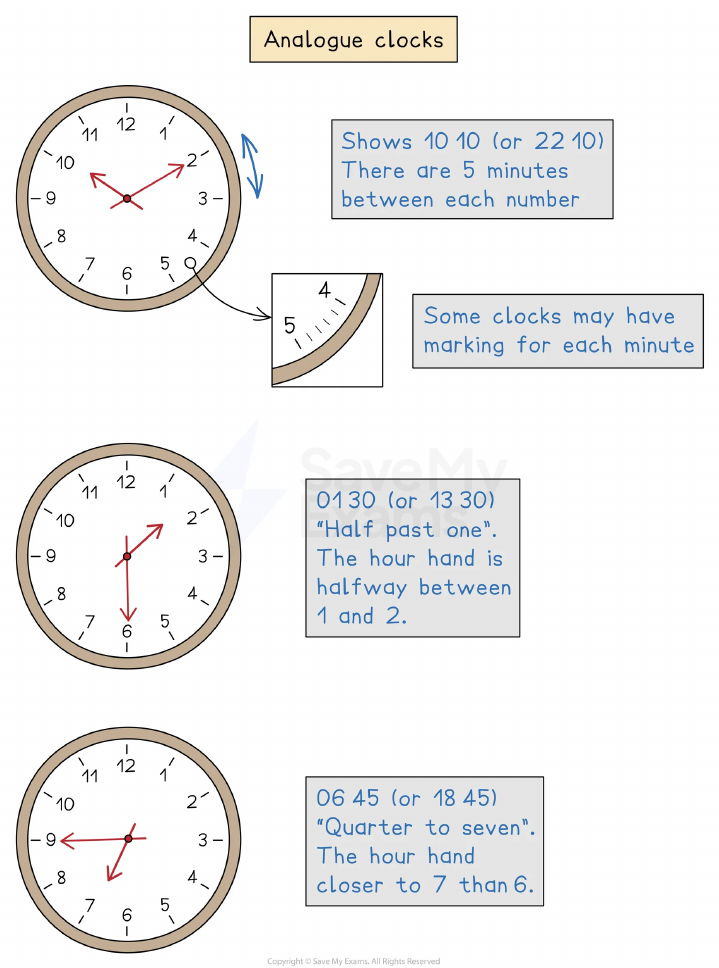
- On an analogue clock, the short hand is the hour hand and the long hand is the minute hand; each number represents 5 minutes for the minute hand.
Reading time from an analogue clock
Calculating with Time
- Work in chunks: add minutes to next hour, then whole hours, then remaining minutes.
- When crossing AM/PM, remember that 12:00pm is midday and 12:00am is midnight.
- For time intervals, subtract start from end, using chunking or conversion to minutes.
- Example: 07:35 to 08:14 is 25 min + 14 min = 39 min.
Bus and Train Timetables
- Timetables typically use 24-hour clock; times are four digits without colon.
- Each column represents a different service; times are usually departure times.
- To find journey duration, subtract departure time from arrival time for the same service.
- Example: 0800 at Coronation Street to 0840 at Ramsey Street = 40 minutes.
Bus timetable
Time Zones
- Time zones differ by hours; some locations are ahead, others behind.
- To convert, add or subtract the time difference depending on direction.
- If a location is behind, subtract hours; if ahead, add hours.
- Example: Madrid is 7 hours ahead of Chicago; 17:15 Madrid = 10:15 Chicago.
Exchange Rates
- Exchange rate shows how much one currency is worth in another.
- To convert from currency A to B, multiply amount in A by the rate (A to B).
- To convert from B to A, divide amount in B by the rate (A to B).
- Example: $1 = 0.8626 euros; $650 × 0.8626 = €560.69.
Converting Units of Length, Mass, Capacity
- Length: 1 cm = 10 mm, 1 m = 100 cm, 1 km = 1000 m.
- Mass: 1 g = 1000 mg, 1 kg = 1000 g, 1 tonne = 1000 kg.
- Capacity: 1 litre = 1000 ml, 1 ml = 1 cm³.
- To convert, multiply or divide by powers of 10; e.g., 5.3 km = 5300 m.
Squared and Cubic Units
- For area, square the linear conversion: 1 m² = 100 cm × 100 cm = 10 000 cm².
- For volume, cube the linear conversion: 1 m³ = 100 cm × 100 cm × 100 cm = 1 000 000 cm³.
- 1 cm² = 100 mm², 1 km² = 1 000 000 m².
- 1 cm³ = 1000 mm³, 1 km³ = 1 000 000 000 m³.
Diapos
Sign up free to view the lesson slides
Step through every slide for this topic — plus flashcards and revision notes — with a free account.
Questions d'entraînement
Aperçu gratuit — 8 sur 36 questions. Inscris-toi pour toutes les voir.
1.How many hours are there in 3 days?
Easy- A36 hours
- B48 hours
- C72 hours
- D24 hours
2.Change 5.3 kilometres into metres.
Easy- A530 m
- B5300 m
- C53 m
- D0.53 m
3.Write 3.25 pm in the 24-hour clock.
Easy- A03:25
- B15:25
- C13:25
- D3:25
4.Change 4.6 metres to centimetres.
Easy- A460 cm
- B46 cm
- C0.046 cm
- D4600 cm
5.Change 560 metres into kilometres.
Easy- A5.6 km
- B0.56 km
- C56 km
- D560000 km
6.Change 3670 centimetres to metres.
Easy- A36.7 m
- B367 m
- C3.67 m
- D0.367 m
7.Change 4365 metres into centimetres.
Easy- A43.65 cm
- B436500 cm
- C436.5 cm
- D4.365 cm
8.Change 645 mm into cm.
Easy- A6.45 cm
- B64.5 cm
- C6450 cm
- D0.645 cm
Unlock all 36 questions, flashcards & more
Crée un compte gratuit pour voir toutes les questions, les diapos, les cartes mémo et les notes de révision de ce thème.
Annales
Les annales d'entraînement pour ce thème arrivent bientôt.
Bientôt disponible