Powers Roots And Standard Form
Apprends en jouant
Réponds à ces questions pour gagner de l'énergie, puis pêche et explore. Sans compte.
Notes de leçon
Powers & Roots
- Powers (indices) show repeated multiplication: e.g., 6³ = 6 × 6 × 6.
- Any non-zero number to the power of 0 equals 1: 3⁰ = 1.
- Any number to the power of 1 equals itself: 3¹ = 3.
- Square roots reverse squaring; every positive number has two square roots (positive and negative). Notation √ refers to the positive root.
- Cube roots reverse cubing; each number has exactly one real cube root (∛).
- nth roots: if n is even, positive numbers have two real nth roots; negative numbers have none. If n is odd, every number has one real nth root.
- Reciprocal of a number is 1 divided by that number; written as index -1 (e.g., 5⁻¹ = 1/5).
Laws of Indices
- Multiplication: aᵐ × aⁿ = aᵐ⁺ⁿ (add powers).
- Division: aᵐ ÷ aⁿ = aᵐ⁻ⁿ (subtract powers).
- Power of a power: (aᵐ)ⁿ = aᵐⁿ (multiply powers).
- Negative power: a⁻ⁿ = 1/aⁿ (reciprocal).
- Fractional power: a1/n = ⁿ√a; am/n = (ⁿ√a)ᵐ = ⁿ√(aᵐ).
- Zero power: a⁰ = 1 (for a ≠ 0).
- Product and quotient rules: (ab)ⁿ = aⁿbⁿ; (a/b)ⁿ = aⁿ/bⁿ.
Converting to Standard Form
- Standard form: A × 10ⁿ, where 1 ≤ A < 10 and n is an integer.
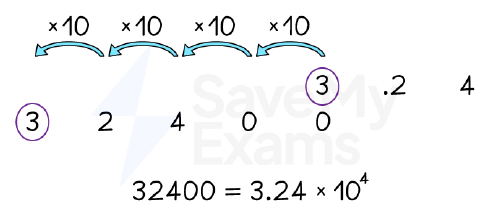
- For large numbers (≥10), n is positive: count how many places the decimal moves left. Example: 32400 = 3.24 × 10⁴.
- For small numbers (0 < number < 1), n is negative: count how many places the decimal moves right. Example: 0.0000324 = 3.24 × 10⁻⁵.
- To convert from standard form to ordinary number, move the decimal point n places (right if n>0, left if n<0).
Converting a large number to standard form
Operations with Standard Form
- Multiplication: multiply the A parts, add the powers of 10, then adjust to standard form. Example: (3×10²)×(4×10⁵)=12×10⁷=1.2×10⁸.
- Division: divide the A parts, subtract the powers of 10, then adjust. Example: (2×10⁻⁵)÷(8×10⁻³)=0.25×10⁻²=2.5×10⁻³.
- Addition/Subtraction (Method 1): convert both to ordinary numbers, add/subtract, then convert back to standard form.
- Addition/Subtraction (Method 2): rewrite numbers to have the same power of 10, add/subtract the A parts, then adjust. Efficient for large or negative exponents.
- On a calculator, use brackets and the ×10ˣ button to enter standard form numbers.
Common Mistakes & Tips
- Index laws only work with same base; e.g., 2³×5² cannot be simplified directly.
- A negative power means reciprocal, not a negative number: 2⁻⁴ = 1/16, not -16.
- When taking even roots of positive numbers, remember there are two roots (e.g., √25 = ±5), but the radical sign denotes the principal (positive) root.
- In standard form, A must be ≥1 and <10; if not, adjust by moving the decimal and changing the exponent accordingly.
Diapos
Sign up free to view the lesson slides
Step through every slide for this topic — plus flashcards and revision notes — with a free account.
Questions d'entraînement
Aperçu gratuit — 8 sur 62 questions. Inscris-toi pour toutes les voir.
1.Write 510 100 000 in standard form.
Easy- A5.101 × 108
- B5.101 × 109
- C51.01 × 107
- D5.101 × 107
2.Write 0.00527 in standard form.
Easy- A5.27 × 10-3
- B5.27 × 10-4
- C5.27 × 103
- D52.7 × 10-4
3.Write 3.4 × 10⁻¹ as an ordinary number.
Easy- A0.34
- B34
- C3.4
- D0.034
4.Which of these numbers is the largest? 3.4 × 10⁻¹, 1.36 × 10⁶, 7.9 × 100, 2.4 × 10⁵, 5.21 × 10⁻³, 4.3 × 10⁻²
Easy- A1.36 × 106
- B2.4 × 105
- C7.9 × 100
- D3.4 × 10-1
5.Find the value of (2/5)2.
Easy- A4/25
- B2/25
- C4/5
- D2/5
6.Work out (5.2 × 10⁷) + (5.2 × 10⁶). Give your answer in standard form.
Medium- A5.72 × 107
- B5.2 × 107
- C5.72 × 106
- D1.04 × 108
7.Work out (9 × 10-4) × (3 × 107). Give your answer in standard form.
Medium- A2.7 × 104
- B2.7 × 103
- C2.7 × 105
- D27 × 103
8.Patrick says that 641/4 = 16 because 1/4 of 64 is 16. What is wrong with his reasoning?
Medium- A641/4 means the fourth root of 64, not 1/4 of 64
- B641/4 = 64 ÷ 4 = 16
- C641/4 = 64 × 1/4 = 16
- DNothing, Patrick is correct
Unlock all 62 questions & more
Crée un compte gratuit pour voir toutes les questions, les diapos, les cartes mémo et les notes de révision de ce thème.