Energy, Work & Power
Apprends en jouant
Réponds à ces questions pour gagner de l'énergie, puis pêche et explore. Sans compte.
Notes de leçon
Energy Stores & Transfers
- Energy is a property stored or transferred, measured in joules (J).
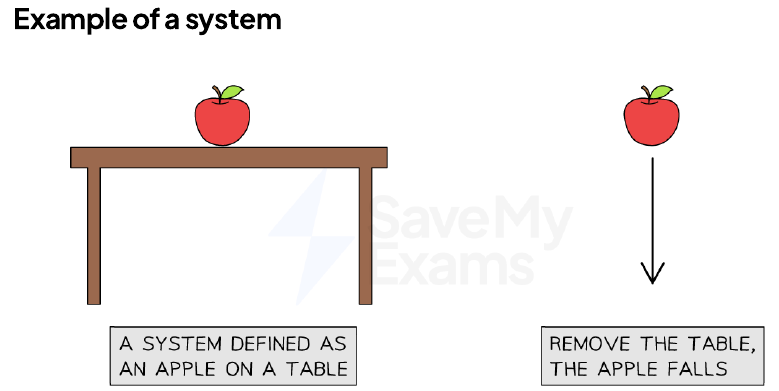
- A system is an object or group of objects; changes within a system involve energy transfer.
- Energy stores include: kinetic, gravitational potential, elastic, magnetic, electrostatic, chemical, nuclear, and thermal.
- Energy transfer pathways: mechanical (force), electrical (charge flow), heating (particle conduction), and radiation (electromagnetic waves).
- Example: a battery-powered torch transfers energy electrically from the chemical store of the battery to the thermal store of the bulb.
- Example: a falling object transfers energy mechanically from its gravitational potential store to its kinetic store.
Example of a system: an apple on a table
Kinetic Energy
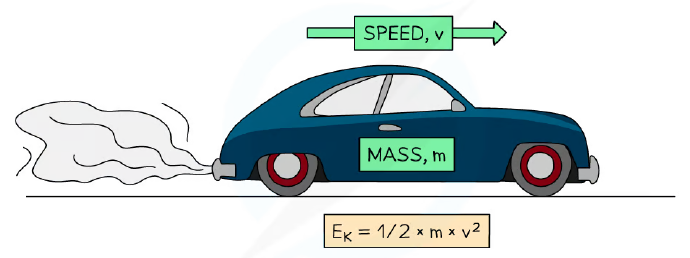
- Kinetic energy is the energy an object has due to its mass and speed: Ek = \frac{1}{2}mv2.
- Doubling mass doubles kinetic energy (directly proportional to mass).
- Doubling speed quadruples kinetic energy (proportional to speed squared).
- Energy is transferred to the kinetic store when an object speeds up, and away when it slows down.
A moving car has energy in its kinetic store
Gravitational Potential Energy
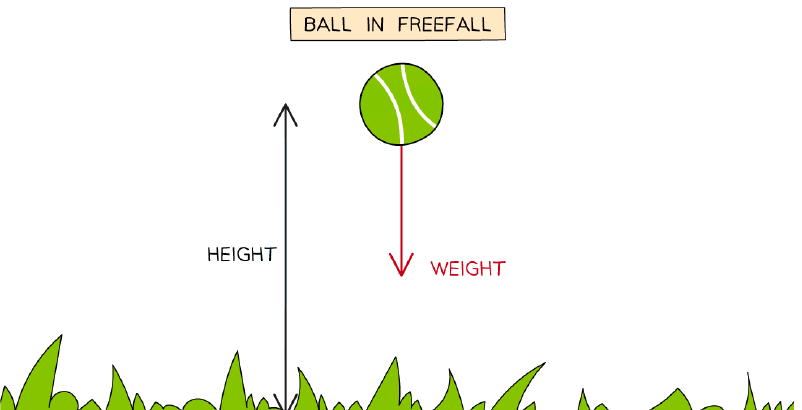
- Gravitational potential energy is the energy an object has due to its height in a gravitational field: \Delta Ep = mg\Delta h.
- Lifting an object transfers energy to its gravitational potential store; lowering transfers energy away.
- Work is done against the weight force to lift an object.
Ball in freefall illustrating height and weight
Conservation of Energy
- Principle of conservation of energy: energy cannot be created or destroyed, only transferred between stores.
- For a closed system, total energy remains constant: total energy in = total energy out.
- Energy can be dissipated (spread out) to the surroundings, often as wasted energy.
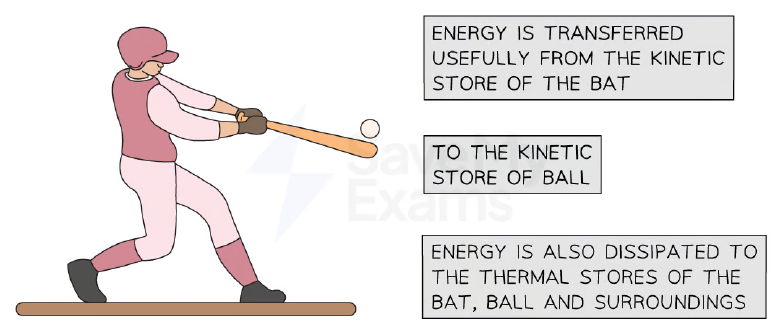
- Example: a bat hitting a ball transfers kinetic energy to the ball (useful) and to thermal stores (wasted).
- Energy flow diagrams show stores and transfers; Sankey diagrams show proportions of useful and wasted energy.
The principle of conservation of energy applied to a bat hitting a ball
Work Done
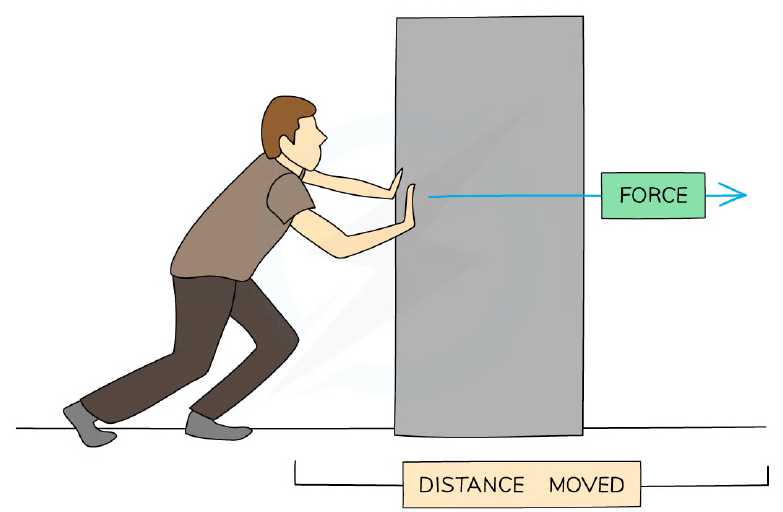
- Work done occurs when a force moves an object over a distance: W = Fd.
- Work done equals energy transferred: 1 N m = 1 J.
- If no movement occurs, no work is done.
- Example: a force of 500 N over 23 m does 11 500 J of work.
Work is done when a force is used to move an object over a distance
Power
- Power is the rate of work done or energy transferred: P = \frac{W}{t} = \frac{\Delta E}{t}.
- Unit of power is the watt (W): 1 W = 1 J/s.
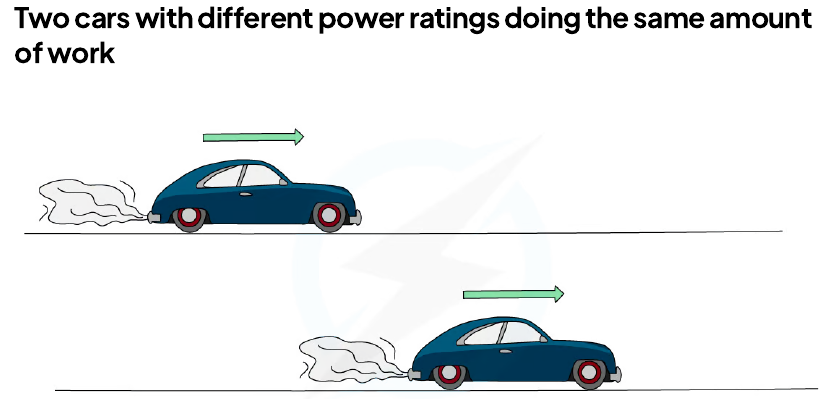
- A more powerful machine does the same work in less time.
- Example: a 2000 W iron used for 5 minutes transfers 600 000 J of energy.
Two cars with different power ratings doing the same amount of work
Efficiency
- Efficiency is the ratio of useful output to total input (energy or power): \text{efficiency} = \frac{\text{useful output}}{\text{total input}} \times 100\%.
- High efficiency means most energy is used usefully; low efficiency means much is wasted.
- Efficiency has no units; can be expressed as a decimal or percentage.
- Example: a motor with 35% efficiency lifting a 7.2 kg load 5.0 m in 3 s has a power input of 336 W.
Sankey diagram: a modern energy-efficient light bulb
Diapos
Sign up free to view the lesson slides
Step through every slide for this topic — plus flashcards and revision notes — with a free account.
Questions d'entraînement
Aperçu gratuit — 8 sur 55 questions. Inscris-toi pour toutes les voir.
1.What is the unit of energy?
Easy- AJoule
- BNewton
- CWatt
- DMetre
2.Which of the following is an energy store?
Easy- AElectrical
- BKinetic
- CMechanical
- DHeating
3.The principle of conservation of energy states that energy cannot be created or destroyed. It can only be:
Easy- Atransferred from one store to another
- Bincreased or decreased
- Cchanged into mass
- Dstored as heat
4.Work done is equal to:
Easy- Aenergy transferred
- Bpower
- Cforce
- Ddistance
5.A car of mass 1000 kg is moving at 20 m/s. What is its kinetic energy?
Medium- A200 000 J
- B10 000 J
- C400 000 J
- D20 000 J
6.Which of the following correctly describes the energy transfer when a ball is thrown upwards?
Easy- AKinetic to gravitational potential
- BGravitational potential to kinetic
- CChemical to kinetic
- DNuclear to thermal
7.A force of 50 N moves an object 2 m in the direction of the force. How much work is done?
Easy- A100 J
- B25 J
- C52 J
- D48 J
8.Which of the following is an energy transfer pathway?
Easy- AThermal
- BMechanical
- CKinetic
- DChemical
Unlock all 55 questions & more
Crée un compte gratuit pour voir toutes les questions, les diapos, les cartes mémo et les notes de révision de ce thème.