Databases: storing and searching information
Apprends en jouant
Réponds à ces questions pour gagner de l'énergie, puis pêche et explore. Sans compte.
Notes de leçon
What is a Database?
- A database is an organised collection of data, like a digital filing cabinet.
- A DBMS (Database Management System) is the software used to create, manage, and search databases.
- Examples of DBMS: MySQL, Microsoft SQL Server, Oracle, and IBM Db2.
- Databases can be small (on a single computer) or huge (on cloud servers).
- They are better than long lists because they allow fast searching and sorting.
Key Terms: Tables, Records, and Fields
- A table stores data about one type of thing, e.g., students or books.
- A record is a single row in a table – it holds all data about one item.
- A field is a column in a table – it holds one piece of data for every record.
- Example: a 'Students' table has fields like Name, Age, and Class.
- Each record is unique, often identified by a primary key.
Why Use a Database?
- Databases can handle large amounts of data efficiently.
- They allow quick searching – finding a record in seconds.
- They support sorting – putting data in order (e.g., alphabetical).
- Multiple users can access the same data at the same time.
- Data is consistent and less likely to be duplicated.
Searching and Sorting with Queries
- A query is a request for specific data from a database.
- Queries can filter records using conditions (e.g., Age > 12).
- Queries can sort results (e.g., by surname).
- SQL (Structured Query Language) is the most common query language.
- Example SQL: SELECT×FROM Students WHERE Age = 13;
Data Types and Validation
- Each field has a data type – e.g., text, number, date, or boolean.
- Data types help keep data accurate (e.g., you can't put letters in a number field).
- Validation rules check data before it is entered.
- Examples: a date must be in a valid format, or a number must be within a range.
- Validation reduces errors and keeps the database reliable.
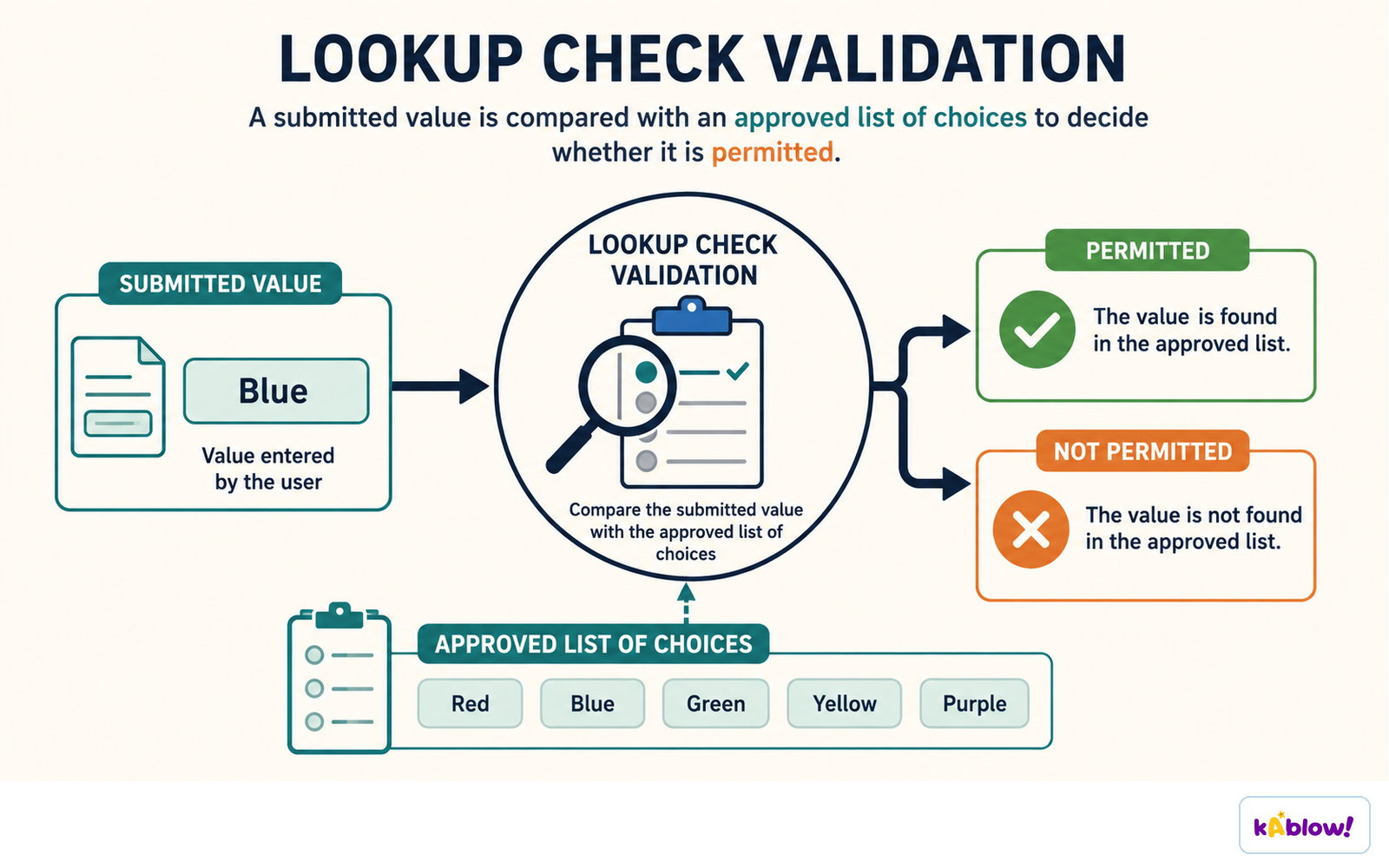
A lookup check accepts a value only when it appears in an approved list of choices.
Everyday Database Examples
- School systems store student details, attendance, and grades.
- Online shops use databases for products, customers, and orders.
- Libraries use databases to track books and borrowers.
- Social media platforms store user profiles and posts.
- Hospitals store patient records and appointments.
Database Models
- The relational model organises data into tables with rows and columns.
- Relational databases use SQL and are the most common today.
- NoSQL databases are non-relational and use different query methods.
- Early models used pointers to link records (hierarchical and network).
- The relational model was invented by Edgar F. Codd in 1970.
Database Management Systems (DBMS)
- A DBMS lets users enter, store, and retrieve data.
- It provides security – only authorised users can access data.
- It manages concurrency – many users can use the database at once.
- It helps backup and recover data if something goes wrong.
- The DBMS and database together are called a database system.
Diapos
Sign up free to view the lesson slides
Step through every slide for this topic — plus flashcards and revision notes — with a free account.
Questions d'entraînement
Aperçu gratuit — 8 sur 49 questions. Inscris-toi pour toutes les voir.
1.What is a database?
Easy- AAn organized collection of data
- BA type of computer virus
- CA programming language
- DA hardware device for storage
2.A database management system (DBMS) is software that allows users to interact with the database and manage the data.
EasyTrue or false?
3.Complete the sentence with the correct term.
EasyIn a relational database, data is organized into ____ and columns in a series of tables.
4.Which of the following is an example of a relational database management system?
Easy- AMySQL
- BMagnetic tape
- CNoSQL
- DSpreadsheet
5.What does SQL stand for?
Medium6.Which of the following is a function of a database management system (DBMS)?
Medium- AData definition
- BCreating computer graphics
- CSending emails
- DCompiling code
7.Which of the following are components of a database system? (Select all that apply)
Medium- ADatabase
- BDatabase management system (DBMS)
- CKeyboard
- DAssociated applications
8.In which year was the relational model first proposed by Edgar F. Codd?
Medium
Unlock all 49 questions, flashcards & more
Crée un compte gratuit pour voir toutes les questions, les diapos, les cartes mémo et les notes de révision de ce thème.