The skeleton
Apprends en jouant
Réponds à ces questions pour gagner de l'énergie, puis pêche et explore. Sans compte.
Pour les enseignants : diapos de leçon, notes de révision prêts à l'emploi pour The skeleton (KS3 Science, Biology) — utilise-les en cours, ou lance le thème en activité de classe interactive que tes apprenants jouent en direct.
Notes de leçon
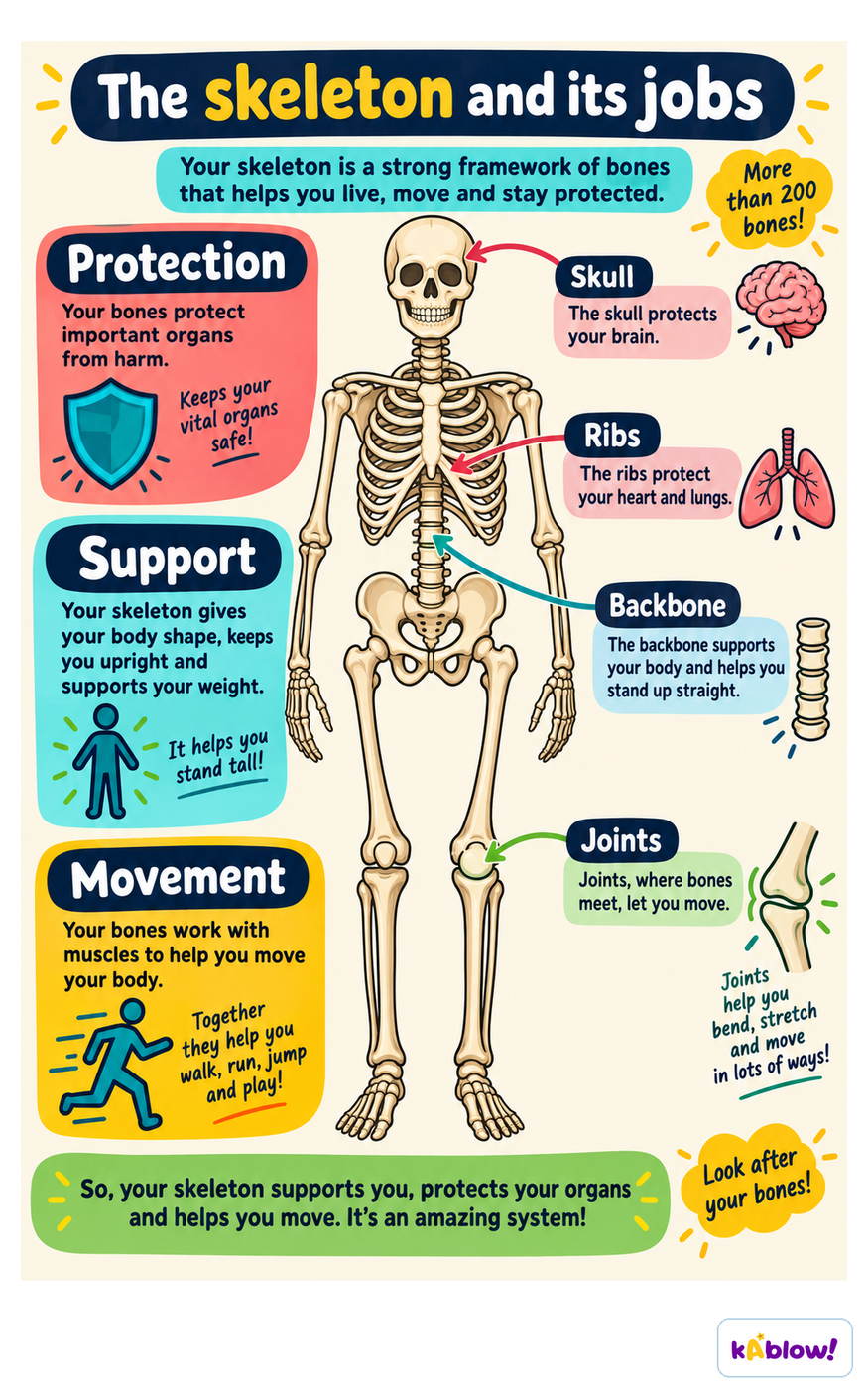
Functions of the Skeleton
- Support: provides a solid framework that maintains body shape.
- Protection: shields vital organs, e.g., the ribcage protects the heart and lungs.
- Movement: bones work with muscles; muscles attach to bones via tendons and pull on them to create movement at joints.
- Blood cell production: bone marrow inside some bones produces red and white blood cells.
- Storage: stores minerals like calcium and phosphorus for bone strength and release when needed.
The skeleton supports the body, protects organs and works with muscles to allow movement at joints.
Major Parts of the Skeleton
- Skull: made of many fused bones; protects the brain and forms the face.
- Spine (Vertebral Column): 33 stacked vertebrae; supports body weight and protects the spinal cord.
- Ribcage: 12 pairs of ribs; protects heart and lungs, supports upper body, aids breathing.
- Pelvis: bowl-shaped; supports upper body weight and protects lower abdomen organs (bladder, intestines).
- Limbs: arms (humerus, radius, ulna) and legs (femur, tibia, fibula); hands and feet have many small bones for range of movement.
Bones of the Arm
- Humerus: upper arm bone.
- Radius: outer forearm bone (thumb side).
- Ulna: inner forearm bone (little finger side).
Bones of the Leg
- Femur: thigh bone (longest bone in the body).
- Tibia: shin bone (larger, weight-bearing).
- Fibula: thinner lower leg bone (beside tibia).
Joints and Movement
- Joints are where two bones meet, allowing movement.
- Muscles contract and pull on bones via tendons to create movement.
- Skeletal muscles work in antagonistic pairs (one contracts, the other relaxes).
Diapos
Sign up free to view the lesson slides
Step through every slide for this topic — plus flashcards and revision notes — with a free account.
Questions d'entraînement
Aperçu gratuit — 8 sur 56 questions. Inscris-toi pour toutes les voir.
1.How many bones does the human skeleton contain?
Easy- A206
- B106
- C306
- D256
2.Which of the following is a function of the skeleton?
Easy- AProtection of vital organs
- BDigestion of food
- CPumping blood
- DProducing hormones
3.What attaches muscles to bones?
Easy- ATendons
- BLigaments
- CCartilage
- DJoints
4.Which of the following bones is found in the leg?
Easy- AFemur
- BHumerus
- CRadius
- DUlna
5.What is produced in bone marrow?
Easy- ARed and white blood cells
- BOnly red blood cells
- COnly white blood cells
- DPlatelets
6.How many pairs of ribs make up the ribcage?
Easy- A12
- B10
- C14
- D24
7.What is the main function of the pelvis?
Easy- ASupports the weight of the upper body and protects lower abdominal organs
- BProtects the brain
- CAllows movement of the legs
- DProduces blood cells
8.Which of the following is NOT a function of the skeleton?
Easy- ADigestion of food
- BSupport
- CMovement
- DStorage of minerals
Unlock all 56 questions, flashcards & more
Crée un compte gratuit pour voir toutes les questions, les diapos, les cartes mémo et les notes de révision de ce thème.
Annales
Les annales d'entraînement pour ce thème arrivent bientôt.
Bientôt disponible