Hooke's law
Apprends en jouant
Réponds à ces questions pour gagner de l'énergie, puis pêche et explore. Sans compte.
Notes de leçon
Hooke's Law
- Hooke's law states that the extension of a spring is directly proportional to the force applied to it.
- This means doubling the force doubles the extension, provided the limit of proportionality is not exceeded.
- The law applies to both extension (stretching) and compression (squeezing) of a spring.
Masses are added to the spring and the extension is measured against a fixed ruler.
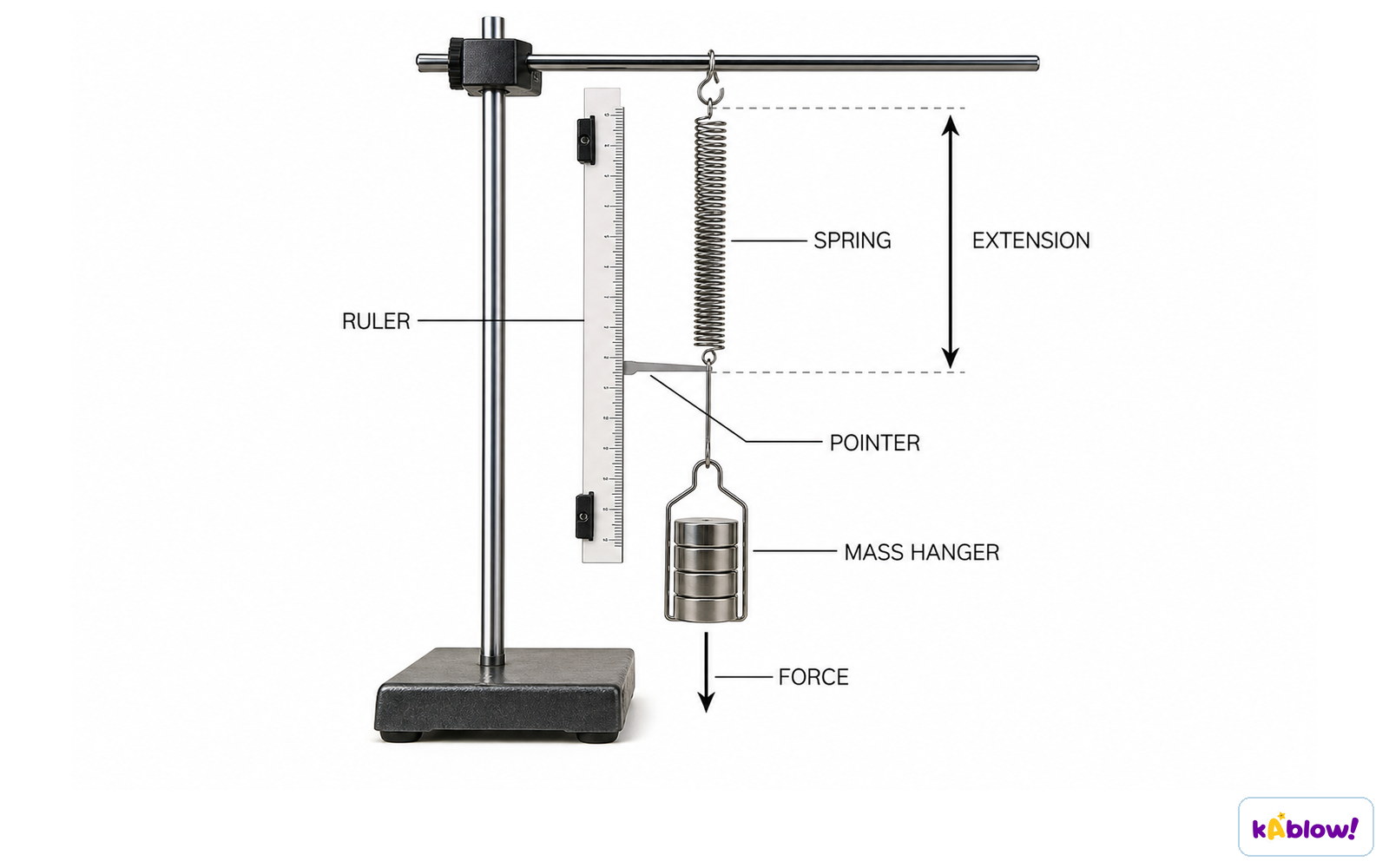
Key Equation
- The equation is: Force = Spring constant × Extension or F = k × e.
- F is force in newtons (N).
- k is the spring constant in newtons per metre (N/m).
- e is extension in metres (m).
Spring Constant
- The spring constant measures how stiff the spring is.
- A higher spring constant means more force is needed to stretch the spring by the same amount.
- A lower spring constant means the spring is easier to stretch.
Calculations
- To find force: F = k × e.
- To find extension: e = F ÷ k.
- To find spring constant: k = F ÷ e.
- Always use consistent units: N, N/m, m.
Example Calculation
- A spring with k = 4 N/m is extended by 0.1 m. Force = 4 × 0.1 = 0.4 N.
- A spring with k = 200 N/m is compressed by 0.04 m. Force = 200 × 0.04 = 8 N.
- A rubber band with k = 60 N/m is pulled with 15 N. Extension = 15 ÷ 60 = 0.25 m.
Graph of Force vs Extension
- A graph of force against extension is a straight line through the origin.
- The gradient of the line equals the spring constant.
- If the force is too large, the line curves (the spring is permanently deformed).
Diapos
Sign up free to view the lesson slides
Step through every slide for this topic — plus flashcards and revision notes — with a free account.
Questions d'entraînement
Aperçu gratuit — 8 sur 55 questions. Inscris-toi pour toutes les voir.
1.What is the unit of force?
Easy- ANewton (N)
- BMetre (m)
- CNewton per metre (N/m)
- DJoule (J)
2.What is the unit of the spring constant?
Easy- ANewton (N)
- BMetre (m)
- CNewton per metre (N/m)
- DMetre per newton (m/N)
3.What is the unit of extension?
Easy- ANewton (N)
- BMetre (m)
- CNewton per metre (N/m)
- DCentimetre (cm)
4.According to Hooke's law, how is the extension of a spring related to the force applied to it?
Easy- AExtension is inversely proportional to force
- BExtension is directly proportional to force
- CExtension is equal to force
- DExtension is independent of force
5.A spring with a spring constant of 4 N/m is extended by 0.1 m. What force is applied?
Easy- A0.4 N
- B4 N
- C40 N
- D0.04 N
6.A rubber band with a spring constant of 10 N/m is extended by 0.2 m. What force is applied?
Easy- A2 N
- B0.5 N
- C50 N
- D20 N
7.A spring with a spring constant of 20 N/m is compressed by 0.05 m. What force is applied?
Easy- A1 N
- B4 N
- C0.25 N
- D400 N
8.The same force is applied to two springs. Spring X has a high spring constant, Spring Y a low spring constant. Which spring has the larger extension?
Medium- ASpring X
- BSpring Y
- CBoth have same extension
- DCannot tell
Unlock all 55 questions, flashcards & more
Crée un compte gratuit pour voir toutes les questions, les diapos, les cartes mémo et les notes de révision de ce thème.