Homeostasis
खेलकर सीखें
इन सवालों के जवाब देकर एनर्जी कमाएं, फिर मछली पकड़ें और घूमें। कोई अकाउंट नहीं चाहिए।
लेसन नोट्स
What is Homeostasis?
- Homeostasis is the maintenance of a constant internal environment within set limits.
- Internal conditions such as temperature, blood pressure, water concentration and glucose concentration must be kept within narrow ranges.
- Keeping these conditions stable ensures that reactions in body cells can function properly, so the organism as a whole can live.
- If a condition deviates far from normal and is not corrected, the body will not function properly and, without medical intervention, death can eventually occur.
- Examples include: diabetics needing to control glucose intake, a prolonged high fever being fatal, and drinking too little or too much water damaging cells, especially in the kidneys and brain.
Negative Feedback
- Most homeostatic mechanisms in the body are controlled by negative feedback.
- Negative feedback occurs when conditions change from the ideal or set point and are returned to this set point.
- If the level of something rises, control systems are switched on to reduce it again.
- If the level of something falls, control systems are switched on to raise it again.
- Negative feedback mechanisms are usually a continuous cycle of bringing levels down and then back up so that overall they stay within a narrow range of what is considered normal.
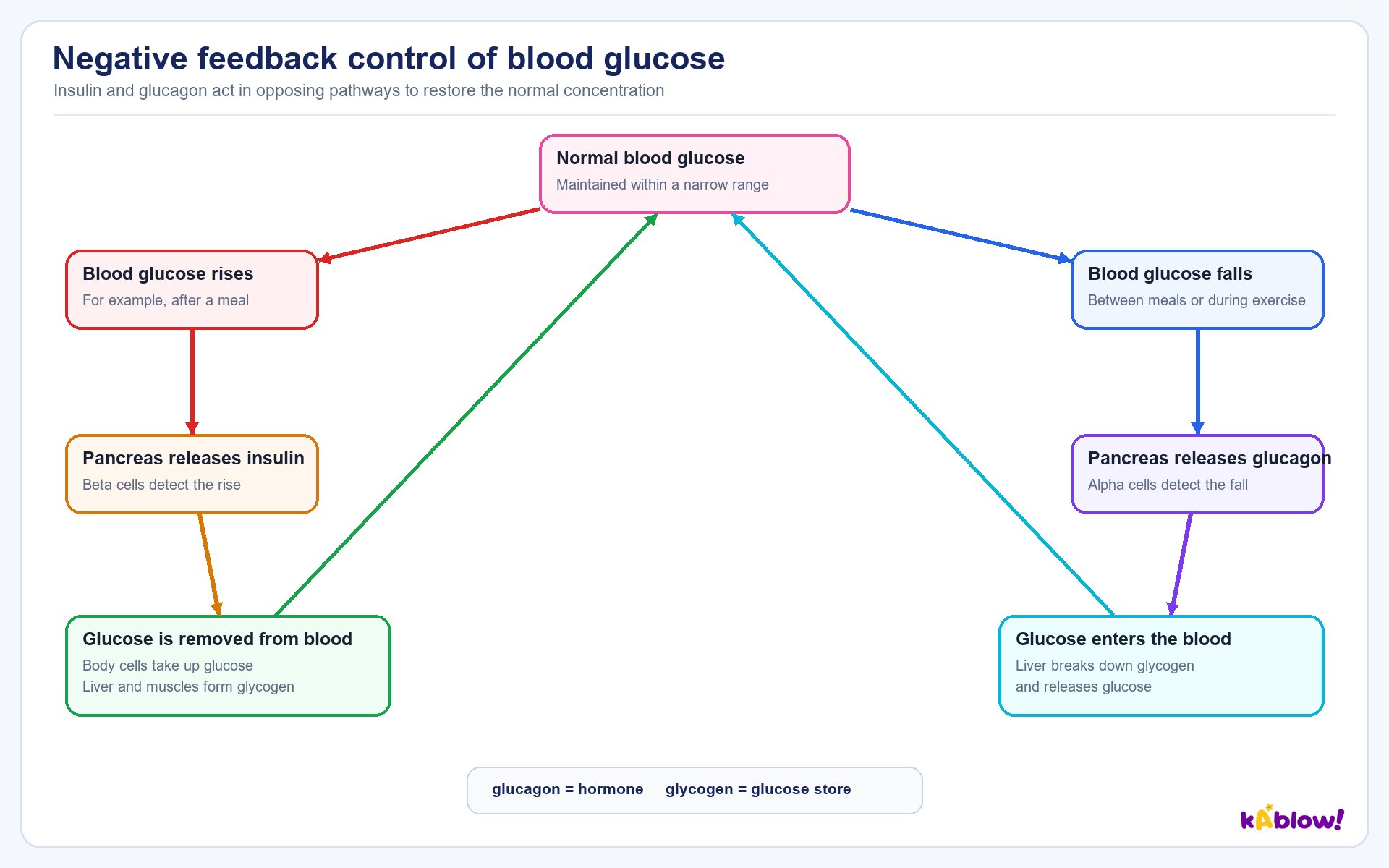
Negative feedback regulation of blood glucose levels
Thermoregulation
- Thermoregulation is the maintenance of body temperature at around 37°C, the temperature at which enzymes work best.
- Processes such as respiration release energy as heat, while the body loses heat energy to its surroundings; the energy gained and lost must be regulated.
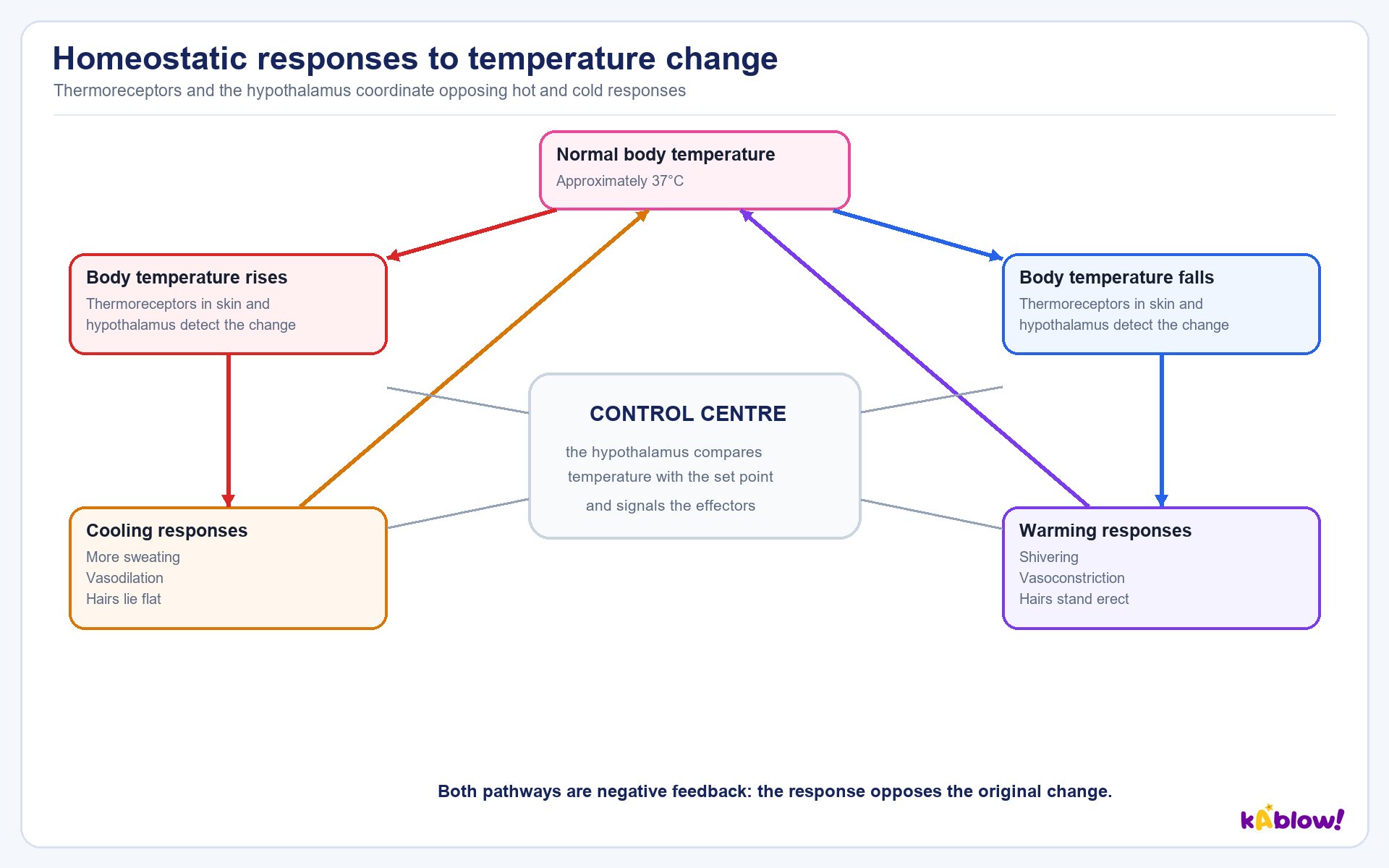
- Body temperature is monitored and controlled by the thermoregulatory centre in the hypothalamus (a structure within the brain).
- The thermoregulatory centre contains receptors sensitive to the temperature of the blood.
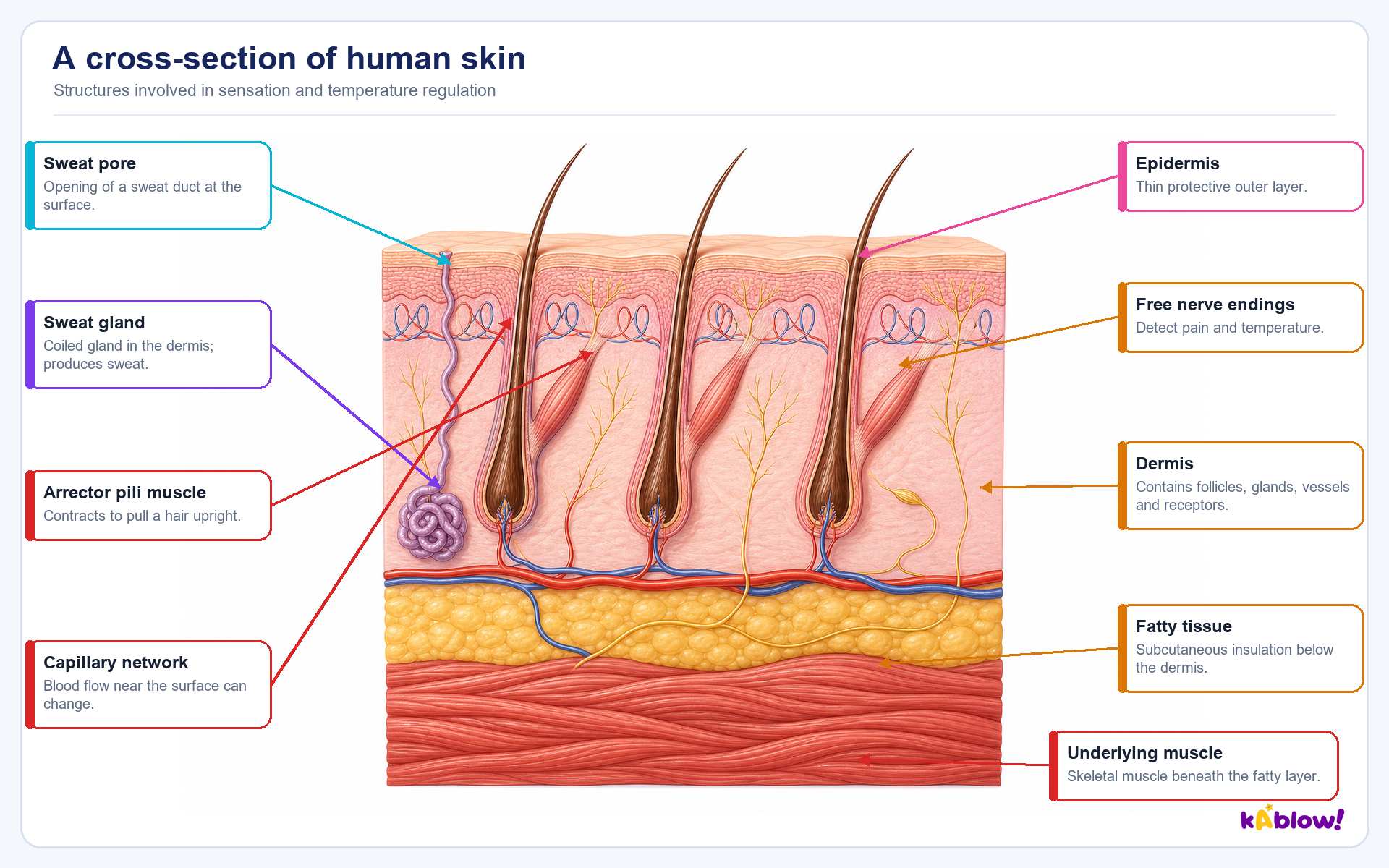
- The skin also contains temperature receptors within the epidermal layer which send nerve impulses to the thermoregulatory centre.
Skin structures involved in thermoregulation
Responses to Temperature Change
- If body temperature is too high: hair erector muscles relax, blood vessels dilate (vasodilation) and sweat is produced from sweat glands.
- These mechanisms cause a transfer of energy from the skin to the environment, cooling the body down.
- If body temperature is too low: hair erector muscles contract, blood vessels constrict (vasoconstriction), sweating stops and skeletal muscles contract (shiver).
- These mechanisms reduce heat loss to the surroundings, with skeletal muscle contraction increasing heat released in the body.
Homeostatic responses to changes in body temperature
Vasoconstriction & Vasodilation (Higher Tier)
- Heat exchange occurs at the body's surface where blood comes into closest proximity to the environment.
- Vasodilation: muscles in the walls of arterioles relax, causing arterioles near the skin to dilate and allowing more blood to flow through capillaries; this increases heat loss by radiation.
- Vasoconstriction: muscles in the arteriole walls contract, causing arterioles near the skin to constrict and allowing less blood to flow through capillaries; this reduces heat loss by radiation.
- It is the arterioles that supply the skin capillaries that vasodilate or vasoconstrict, not the capillaries themselves; capillary walls are only one cell thick and contain no muscle.
- During vasoconstriction, blood is diverted through shunt vessels which are further down in the skin and therefore do not lose heat to the environment.
- Vasoconstriction is not strictly a 'warming' mechanism as it does not raise blood temperature but reduces heat loss from the blood as it flows through the skin.
Osmoregulation and the Urinary System
- Osmoregulation is the process of maintaining water and salt concentrations (osmotic balance) across membranes within the body.
- Maintaining water levels is vital to prevent harmful changes to cells by osmosis: too much water causes cells to swell and possibly lyse (burst); too little water causes cells to lose water and possibly die.
- Water enters the body from aerobic respiration and from the diet; it is lost via the lungs during exhalation, from the skin as sweat, and in urine.
- Water lost through the lungs or skin cannot be controlled, but the volume of water lost in urine can be controlled by the kidneys.
- The urinary system consists of two kidneys joined to the bladder by two tubes called ureters; the urethra carries urine from the bladder to outside the body.
- Each kidney is connected to the renal artery (from the aorta, delivering oxygenated blood) and the renal vein (delivering deoxygenated blood to the vena cava).
Forming Urine
- The kidneys regulate the water content of the blood and excrete toxic waste products of metabolism (such as urea) and substances in excess (such as salts).
- Each kidney contains about a million nephrons (kidney tubules), which start in the cortex, loop down into the medulla and back up to the cortex.
- The nephron is made up of: Bowman's capsule, proximal convoluted tubule, Loop of Henlé, distal convoluted tubule and collecting duct.
- Ultrafiltration: high pressure in the glomerulus (a knot of capillaries inside Bowman's capsule) forces smaller molecules out of the blood into the Bowman's capsule, forming filtrate.
- The filtrate contains glucose, water, urea and salts; some of these are useful and are reabsorbed back into the blood further down the nephron.
- Reabsorption of glucose: glucose is reabsorbed at the proximal convoluted tubule by active transport; the nephron has many mitochondria to provide energy for this.
- Reabsorption of water & salts: salts are reabsorbed by diffusion in the Loop of Henle, and water follows by osmosis; water is also reabsorbed from the collecting duct in varying amounts.
ADH and Water Regulation (Higher Tier)
- Urine contains urea, excess mineral ions and excess water.
- Large quantities of urine are usually pale yellow (dilute); small quantities are darker yellow/orange (concentrated).
- Urine concentration changes with water intake, temperature and exercise.
- Water reabsorption by the tubules is controlled by the hormone ADH, released by the pituitary gland in the brain.
- If blood water content is too high: less ADH is released, tubules become less permeable to water, less water is reabsorbed, and a large volume of dilute urine is produced.
- If blood water content is too low: more ADH is released, tubules become more permeable to water, more water is reabsorbed, and a small volume of concentrated urine is produced.
- This is an example of negative feedback.
Kidney Failure and Treatment
- Kidneys may fail due to accidents or disease; if both are damaged, toxic wastes build up and this is fatal if not removed.
- Dialysis is an artificial method of filtering the blood: blood is taken from an artery, pumped through a dialysis machine and returned to a vein.
- In the machine, blood and dialysis fluid are separated by a partially permeable membrane and flow in opposite directions.
- Dialysis fluid contains glucose at normal blood concentration, salts at normal blood concentration, and no urea.
- Urea diffuses from blood to dialysis fluid down a concentration gradient; glucose has no net movement; salts move only where there is an imbalance.
- Dialysis takes 3–4 hours and is needed several times a week; an anticoagulant is added to prevent clotting.
- Kidney transplant is a better long-term solution but risks rejection (donors have different antigens), requires immunosuppressant drugs, and there are not enough donors; benefits include more freedom, less restrictive diet, and removal of dialysis costs.
Formation of Urea
- Excretion is the removal of waste substances of metabolic reactions, toxic materials and substances in excess of requirements.
- Too much carbon dioxide is toxic; it dissolves in water to form an acidic solution which can lower the pH of cells and reduce enzyme activity.
- Urea is toxic in higher concentrations and must be excreted.
- In the liver, excess amino acids are broken down by deamination.
- Enzymes in the liver split amino acid molecules: the carbon-containing part is turned into glycogen and stored; the nitrogen-containing part is turned into ammonia (highly toxic), which is immediately converted into urea (less toxic).
- Urea dissolves in the blood and is taken to the kidney to be excreted; a small amount is also excreted in sweat.
Regulating Blood Glucose Concentration
- Blood glucose concentration must be kept within a narrow range and is monitored and controlled by the pancreas.
- The pancreas is an endocrine gland (making and secreting hormones into the bloodstream) and also plays a role in digestion (making and secreting enzymes).
- Eating foods containing carbohydrate increases glucose in the bloodstream.
- If blood glucose is too high, the pancreas produces insulin, which stimulates cells (particularly liver and muscle cells) to take in glucose from the bloodstream.
- In liver and muscle cells, excess glucose is converted into glycogen (a polymer of glucose) for storage.
- If blood glucose is too low, the pancreas produces glucagon, which causes glycogen to be converted into glucose and released into the blood.
- Insulin and glucagon interact as part of a negative feedback cycle to control blood glucose levels.
Diabetes
- Type 1 diabetes: the pancreas fails to produce sufficient insulin, thought to be due to the person's own immune system destroying the cells of the pancreas that make insulin during development.
- Type 1 diabetes is characterised by uncontrolled high blood glucose levels and is normally treated with insulin injections.
- Type 2 diabetes: body cells no longer respond to insulin produced by the pancreas; the person still makes insulin but their cells are resistant to it.
- Type 2 diabetes can also lead to uncontrolled high blood glucose levels; common treatments are a carbohydrate-controlled diet and an exercise regime.
- Obesity is a major risk factor for Type 2 diabetes; a person who is obese is likely to consume a diet rich in carbohydrates, causing over-production of insulin and development of insulin resistance.
- An individual is classified as obese if their BMI is greater than 30; BMI = mass (kg) ÷ height (m)².
- Excess fat stored around the abdomen increases risk; a waist-to-hip ratio above 1.0 for men and 0.85 for women is associated with increased risk.
स्लाइड्स
Sign up free to view the lesson slides
Step through every slide for this topic — plus flashcards and revision notes — with a free account.
प्रैक्टिस सवाल
फ्री प्रीव्यू — 59 में से 8 सवाल। सभी देखने के लिए साइन अप करें।
1.Which part of the brain constantly monitors body temperature?
Easy- ACerebrum
- BHypothalamus
- CMedulla oblongata
- DCerebellum
2.Which of the following are examples of homeostasis? (Select all that apply)
Medium- ARed blood cells bursting when placed in a beaker of water
- BA person shivering after swimming in the sea
- CA person urinating frequently after drinking lots of water
- DPulling your hand away after touching a hot object
- ESweating when you are hot
3.Which organ releases insulin?
Easy- ALiver
- BPancreas
- CKidney
- DAdrenal gland
4.Which one of the following statements accurately describes the function of insulin?
Medium- AStimulation of cell respiration.
- BMonitors the blood glucose concentration.
- CCauses glucose to be moved from the blood into the cells.
- DIt increases the level of glucose in the blood.
5.After eating a large meal, place the events of blood glucose control in the correct chronological order.
Medium- Insulin causes liver, muscle and other cells to take up glucose
- Blood glucose concentration falls to normal levels
- Blood glucose concentration rises
- Pancreas releases insulin
- Glucose is absorbed from the small intestine after the digestion of food
6.What is the function of glucagon?
Medium- AIt causes glycogen to be converted into glucose and released into the blood.
- BIt causes glucose to be converted into glycogen for storage.
- CIt increases the permeability of the collecting duct to water.
- DIt stimulates the pancreas to release insulin.
7.Homeostasis keeps internal conditions exactly constant at all times.
EasyTrue or false?
8.Which of the following correctly identifies the receptor, coordination centre and effector in the control of blood glucose?
Medium- AReceptor: pancreas; Coordination centre: pancreas; Effector: liver and muscle cells
- BReceptor: liver; Coordination centre: brain; Effector: pancreas
- CReceptor: muscle cells; Coordination centre: spinal cord; Effector: pancreas
- DReceptor: pancreas; Coordination centre: brain; Effector: liver and muscle cells
Unlock all 59 questions, flashcards & more
इस टॉपिक के हर सवाल, स्लाइड्स, फ्लैशकार्ड और रिवीज़न नोट्स देखने के लिए फ्री अकाउंट बनाएं।