Reversible reactions and dynamic equilibrium
खेलकर सीखें
इन सवालों के जवाब देकर एनर्जी कमाएं, फिर मछली पकड़ें और घूमें। कोई अकाउंट नहीं चाहिए।
लेसन नोट्स
Reversible Reactions
- In a reversible reaction, the products can react together to form the original reactants again.
- The reaction happens in both directions: the forward reaction makes products, and the reverse (backward) reaction makes reactants.
- A special symbol, ⇌, is used in equations to show that the reaction is reversible; the top arrow points right and the bottom arrow points left.
- The direction a reversible reaction takes can be changed by changing the conditions, such as temperature or pressure.
- Example: heating ammonium chloride produces ammonia and hydrogen chloride gases: NH₄Cl (s) ⇌ NH₃ (g) + HCl (g).
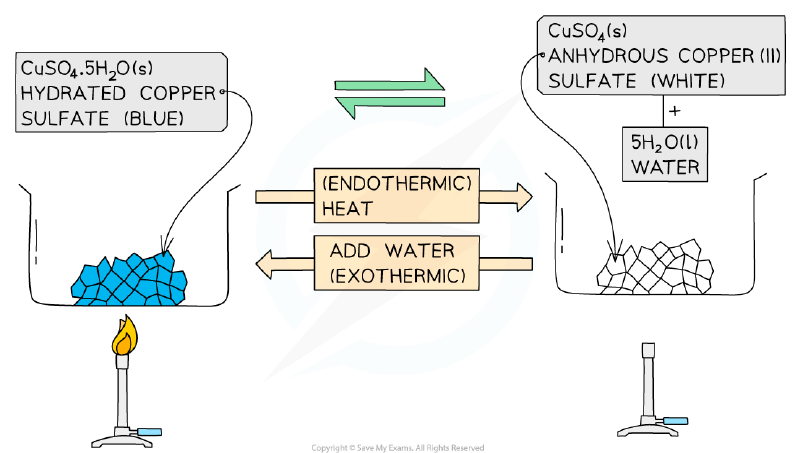
Hydrated copper(II) sulfate (blue) heated to anhydrous copper(II) sulfate (white); adding water reverses the change
Energy Changes in Reversible Reactions
- If a reversible reaction is exothermic in one direction, it is endothermic in the opposite direction.
- The same amount of energy is transferred in each direction.
- Example: heating hydrated copper(II) sulfate (blue) drives off water to form anhydrous copper(II) sulfate (white); this forward reaction is endothermic.
- Adding water to anhydrous copper(II) sulfate turns it blue again and releases heat; this reverse reaction is exothermic.
- The equation is: CuSO₄·5H₂O (s) ⇌ CuSO₄ (s) + 5H₂O (l).
Dynamic Equilibrium
- Dynamic equilibrium is reached when the rate of the forward reaction equals the rate of the reverse reaction.
- At equilibrium, the concentrations of reactants and products remain constant, but the reactions do not stop.
- Equilibrium can only be reached in a closed system, where no substances can enter or leave.
- In a closed system, the forward and reverse reactions continue at equal rates, so the amounts of reactants and products stay the same.
- Example: in the Haber process, N₂(g) + 3H₂(g) ⇌ 2NH₃(g), equilibrium is reached in a closed container.
The Haber Process
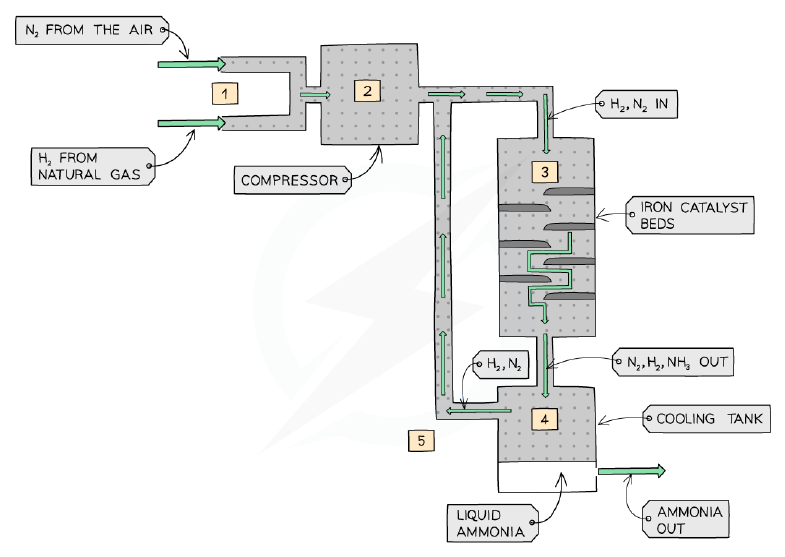
- Ammonia is manufactured by the Haber process from nitrogen and hydrogen.
- The equation is: N₂(g) + 3H₂(g) ⇌ 2NH₃(g).
- The forward reaction is exothermic.
- Typical conditions: temperature about 450 °C, pressure about 200 atmospheres, and an iron catalyst.
- Nitrogen is obtained from the air and hydrogen is obtained from natural gas.
- The reaction is reversible, so unreacted nitrogen and hydrogen are recycled back into the reactor.
Equilibrium and the Haber process
The Position of Equilibrium
- The position of equilibrium describes the relative amounts of reactants and products at equilibrium.
- If the position shifts to the right, more products are formed; if it shifts to the left, more reactants are formed.
- Le Chatelier’s principle states that when a change is made to a system at equilibrium, the system moves to oppose the change.
- The position of equilibrium can be changed by altering temperature, pressure, or concentration.
- A catalyst speeds up both the forward and reverse reactions equally, so it does not change the position of equilibrium or the yield.
Effect of Changing Concentration
- If the concentration of a reactant is increased, the equilibrium shifts to the right to make more product.
- If the concentration of a reactant is decreased, the equilibrium shifts to the left to make more reactant.
- If the concentration of a product is decreased, the equilibrium shifts to the right to make more product.
- Changing concentration pushes the system away from equilibrium, and it responds to restore equilibrium.
Effect of Temperature Changes
- If the temperature is increased, the equilibrium shifts in the direction of the endothermic reaction.
- If the temperature is decreased, the equilibrium shifts in the direction of the exothermic reaction.
- For an exothermic forward reaction, increasing temperature shifts the equilibrium to the left, reducing the yield of products.
- For an endothermic forward reaction, increasing temperature shifts the equilibrium to the right, increasing the yield of products.
Effect of Pressure Changes
- Changes in pressure only affect reactions involving gases.
- An increase in pressure shifts the equilibrium towards the side with the fewer gas molecules.
- A decrease in pressure shifts the equilibrium towards the side with the more gas molecules.
- If the number of gas molecules is the same on both sides, pressure has no effect on the position of equilibrium.
- Example: in N₂(g) + 3H₂(g) ⇌ 2NH₃(g), increasing pressure shifts equilibrium to the right because there are fewer gas molecules on the product side.
स्लाइड्स
Sign up free to view the lesson slides
Step through every slide for this topic — plus flashcards and revision notes — with a free account.
प्रैक्टिस सवाल
फ्री प्रीव्यू — 62 में से 8 सवाल। सभी देखने के लिए साइन अप करें।
1.What does the symbol ⇌ in a chemical equation mean?
Easy- AThe reaction is reversible
- BThe reaction releases energy
- CThe reaction has stopped
- DThe reaction needs a catalyst
2.Which statement about the Haber process is true?
Medium- AA higher yield of ammonia is obtained at lower temperatures
- BA pressure of 450 atmospheres is used
- CCopper is used as a catalyst
- DA higher yield of ammonia is obtained at lower pressures
3.Which two statements about a system at dynamic equilibrium are correct? (select all that apply)
Hard- AThe rate of the forward reaction equals the rate of the reverse reaction
- BThe concentrations of reactants and products remain unchanged
- CThe concentrations of reactants and products are equal
- DThe position of equilibrium cannot be changed
- EA catalyst is needed to establish dynamic equilibrium
4.At equilibrium, the forward and reverse reactions have stopped.
EasyTrue or false?
5.Equilibrium can only be reached in a closed system.
EasyTrue or false?
6.Place the stages of the Haber process in the correct order.
Medium- Hydrogen and nitrogen are obtained from natural gas and air
- Gases are compressed to about 200 atmospheres
- Gases pass over iron catalyst beds at 450°C
- Ammonia is liquefied and removed
- Unreacted hydrogen and nitrogen are recycled
7.Match each term with its correct definition.
Medium- Reversible reaction
- Dynamic equilibrium
- Closed system
- A reaction that can go in both forward and reverse directions
- When the rates of forward and reverse reactions are equal and concentrations remain constant
- A system where no reactants or products can escape
8.Which row correctly shows the type of reaction for the forward and backward reactions?
Medium- AForward: endothermic, Backward: exothermic
- BForward: exothermic, Backward: endothermic
- CForward: endothermic, Backward: endothermic
- DForward: exothermic, Backward: exothermic
Unlock all 62 questions, flashcards & more
इस टॉपिक के हर सवाल, स्लाइड्स, फ्लैशकार्ड और रिवीज़न नोट्स देखने के लिए फ्री अकाउंट बनाएं।