Red-shift
खेलकर सीखें
इन सवालों के जवाब देकर एनर्जी कमाएं, फिर मछली पकड़ें और घूमें। कोई अकाउंट नहीं चाहिए।
लेसन नोट्स
The Doppler Effect
- When a wave source is stationary, its wavefronts spread out symmetrically in all directions.
- If the source moves, the wavefronts become squashed in front of it and stretched out behind it.
- The Doppler effect is the change in observed frequency or wavelength caused by relative motion between a source and an observer.
- In front of a moving source, the wavelength decreases and the frequency increases.
- Behind a moving source, the wavelength increases and the frequency decreases.
- Wavelength and frequency are inversely related: if one increases, the other decreases.
Red-shift and Blue-shift
- The Doppler effect affects light as well as sound.
- If a light source moves away from an observer, its wavelength increases — this is called red-shift because the light shifts towards the red end of the spectrum.
- If a light source moves towards an observer, its wavelength decreases — this is called blue-shift because the light shifts towards the blue end of the spectrum.
- Red-shift is defined as the observed increase in wavelength of light due to the source moving away from the observer.
- In the visible spectrum, red light has the longest wavelength and the lowest frequency; blue light has a shorter wavelength and higher frequency.
- An increase in wavelength means a decrease in frequency, and vice versa.
Galactic Red-shift and the Expanding Universe
- Light from most distant galaxies is observed to be red-shifted.
- This shows that distant galaxies are moving away from the Earth and from each other.
- The further away a galaxy is, the greater its red-shift and the faster it is moving away.
- This relationship — distance proportional to speed — is evidence that the universe is expanding.
- Red-shift is caused by space itself expanding between galaxies, which stretches the light waves as they travel.
- The observed red-shift provides evidence for the Big Bang theory.
The Big Bang Theory
- The Big Bang theory states that around 14 billion years ago the universe began from a very small region that was extremely hot and dense.
- A giant explosion — the Big Bang — caused the universe to expand from a single point, cooling as it did so.
- Each point in the universe expands away from the others; galaxies move away from each other, and the further away they are, the faster they move.
- As a result of the initial explosion, the universe continues to expand today.
- If you could travel back in time, galaxies would become closer together until the entire universe was a single point.
- The Steady State theory was the main rival to the Big Bang until the mid-1960s; it suggested the universe has always existed and new galaxies form in the gaps as others move apart.
- The Steady State theory could not explain the Cosmic Microwave Background radiation, so it is no longer accepted.
The Big Bang and expansion of the Universe
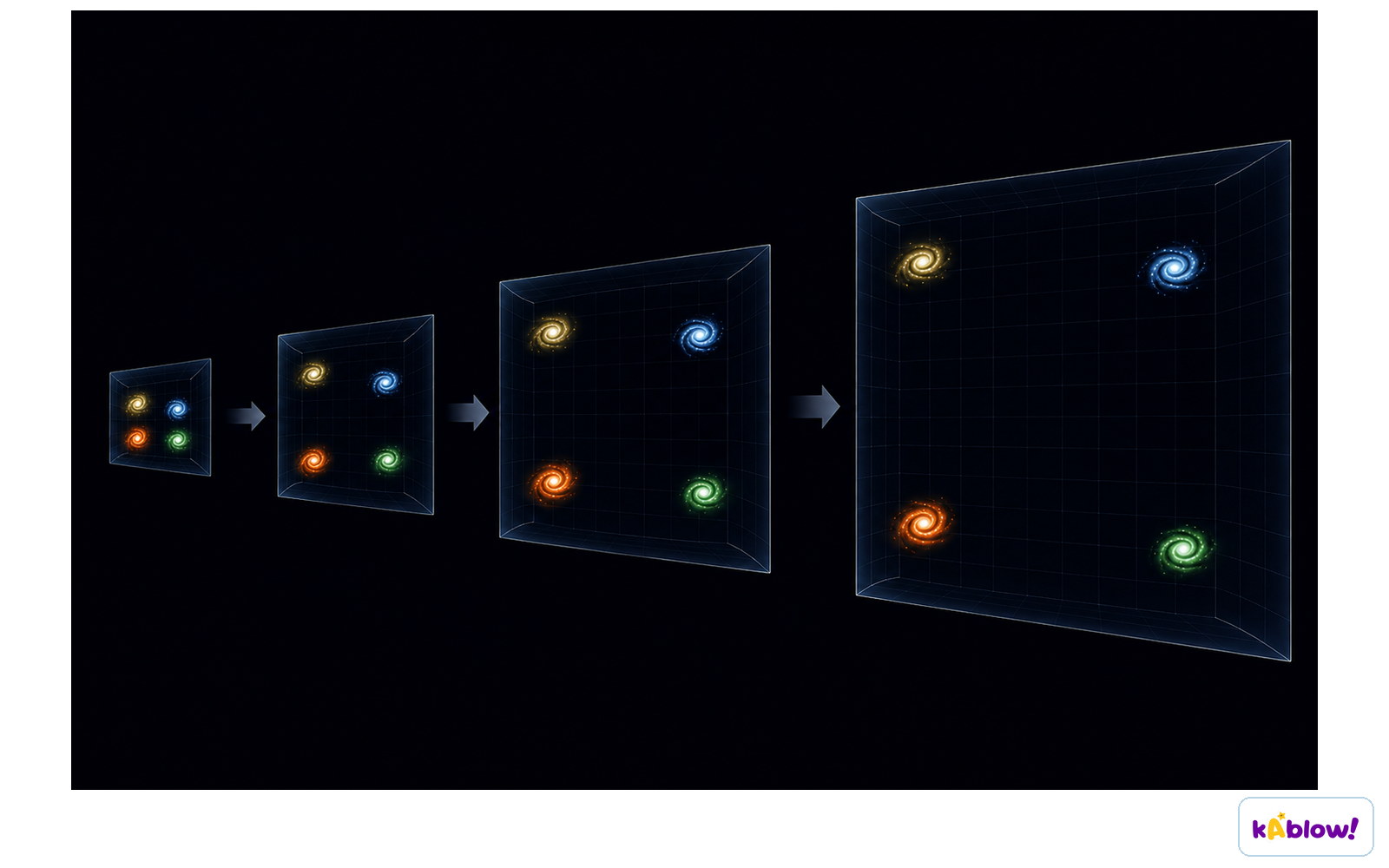
Evidence for the Big Bang: Red-shift and Supernovae
- By observing light spectra from supernovae in other galaxies, astronomers found evidence that distant galaxies are receding even faster than nearby ones.
- These observations were first made in 1998.
- The light spectra show that light from distant galaxies is red-shifted, which is evidence that the universe is expanding.
- This matches what is expected after an explosion: matter starts densely packed and moves out in all directions, with lighter matter travelling faster and further.
- The galaxies that are furthest away are moving the fastest — their distance is proportional to their speed.
- Tracing the expansion back to the beginning leads to the idea that the universe began with a Big Bang.
Evidence for the Big Bang: Cosmic Microwave Background (CMB) Radiation
- According to the Big Bang theory, the early universe was extremely hot and dense, so it must have emitted thermal radiation.
- In 1964, astronomers discovered radiation in the microwave region of the electromagnetic spectrum coming from all directions at a temperature of about 2.73 K.
- This is the Cosmic Microwave Background (CMB) radiation, thought to be the remains of thermal energy from the Big Bang.
- The radiation is in the microwave region because over the past 14 billion years it has been red-shifted as the universe expanded.
- Initially it would have been high-energy radiation towards the gamma end of the spectrum; as the universe expanded, its wavelength increased into the microwave region.
- The CMB is very uniform and has the exact profile expected from a hot body that has cooled over a very long time.
- This phenomenon cannot be explained by the Steady State theory, which is why the Big Bang became the accepted model.
The CMB Map
- The CMB is represented by a map showing tiny temperature variations across the sky.
- Different colours represent different temperatures: red/orange/brown regions are warmer and indicate a higher density of galaxies.
- Blue/green regions are cooler and indicate a lower density of galaxies.
- The temperature of the CMB is mostly uniform, with minuscule fluctuations of about 0.00001 K.
- This implies that all objects in the universe are more or less uniformly spread out.
Dark Energy and Dark Matter
- Evidence from the rotation and motion of galaxies suggests there is much more matter in the universe than we can account for.
- This unseen matter is called dark matter; its nature is not currently known.
- Measurements of the expansion of the universe using supernovae suggest that the universe is starting to expand at a faster rate.
- It has been suggested that this accelerated expansion is caused by dark energy pushing everything apart.
- If gravity acted alone, everything might be expected to become closer together, but we observe the opposite.
- Dark energy is a possible solution that could be counteracting gravity and causing the universe to expand faster.
- There is still much about the universe that is not understood, including dark matter and dark energy.
स्लाइड्स
Sign up free to view the lesson slides
Step through every slide for this topic — plus flashcards and revision notes — with a free account.
प्रैक्टिस सवाल
फ्री प्रीव्यू — 60 में से 8 सवाल। सभी देखने के लिए साइन अप करें।
1.Light from a distant galaxy is observed to be red-shifted. Which row correctly describes the change in frequency and wavelength of the light when it is observed on Earth?
Medium- AFrequency decreases, wavelength increases
- BFrequency increases, wavelength decreases
- CFrequency decreases, wavelength decreases
- DFrequency increases, wavelength increases
2.Which of the following statements provides evidence that the universe is expanding?
Medium- ALight from galaxies is red-shifted
- BNuclear fusion occurs in stars
- CMany stars have orbiting planets
- DStars form from large clouds of dust and gas
3.An astronomer observes that light from a galaxy has been shifted towards the blue end of the spectrum. What can be deduced about the motion of the galaxy from this observation?
Medium- AThe galaxy is moving towards the Earth
- BThe galaxy is moving away from the Earth
- CThe galaxy is not moving relative to the Earth
- DThe galaxy is expanding
4.Light from distant galaxies appears red-shifted to observers on Earth. Which of the following ideas does this provide evidence for? 1. The Big Bang Theory 2. The Universe is expanding 3. Distant galaxies are moving both towards us and away from us
Medium- A1 and 2
- B1 only
- C2 only
- D1, 2 and 3
5.Wavelengths observed from a distant galaxy are compared with the same wavelengths from a laboratory source, and are found to be red-shifted. Which statement about the red-shifted light is correct?
Medium- AAll the lines move towards the 'long λ' side by the same amount
- BAll the lines move towards the 'short λ' side by the same amount
- CAll the lines move towards the 'long λ' side by different amounts
- DAll the lines move towards the 'short λ' side by different amounts
6.Which of the following is the main piece of evidence that led to the Big Bang theory becoming the accepted model over the Steady State theory?
Medium- AThe discovery of cosmic microwave background radiation
- BThe observation that stars are powered by nuclear fusion
- CThe fact that galaxies are made up of billions of stars
- DThe observation that the Sun is a medium-sized star
7.Red-shift of light from distant galaxies provides evidence that the universe is expanding.
EasyTrue or false?
8.The Big Bang theory states that the universe began from a very small region that was extremely hot and dense.
EasyTrue or false?
Unlock all 60 questions, flashcards & more
इस टॉपिक के हर सवाल, स्लाइड्स, फ्लैशकार्ड और रिवीज़न नोट्स देखने के लिए फ्री अकाउंट बनाएं।