Energy flow and nutrient cycles
खेलकर सीखें
इन सवालों के जवाब देकर एनर्जी कमाएं, फिर मछली पकड़ें और घूमें। कोई अकाउंट नहीं चाहिए।
लेसन नोट्स
Big idea: energy flows, matter cycles
- Big idea (key concept): Systems. An ecosystem is a system. Living things and their surroundings are linked by flows of energy and cycles of matter.
- Related concept: Energy. Energy cannot be made or destroyed, only transferred. Tracking where it goes explains why ecosystems look the way they do.
- Global context: Globalization and sustainability. Food supplies, climate and water all depend on these flows, so understanding them helps us plan how to feed people without damaging the planet.
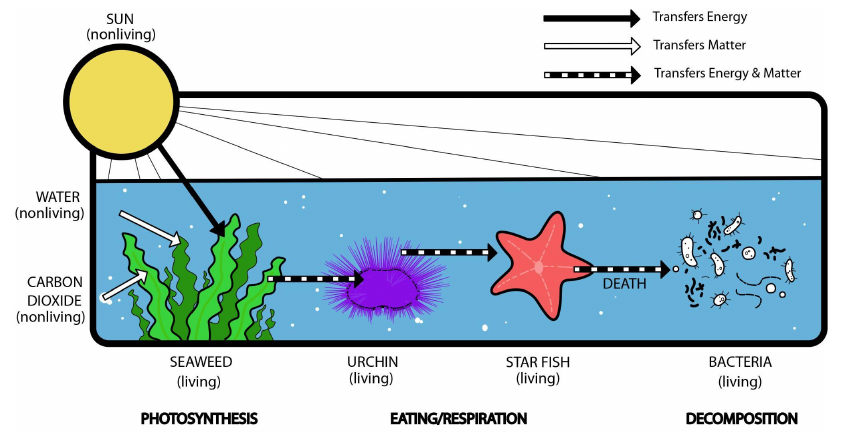
- Almost all energy enters an ecosystem as light from the Sun. Producers capture it by photosynthesis and store it as chemical energy in food.
- Energy flows one way: Sun, then producers, then consumers, then to the surroundings as heat. It is never recycled, so ecosystems need a constant supply of sunlight.
- Matter such as carbon, water and nitrogen cycles. The same atoms are used again and again, passing between living things, the air, water and soil.
Energy and matter moving through a tide pool
Food chains and trophic levels
- A food chain shows who eats whom. The arrows point in the direction energy and matter are transferred, from the food to the feeder.
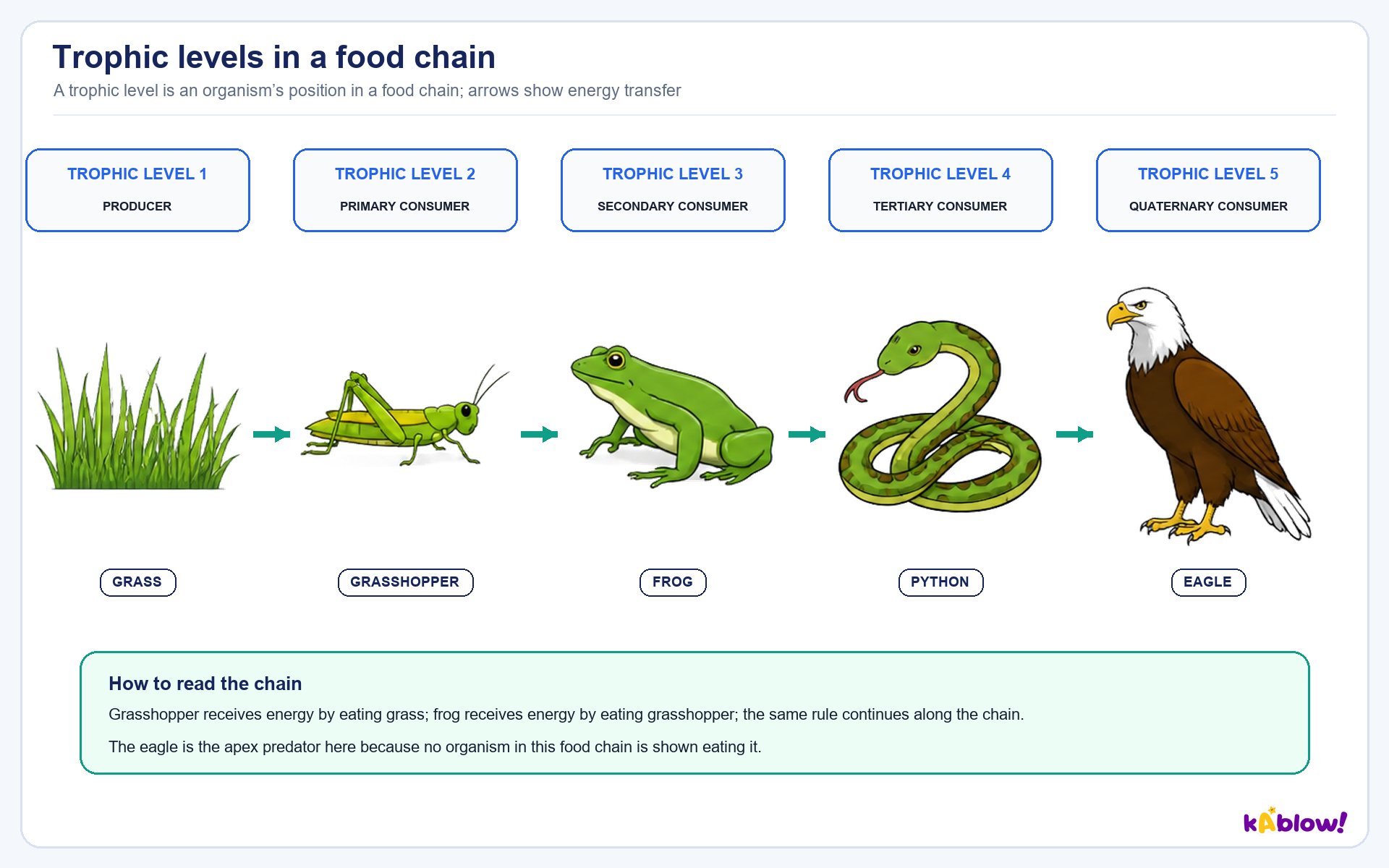
- Each step is a trophic level. Level 1 is the producer. Level 2 is the primary consumer (eats producers). Then secondary and tertiary consumers eat other animals.
- Example: grass, grasshopper, frog, python, eagle. Grass is level 1 and the eagle is level 5. The eagle is the apex predator because nothing in the chain eats it.
- Animals are classed by diet: herbivores eat plants, carnivores eat animals and omnivores eat both. One animal can sit at different levels in different chains.
- Decomposers (bacteria and fungi) feed on dead remains and waste from every level, so they link to all of them.
- Real ecosystems are food webs, many interlinked chains. If one species falls in number, many others are affected.
Trophic levels from grass to eagle
Energy transfer, efficiency and pyramids
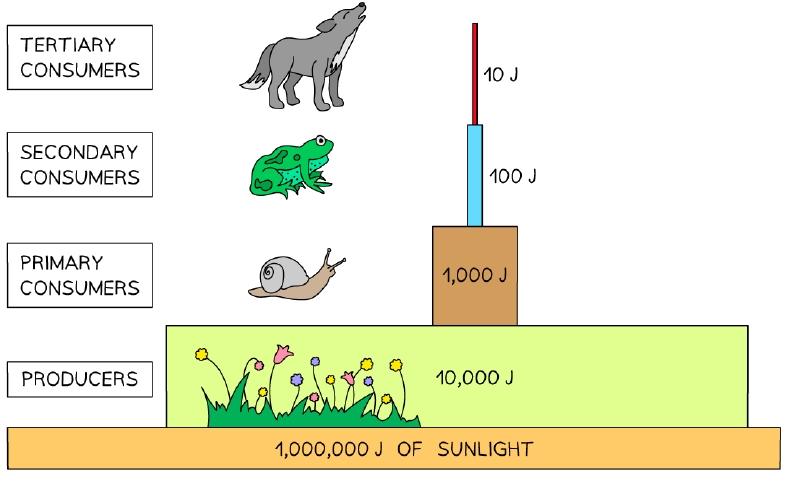
- Only about 10% of the energy at one trophic level is passed to the next. The rest is lost. In a pyramid of energy the bars shrink quickly: for example 10,000 J in producers, 1,000 J in primary consumers and 100 J in secondary consumers.
- Percentage efficiency = energy passed on ÷ energy available × 100. If primary consumers get 1,000 J from 10,000 J in the producers, the efficiency is 1,000 ÷ 10,000 × 100 = 10%.
- Energy is lost as heat from respiration, as movement and other life processes, in faeces and urine, and in parts that are not eaten such as roots, bones and fur. It is not destroyed: it spreads into the surroundings.
- This is why food chains rarely have more than four or five levels, and why there are far fewer top predators than herbivores. Eating crops directly also wastes less energy than feeding crops to animals and eating the animals.
- A pyramid of biomass shows the dry mass of living material at each level. It is usually pyramid-shaped. Dry mass is used because water content varies. Ocean pyramids can be narrower at the base, because fast-reproducing phytoplankton have a small mass at any moment.
- A pyramid of numbers counts organisms and can look odd: one oak tree feeds hundreds of caterpillars. A pyramid of energy over a year is never inverted, because energy is lost at every step.
A pyramid of energy with 10% passed on at each level
The carbon cycle and the water cycle
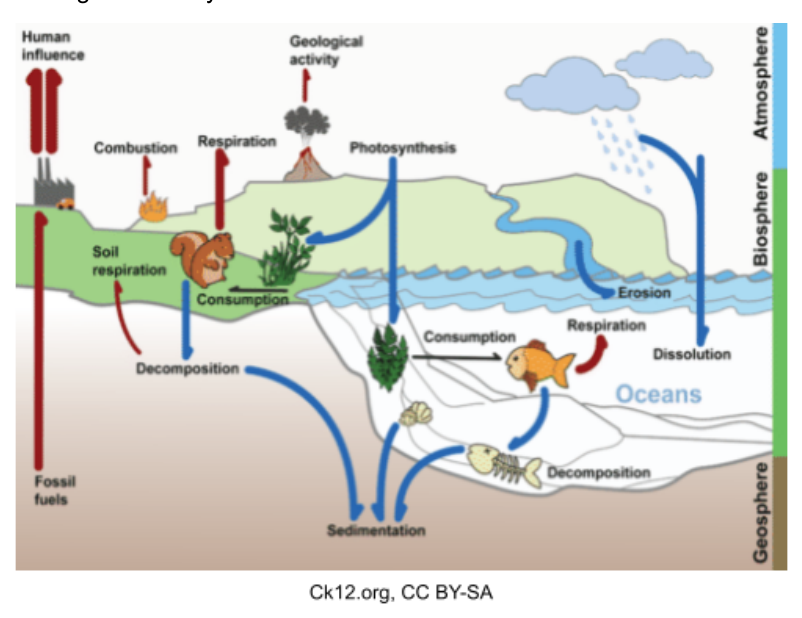
- Carbon dioxide makes up only about 0.04% of the air, but it is the starting point of the carbon cycle. Photosynthesis removes carbon dioxide from the air and turns it into carbon compounds in plants.
- Carbon passes along food chains by feeding. All organisms, including plants and decomposers, return carbon dioxide to the air by respiration.
- When organisms die, decomposers break them down and release carbon dioxide. Over millions of years, buried remains can become fossil fuels. Burning wood or fossil fuels (combustion) releases the carbon dioxide quickly.
- Humans burn fossil fuels and clear forests faster than natural processes remove carbon dioxide, so the amount in the air is rising. Oceans also take in and release carbon dioxide.
- The water cycle is powered by the Sun and gravity. Evaporation turns liquid water into vapour, and plants lose vapour from their leaves by transpiration.
- Vapour cools and condenses into clouds. Precipitation (rain, snow) brings water to the ground, where it soaks in or flows as runoff into rivers and back to the sea.
The carbon cycle
Decomposers: recycling nutrients
- Decomposers are mainly bacteria and fungi. They break down dead plants, dead animals and waste. Detritivores such as earthworms and woodlice help by breaking material into small pieces first.
- Decomposers release enzymes onto the dead material. The enzymes break it into small, soluble molecules, and the decomposers absorb them.
- As they respire, they release carbon dioxide. They also release mineral ions such as nitrates into the soil, which plants take up through their roots to make proteins.
- Without decomposers, dead material would pile up and nutrients would stay locked inside it. Plants would run out of minerals and the whole food web would collapse.
- Decay is fastest when it is warm, moist and has plenty of oxygen. It is slow in cold, dry conditions, and in waterlogged, acidic peat bogs where oxygen is scarce.
- People use this: compost heaps keep material warm, damp and aerated, so decomposers turn waste into nutrient-rich compost. Food is kept in fridges and freezers to slow decay.
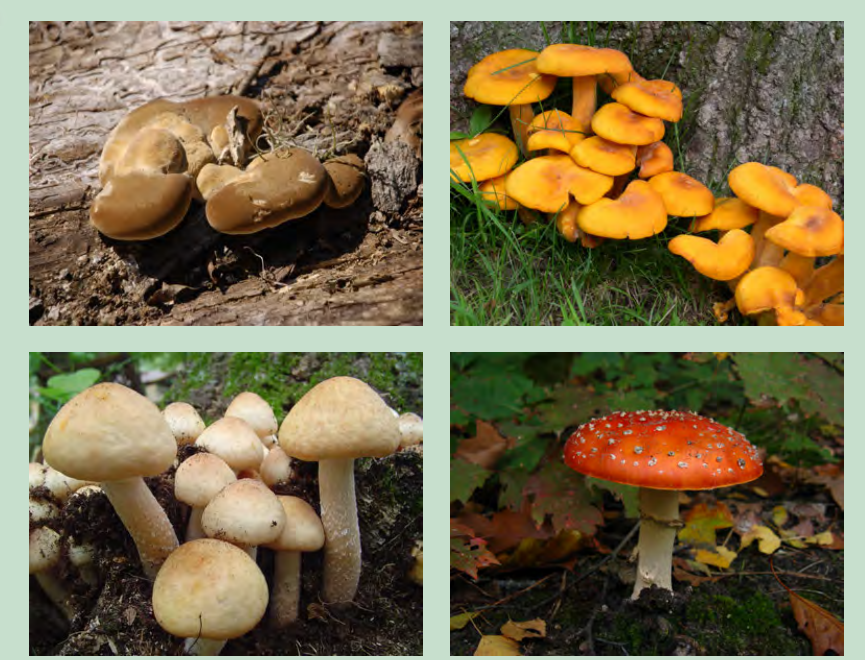
Fungi growing on dead wood and leaf litter
Think like a scientist: what makes things decay?
- Investigation. Put equal masses of dried leaf pieces in mesh bags and bury them in moist soil in identical pots. Keep the pots at different temperatures, for example 5, 15, 25 and 35 °C. After two weeks, dry and weigh the leaf pieces again.
- The independent variable is the temperature. The dependent variable is the mass lost by the leaf pieces (starting mass minus final mass).
- Control variables: the type and starting mass of leaf, the soil type, the amount of water, the size of the pieces, the time and the amount of air. Why must the soil moisture be the same?
- Inquiry task: how many bags would you use at each temperature, and why? Repeat so you can calculate a mean and spot an anomaly, and decide how you would dry the leaves to the same level each time.
- Evaluate: at 55 °C the decay is likely to slow down again, because heat damages the enzymes and kills the decomposers. What does that tell you about the claim that warmer always means faster?
- Data skill: to compare energy transfer between two food chains, calculate the percentage efficiency each time and compare the percentages, not the raw numbers.
स्लाइड्स
Sign up free to view the lesson slides
Step through every slide for this topic — plus flashcards and revision notes — with a free account.
प्रैक्टिस सवाल
फ्री प्रीव्यू — 49 में से 8 सवाल। सभी देखने के लिए साइन अप करें।
1.What is the original source of energy for almost all food chains?
Easy- AFossil fuels
- BThe Sun
- CThe wind
- DThe soil
2.What is a producer?
Easy- AAn animal that eats other animals
- BAn organism that breaks down dead material
- CAn organism that makes its own food, usually by photosynthesis
- DAn animal that eats only plants
3.A primary consumer eats producers.
EasyTrue or false?
4.In the food chain grass → rabbit → fox, which organism is the secondary consumer?
Easy- AThe grass
- BThe rabbit
- CThe soil bacteria
- DThe fox
5.What do the arrows in a food chain show?
Easy- AThe direction in which energy is transferred
- BWhich animal is the bigger one
- CWhich organism lives the longest
- DThe direction in which animals migrate
6.Complete the sentence.
EasyAn organism's position in a food chain is called its ____ level.
7.About what percentage of energy is passed on from one trophic level to the next?
Easy- AAbout 90%
- BAbout 10%
- CAbout 50%
- DAbout 1%
8.Energy is recycled round an ecosystem again and again, like carbon is.
EasyTrue or false?
Unlock all 49 questions, flashcards & more
इस टॉपिक के हर सवाल, स्लाइड्स, फ्लैशकार्ड और रिवीज़न नोट्स देखने के लिए फ्री अकाउंट बनाएं।