Genetic technologies: pedigrees, DNA profiling and the genome
खेलकर सीखें
इन सवालों के जवाब देकर एनर्जी कमाएं, फिर मछली पकड़ें और घूमें। कोई अकाउंट नहीं चाहिए।
शिक्षकों के लिए: Genetic technologies: pedigrees, DNA profiling and the genome (MYP Biology, Year 5) के लिए इस्तेमाल के लिए तैयार लेसन स्लाइड्स, रिवीज़न नोट्स — इन्हें अपने लेसन में इस्तेमाल करें, या टॉपिक को एक इंटरैक्टिव क्लास एक्टिविटी की तरह चलाएं जिसे आपके शिक्षार्थी लाइव गेम की तरह खेलें।
लेसन नोट्स
Big idea: genetic information as evidence
- Big idea (key concept): Systems. Genes, chromosomes and the cell work together as a system that stores and passes on information. We can now read that information, and use it for medicine and for justice.
- Related concept: Evidence. A family tree, a DNA profile or a genetic test result is evidence. Good scientists ask how strong the evidence is and what it can and cannot show.
- Global context: Scientific and technical innovation. Sequencing a human genome once took over a decade and billions of dollars. Today it can be done in days for a tiny fraction of the cost. New tools bring new benefits and new ethical questions.
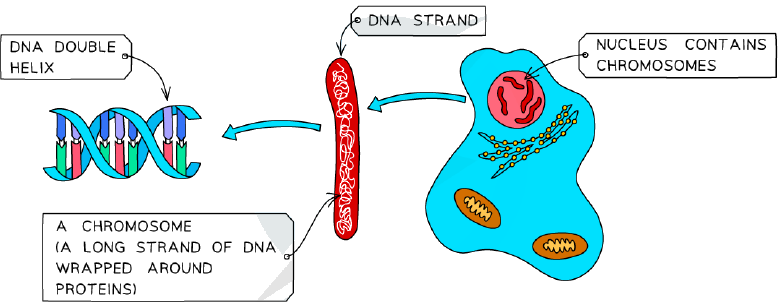
- A gene is a short section of DNA that codes for a protein. Genes are arranged along chromosomes. Humans have 23 pairs of chromosomes in each body cell, 46 in total. The genome is all the genetic material of an organism.
- The human genome has about 3 billion base pairs of DNA and roughly 20 000 genes. Only about 1 to 2 per cent of the DNA codes for proteins. Most of the rest is regulatory or has no known function. Any two people share about 99.9 per cent of their DNA sequence, and the small differences make each of us (apart from identical twins) genetically unique.
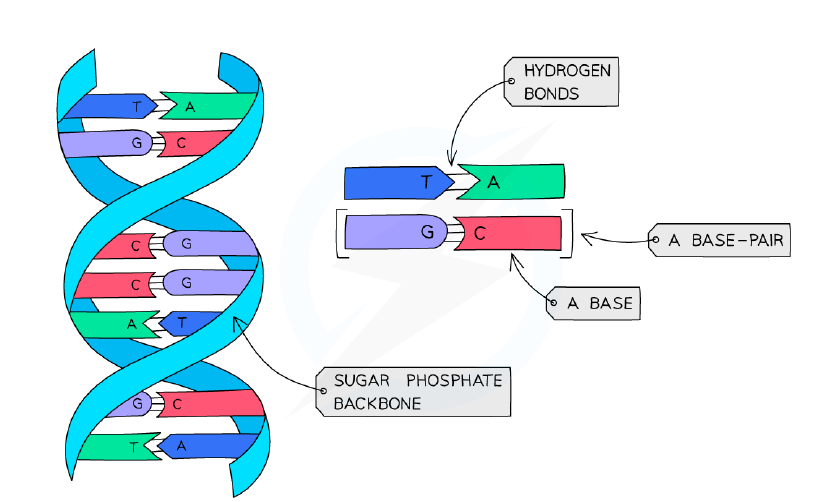
- DNA is made of four bases: A, T, C and G. A always pairs with T and C always pairs with G, held by hydrogen bonds. It is the order of bases along the strand that carries the information.
From the nucleus to the chromosome to the DNA double helix
Reading pedigrees: autosomal recessive and dominant
- A pedigree is a family tree that follows one characteristic. Squares are males and circles are females. A horizontal line joins a couple, a vertical line leads to their children, and shaded symbols show affected people. Generations are numbered I, II, III from the top.
- Autosomal means the gene is on one of the 22 pairs of non-sex chromosomes, so males and females are equally likely to be affected.
- Autosomal recessive (for example cystic fibrosis, sickle cell disease). The condition needs two copies of the allele. Clue: two unaffected parents have an affected child, because both are carriers. It often skips generations. Each child of two carriers has a 25% chance of being affected, a 50% chance of being a carrier and a 25% chance of being neither.
- Autosomal dominant (for example Huntington's disease, polydactyly). One copy of the allele is enough. Clue: every affected person has at least one affected parent, and the condition appears in every generation. A person with one copy has a 50% chance of passing it to each child. Two affected parents can still have an unaffected child if both are heterozygous.
- Huntington's disease usually causes symptoms only in adulthood, so a person can have children before they know they carry the allele. This is one reason genetic counselling and testing are important in affected families.
- Working method. (1) Look for unaffected parents with an affected child, which means recessive. (2) Look for an affected child with an affected parent in every generation, which suggests dominant. (3) Write the genotype of each person you can be sure about. (4) Check your idea against every family, because one counter-example rules a pattern out.
X-linked inheritance and calculating risk
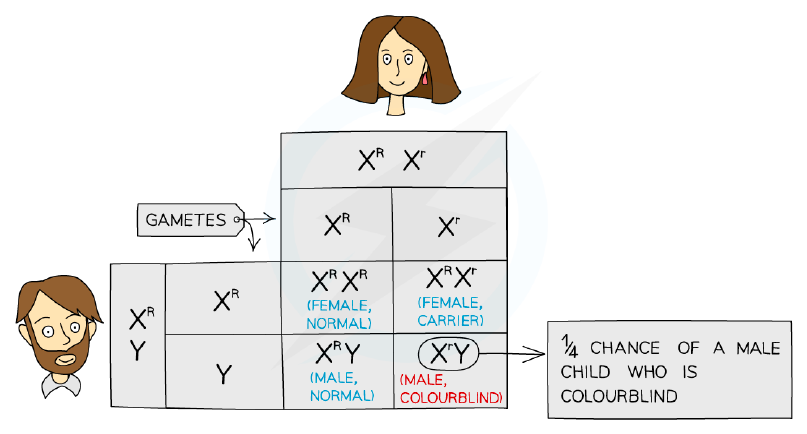
- Some genes are on the X chromosome. Females are XX and males are XY. A male has only one X, so a single recessive allele on it will show. A female needs two copies, so she is usually a carrier.
- X-linked recessive examples are haemophilia (the blood does not clot properly) and red-green colour blindness. Clues: many more affected males than females; an affected father cannot pass it to his sons (he gives them his Y); all his daughters are carriers; a carrier mother passes it to half her sons.
- Worked example. A carrier mother (XHXh) and an unaffected father (XHY). Their children are XHXH (unaffected daughter), XHXh (carrier daughter), XHY (unaffected son) and XhY (affected son). Each son has a 50% chance of being affected and each daughter has a 50% chance of being a carrier, but no daughter is affected. Across all children the chance of an affected child is 1 in 4.
- An affected father (XhY) and an unaffected non-carrier mother (XHXH) have children XHXh (carrier daughters) and XHY (unaffected sons), so no children are affected but all the daughters are carriers.
- Multi-step risk. If a woman's brother has haemophilia and her parents are unaffected, her mother must be a carrier, so the woman has a 1 in 2 chance of being a carrier. The chance that her son is affected is then 1/2 x 1/2 = 1 in 4.
- Conditional risk. Two carriers of an autosomal recessive condition have an unaffected child. The child is either homozygous dominant (1 box) or a carrier (2 boxes) out of the 3 unaffected boxes, so the chance the child is a carrier is 2 in 3, not 1 in 2. For population risk, multiply independent chances: if 1 in 25 people carry the cystic fibrosis allele, the chance that a random couple are both carriers is 1/25 x 1/25 = 1/625, and the chance of an affected child is 1/625 x 1/4 = 1 in 2500.
A cross for a recessive allele carried on the X chromosome
DNA profiling: how it works and where it falls short
- A DNA profile is a pattern of DNA fragments that is almost unique to a person. It does not read the whole genome. It looks at short tandem repeats (STRs), short sequences in non-coding DNA that repeat over and over. The number of repeats at each position varies a lot between people.
- Step 1: extract the DNA from a sample such as blood, saliva, a hair root or skin cells. Step 2: copy it. The polymerase chain reaction (PCR) makes millions of copies of the chosen STR regions, so even a tiny crime-scene sample is enough. The copies are labelled so that they can be seen.
- Step 3: separate the fragments by size using gel electrophoresis. The DNA is placed in wells at one end of a gel and an electric current is applied. DNA is negatively charged, so it moves toward the positive electrode. Shorter fragments travel further through the gel than longer ones.
- Step 4: compare the bands. Samples from the same person give the same pattern of bands. A crime-scene profile and a suspect's profile that match at every position are a match. Relatives share some bands, because they inherit DNA from common ancestors. A child gets half of its bands from each parent.
- Reading a paternity test. Every band in the child must come from the mother or from the father. Bands in the child that the mother does not have must come from the father. A man who lacks any of those bands cannot be the father.
- Uses include identifying a suspect or clearing an innocent person, paternity and family-relationship testing, identifying human remains after a disaster, checking the origin of ivory or timber, and monitoring endangered species.
- A match is evidence, not proof. A profile uses a limited number of positions, so there is always a small random match probability. A statement such as '1 in 20 million' means that, in a population of 60 million, about 3 people would be expected to match by chance.
- The prosecutor's fallacy is to say '1 in 20 million is the chance the suspect is innocent'. It is not. It is the chance that a random person matches. A DNA match has to be weighed with other evidence.
- Other limits: identical twins have the same profile, a sample can be contaminated or degraded, a mixture of several people's DNA is hard to read, and DNA at a scene shows that someone was there at some time, not when or why. National DNA databases raise privacy questions about who is stored and for how long.
The DNA double helix with complementary base pairs
The genome, genetic testing and ethics
- The Human Genome Project (1990 to 2003) was an international effort to work out the order of all the bases in human DNA. It was one of the largest projects in biology. It identified the genes, showed that humans have far fewer genes than expected, and gave a reference genome.
- Knowing the genome has helped find genes linked to disease, understand how medicines work in different people (personalised medicine) and speed up diagnosis of rare conditions. It does not mean we can predict every health outcome: most common conditions, such as heart disease, depend on many genes and the environment.
- Today a human genome can be sequenced in a few days, at a small fraction of the original cost. Cheaper sequencing means more testing, more data and more questions about how that data is used.
- Types of genetic test. Carrier testing checks whether a healthy person has one copy of a recessive allele. Prenatal testing checks a developing fetus, from a blood sample, or with procedures such as amniocentesis that carry a small risk of miscarriage. Newborn screening (a heel-prick blood sample) finds treatable conditions early. Predictive testing shows the risk of a condition appearing later. Diagnostic testing confirms a condition in someone with symptoms.
- Benefits: early treatment, informed choices about family planning, targeted care and, for some conditions, preventing disease through changes in lifestyle or medicine. Embryos can also be tested during IVF for a serious inherited condition.
- Risks and concerns: results are often a risk, not a certainty. Tests can give false positives (saying a condition is present when it is not) and false negatives. A result can cause anxiety, and can affect relatives who share the same genes. There are worries about privacy, about discrimination by insurers or employers, and about a person's right not to know about an untreatable condition.
- Consent and children. Should a child be tested for a condition that only appears in adulthood? Many guidelines advise waiting until the person can decide for themselves, unless testing would change their treatment now.
- Fairness. Genetic tests, and the treatments that follow, are not equally available in all countries or to all families. Databases that mainly contain DNA from people of European ancestry can give less accurate results for others.
- A balanced evaluation gives benefits and risks, says who is affected, and avoids telling any individual what they should choose. Different people reach different decisions for good reasons.
Think like a scientist: extracting DNA and evaluating DNA evidence
- A teacher-led practical can extract DNA from fruit such as strawberries: crush the fruit, add a detergent and salt solution, filter, then gently layer ice-cold ethanol (supplied and handled by the teacher) on top. White strands of DNA come out of solution where the layers meet.
- Planning a fair test. Suppose you compare the effect of detergent concentration on how much DNA is extracted. The independent variable is the detergent concentration. The dependent variable is the amount of DNA, for example the height of the white layer or its mass. Control variables include the mass of fruit, the volume of each liquid, the temperature, the mixing time and the filter used.
- Reliability. Repeat each concentration at least three times and calculate a mean. Treat any result that is far from the others as a possible anomaly and consider repeating it.
- Evaluating DNA evidence. Ask: how many positions were compared? Was the sample complete or partial? Could the sample have been contaminated? Is the match probability stated clearly? What other evidence supports or conflicts with the match?
- Evaluating a claim. A company says its home DNA test 'proves what diseases you will get'. A good evaluation says that most results are risks, that the test looks at only some variants, that a normal result does not rule out a condition and that the claim is too strong for the evidence.
- Inquiry task: design an investigation to find out which of three sources, strawberry, banana or kiwi, gives the most DNA. State your independent, dependent and control variables, describe how you will measure the amount of DNA, say how many repeats you will do, and explain how you would decide whether any difference is real.
स्लाइड्स
Sign up free to view the lesson slides
Step through every slide for this topic — plus flashcards and revision notes — with a free account.
प्रैक्टिस सवाल
फ्री प्रीव्यू — 55 में से 8 सवाल। सभी देखने के लिए साइन अप करें।
1.In a pedigree, what does a square represent?
Easy- AA female
- BAn affected person
- CA male
- DA carrier
2.In a pedigree, what does a shaded symbol show?
Easy- AThe person has the condition
- BThe person is a carrier
- CThe person has died
- DThe person is adopted
3.What is a genome?
Easy- AA single gene that codes for one protein
- BThe number of chromosomes in a cell
- CThe set of proteins in a cell
- DAll of the genetic material of an organism
4.The Human Genome Project aimed to find the order of the bases in human DNA.
EasyTrue or false?
5.In DNA, which base always pairs with adenine (A)?
Easy- AGuanine (G)
- BThymine (T)
- CCytosine (C)
- DUracil (U)
6.Which of these is a use of DNA profiling?
Easy- AMeasuring the blood sugar level of a patient
- BComparing a sample from a crime scene with a suspect's DNA
- CCounting the chromosomes in a plant cell
- DGrowing bacteria on agar plates
7.Which technique separates DNA fragments according to their size?
Easy- APCR
- BFermentation
- CChromatography with ink
- DGel electrophoresis
8.What is the polymerase chain reaction (PCR) used for?
Easy- AMaking many copies of a small amount of DNA
- BCutting DNA into fragments of equal size
- CReading the order of every base in a genome
- DSeparating DNA by electric charge
Unlock all 55 questions, flashcards & more
इस टॉपिक के हर सवाल, स्लाइड्स, फ्लैशकार्ड और रिवीज़न नोट्स देखने के लिए फ्री अकाउंट बनाएं।
पास्ट पेपर
इस टॉपिक के लिए पास्ट-पेपर प्रैक्टिस जल्द आ रही है।
जल्द आ रहा है