Magnets and magnetic fields
खेलकर सीखें
इन सवालों के जवाब देकर एनर्जी कमाएं, फिर मछली पकड़ें और घूमें। कोई अकाउंट नहीं चाहिए।
लेसन नोट्स
Big idea: forces without touching
- Big idea. Key concept: Relationships. Magnets show how two objects can affect each other from a distance.
- Related concept: Interaction. Two magnets interact: each one pushes or pulls the other.
- Global context: Scientific and technical innovation. Magnets are in compasses, motors, speakers, door catches, hard drives and many more machines.
- A magnet is an object that attracts some metals. Every magnet has two poles, a north pole and a south pole, near its ends. The magnetic force is strongest at the poles.
- Magnetic force is a non-contact force. A magnet can pull a paper clip without touching it.
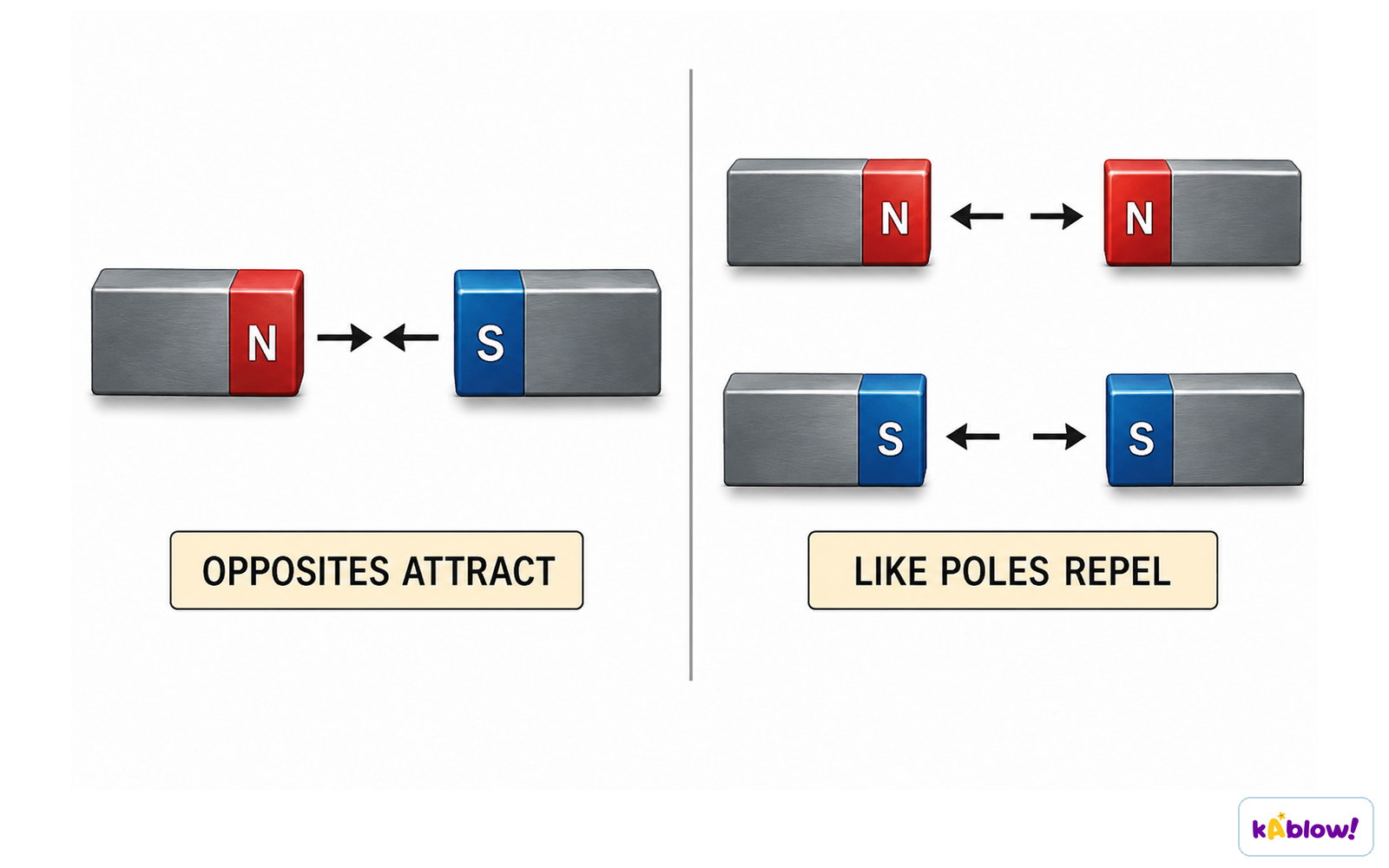
- Unlike poles attract (north and south). Like poles repel (north and north, or south and south).
- If you cut a bar magnet in half, you do not get a north-only piece and a south-only piece. You get two smaller magnets, each with a north and a south pole.
Attraction and repulsion between magnets
Magnetic materials and induced magnets
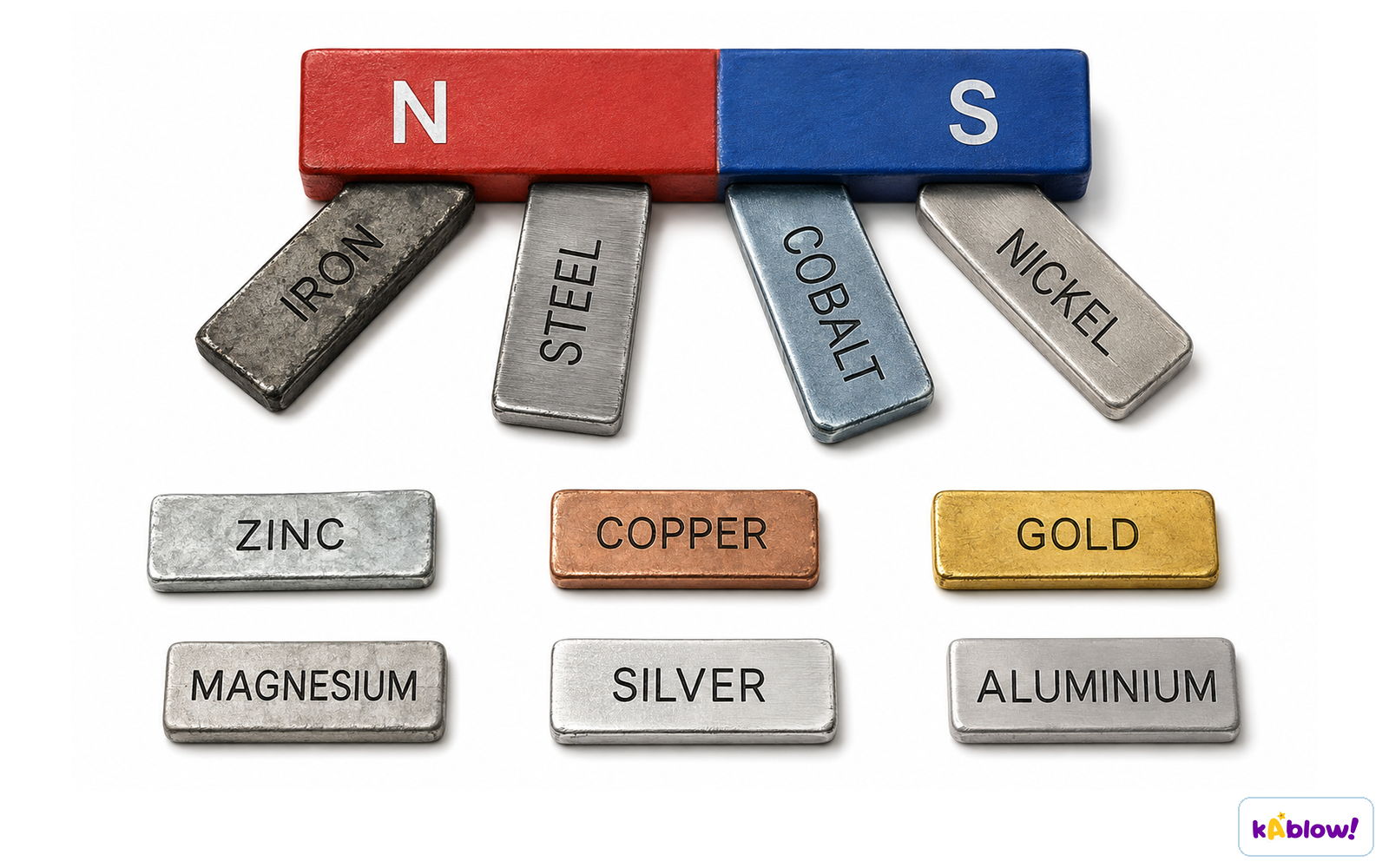
- A magnetic material is attracted to a magnet. The magnetic materials you need to know are iron, steel, nickel and cobalt. Steel is mostly iron, so it is magnetic too.
- Most other materials are not magnetic: copper, aluminium, gold, silver, wood, plastic and glass. Not every metal is magnetic.
- When a magnetic material such as an iron nail is held near a magnet, it becomes a magnet too. We say that magnetism is induced. The end nearest the magnet becomes the opposite pole, so the nail is attracted.
- Iron is a soft magnetic material. It is easily magnetised and loses its magnetism quickly. It makes a temporary magnet.
- Steel is a hard magnetic material. It is harder to magnetise, but it keeps its magnetism. It makes a permanent magnet.
- A permanent magnet can lose its magnetism if it is dropped, hit hard or heated. The only sure test for a magnet is that it repels another magnet. Attraction alone is not enough, because a magnet also attracts unmagnetised iron.
Magnetic and non-magnetic materials
Magnetic fields and field lines
- The magnetic field is the region around a magnet where it can push or pull on magnetic materials and other magnets. You cannot see it, but you can show it.
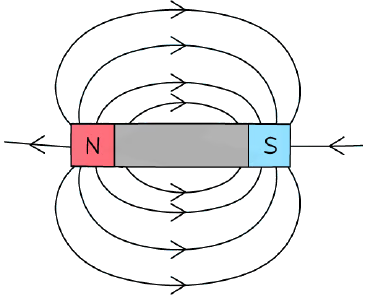
- We draw the field using field lines. Outside the magnet, the lines run from the north pole to the south pole. The arrows show the direction a north pole would be pushed.
- The field is strongest where the lines are closest together, near the poles. It gets weaker further away, where the lines are far apart.
- Field lines never cross each other.
- Sprinkling iron filings on paper above a magnet shows the shape of the field. The filings become tiny magnets and line up along the field.
- Between two unlike poles that face each other, the field lines run straight from one magnet to the other and the magnets are pulled together. Between two like poles, the lines push apart and the magnets are pushed away.
Field lines around a bar magnet
Plotting compasses and the Earth's magnetic field
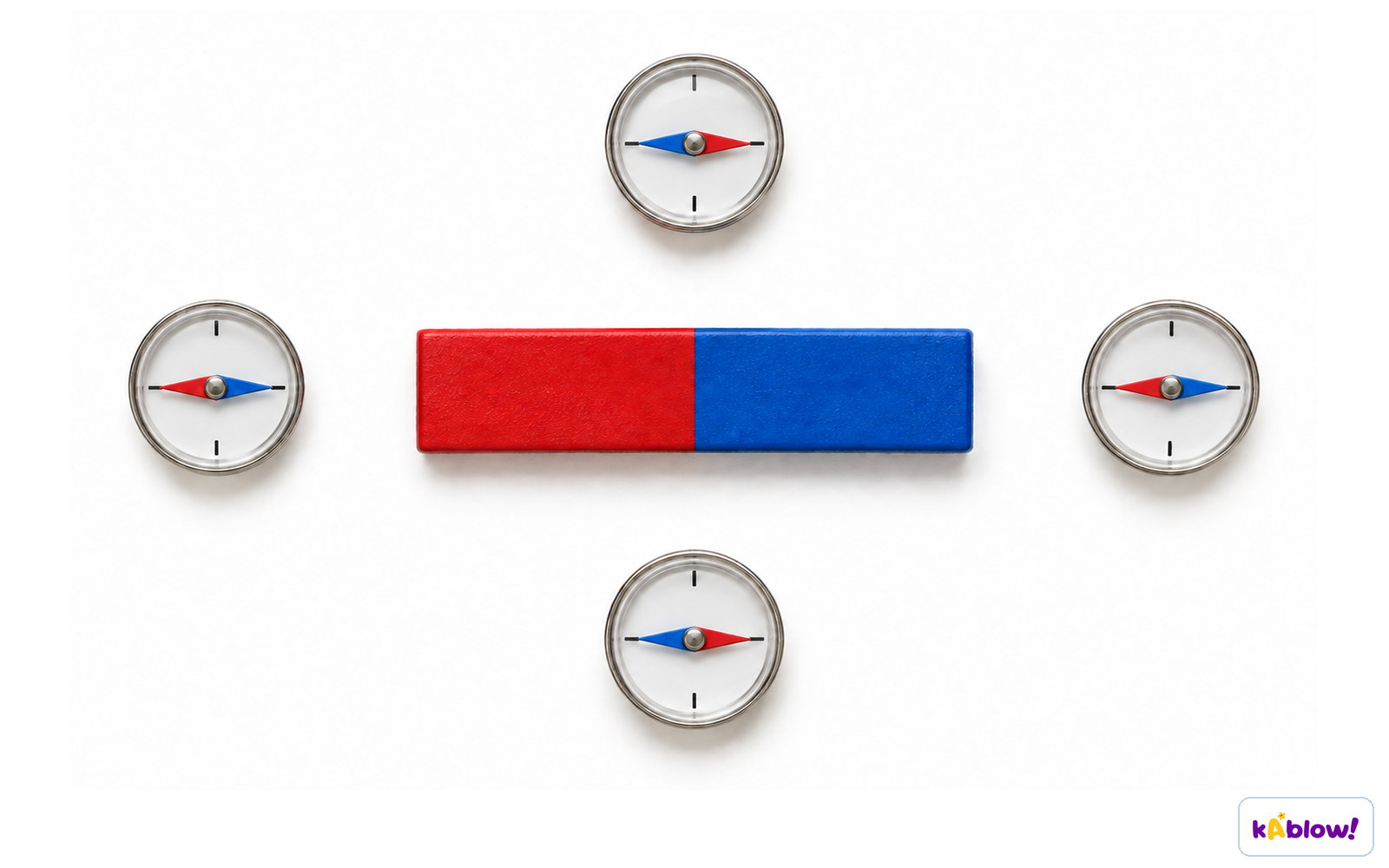
- A plotting compass is a tiny magnet on a pivot, so it is free to turn. It lines up with the magnetic field where it is placed. The north-seeking end of the needle points along the field, away from a north pole and towards a south pole.
- To plot a field line, place a bar magnet on paper. Put the compass near one pole and mark a dot at each end of the needle. Move the compass so that one end sits on the last dot, and repeat. Join the dots, then add an arrow from north to south.
- The Earth has its own magnetic field. It behaves as if there is a giant bar magnet inside it, tilted slightly from the Earth's spin axis.
- Scientists think the field is made by the slow movement of molten iron and nickel in the Earth's outer core.
- A compass needle lines up with the Earth's field, so its north-seeking end points towards the Earth's north. Since opposite poles attract, the magnetic pole in the Arctic must really be a magnetic south pole.
- Animals such as some birds and turtles are thought to use the Earth's field to find their way.
Plotting compasses round a bar magnet
Electromagnets
- An electric current produces a magnetic field. An electromagnet is a coil of wire wrapped round a soft iron core. When current flows, the coil and the core act as a magnet.
- The big advantage is that an electromagnet can be switched on and off. When the current stops, the soft iron loses its magnetism.
- You can make an electromagnet stronger by adding more turns of wire, by using a bigger current, or by using an iron core.
- If you reverse the current, the north and south poles swap over.
- Electromagnets are used in scrapyard cranes that lift and drop iron and steel, in electric bells and in door locks. Very strong ones are used in medical MRI scanners.
- For safety, use low-voltage cells in school. The wire can get warm, so switch the current off between readings.
An electromagnet
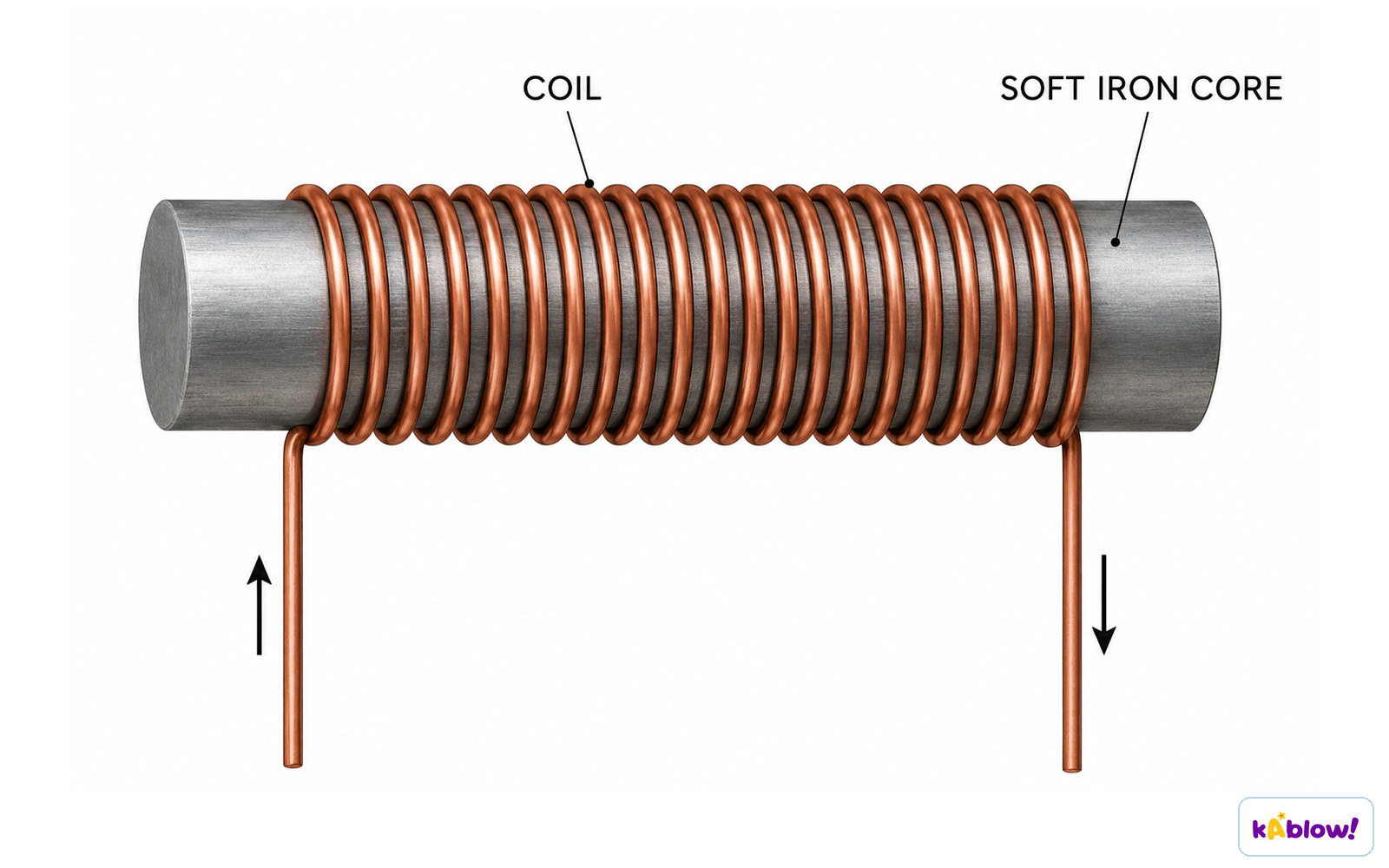
Think like a scientist: how strong is the electromagnet?
- Question: does the number of turns of wire change how strong an electromagnet is?
- The independent variable is the number of turns. The dependent variable is the strength of the electromagnet, which you can measure by counting how many identical paper clips it picks up.
- Control variables include the same cell (same current), the same iron nail and the same size of paper clip.
- Repeat each test three times and find a mean, because the number of clips can change between tries.
- To evaluate your results, ask what could be wrong. The cell may have run down, the clips may have been tangled, or the wire may have heated up.
- Inquiry task: plan a fair test to find out whether the distance between a magnet and a paper clip changes the force on it. List your variables and say how you will measure the distance and the effect.
स्लाइड्स
Sign up free to view the lesson slides
Step through every slide for this topic — plus flashcards and revision notes — with a free account.
प्रैक्टिस सवाल
फ्री प्रीव्यू — 51 में से 8 सवाल। सभी देखने के लिए साइन अप करें।
1.Where is the pull of a bar magnet strongest?
Easy- AIn the middle of the magnet
- BIt is the same everywhere along the magnet
- CNear the poles, at the ends
- DOnly at the north pole, not at the south pole
2.What happens when the north poles of two magnets are brought close together?
Easy- AThey push each other away
- BThey pull towards each other
- CThey have no effect on each other
- DThey swap poles with each other
3.Two magnets are pulling towards each other. Which poles must be facing?
Easy- ATwo north poles
- BTwo south poles
- CIt could be any two poles
- DA north pole and a south pole
4.Which of these objects would a magnet pick up?
Easy- AA piece of aluminium foil
- BA steel paper clip
- CA plastic spoon
- DA wooden pencil
5.What is a magnetic field?
Easy- AThe metal inside the magnet that makes it magnetic in the first place
- BThe region around a magnet where it can push or pull on magnetic materials
- CThe strongest pole at one end of the magnet, where the force acts
- DA kind of force that only ever works when the objects are touching
6.A magnet pulls a paper clip towards it without touching it. What kind of force is this?
Easy- AA contact force
- BA friction force
- CA force that only acts on plastic
- DA non-contact force
7.Which way do magnetic field lines point outside a bar magnet?
Easy- AFrom the north pole to the south pole
- BFrom the south pole to the north pole
- CAway from both poles at the same time
- DTowards the middle of the magnet only
8.Where are the field lines closest together around a bar magnet?
Easy- AIn the middle of the magnet
- BFar away from the magnet
- CNear the poles, where the field is strongest
- DThey are always spaced evenly
Unlock all 51 questions, flashcards & more
इस टॉपिक के हर सवाल, स्लाइड्स, फ्लैशकार्ड और रिवीज़न नोट्स देखने के लिए फ्री अकाउंट बनाएं।