Membranes & Membrane Transport
खेलकर सीखें
इन सवालों के जवाब देकर एनर्जी कमाएं, फिर मछली पकड़ें और घूमें। कोई अकाउंट नहीं चाहिए।
लेसन नोट्स
Lipid Bilayers: Structure and Barrier Function
- Phospholipids are the main component of cell membranes and are amphipathic, meaning they have both hydrophilic and hydrophobic regions.
- A phospholipid consists of a hydrophilic phosphate head (polar, soluble in water) bonded to two hydrophobic hydrocarbon tails (nonpolar, insoluble in water).
- In water, phospholipids arrange themselves so that hydrophilic heads face the water and hydrophobic tails face away, forming a monolayer at low concentrations and a bilayer at higher concentrations.
- A phospholipid bilayer has a hydrophobic core and hydrophilic outer layers; this arrangement forms a barrier that controls what enters and leaves the cell.
- The hydrophobic core is tightly packed and has low permeability to large molecules, while polar molecules and ions cannot pass through because they do not interact with the hydrophobic tails.
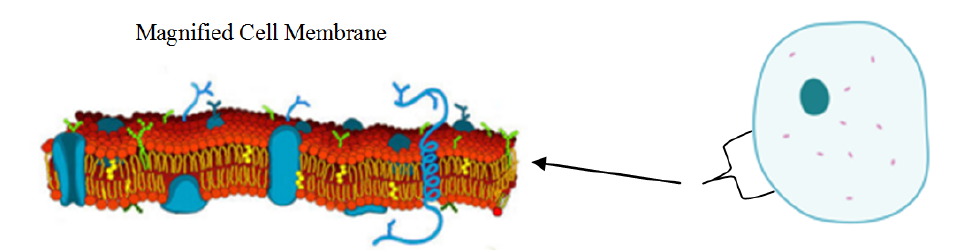
Lipids and proteins in the cell membrane
Membrane Proteins: Types and Functions
- Integral proteins are partially hydrophobic (amphipathic) and are embedded within the phospholipid bilayer, either across both layers or just one.
- Peripheral proteins are hydrophilic and attach to the surface of integral proteins or to the membrane via a hydrocarbon chain; they can be inside or outside the cell.
- The protein content of membranes varies with cell function; for example, mitochondrial and chloroplast membranes have high protein content due to many electron carriers.
- Membrane proteins carry out functions including transport, receptors, cell adhesion, cell-to-cell recognition, and immobilised enzymes.
- Transport proteins allow ions and polar molecules to cross the membrane; they are specific to a particular ion or molecule and include channel proteins (pores) and carrier proteins (change shape).
- Receptors bind peptide hormones (e.g., insulin), neurotransmitters, or antibodies, generating a signal that triggers reactions inside the cell.
- Immobilised enzymes are integral proteins with their active site exposed on the membrane surface, either inside or outside the cell.
- Cell adhesion allows cells to attach to neighbouring cells, and glycoproteins act as cell markers (antigens) for cell-to-cell recognition, such as ABO blood group antigens.
Membrane Transport: Diffusion and Osmosis
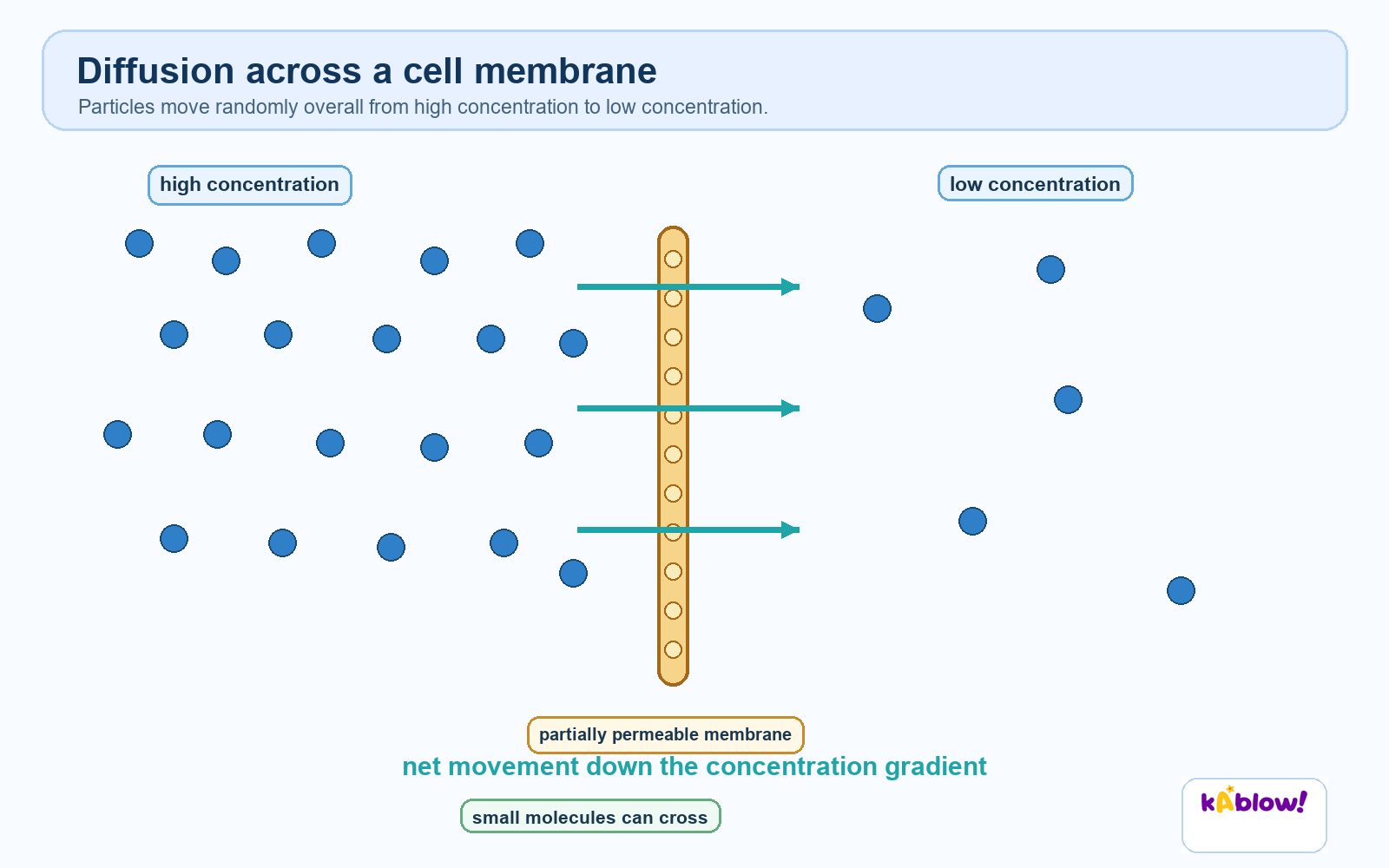
- Simple diffusion is the net movement of molecules or ions from a region of higher concentration to a region of lower concentration, due to random motion caused by kinetic energy.
- Molecules move down a concentration gradient; if diffusion continues long enough, equilibrium is reached with even distribution on both sides of the membrane.
- Oxygen diffuses into cells (used in respiration, creating a low internal concentration) and carbon dioxide diffuses out (produced by respiration, creating a high internal concentration).
- The rate of diffusion depends on the steepness of the concentration gradient, temperature, surface area, and properties of the molecules or ions (size, charge, polarity).
- Large molecules diffuse more slowly; uncharged and non-polar molecules diffuse faster as they can move directly through the phospholipid bilayer; small polar molecules like urea can diffuse at low rates.
- Osmosis is the diffusion of water molecules from a dilute solution to a solution with a higher solute concentration, across a partially permeable membrane.
- Osmosis can also be described as the net movement of water from a region of higher water potential to a region of lower water potential; water potential describes the tendency of water to move.
- Water can move directly between phospholipids, but aquaporins (channel proteins) allow water to pass through membranes more freely; water is unusual as a polar molecule that can cross membranes directly.
Diffusion across the cell membrane
Facilitated Diffusion and Active Transport
- Facilitated diffusion is a passive form of transport that uses transport proteins to move large molecules, polar molecules, and ions down a concentration gradient.
- Channel proteins form pores that allow specific substances (e.g., ions) to diffuse; some are gated and can open or close to control ion exchange.
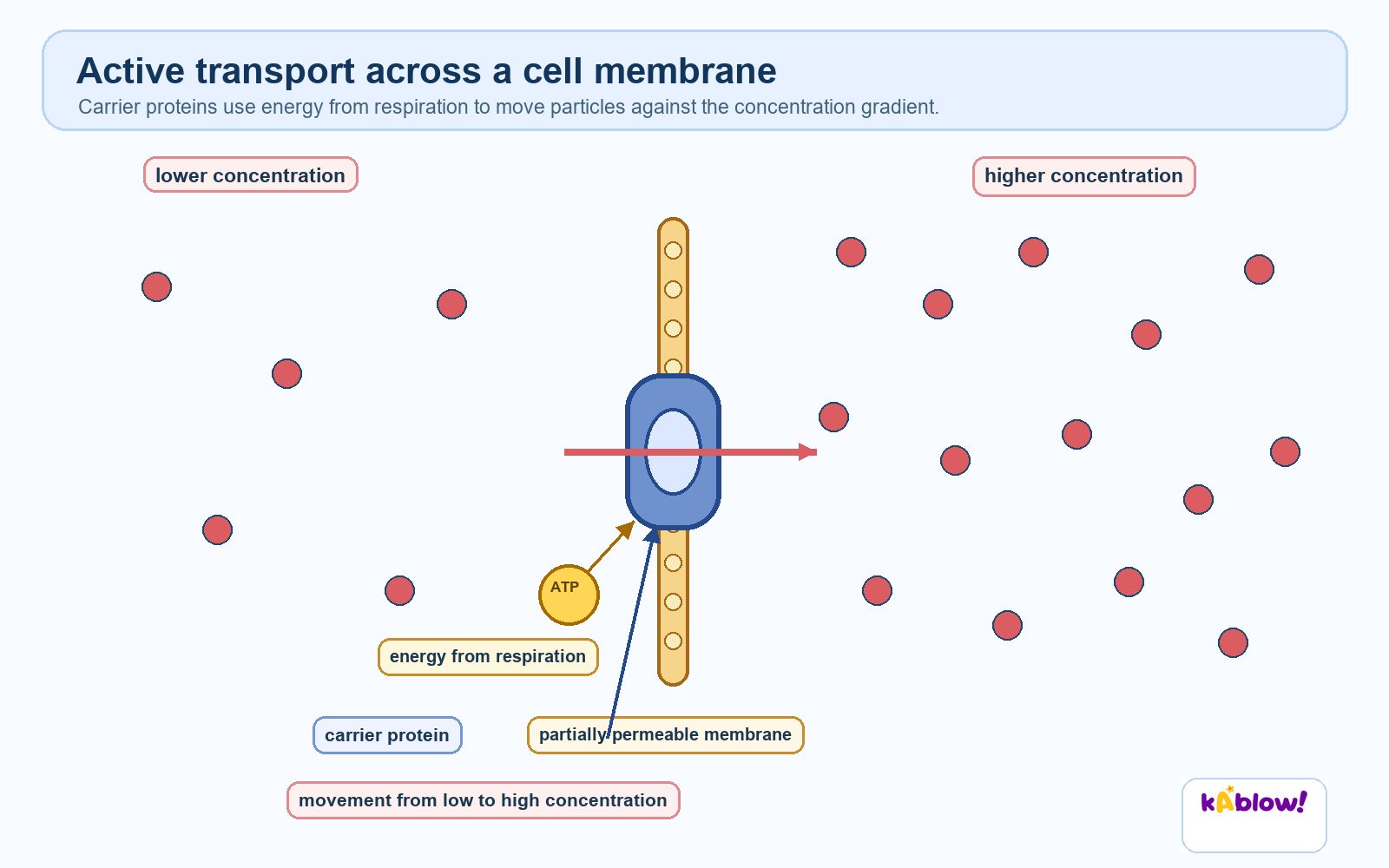
- Carrier proteins change shape to transport a substance across the membrane; the substance binds to a specific site, causing a shape change that opens to the other side.
- Active transport is the movement of molecules and ions across a cell membrane from a region of lower concentration to a region of higher concentration, using energy from respiration.
- Active transport occurs against the concentration gradient and requires carrier proteins (often called pumps) and ATP; ATP is hydrolysed to release energy for the shape change.
- Selective permeability is the ability of the membrane to differentiate between molecules, allowing some through while blocking others; facilitated diffusion and active transport enable this.
Active transport by carrier proteins
Glycolipids and Glycoproteins
- Glycoproteins are membrane proteins with a carbohydrate chain attached on the extracellular side; glycolipids are lipids with carbohydrate chains attached, also on the outer surface.
- The carbohydrate chain enables them to act as receptor molecules, binding substances at the cell surface.
- Receptor types include signalling receptors (bind hormones and neurotransmitters), receptors for endocytosis, and receptors for cell adhesion and stabilisation.
- Some glycoproteins and glycolipids act as cell markers (antigens) for cell identification, allowing the immune system to distinguish body cells from pathogens.
The Fluid Mosaic Model
- The fluid mosaic model was first outlined in 1972 by Singer and Nicolson and explains how biological molecules are arranged in cell membranes.
- Membranes are described as fluid because phospholipids and proteins can move around within their own layers.
- Membranes are described as mosaic because the scattered pattern of proteins within the phospholipid bilayer looks like a mosaic when viewed from above.
- The model includes four main components: phospholipids, cholesterol, glycoproteins and glycolipids, and integral and peripheral proteins.
- Membranes form partially permeable barriers between the cell and its environment, between cytoplasm and organelles, and within organelles; they also play a role in cell signalling.
- When drawing the fluid mosaic model, label the phospholipid bilayer (showing phosphate heads and hydrocarbon tails), integral proteins (e.g., channel/carrier), peripheral proteins, glycoproteins, and cholesterol (with OH group near phosphate heads).
Membrane Fluidity
- Saturated fatty acids have no double bonds, are straight, pack tightly, and have higher melting points, helping membranes maintain stability at higher temperatures.
- Unsaturated fatty acids have one or more double bonds, causing kinks that prevent tight packing, resulting in lower melting points and allowing membranes to be fluid and flexible.
- Bacteria produce fatty acid desaturases to increase double bonds in fatty acids, maintaining membrane fluidity in cold temperatures.
- Cholesterol is an important membrane lipid with hydrophobic and hydrophilic regions; it affects fluidity and permeability.
- Cholesterol maintains membrane fluidity at low temperatures by disrupting close packing of phospholipids, and at high temperatures by holding fatty acid tails together, providing stability.
- Cholesterol acts as a barrier by fitting in spaces between phospholipids, preventing water-soluble substances from diffusing across the membrane.
Bulk Transport: Endocytosis and Exocytosis
- Bulk transport moves larger quantities of materials into or out of cells and requires energy, making it a form of active transport.
- Bulk transport requires the formation of vesicles, which are small spherical sacs of plasma membrane; vesicle formation depends on membrane fluidity.
- Endocytosis transports material into cells by the plasma membrane engulfing material and forming a sac; it includes phagocytosis (solids) and pinocytosis (liquids).
- Phagocytosis is the bulk intake of solid material by cells called phagocytes, forming phagocytic vacuoles; an example is the engulfing of bacteria by white blood cells.
- Exocytosis is the process by which materials are removed from cells; substances are packaged into secretory vesicles that fuse with the cell membrane and release contents outside.
- An example of exocytosis is the secretion of digestive enzymes from pancreatic cells.
Gated Ion Channels and Pumps
- Gated ion channels are specialised ion channels that operate in response to chemical or electrical stimuli.
- Nicotinic acetylcholine receptors are neurotransmitter-gated ion channels; binding of acetylcholine triggers opening, allowing ions such as calcium (Ca²⁺) or sodium (Na⁺) to pass through.
- The influx of ions changes the membrane potential, which can generate an action potential in neurones; these receptors are found at the neuromuscular junction.
- Sodium-potassium pumps are integral proteins that generate an electrochemical gradient across nerve cell membranes; they are an example of an exchange transporter.
- The pump moves three sodium ions out and two potassium ions in using one ATP molecule, always against their concentration gradients via active transport.
- The pumping process involves phosphorylation (ATP transfers a phosphate) causing shape changes that release sodium outside and potassium inside.
- This process is essential for nerve cell function: more positive sodium ions are moved out than potassium ions in, making the inside of the cell negatively charged relative to the outside.
- When nerve cells are stimulated, sodium ion channels open and sodium ions rush in down the electrochemical gradient, reversing the charge and generating a nerve impulse.
Co-transport and Cell Adhesion
- Co-transport is the coupled movement of substances across a cell membrane via a carrier protein, combining facilitated diffusion and indirect active transport.
- Indirect active transport uses the energy released by one molecule moving down its concentration gradient to move another against its concentration gradient; ATP sets up the initial gradient.
- In the sodium-dependent glucose co-transporter in the mammalian ileum, sodium-potassium pumps create a sodium gradient; sodium moves into the cell down its gradient, drawing glucose in with it against its gradient.
- Glucose then moves down its concentration gradient into the blood; the active part is the generation of the sodium gradient, so glucose transport itself does not directly require energy.
- This process also occurs in the kidney, where glucose is reabsorbed back into the blood via sodium-dependent glucose cotransporter proteins.
- Cell adhesion is required for multicellular organisms; cells stick together to form tissues, and this can be permanent or temporary.
- Cell adhesion molecules (CAMs) are cell surface proteins that bind cells to other cells or to the extracellular matrix (which contains supporting structures like collagen).
- Different CAMs are present in different cell-cell junctions, such as tight junctions, adherens junctions, desmosomes, and gap junctions.
स्लाइड्स
Sign up free to view the lesson slides
Step through every slide for this topic — plus flashcards and revision notes — with a free account.
प्रैक्टिस सवाल
फ्री प्रीव्यू — 61 में से 8 सवाल। सभी देखने के लिए साइन अप करें।
1.Which part of a phospholipid molecule is hydrophobic?
Easy- AThe phosphate head
- BThe glycerol backbone
- CThe fatty acid tails
- DThe carbohydrate chain
2.Which property of phospholipids causes them to form bilayers when placed in water?
Easy- AThey are amphipathic
- BThey are completely hydrophobic
- CThey are completely hydrophilic
- DThey are saturated
3.What is the function of cholesterol in animal cell membranes?
Medium- ATo act as a channel for ions
- BTo regulate membrane fluidity
- CTo provide energy for active transport
- DTo form the hydrophilic head of phospholipids
4.Which of the following is the correct definition of active transport?
Medium- AThe net movement of molecules from high to low concentration without energy
- BThe movement of water across a partially permeable membrane
- CThe movement of molecules and ions across a membrane from low to high concentration, using energy from respiration
- DThe bulk intake of solid material by a cell
5.Which of the following is NOT a factor that affects the rate of diffusion across a membrane?
Medium- AThe steepness of the concentration gradient
- BThe temperature
- CThe surface area
- DThe number of ribosomes in the cell
6.In the sodium-potassium pump, how many sodium ions are moved out of the cell and how many potassium ions are moved into the cell per ATP molecule used?
Medium- A2 sodium out, 3 potassium in
- B3 sodium out, 2 potassium in
- C3 sodium out, 3 potassium in
- D2 sodium out, 2 potassium in
7.Which of the following is an example of indirect active transport?
Hard- ASimple diffusion of oxygen
- BFacilitated diffusion of glucose via a channel protein
- CSodium-dependent glucose co-transport in the ileum
- DOsmosis of water through aquaporins
8.Which of the following are functions of membrane proteins? (select all that apply)
Medium- ATransport of ions and polar molecules
- BActing as receptors for hormones
- CActing as immobilised enzymes
- DCell-to-cell recognition
- EStoring genetic information
Unlock all 61 questions & more
इस टॉपिक के हर सवाल, स्लाइड्स, फ्लैशकार्ड और रिवीज़न नोट्स देखने के लिए फ्री अकाउंट बनाएं।