Photosynthesis
खेलकर सीखें
इन सवालों के जवाब देकर एनर्जी कमाएं, फिर मछली पकड़ें और घूमें। कोई अकाउंट नहीं चाहिए।
लेसन नोट्स
The Process of Photosynthesis
- Photosynthesis converts simple inorganic compounds into complex organic compounds using light energy.
- It occurs in autotrophic organisms such as plants, algae and cyanobacteria.
- It is an energy conversion: light energy is transformed into chemical energy stored in biomass.
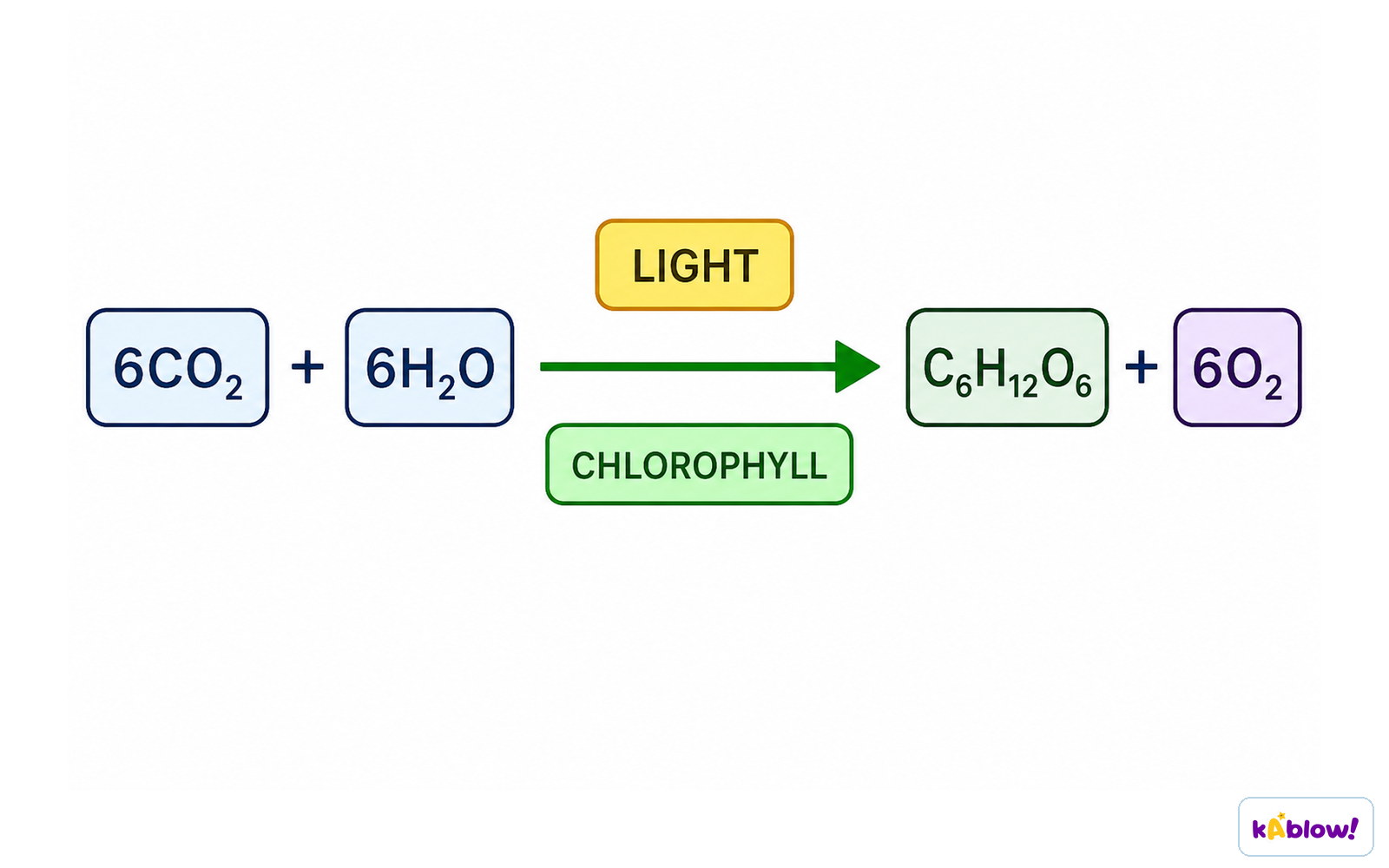
- The reactants are carbon dioxide and water; the products are glucose and oxygen.
- Carbon dioxide is converted to glucose using hydrogen released when a water molecule is split.
- Oxygen is released as a waste product.
- The word equation for photosynthesis is: carbon dioxide + water → glucose + oxygen.
- Energy is never created or destroyed, only converted from one form to another.
Balanced equation for photosynthesis
Separating Photosynthetic Pigments: Skills
- Plants contain several photosynthetic pigments, which absorb different wavelengths of light.
- There are two groups of pigments: chlorophylls (chlorophyll a and b) and carotenoids (β carotene and xanthophyll).
- Chlorophylls absorb wavelengths in the blue-violet and red regions of the spectrum; they reflect green light, making plants appear green.
- Carotenoids absorb wavelengths mainly in the blue-violet region of the spectrum.
- Carotenoids surround the chlorophyll and absorb both similar and different wavelengths, expanding the range of wavelengths absorbed for photosynthesis.
- Chromatography separates mixtures because different components travel through the material at different speeds.
- The retardation factor (Rf value) is calculated as: distance moved by pigment ÷ distance moved by solvent.
- In general, carotenoids have the highest Rf values (close to 1), chlorophyll b has a much lower Rf value, and chlorophyll a has an Rf value between those of carotenoids and chlorophyll b.
- Paper chromatography is not as specific as other techniques; it does not give data on the amount of each pigment present or the wavelengths they absorb.
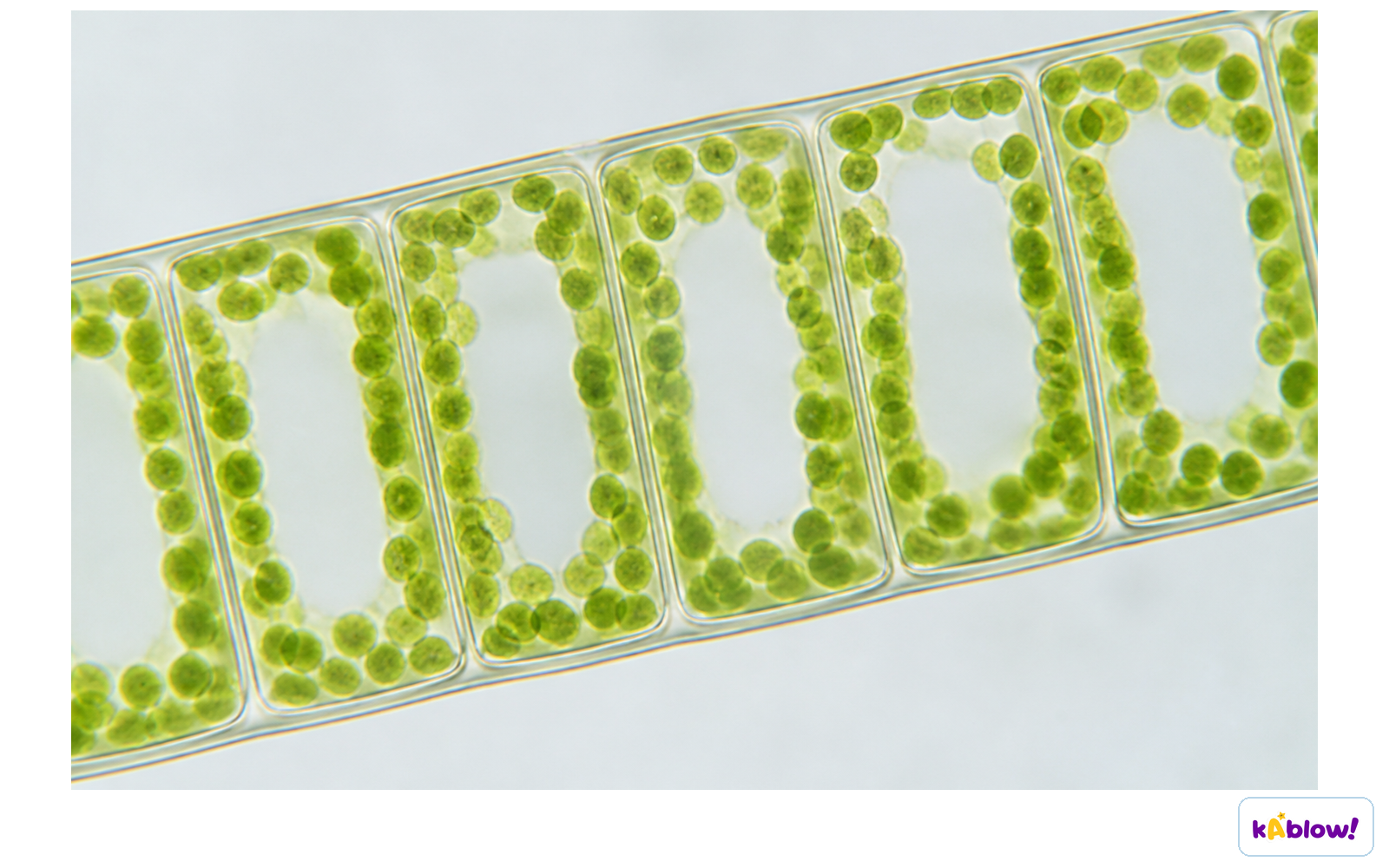
Chlorophyll within chloroplasts
Absorption Spectra
- An absorption spectrum is a graph showing the absorbance of different wavelengths of light by a particular pigment.
- Within chlorophyll, light energy excites electrons, triggering a transfer of electrons that leads to a series of reactions making up photosynthesis.
- During photosynthesis, light energy is transformed to chemical energy when glucose is formed.
- Chlorophylls absorb wavelengths in the blue-violet and red regions of the light spectrum.
- Carotenoids absorb wavelengths of light mainly in the blue-violet region of the spectrum.
- The chemical structure of pigment molecules determines the wavelengths of light that can be absorbed.
- The green part of the spectrum is largely reflected from the leaf, which is why leaves usually appear green.
Absorption & Action Spectra: Skills
- An action spectrum is a graph showing the rate of photosynthesis at different wavelengths of light.
- The rate of photosynthesis is highest at the blue-violet and red regions of the light spectrum, as these are the wavelengths that chlorophylls and carotenoids can absorb.
- There is a strong correlation between the cumulative absorption spectra of all pigments and the action spectrum.
- Both graphs have two main peaks – at the blue-violet region and the red region – supporting the idea that the most light energy is absorbed at these wavelengths, leading to the fastest rate of photosynthesis.
- Both graphs have a trough in the green-yellow region, supporting the idea that the least light energy is absorbed at these wavelengths, leading to the slowest rate of photosynthesis.
- The rate of photosynthesis can be determined by measuring the volume of oxygen produced or the carbon dioxide consumption at different wavelengths of light.
- When drawing an action spectrum, label the x-axis 'wavelength / nm' from 400 to 700 nm, and the y-axis 'Rate of photosynthesis / % of maximum rate' from 0 to 100.
- The curve should have two peaks (blue and red) and a trough in the middle (green light).
Limiting Factors of Photosynthesis: Skills
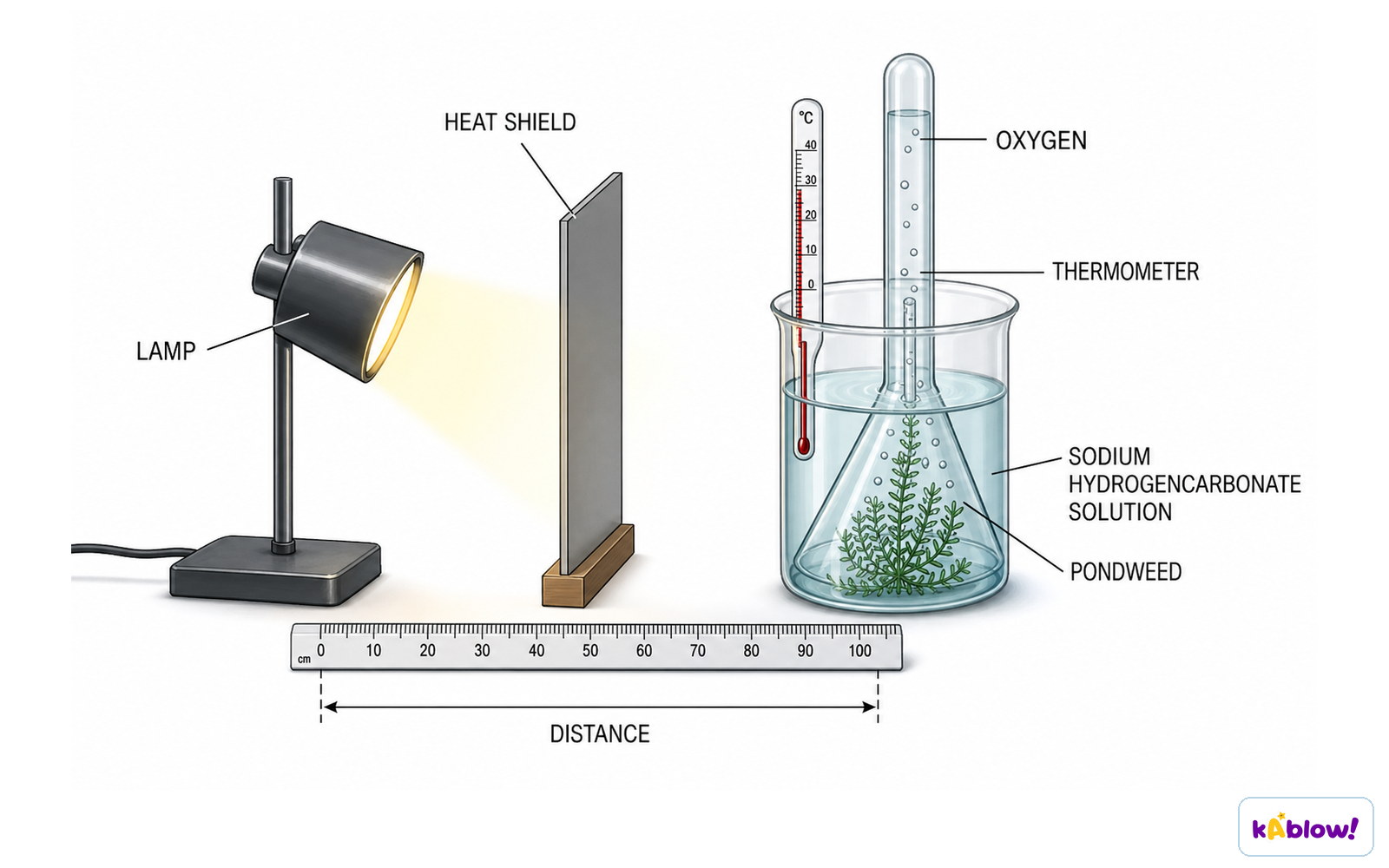
- An aquatic plant such as Elodea or Cabomba is a good choice for investigating photosynthesis because the rate can be measured by counting oxygen bubbles released from a cutting.
- A hypothesis is a proposed explanation for an idea which may be true or false; it can be tested through observations or experiments.
- The independent variable is the factor deliberately manipulated; the dependent variable is the factor measured; other variables must be controlled.
- Light intensity, carbon dioxide concentration and temperature are all limiting factors that affect the rate of photosynthesis and can be altered experimentally.
- As light intensity increases, the rate of photosynthesis increases (positive correlation) until light intensity is no longer limiting; then temperature or carbon dioxide concentration may become limiting.
- An increase in temperature increases the rate of photosynthesis due to increased kinetic energy of enzyme and substrate molecules, resulting in more collisions and more enzyme-substrate complexes.
- This increase continues until the optimum temperature; further increase causes enzymes to denature, so they cannot form enzyme-substrate complexes and the rate decreases.
- In experiments, temperature can be controlled using a water bath or by placing a glass tank of water between the lamp and plant; carbon dioxide concentration can be controlled using sodium hydrogencarbonate solution.
Investigating light intensity
Carbon Dioxide Enrichment Experiments
- Future rates of photosynthesis and plant growth can be predicted using enclosed greenhouse experiments and free air carbon dioxide enrichment (FACE) experiments.
- Enclosed greenhouse experiments allow variables such as light, carbon dioxide, temperature and wavelengths of light to be manipulated or controlled.
- Only small species that can be contained in a greenhouse can be studied using enclosed greenhouse experiments.
- FACE experiments are carried out in natural ecosystems where carbon dioxide is pumped into the area to increase localised carbon dioxide concentrations.
- FACE experiments allow larger plants and trees to be studied, but other variables cannot be controlled; they can be monitored to establish relationships.
- In an experiment, the independent variable is the only variable that should be changed; controlled/confounding variables must be controlled or monitored; the dependent variable is measured.
- It is essential that any variable that may affect the outcome is controlled for the results to be valid.
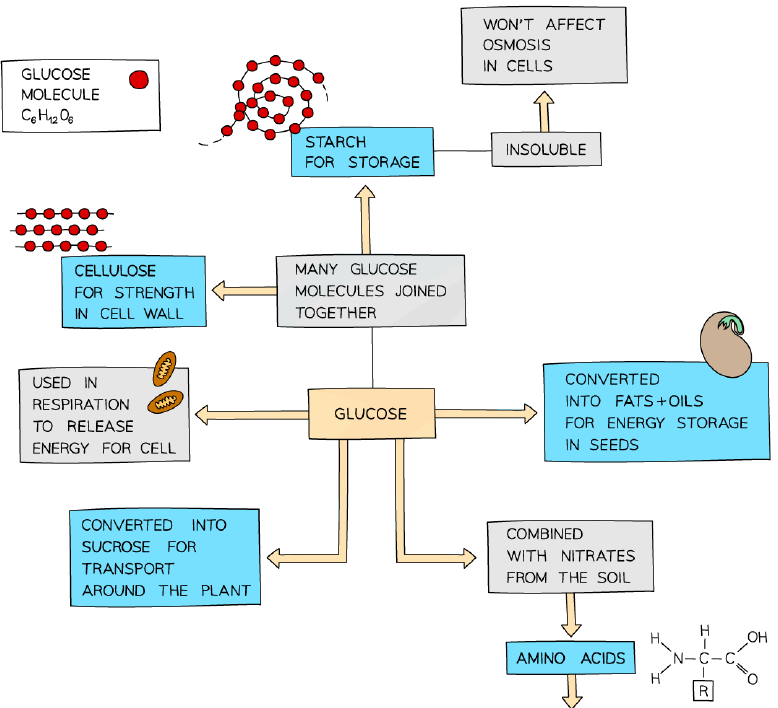
The fate of glucose in a plant
Photosystems
- Chlorophyll and accessory pigments are grouped together as structures called photosystems, located in the thylakoid membranes.
- Photosystems contain many chlorophyll molecules, accessory pigments (carotene and xanthophylls) and a reaction centre.
- Photosystem I contains the reaction centre P700 (activated by light of 700 nm); Photosystem II contains the reaction centre P680 (activated by light of 680 nm).
- Chlorophyll molecules and accessory pigments within Photosystem II absorb light energy (photons) and pass it to a chlorophyll molecule in reaction centre P680.
- Electrons within the reaction centre of Photosystem II are excited to a higher energy level by photons of light; the chlorophylls are said to be photoactivated.
- Excited electrons are donated to an electron acceptor in a reduction reaction.
- The presence of many different types of pigment allows the photosystem to efficiently absorb light of different wavelengths.
- The structured arrangement of pigments allows electrons to be excited in a controlled manner and directed along the electron transport chain.
- All the pigments in photosystems I and II are required for photosynthesis to occur; a single pigment molecule would not be able to perform any part of photosynthesis.
Light Dependent Reactions
- The light-dependent reaction relies on light directly and takes place in the thylakoid intermembrane space and across the thylakoid membrane.
- Thylakoids are disc-like structures that make up the grana in stacks of up to 100; they contain chlorophyll and some have tubular extensions (intergranal lamellae) joining adjacent grana.
- The thylakoid membrane contains a transfer chain where electrons are passed along a number of electron carriers in a series of oxidation-reduction reactions.
- Three key processes occur during the light-dependent reaction: photolysis, chemiosmosis, and reduction of NADP.
- Photolysis is the splitting of a water molecule using light energy; it occurs in Photosystem II.
- Chemiosmosis is the synthesis of ATP using an electrochemical gradient produced by H+ protons; the proton gradient forms across the thylakoid membrane when protons are pumped from the stroma into the thylakoid space.
- Reduction of NADP: NADP accepts electrons and H+ protons to become NADPH; this occurs in Photosystem I.
- During the light-dependent reaction, light energy is converted into chemical energy in the form of ATP and reduced NADP; oxygen is given off as a waste product.
- The useful products (ATP and reduced NADP) are transferred to the light-independent reaction within the chloroplast.
Photophosphorylation
- Photophosphorylation is the overall process of using light energy and the electron transport chain to generate ATP from ADP.
- The photophosphorylation of ADP to ATP can be cyclic or non-cyclic, depending on the pattern of electron flow in photosystem I or photosystem II or both.
- Cyclic photophosphorylation involves only photosystem I; an electron is excited and passed to an electron acceptor, transported via an electron transport chain, and passed back to the chlorophyll molecule in photosystem I.
- As electrons pass through the electron transport chain, they provide energy to pump protons (H+) from the stroma to the thylakoid lumen via a proton pump.
- A build-up of protons in the thylakoid lumen drives the synthesis of ATP from ADP and inorganic phosphate (π) by chemiosmosis.
- Chemiosmosis is the movement of protons down their concentration gradient; the energy released is used by ATP synthase to synthesise ATP.
- Non-cyclic photophosphorylation involves both photosystem I and photosystem II; excited electrons from Photosystem II are passed down a series of electron carriers forming the electron transport chain.
- The electron carriers undergo a series of redox reactions; excited electrons gradually release energy used to generate a proton gradient.
- The electrons are eventually picked up by the reaction centre in Photosystem I and used to reduce NADP (along with protons from the photolysis of water).
- Cyclic photophosphorylation differs from non-cyclic in two key ways: it only involves photosystem I, and it does not produce reduced NADP.
Light Independent Reactions
- The light-independent reactions take place in the stroma of the chloroplast, a thick protein-rich environment containing the necessary enzymes.
- The light-independent reactions are also known as the Calvin cycle and have three main steps: carbon fixation, reduction, and regeneration.
- Carbon fixation: the enzyme Rubisco catalyses the fixation of carbon dioxide by combination with ribulose bisphosphate (RuBP), a 5C compound, to yield two molecules of glycerate 3-phosphate (GP), a 3C compound.
- Rubisco is the most abundant enzyme on Earth; it works relatively slowly, so high concentrations are needed in the stroma, and it is not effective at low carbon dioxide concentrations.
- Reduction: GP is reduced to triose phosphate (TP) in a reaction involving reduced NADP and ATP.
- Regeneration: RuBP is regenerated from TP in reactions that use ATP; five molecules of triose phosphate are converted to three molecules of RuBP.
- One sixth of the triose phosphate is converted into usable products for the plant, such as hexose phosphates (for carbohydrates like starch, sucrose or cellulose), glycerol and fatty acids (for cell membranes), and amino acids (for protein synthesis).
- The remaining five sixths of triose phosphate are used to regenerate RuBP; this is important because otherwise the supplies of RuBP would run out.
- To produce one molecule of glucose, six turns of the Calvin cycle are needed.
Interdependence of Photosynthetic Reactions
- The light-dependent and light-independent reactions are interdependent; one cannot occur without the other.
- Products from the light-dependent reaction (reduced NADP and ATP) are directly used in the Calvin cycle to produce carbohydrates.
- In low light intensity, these products are produced at a slower rate, limiting the conversion of GP to TP.
- Once reduced NADP has been oxidised in the Calvin cycle, NADP is returned to the light-dependent stage to accept electrons at the end of the electron transport chain.
- In high light intensity, the light-dependent reactions occur more quickly, providing more reduced NADP and ATP to drive the Calvin cycle.
- If NADP is not returned to the light-dependent stage quickly enough, the process will be restricted.
- Carbon dioxide, in the form of hydrogen carbonate ions (HCO3−), accepts protons from photosystem II when water is split during photolysis.
- Hydrogen carbonate also plays an important role in the functioning of the electron transport chain.
- A lack of carbon dioxide (and thus hydrogen carbonate) will not only prevent carbon fixation but also prevent photosystem II from functioning.
स्लाइड्स
Sign up free to view the lesson slides
Step through every slide for this topic — plus flashcards and revision notes — with a free account.
प्रैक्टिस सवाल
फ्री प्रीव्यू — 62 में से 8 सवाल। सभी देखने के लिए साइन अप करें।
1.Which of the following are the reactants of photosynthesis?
Easy- ACarbon dioxide and water
- BGlucose and oxygen
- CCarbon dioxide and glucose
- DWater and oxygen
2.What is the primary role of a photosynthetic pigment?
Easy- ATo absorb light energy
- BTo reflect all wavelengths of light
- CTo produce carbon dioxide
- DTo store glucose
3.Which region of the light spectrum is absorbed by chlorophyll a?
Easy- ABlue-violet and red
- BGreen and yellow
- COrange and red
- DBlue-violet and green
4.Carotenoids absorb light mainly in the blue-violet region of the spectrum.
EasyTrue or false?
5.In chromatography, which pigment would have the highest Rf value?
Medium- ACarotene
- BChlorophyll b
- CChlorophyll a
- DXanthophyll
6.Where in the chloroplast do the light-dependent reactions take place?
Medium- AThylakoid membrane
- BStroma
- COuter membrane
- DIntermembrane space
7.Where do the light-independent reactions (Calvin cycle) take place?
Medium- AStroma
- BThylakoid membrane
- CThylakoid lumen
- DCytoplasm
8.Which of the following are products of the light-dependent reaction of photosynthesis? (select all that apply)
Medium- AATP
- BReduced NADP
- COxygen
- DGlucose
- ECarbon dioxide
Unlock all 62 questions & more
इस टॉपिक के हर सवाल, स्लाइड्स, फ्लैशकार्ड और रिवीज़न नोट्स देखने के लिए फ्री अकाउंट बनाएं।