DNA Replication
खेलकर सीखें
इन सवालों के जवाब देकर एनर्जी कमाएं, फिर मछली पकड़ें और घूमें। कोई अकाउंट नहीं चाहिए।
लेसन नोट्स
Why DNA Replication Matters
- DNA replication is semi-conservative and depends on complementary base pairing.
- It occurs in the nucleus and takes place before a parent cell divides.
- It ensures each daughter cell receives a full copy of the parental DNA.
- In multicellular organisms it is needed for growth, replacement of old or damaged cells and tissues, and reproduction.
Semi-Conservative Replication
- Semi-conservative means one strand of the parent DNA is kept in each daughter molecule — this is the template strand.
- The other strand is built up from free nucleotides in the nuclear space around the chromosomes.
- Each new DNA molecule therefore contains half of the original DNA and one newly made strand.
- Keeping one original strand ensures genetic continuity with a high degree of accuracy between cell generations.
- New cells inherit all their genes with the correct sequence of DNA bases from their parent cells.
Complementary Base Pairing
- If an adenine is the next exposed base on the template strand, a thymine nucleotide is added, and vice versa.
- If a cytosine is the next exposed base, a guanine nucleotide is added, and vice versa.
- Nucleotides are added one by one to the new strand according to the rules of complementary base pairing.
- Hydrogen bonds can only form between the template strand and the new strand if the correct bases are paired up.
The DNA double helix
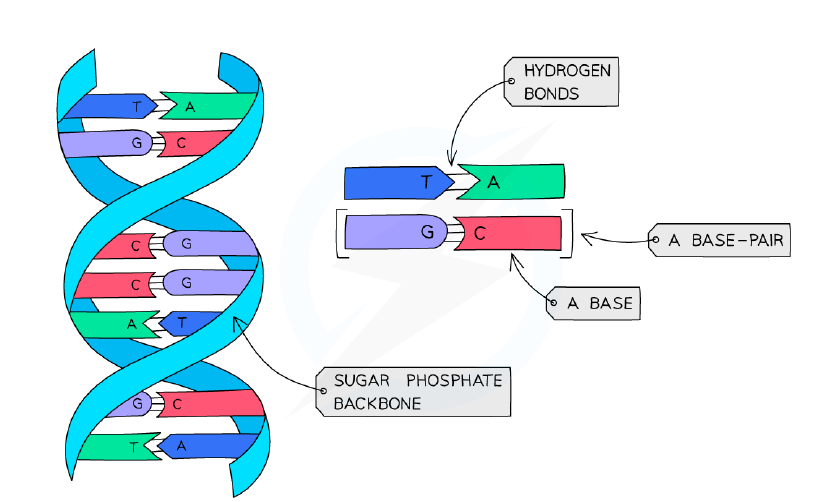
Crick, Watson, Meselson and Stahl
- As part of their discovery of the double-helix structure of DNA, Crick and Watson hypothesised that DNA copies semi-conservatively.
- They proposed the semi-conservative model but had not provided the evidence.
- Meselson and Stahl later provided the evidence supporting this hypothesis.
- Analysis of Meselson and Stahl's results gave the necessary support for semi-conservative replication of DNA.
Helicase and DNA Polymerase
- Helicase first unwinds the DNA, flattening out its helical structure, then breaks the hydrogen bonds between pairs of bases.
- This exposes bases on either strand, and each single polynucleotide strand acts as a template.
- DNA polymerase links nucleotides together to form a new strand, using the pre-existing strand as a template.
- DNA polymerase catalyses condensation reactions between the deoxyribose sugar and phosphate groups of adjacent nucleotides.
- This creates the sugar-phosphate backbone of the new DNA strands.
- Hydrogen bonds then form between the complementary base pairs of the template and new DNA strands.
Direction of Strand Building
- DNA polymerase always builds a new DNA strand in the same direction: the 5' to 3' direction.
- It attaches to the 3' end of the original template strand and reads the strand in a 3' to 5' direction.
- Because the two DNA strands are antiparallel, the new strand is built in the 5' to 3' direction.
Gel Electrophoresis
- Gel electrophoresis separates molecules with an electric current according to their size or mass and their net charge.
- Positively charged molecules move towards the cathode (negative pole); negatively charged molecules move towards the anode (positive pole).
- DNA is negatively charged due to its phosphate groups, so it moves towards the anode.
- Smaller molecules move quickly through the tiny pores in the gel, whereas larger molecules move slowly.
- Agarose gel is used for DNA and polyacrylamide for proteins; different gels have different sized pores.
Steps of Gel Electrophoresis
- An agarose gel plate is created in a tank, with wells cut into the gel at one end.
- The gel is submerged in an electrolyte solution (a salt solution that conducts electricity).
- DNA fragments are loaded into the wells using a micropipette.
- An electrical current is applied; the negative electrode must be connected to the end with the wells.
- Smaller (shorter) fragments move faster and further from the wells than larger fragments.
- Fragments are transferred onto absorbent paper or nitrocellulose and heated to separate the two DNA strands.
- Probes are added to develop a visual output: a radioactive label (e.g. a phosphorus isotope) or a fluorescent stain or dye (e.g. ethidium bromide).
Polymerase Chain Reaction (PCR)
- PCR is the in vitro method of DNA amplification, producing large quantities of specific DNA or RNA fragments from very small quantities.
- Each reaction requires the target DNA or RNA, DNA polymerase, free nucleotides, and a buffer solution for optimum pH.
- Taq polymerase comes from the thermophilic bacterium×Thermus aquaticus×and does not denature at the high temperatures used.
- Stage 1 – Denaturation: DNA is heated to 95°C, breaking the hydrogen bonds between the two strands.
- Stage 2 – Annealing: temperature decreases to 50–60°C so primers can anneal to the ends of the single strands.
- Stage 3 – Elongation/Extension: temperature increases to 72°C for at least a minute, the optimum for Taq polymerase to build complementary strands.
- Each cycle doubles the DNA, so amplification is exponential — 30 cycles can generate over a billion copies in a few hours.
- PCR occurs in a thermal cycler, which automatically provides the optimal temperature for each stage.
DNA Profiling
- DNA profiling (genetic fingerprinting) can identify suspects of a crime and identify victims.
- The regions analysed are VNTRs (Variable Number Tandem Repeats): repeating, short, non-coding regions between 20 and 50 bases long.
- Every person apart from identical twins has a unique combination of VNTRs.
- DNA profiling uses gel electrophoresis to separate VNTR fragments according to length, creating a unique pattern of bands.
- The sequence is: DNA extraction, PCR amplification, cutting with restriction endonucleases, separation by gel electrophoresis, adding probes complementary to the VNTRs, then visualising by X-ray or UV light.
- Every person inherits VNTRs from both mother and father, so profiling can identify parents or ancestors — a parent shares about 50% of the offspring's bands.
- Reliability can be increased by increasing the number of VNTR markers compared, lowering the chance of a false match.
स्लाइड्स
Sign up free to view the lesson slides
Step through every slide for this topic — plus flashcards and revision notes — with a free account.
प्रैक्टिस सवाल
फ्री प्रीव्यू — 62 में से 8 सवाल। सभी देखने के लिए साइन अप करें।
1.What is meant by semi-conservative replication?
Easy- AOne strand of the parent DNA is kept in each daughter molecule
- BBoth strands of the parent DNA are kept in one daughter molecule
- CNeither strand of the parent DNA is kept in the daughter molecules
- DHalf of the bases in each strand are conserved
2.Which enzyme is responsible for unwinding the DNA double helix and breaking the hydrogen bonds between base pairs during DNA replication?
Easy- ADNA polymerase
- BHelicase
- CLigase
- DRestriction endonuclease
3.During DNA replication, DNA polymerase catalyses condensation reactions between which two components of adjacent nucleotides?
Medium- AThe deoxyribose sugar of one nucleotide and the phosphate group of the next
- BThe phosphate group of one nucleotide and the phosphate group of the next
- CThe nitrogenous base of one nucleotide and the deoxyribose sugar of the next
- DThe nitrogenous base of one nucleotide and the phosphate group of the next
4.DNA polymerase always builds a new DNA strand in the 5' to 3' direction.
EasyTrue or false?
5.In the polymerase chain reaction (PCR), what is the role of the primer?
Medium- AIt provides a starting point for DNA polymerase to begin synthesis
- BIt unwinds the double-stranded DNA
- CIt joins together the Okazaki fragments
- DIt provides free nucleotides for the new strand
6.Which of the following is a property of Taq polymerase that makes it suitable for use in PCR?
Medium- AIt is resistant to denaturation at high temperatures
- BIt can synthesise RNA from a DNA template
- CIt can cut DNA at specific recognition sites
- DIt can join DNA fragments together
7.Which of the following are required for a polymerase chain reaction (PCR)? (select all that apply)
Medium- ATarget DNA or RNA
- BDNA polymerase
- CFree nucleotides
- DBuffer solution
- ERestriction endonucleases
8.What is the function of DNA polymerase during DNA replication?
Easy- AIt links nucleotides together to form a new strand using a template strand
- BIt breaks hydrogen bonds between complementary bases
- CIt unwinds the DNA double helix
- DIt adds a poly-A tail to the new strand
Unlock all 62 questions & more
इस टॉपिक के हर सवाल, स्लाइड्स, फ्लैशकार्ड और रिवीज़न नोट्स देखने के लिए फ्री अकाउंट बनाएं।