Motion In Electromagnetic Fields
खेलकर सीखें
इन सवालों के जवाब देकर एनर्जी कमाएं, फिर मछली पकड़ें और घूमें। कोई अकाउंट नहीं चाहिए।
लेसन नोट्स
Magnetic Force on a Current-Carrying Conductor
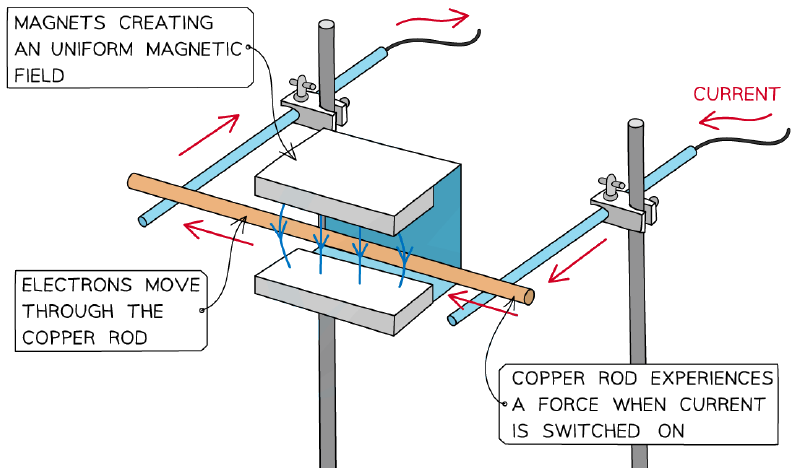
- A current-carrying conductor produces its own magnetic field and experiences a force when placed in an external magnetic field.
- The force F on a conductor of length L carrying current I at an angle θ to a magnetic field of flux density B is given by F = BIL sin θ.
- The force is maximum when the conductor is perpendicular to the field (θ = 90°, sin θ = 1), giving F = BIL.
- The force is zero when the conductor is parallel to the field (θ = 0°, sin θ = 0).
- The force can be increased by increasing the magnetic field strength, the current, or the length of the conductor within the field.
- The direction of the force is given by Fleming's left-hand rule: thumb = force (motion), first finger = magnetic field, second finger = conventional current.
- In three dimensions, dots represent a magnetic field directed out of the page and crosses represent a field directed into the page.
Setup for demonstrating the force on a current-carrying conductor in a magnetic field.
Magnetic Force between Two Parallel Conductors
- A current-carrying conductor produces a magnetic field around it; the direction is given by the right-hand thumb rule.
- Two parallel conductors attract each other if their currents flow in the same direction and repel if the currents are in opposite directions.
- The force per unit length between two parallel conductors is F/L = (μ₀ I₁ I₂) / (2π r), where r is the separation between them.
- μ₀ is the magnetic permeability of free space, equal to 4π × 10⁻⁷ N A⁻².
- The forces on each wire are equal in magnitude and opposite in direction, consistent with Newton's third law.
Magnetic Force on a Moving Charge
- A moving charge produces its own magnetic field and experiences a force when interacting with an external magnetic field.
- The force F on a charge q moving with speed v at an angle θ to a magnetic field B is F = Bqv sin θ.
- The force is maximum when the charge moves perpendicular to the field (θ = 90°), giving F = Bqv.
- A charge moving parallel to the magnetic field experiences no magnetic force.
- The direction of the force is found using Fleming's left-hand rule, with the second finger pointing in the direction of conventional current (opposite to the motion of a negative charge).
- The force is always perpendicular to both the velocity and the magnetic field.
Charged Particles in Magnetic Fields
- A charged particle moving perpendicular to a uniform magnetic field follows a circular path because the magnetic force is always perpendicular to its velocity.
- The magnetic force provides the centripetal force, so mv²/r = BQv.
- Rearranging gives the radius of the path: r = mv / (BQ).
- The radius is larger for faster particles (r ∝ v) and more massive particles (r ∝ m).
- The radius is smaller for particles with greater charge (r ∝ 1/q) and in stronger magnetic fields (r ∝ 1/B).
- The centripetal acceleration is in the same direction as the magnetic force, given by Newton's second law F = ma.
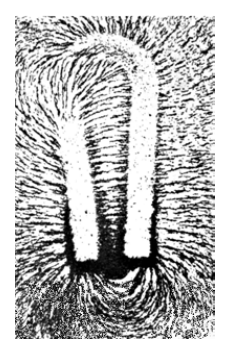
Magnetic field lines
Charged Particles in Electric Fields
- A charged particle in a uniform electric field experiences a constant electric force F = EQ.
- A stationary charged particle will move parallel to the electric field lines (along or against depending on its charge).
- A charged particle moving through a uniform electric field follows a parabolic trajectory.
- A positive charge is deflected towards the negative plate; a negative charge is deflected towards the positive plate.
- The amount of deflection depends on the particle's mass (greater mass → smaller deflection), charge (greater charge → greater deflection), and speed (greater speed → smaller deflection).
- An uncharged particle, such as a neutron, experiences no force and travels straight through undeflected.
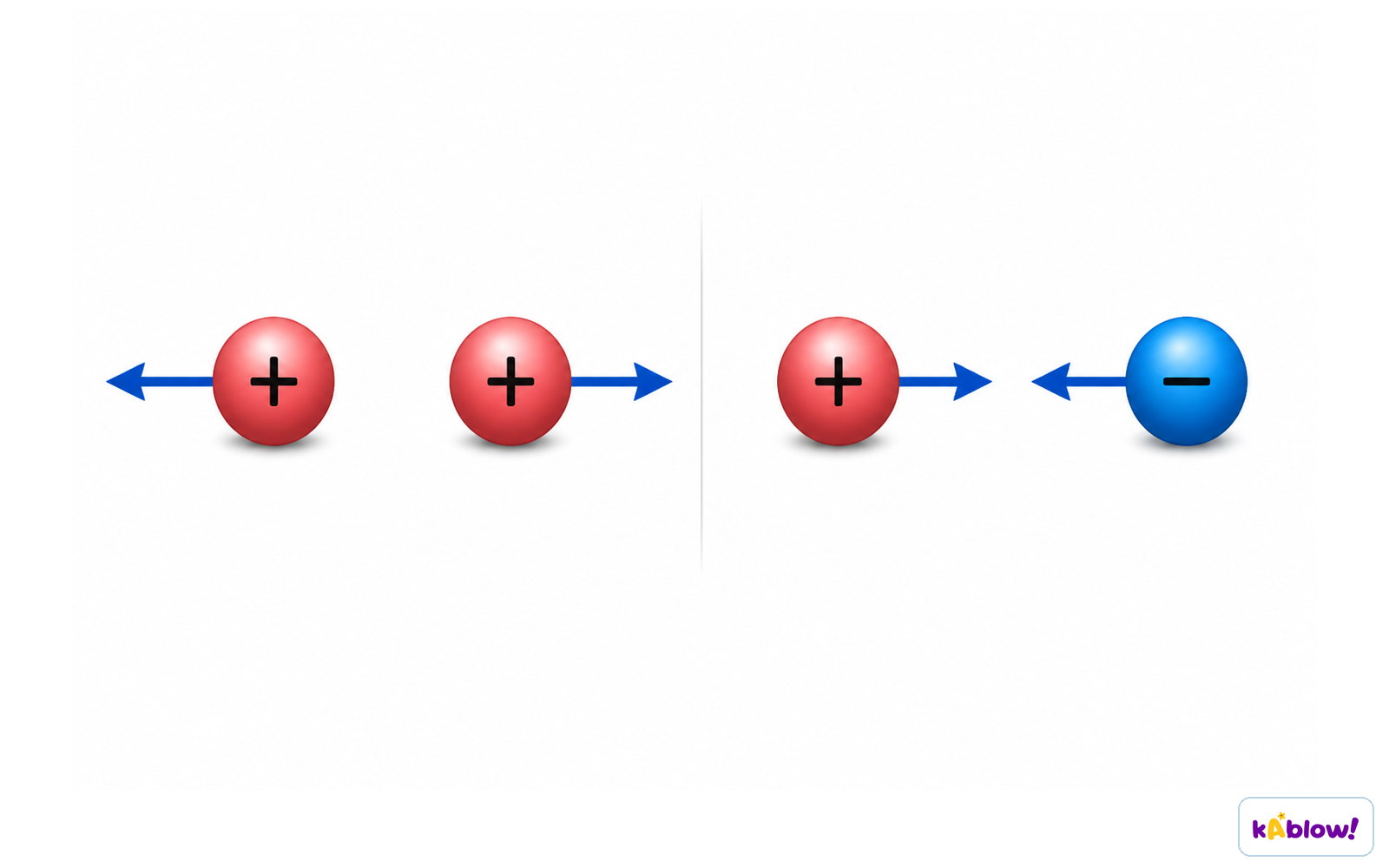
Attraction and repulsion of charge
Charged Particles in Electric and Magnetic Fields
- A charged particle moving in perpendicular uniform electric and magnetic fields experiences a force parallel to the electric field and a force perpendicular to the magnetic field.
- For a positively charged particle, the electric force acts in the direction of the electric field, while the magnetic force acts in the opposite direction.
- For a negatively charged particle, the electric force acts opposite to the electric field, while the magnetic force acts in the opposite direction to that on a positive charge.
- When the electric and magnetic forces are equal in magnitude and opposite in direction, the particle moves in a straight line with constant speed.
- Equating the forces qE = Bqv gives the speed v = E/B.
- This principle is used in velocity selectors and in J.J. Thomson's experiment to determine the charge-to-mass ratio of an electron.
Charge-to-Mass Ratio
- The charge-to-mass ratio is defined as Q/m.
- For an electron, e/mₑ = 1.76 × 10¹¹ C kg⁻¹; for a proton, e/mₚ = 9.58 × 10⁷ C kg⁻¹.
- The charge-to-mass ratio can be determined by investigating the path of a charged particle in a uniform magnetic field.
- J.J. Thomson used Helmholtz coils to produce a uniform magnetic field and oppositely charged parallel plates to produce a uniform electric field.
- When the electric and magnetic forces balance, the beam is straight and the speed is v = V / (Bd).
- With the electric field off, the particle moves in a circular path of radius r = mv / (Bq).
- Combining these gives the charge-to-mass ratio: q/m = V / (r B² d).
स्लाइड्स
Sign up free to view the lesson slides
Step through every slide for this topic — plus flashcards and revision notes — with a free account.
प्रैक्टिस सवाल
फ्री प्रीव्यू — 63 में से 8 सवाल। सभी देखने के लिए साइन अप करें।
1.A straight wire carrying current I is placed in a uniform magnetic field of flux density B. The force on the wire is given by F = BIL sin θ. What does θ represent in this equation?
Easy- AThe angle between the wire and the magnetic field
- BThe angle between the current and the magnetic force
- CThe angle between the wire and the horizontal
- DThe angle between the magnetic field and the magnetic force
2.Which of the following is the fundamental SI unit of magnetic flux density?
Easy- ATesla (T)
- BWeber (Wb)
- CNewton (N)
- DAmpere (A)
3.A wire of length 0.50 m carries a current of 2.0 A and is placed at 30° to a uniform magnetic field of flux density 0.10 T. What is the magnitude of the force on the wire?
Medium- A0.050 N
- B0.10 N
- C0.025 N
- D0.43 N
4.A charged particle moves with speed v perpendicular to a uniform magnetic field B. The magnetic force on the particle is given by F = Bqv. Which of the following changes would double the magnetic force?
Easy- ADoubling the speed of the particle
- BDoubling the mass of the particle
- CDoubling the charge of the particle and halving its speed
- DHalving the magnetic flux density
5.An electron enters a uniform magnetic field directed into the page, moving from left to right. In which direction does the magnetic force on the electron act?
Medium- AUpwards
- BDownwards
- CInto the page
- DOut of the page
6.A charged particle moves in a circular path of radius r in a uniform magnetic field B. The radius is given by r = mv/(Bq). Which of the following will increase the radius of the path?
Medium- AIncreasing the mass of the particle
- BIncreasing the magnetic flux density
- CIncreasing the charge of the particle
- DDecreasing the speed of the particle
7.Which of the following statements about the magnetic force on a current-carrying conductor are correct? (Select all that apply.)
Medium- AThe force is maximum when the conductor is perpendicular to the magnetic field.
- BThe force is zero when the conductor is parallel to the magnetic field.
- CThe force is always in the same direction as the magnetic field.
- DThe force can be increased by increasing the current in the conductor.
- EThe force depends on the length of the conductor within the field.
8.A charged particle moves through a region where uniform electric and magnetic fields are perpendicular to each other and to the particle's velocity. The particle travels undeflected. Which of the following statements are correct? (Select all that apply.)
Medium- AThe electric force and magnetic force are equal in magnitude.
- BThe electric force and magnetic force act in opposite directions.
- CThe speed of the particle is given by v = E/B.
- DThe particle must be uncharged.
- EThe particle's path is circular.
Unlock all 63 questions & more
इस टॉपिक के हर सवाल, स्लाइड्स, फ्लैशकार्ड और रिवीज़न नोट्स देखने के लिए फ्री अकाउंट बनाएं।