Rigid Body Mechanics
खेलकर सीखें
इन सवालों के जवाब देकर एनर्जी कमाएं, फिर मछली पकड़ें और घूमें। कोई अकाउंट नहीं चाहिए।
लेसन नोट्स
Torque & Couples
- A moment is the turning effect of a force around a pivot: Moment = Force × perpendicular distance from the pivot (N m).
- For a non-perpendicular force, resolve the force or use τ = Fr sin θ, where θ is the angle between the force and the line from the pivot.
- A couple is a pair of equal and opposite coplanar forces that produce rotation only; the forces are equal in magnitude, opposite in direction, and perpendicular to the distance between them.
- The moment of a couple is Force × perpendicular distance between the lines of action; it does not depend on a pivot.
- A couple produces zero resultant force (no linear acceleration) but a net torque causing angular acceleration.
- For a couple on a wheel of radius r, the net torque is τ = 2Fr sin θ; when θ = 90°, τ = 2Fr.
- Torque is maximum when the force is applied perpendicular to the lever arm (θ = 90°); at θ = 0° or 180°, torque is zero.
Rotational Equilibrium
- A body is in rotational equilibrium if the resultant torque acting on it is zero; it remains at rest or rotates with constant angular velocity.
- The condition for rotational equilibrium is: sum of clockwise torques = sum of anticlockwise torques (principle of moments).
- A resultant (unbalanced) torque causes angular acceleration; the direction of angular acceleration is the same as the net torque direction.
- When solving equilibrium problems, you can take torques about any point; choose a point that simplifies the calculation (e.g. where unknown forces act).
- For a beam balanced on a pivot, the weight acts at the centre of mass; torques are calculated using τ = Fr for perpendicular forces.
Angular Displacement, Velocity & Acceleration
- Angular displacement Δθ is the change in angle through which a body rotates, measured in radians.
- Linear displacement is related to angular displacement by s = rΔθ.
- Angular velocity ω is the rate of change of angular displacement: ω = Δθ / Δt, measured in rad s⁻¹.
- Linear speed is related to angular speed by v = rω; also ω = 2πf = 2π/T and v = 2πfr.
- Angular acceleration α is the rate of change of angular velocity: α = Δω / Δt, measured in rad s⁻².
- Linear acceleration is related to angular acceleration by a = rα.
- Graphs: angular displacement is the area under the angular velocity–time graph; angular velocity is the gradient of the angular displacement–time graph and the area under the angular acceleration–time graph; angular acceleration is the gradient of the angular velocity–time graph.
Angular Acceleration Formula (Rotational Kinematics)
- The linear kinematic equations can be rewritten for uniform angular acceleration:
- ωf = ωi + αt
- Δθ = ωi t + ½ αt²
- ωf² = ωi² + 2αΔθ
- Δθ = (ωi + ωf) t / 2
- These equations are used when angular acceleration is constant; identify the known and unknown quantities to select the appropriate equation.
- When converting from RPM to rad s⁻¹, use ω = 2π × (RPM / 60).
Moment of Inertia
- Moment of inertia I is the resistance of a body to a change in rotational motion; it depends on the mass distribution about the axis of rotation.
- Moment of inertia is measured in kg m².
- For a point mass, I = mr², where r is the distance from the axis of rotation.
- The total moment of inertia of a system is the sum of the moments of inertia of its parts: Itotal = Σ mr².
- The moment of inertia of a rigid body depends on its shape, density, and orientation relative to the axis of rotation.
- Common moments of inertia (given in exams): solid cylinder/disc I = ½MR², solid sphere I = ⅖mr², hollow sphere I = ⅔mr², thin rod about centre I = 1/12 mL².
- You are not expected to memorise moments of inertia of different shapes; they will be provided where needed.
Newton’s Second Law for Rotation
- Newton’s second law for rotation: τ = Iα, where τ is torque (N m), I is moment of inertia (kg m²), and α is angular acceleration (rad s⁻²).
- This is the rotational analogue of F = ma.
- Torque is the rotational equivalent of force; moment of inertia is the rotational equivalent of mass.
- For a point mass, I = mr² and α = a/r, leading to τ = Iα.
- In problems with a hanging mass and pulley, apply F = ma to the linear motion and τ = Iα to the rotation, linking linear and angular acceleration by a = rα.
Angular Momentum
- Angular momentum L is the rotational equivalent of linear momentum: L = Iω, measured in kg m² rad s⁻¹ (or kg m² s⁻¹).
- For a point mass, L = mvr, where r is the perpendicular distance from the axis of rotation.
- Conservation of angular momentum: the total angular momentum of a system remains constant unless acted upon by a net resultant torque.
- For a constant total angular momentum: Iiωi = Ifωf.
- Examples: an ice skater spinning faster when arms are pulled in (I decreases, ω increases); a diver tucking; a collapsing star increasing its rotation rate.
- Objects travelling in straight lines can have angular momentum about a point not on their line of motion.
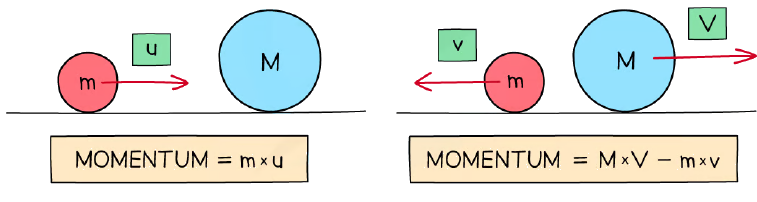
Conservation of momentum
Angular Impulse
- Angular impulse is the change in angular momentum produced by a torque acting over a time interval: ΔL = τΔt.
- Angular impulse is measured in kg m² s⁻¹ or N m s.
- The equation requires a constant resultant torque; if torque varies, use an average value.
- A small torque acting for a long time can produce the same angular impulse as a large torque acting for a short time.
- On a torque–time graph, the area under the graph equals the angular impulse or change in angular momentum.
- For a changing torque, ΔL = I(ωf − ωi) can be used with the area under the graph.
Rotational Kinetic Energy
- A rotating body has rotational kinetic energy: Ek = ½Iω² (or Ek = L² / 2I).
- For an object rolling without slipping, total kinetic energy is the sum of translational and rotational kinetic energy: Ektotal = ½mv² + ½Iω².
- Rolling without slipping requires friction; the point of contact has zero velocity, the centre of mass has velocity v = ωr, and the top point has velocity 2v.
- When an object rolls down a slope, gravitational potential energy is converted into both translational and rotational kinetic energy: mgΔh = ½mv² + ½Iω².
- Using v = ωr and the moment of inertia, the total kinetic energy can be expressed in terms of ω or v; for a solid sphere, mgΔh = 7/10 mω²r².
- If an object slides (slips) without rolling, there is no rotational kinetic energy and angular velocity is zero.
स्लाइड्स
Sign up free to view the lesson slides
Step through every slide for this topic — plus flashcards and revision notes — with a free account.
प्रैक्टिस सवाल
फ्री प्रीव्यू — 61 में से 8 सवाल। सभी देखने के लिए साइन अप करें।
1.Which of the following best defines the moment of a force about a pivot?
Easy- AThe product of the force and the perpendicular distance from the pivot to the line of action of the force
- BThe product of the force and the distance from the pivot to the point of application of the force
- CThe force divided by the perpendicular distance from the pivot
- DThe product of the force and the time for which it acts
2.Which pair of forces acts as a couple?
Easy- ATwo forces equal in magnitude, opposite in direction, and perpendicular to the distance between them
- BTwo forces equal in magnitude and in the same direction, separated by a distance
- CTwo forces of different magnitudes acting in opposite directions
- DTwo forces equal in magnitude and opposite in direction, but not perpendicular to the distance between them
3.A force of 50 N is applied at an angle of 30° to a spanner of length 0.20 m. What is the torque produced?
Medium- A5.0 N m
- B8.7 N m
- C10 N m
- D0.50 N m
4.A uniform beam is pivoted at its centre. Two forces act on it: a 10 N force downwards at 0.30 m to the left of the pivot, and a 15 N force downwards at 0.20 m to the right of the pivot. What is the resultant torque on the beam?
Medium- A0 N m, the beam is in rotational equilibrium
- B1.0 N m clockwise
- C1.0 N m anticlockwise
- D6.0 N m clockwise
5.A solid cylinder of mass 2.0 kg and radius 0.50 m rotates about its central axis. What is its moment of inertia? (I = ½MR²)
Medium- A0.25 kg m²
- B0.50 kg m²
- C1.0 kg m²
- D0.125 kg m²
6.A star of mass M and radius R rotates with angular velocity ω. It collapses to a sphere of radius R/4 without losing mass. What is its new angular velocity? (Assume it remains a uniform sphere.)
Hard- A16ω
- B4ω
- Cω/4
- Dω/16
7.Which of the following statements about a couple are correct? (Select all that apply.)
Medium- AThe resultant force of a couple is zero.
- BA couple produces a net torque.
- CThe moment of a couple depends on the choice of pivot.
- DA couple causes angular acceleration.
- EThe forces in a couple must act along the same line of action.
8.Which of the following are units of angular momentum? (Select all that apply.)
Medium- Akg m² s⁻¹
- BN m s
- Ckg m s⁻¹
- DJ s
- Ekg m² s⁻²
Unlock all 61 questions & more
इस टॉपिक के हर सवाल, स्लाइड्स, फ्लैशकार्ड और रिवीज़न नोट्स देखने के लिए फ्री अकाउंट बनाएं।