Wave Model
खेलकर सीखें
इन सवालों के जवाब देकर एनर्जी कमाएं, फिर मछली पकड़ें और घूमें। कोई अकाउंट नहीं चाहिए।
लेसन नोट्स
Properties of Travelling Waves
- Travelling waves are oscillations that transfer energy from one place to another without transferring matter.
- Waves are generated by oscillating sources; the oscillations travel away from the source.
- Oscillations can propagate through a medium (e.g. air, water) or in a vacuum (no particles), depending on the type of wave.
- Key properties of travelling waves: displacement, wavelength, amplitude, period, frequency, wave speed.
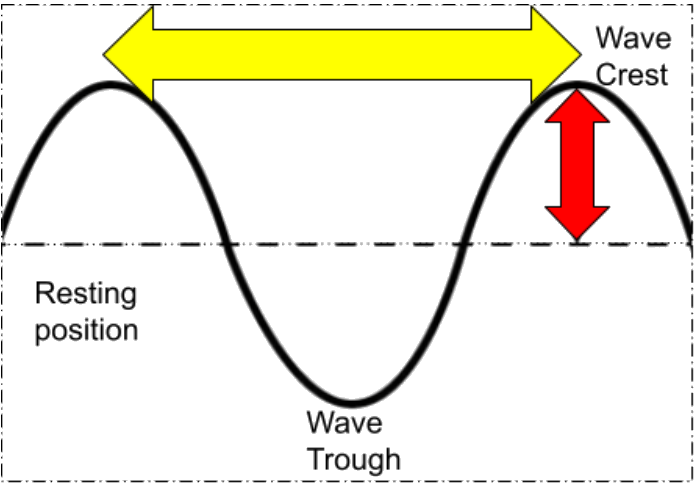
Displacement, Wavelength and Amplitude
- Displacement x is the distance of a point on the wave from its equilibrium position; it is a vector (can be positive or negative) and is measured in metres (m).
- Wavelength \lambda is the length of one complete oscillation, measured from the same point on two consecutive waves (e.g. crest to crest or trough to trough); measured in metres (m).
- Amplitude A is the maximum displacement from the equilibrium position (x = 0); it can be positive or negative and is measured in metres (m).
- The horizontal line where the wave has zero amplitude is the equilibrium position.
Diagram showing wave crest, trough, resting position, wavelength, and amplitude
Period, Frequency and the Wave Equation
- Period T is the time taken for one complete oscillation to pass a fixed point; measured in seconds (s).
- Frequency f is the number of complete oscillations passing a fixed point per second; measured in Hertz (Hz).
- Frequency and period are related by f = \frac{1}{T}.
- Wave speed v is the distance travelled by the wave per unit time; measured in metres per second (m s⁻¹).
- The wave equation is v = f\lambda = \frac{\lambda}{T}.
- For a wave of constant speed: as wavelength increases, frequency decreases; as wavelength decreases, frequency increases.
Interpreting Wave Graphs
- If the x-axis is time, the distance for one full wave is the period T.
- If the x-axis is distance, the distance for one full wave is the wavelength \lambda.
- Always convert units: for frequency in Hz, the period must be in seconds (not milliseconds or microseconds).
- Amplitude is read from the vertical axis as the maximum displacement from the equilibrium position.
Transverse Waves
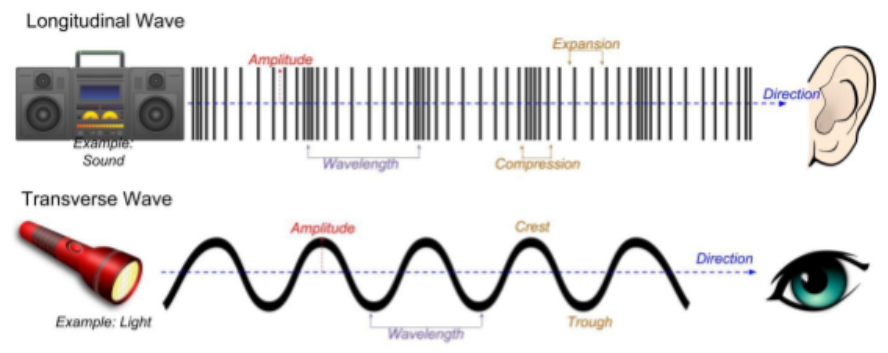
- Transverse waves have oscillations perpendicular to the direction of motion and energy transfer.
- Particles in a transverse wave vibrate up and down.
- Transverse waves show areas of peaks (crests) and troughs.
- Examples: electromagnetic waves (radio, visible light, UV) and mechanical waves (e.g. vibrations on a guitar string).
- Transverse waves transfer energy even if there is no resultant displacement of the medium; they do not need particles to propagate, so they can travel through a vacuum.
Longitudinal and transverse waves.
Longitudinal Waves
- Longitudinal waves have oscillations parallel to the direction of motion and energy transfer.
- Particles in a longitudinal wave vibrate left and right (back and forth along the direction of travel).
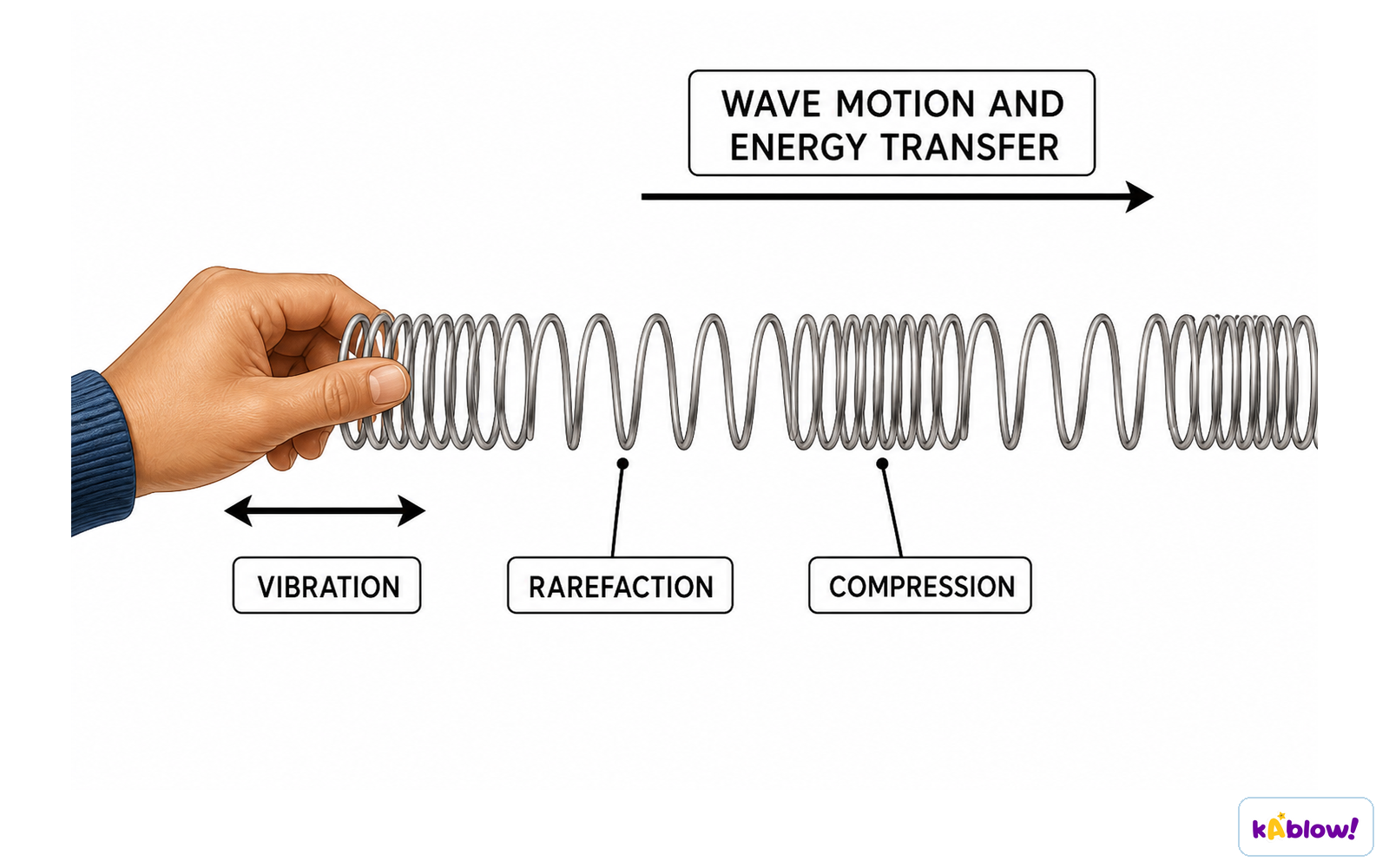
- As a longitudinal wave propagates, areas of high pressure (compressions) and low pressure (rarefactions) are observed.
- A compression is where particles are closer together; a rarefaction is where particles are further apart.
- Examples: sound waves and ultrasound waves.
- Longitudinal waves are mechanical waves; they need particles to propagate and cannot travel through a vacuum.
Longitudinal wave motion
Sound Waves
- Sound waves are longitudinal and require a medium to propagate.
- They are generated by oscillating sources that produce a change in density of the surrounding medium, travelling as a series of compressions and rarefactions.
- Sound waves form a continuous spectrum based on frequency.
- Humans can hear frequencies in the range 20 Hz – 20 kHz (the audible range).
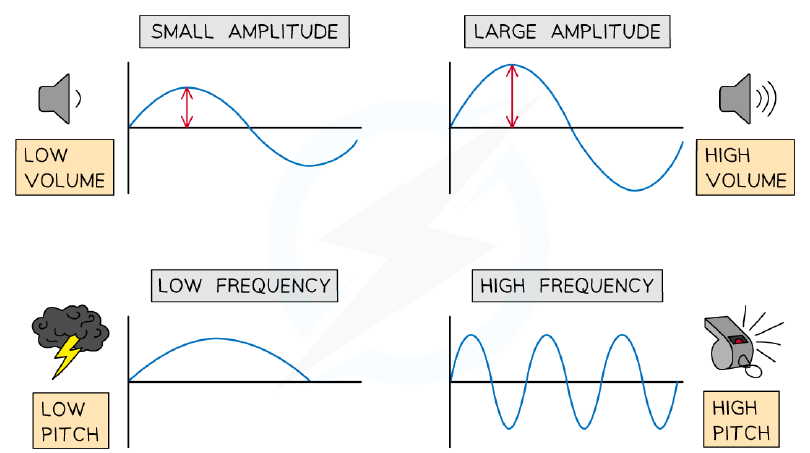
- Pitch is related to frequency: high pitch = high frequency (short wavelength); low pitch = low frequency (long wavelength).
- Volume is related to amplitude: large amplitude = high volume; small amplitude = low volume.
- Speed of sound in air at room temperature is about 340 m s⁻¹; it increases with air temperature because the average kinetic energy of particles is higher.
- Sound travels fastest through solids (particles closely packed) and slowest through gases (particles spread out).
Pitch and amplitude of sound waves
Electromagnetic Waves
- An electromagnetic wave is generated by the combined oscillation of an electric field and a magnetic field.
- These fields oscillate perpendicularly to each other and to the direction of motion (energy transfer).
- Electromagnetic waves are transverse and can travel through a vacuum.
- All electromagnetic waves travel at the speed of light c = 3 \times 108 \text{ m s}-1 in a vacuum, regardless of frequency.
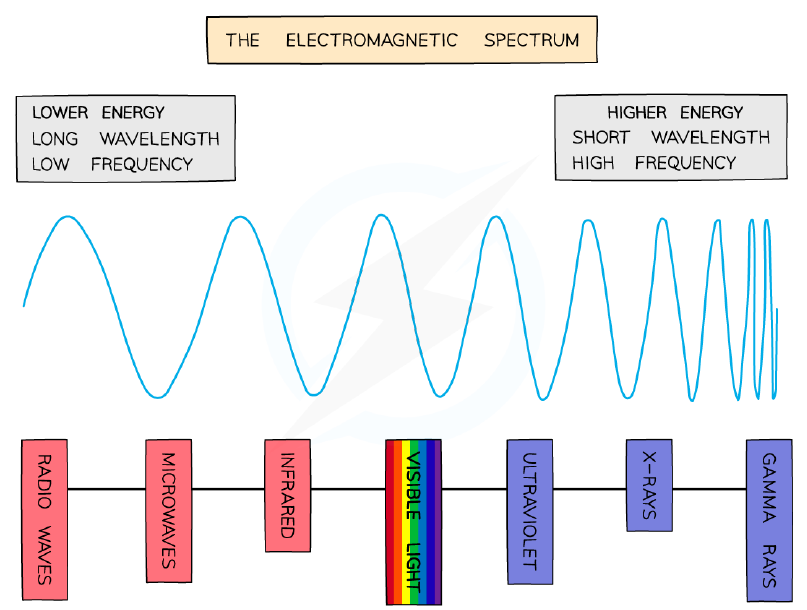
- They form a continuous spectrum based on frequency (or wavelength).
- The shorter the wavelength (or higher the frequency), the greater the energy of the wave.
- Humans can only sense wavelengths in the range 700 nm – 400 nm (the visible spectrum).
- Frequencies can be calculated using the wave equation c = f\lambda with c = 3 \times 108 \text{ m s}-1.
The electromagnetic spectrum, showing the seven regions in order of decreasing wavelength (increasing frequency), from radio waves to gamma rays.
Mechanical vs Electromagnetic Waves
- Mechanical waves require a medium (fluid or solid) to propagate; they can be transverse or longitudinal; they cannot travel through a vacuum.
- Electromagnetic waves do not require a medium; they are only transverse; they can travel through a vacuum.
- Mechanical waves are produced by the oscillation of particles in a medium; electromagnetic waves are produced by oscillating charged particles.
- Examples of mechanical waves: sound waves, water waves, seismic waves. Examples of electromagnetic waves: radio waves, UV rays, X-rays.
- Mechanical waves travel much slower than the speed of light; electromagnetic waves travel at the speed of light.
स्लाइड्स
Sign up free to view the lesson slides
Step through every slide for this topic — plus flashcards and revision notes — with a free account.
प्रैक्टिस सवाल
फ्री प्रीव्यू — 60 में से 8 सवाल। सभी देखने के लिए साइन अप करें।
1.Which statement does not describe a property of travelling waves?
Easy- AEnergy and matter are transferred by travelling waves
- BThe direction of motion of a travelling wave is the direction of energy transfer
- CTravelling waves travel away from the source of oscillation
- DThe oscillations can propagate through a medium or in a vacuum depending on the type of travelling wave
2.Identify the correct units for the quantities in the wave equation v = fλ.
Easy- AWave speed: m s⁻², Frequency: J, Wavelength: m
- BWave speed: m s⁻¹, Frequency: Hz, Wavelength: m
- CWave speed: m s⁻¹, Frequency: Hz, Wavelength: s
- DWave speed: m s⁻¹, Frequency: Hz, Wavelength: m²
3.A sound wave has a frequency f of 50 Hz. Identify the correct expression showing the time period T of the wave.
Easy- AT = 50
- BT = 1/50
- CT = 1/(2×50)
- DT = 2×50
4.Identify the example that is not a transverse wave.
Easy- ASound wave
- BMicrowave
- CWater wave
- DSunlight
5.Which of the following gives regions of the electromagnetic spectrum in order of increasing frequency?
Medium- AGamma ray, visible, radio wave
- BX-ray, microwave, ultraviolet
- CRadio wave, infrared, microwave
- DInfrared, ultraviolet, x-ray
6.An electromagnetic wave is generated by combined oscillations of electric and magnetic fields. These fields oscillate perpendicular to each other and to the direction of motion. In a diagram, if the electric field oscillates in plane P, which labels correctly identify Q and R?
Medium- AQ: Motion, R: Magnetic field
- BQ: Electric field, R: Motion
- CQ: Magnetic field, R: Electric field
- DQ: Magnetic field, R: Motion
7.Which of the following has a frequency lower than that of visible light?
Easy- AUltraviolet
- BInfrared
- CGamma ray
- DX-ray
8.Which frequency of sound wave would a human be able to hear?
Easy- A2 Hz
- B200 Hz
- C200 kHz
- D2000 kHz
Unlock all 60 questions & more
इस टॉपिक के हर सवाल, स्लाइड्स, फ्लैशकार्ड और रिवीज़न नोट्स देखने के लिए फ्री अकाउंट बनाएं।