Chemical Change & Rate Of Reaction
खेलकर सीखें
इन सवालों के जवाब देकर एनर्जी कमाएं, फिर मछली पकड़ें और घूमें। कोई अकाउंट नहीं चाहिए।
लेसन नोट्स
Physical & Chemical Changes
- Physical changes do not produce new substances; they are often easy to reverse (e.g., melting, dissolving).
- Chemical changes form new substances with different properties; signs include colour change, temperature change, effervescence.
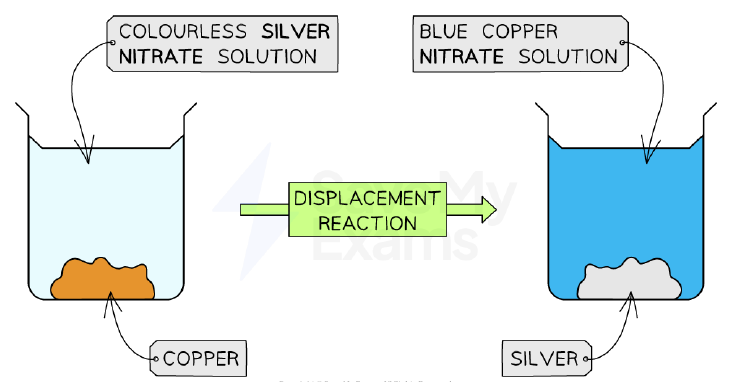
- Example of colour change: copper (orange-brown) + silver nitrate → silver solid + blue solution.
- Temperature changes: exothermic reactions release heat (e.g., CaO + water); endothermic reactions absorb heat (e.g., dissolving ammonium chloride).
- Effervescence (fizzing) indicates gas production, e.g., alkali metals + water produce hydrogen.
The metal displacement reaction of silver and copper
Rates of Reaction Factors
- Rate of reaction is affected by: concentration (or pressure for gases), surface area of solids, temperature, and catalysts.
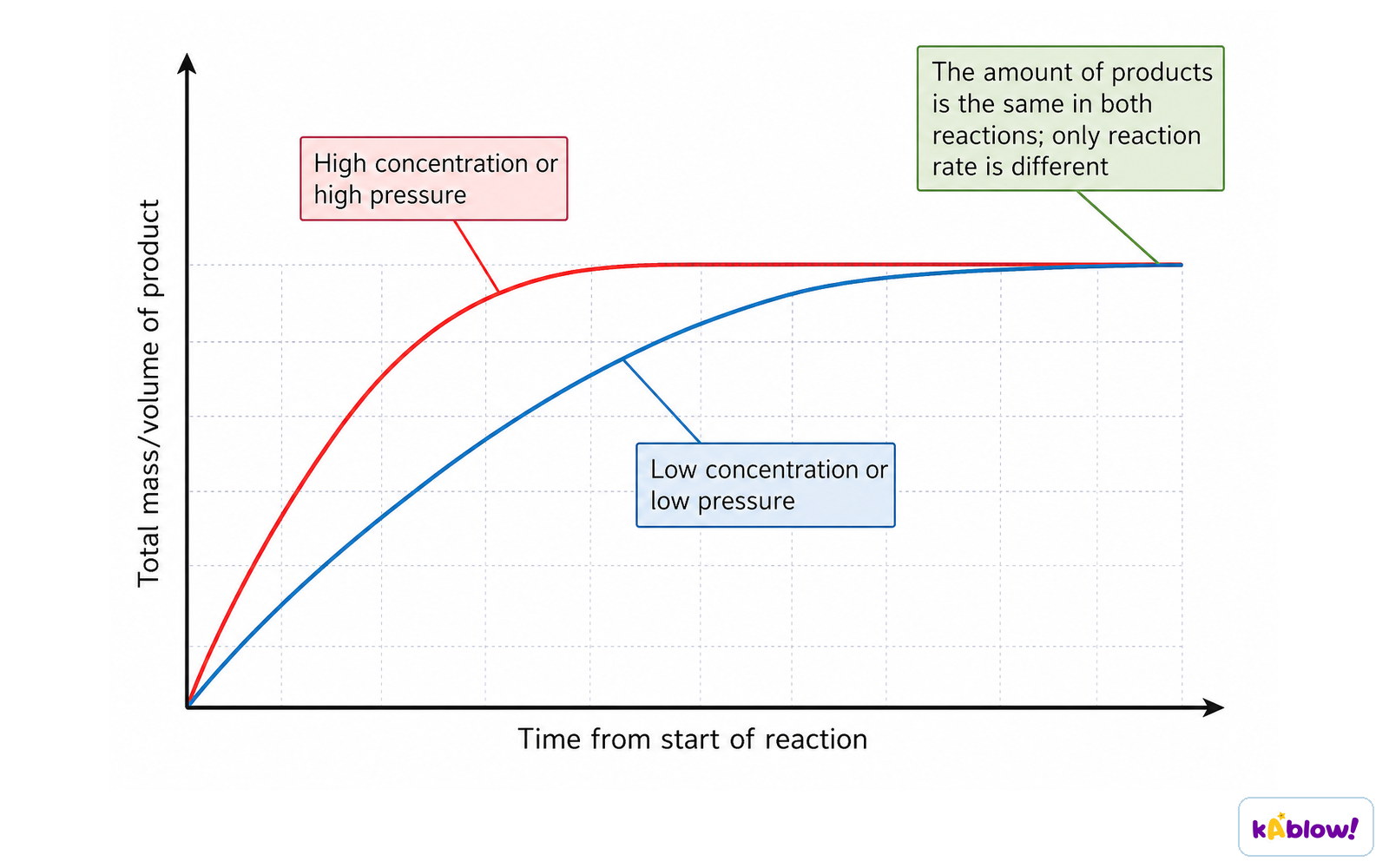
- Higher concentration/pressure → more particles per volume → steeper initial gradient, same final product amount.
- Higher surface area (e.g., powder vs lumps) → more exposed particles → steeper initial gradient, same final product.
- Higher temperature → particles have more kinetic energy → steeper initial gradient, same final product.
- Catalysts speed up reaction without being consumed; they provide an alternative pathway with lower activation energy.
Graph showing the effect of concentration on rate of reaction
Collision Theory (Extended)
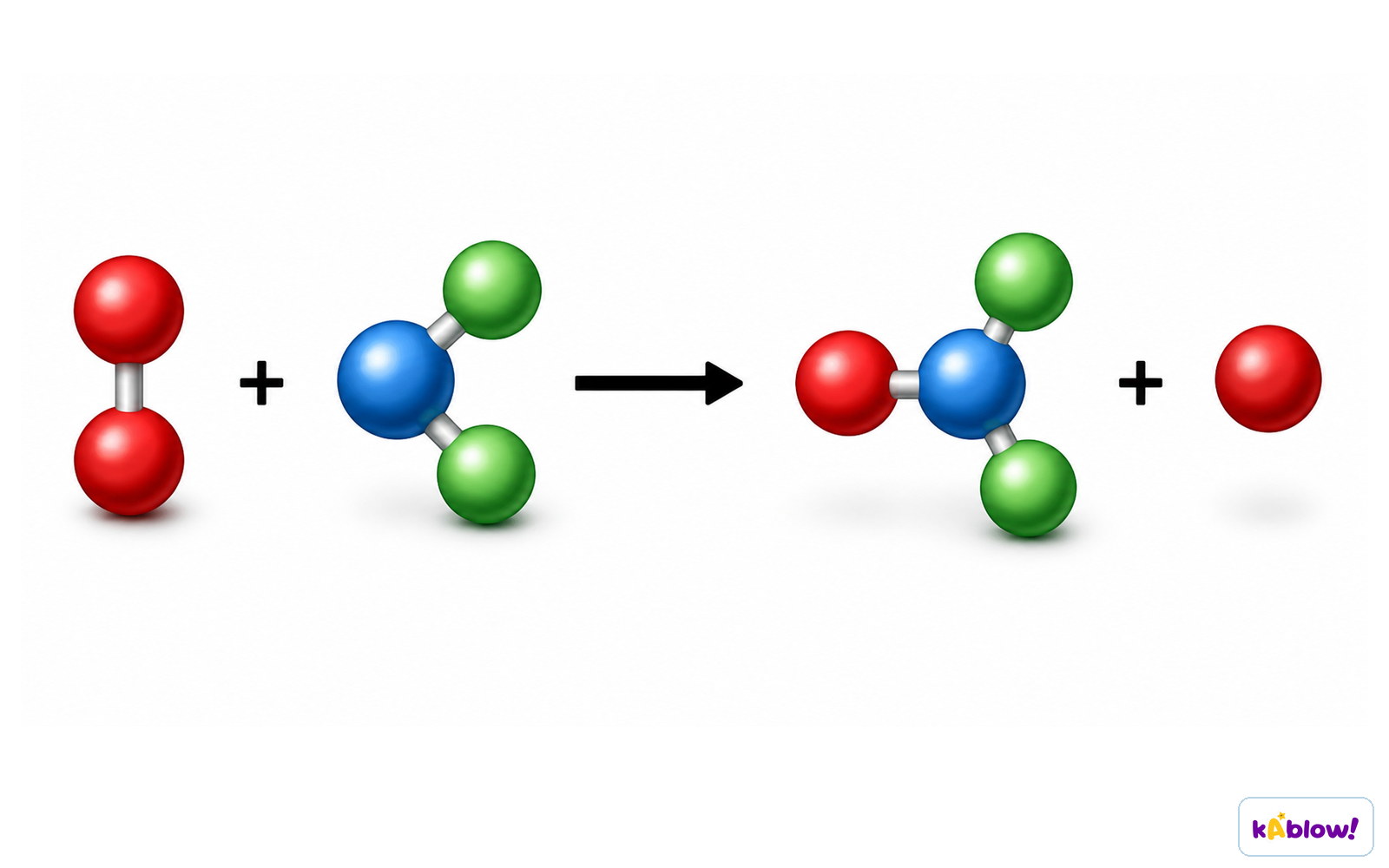
- For a reaction to occur, particles must collide with sufficient energy (≥ activation energy) and correct orientation.
- Successful collisions lead to product formation; unsuccessful collisions result in particles bouncing off unchanged.
- Rate depends on: number of particles per unit volume, collision frequency, kinetic energy of particles, and activation energy.
- Increasing any factor that raises collision frequency or energy increases the number of successful collisions per second.
A successful collision
Explaining Rates Using Collision Theory (Extended)
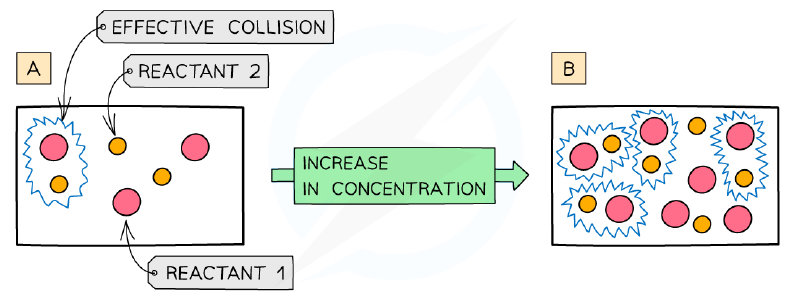
- Concentration: more particles per volume → more collisions per second → higher rate.
- Pressure (gases): same particles in smaller volume → more collisions per second → higher rate.
- Surface area: more exposed particles → more collisions per second → higher rate.
- Temperature: particles gain kinetic energy → more collisions and a greater proportion exceed activation energy → rate increases sharply (≈ doubles per 10 °C).
- Catalysts: lower activation energy → more collisions have sufficient energy → higher rate.
Diagram showing the effect of increasing concentration
Investigating the Rate of a Reaction
- Common methods: mass loss on a balance, gas volume (downward displacement or gas syringe), disappearing cross (precipitate formation).
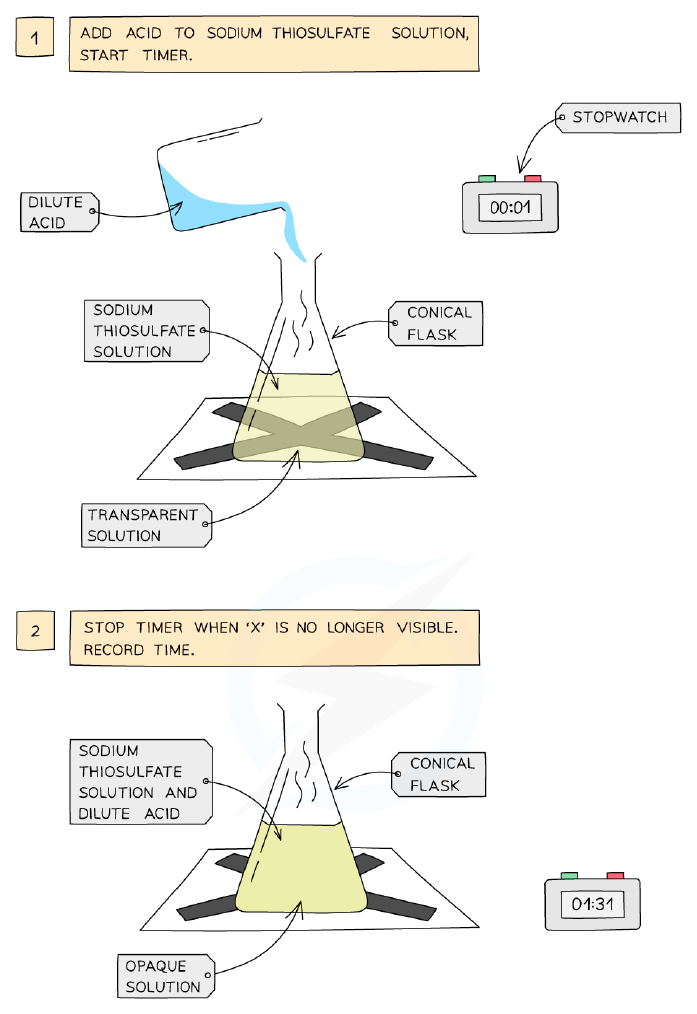
- Disappearing cross: measure time for a cross to become obscured by sulfur precipitate from sodium thiosulfate + HCl.
- Gas collection: e.g., magnesium + acid → hydrogen; measure volume over time.
- Catalyst investigation: e.g., hydrogen peroxide decomposition with MnO₂ catalyst; compare gas volumes.
- Advantages/disadvantages: mass loss is simple but unsuitable for low‑mass gases; gas syringes are accurate but fragile.
Diagram showing the apparatus needed to investigate the effect of concentration on the rate of reaction
Interpreting Data
- Rate is fastest at the start (steepest gradient) because reactant concentration is highest.
- As reaction proceeds, gradient decreases; when one reactant is used up, the line becomes horizontal (rate = 0).
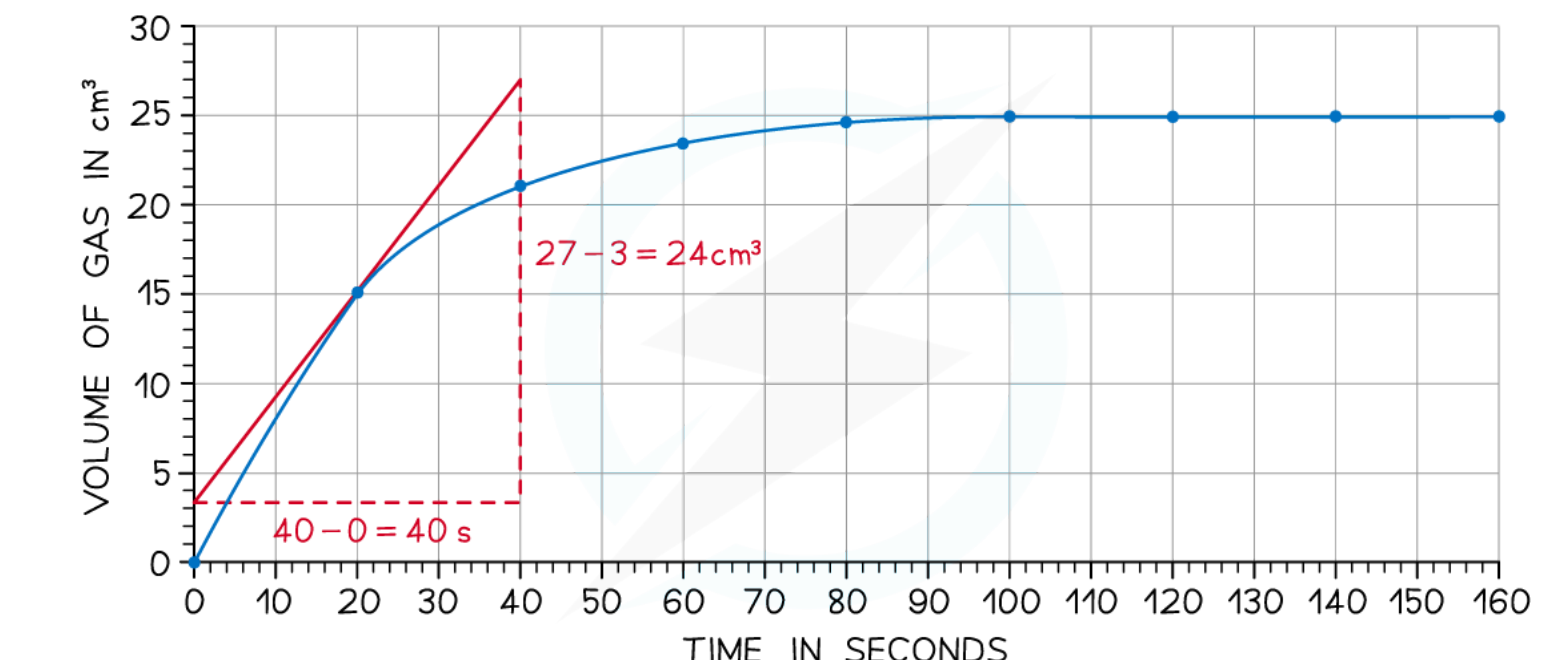
- To find rate at a specific time, draw a tangent to the curve and calculate gradient = change in y / change in x.
- Comparing experiments: higher concentration, temperature, surface area, or catalyst gives a steeper initial curve and same final product amount (if limiting reactant unchanged).
- If the amount of limiting reactant is increased, the final product amount increases.
Calculating the rate of reaction from a tangent
स्लाइड्स
Sign up free to view the lesson slides
Step through every slide for this topic — plus flashcards and revision notes — with a free account.
प्रैक्टिस सवाल
फ्री प्रीव्यू — 40 में से 8 सवाल। सभी देखने के लिए साइन अप करें।
1.Which of the following processes represents a physical change?
Easy- AAcid base neutralisation
- BMetal displacement reactions
- CBoiling ethanol
- DCombustion of magnesium
2.Physical and chemical changes are different processes. Which of the following rows correctly identifies characteristics of each one?
Easy- Achemical change - no new substance formed; physical change - change of state
- Bchemical change - no new substance formed; physical change - involves electron transfer
- Cchemical change - new substance formed; physical change - involves electron transfer
- Dchemical change - new substance formed; physical change - change of state
3.Which process is a physical change?
Easy- Acracking of an alkane
- Bhydration of ethene
- Cfractional distillation of petroleum
- Dthermal decomposition of calcium carbonate
4.The rate of a reaction was monitored by recording the volume of gas produced every 5 seconds. What is the mean rate of reaction in the first 10 seconds of the reaction, in cm³/s? (Data: at 0 s, 0 cm³; at 5 s, 15 cm³; at 10 s, 35 cm³)
Easy- A2.9
- B3.0
- C3.5
- D2.5
5.A student was investigating the rate of reaction between iron and a solution of sulfuric acid. Two experiments were performed, P and Q, in which the volume of hydrogen was recorded at regular intervals. Which change could explain the difference in results between P and Q? (Graph shows P has steeper initial slope and reaches higher final volume than Q)
Medium- AThe student added a catalyst in P.
- BLarger pieces of iron were used in P.
- CLess concentrated acid was used in P.
- DLarger quantities of both reactants are used in P.
6.A student investigates the rate of reaction between aqueous sodium thiosulphate and aqueous hydrochloric acid by measuring the time taken for a precipitate to obscure a cross underneath the beaker. Which statement is correct for the reaction?
Medium- AThe precipitate will be formed faster if ice is placed in contact with the beaker.
- BThe precipitate will be formed faster if 10.0 cm³ of water are added to the aqueous sodium thiosulphate.
- CThe precipitate will be formed slower if a catalyst is added to the reaction mixture.
- DThe precipitate will be formed faster if drops of concentrated hydrochloric acid are added to the reaction mixture.
7.A student investigates the effect of temperature on the rate of a reaction. In Experiment 1, the reaction is performed at 10 °C. In Experiment 2, the reaction is repeated at 20 °C. All other conditions stay the same. Which graph shows the results for the volume of gas produced against time? (Options: four graphs showing curves; correct one has steeper initial slope and reaches same final volume sooner for 20°C)
Medium- AGraph A: both curves identical
- BGraph B: 20°C curve has steeper slope and higher final volume
- CGraph C: 20°C curve has steeper slope and same final volume, levels off earlier
- DGraph D: 20°C curve has less steep slope and lower final volume
8.Magnesium metal reacts with an excess of hydrochloric acid solution to form magnesium chloride and hydrogen: Mg (s) + 2HCl (aq) → MgCl₂ (aq) + H₂ (g). Which of the following will not increase the rate of this reaction?
Medium- AIncrease the temperature of the acid
- BIncrease the surface area to volume ratio of the pieces of magnesium
- CIncrease the concentration of the hydrochloric acid
- DIncrease the volume of hydrochloric acid solution used
Unlock all 40 questions & more
इस टॉपिक के हर सवाल, स्लाइड्स, फ्लैशकार्ड और रिवीज़न नोट्स देखने के लिए फ्री अकाउंट बनाएं।