The Characteristic Properties Of Acids And Bases
खेलकर सीखें
इन सवालों के जवाब देकर एनर्जी कमाएं, फिर मछली पकड़ें और घूमें। कोई अकाउंट नहीं चाहिए।
लेसन नोट्स
Properties of Acids
- Acids have pH < 7, sour taste (if edible), and are corrosive.
- Acids neutralise bases to form a salt and water.
- In water, acids release hydrogen ions (H⁺); e.g., HCl → H⁺ + Cl⁻.
- Acids react with metals (above H in reactivity series) to give salt + H₂.
- Acids react with metal oxides/hydroxides (bases) to give salt + water (neutralisation).
- Acids react with metal carbonates to give salt + CO₂ + H₂O.
Properties of Bases & Alkalis
- Bases have pH > 7; a water‑soluble base is an alkali.
- Bases neutralise acids to form a salt and water.
- In water, alkalis release hydroxide ions (OH⁻); e.g., NaOH → Na⁺ + OH⁻.
- Bases are usually metal oxides or hydroxides.
- Alkalis react with ammonium salts (e.g., NH₄Cl) to give salt + water + NH₃ (test: damp red litmus turns blue).
Indicators
- Litmus: red in acid, blue in alkali (not sharp for titrations).
- Methyl orange: red in acid, yellow in alkali.
- Thymolphthalein: colourless in acid, blue in alkali.
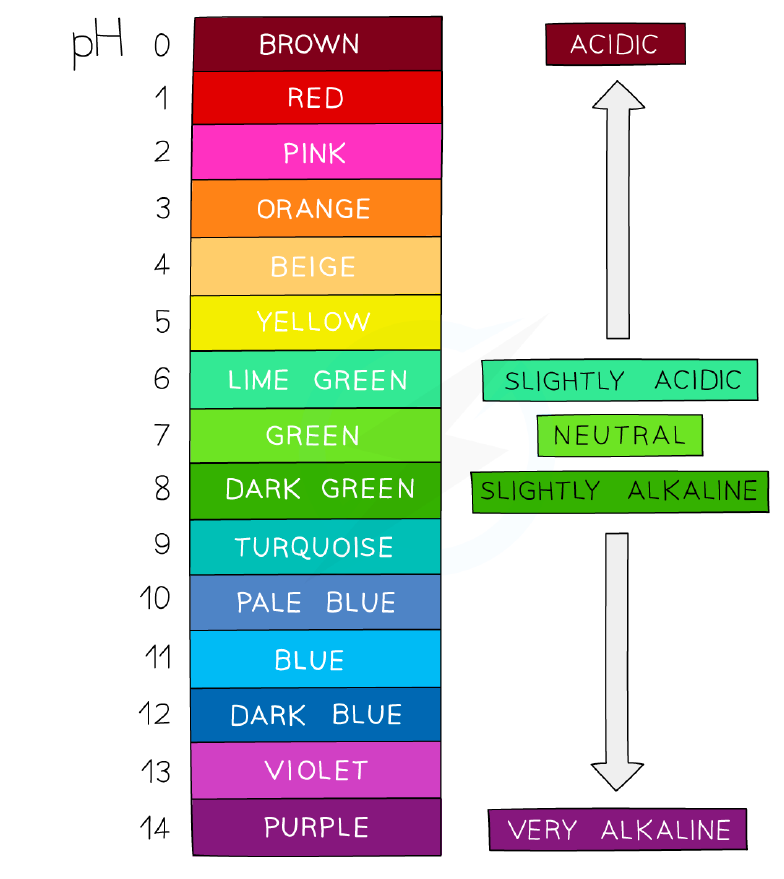
- Universal indicator: mixture of dyes giving a colour range for pH 1–14.
Universal indicator colours across the pH scale
Neutralisation & Ions
- Neutralisation: H⁺ + OH⁻ → H₂O (net ionic equation).
- Acids are sources of H⁺; alkalis are sources of OH⁻.
- Not all acid reactions are neutralisations (e.g., acid + metal produces no water).
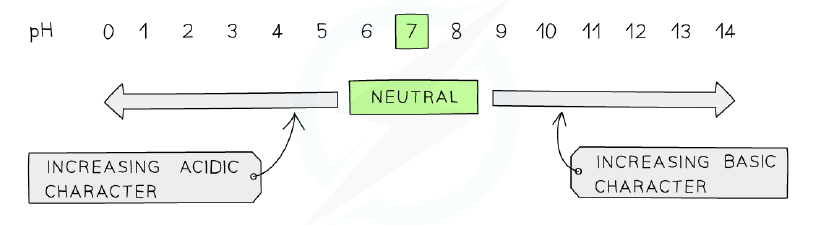
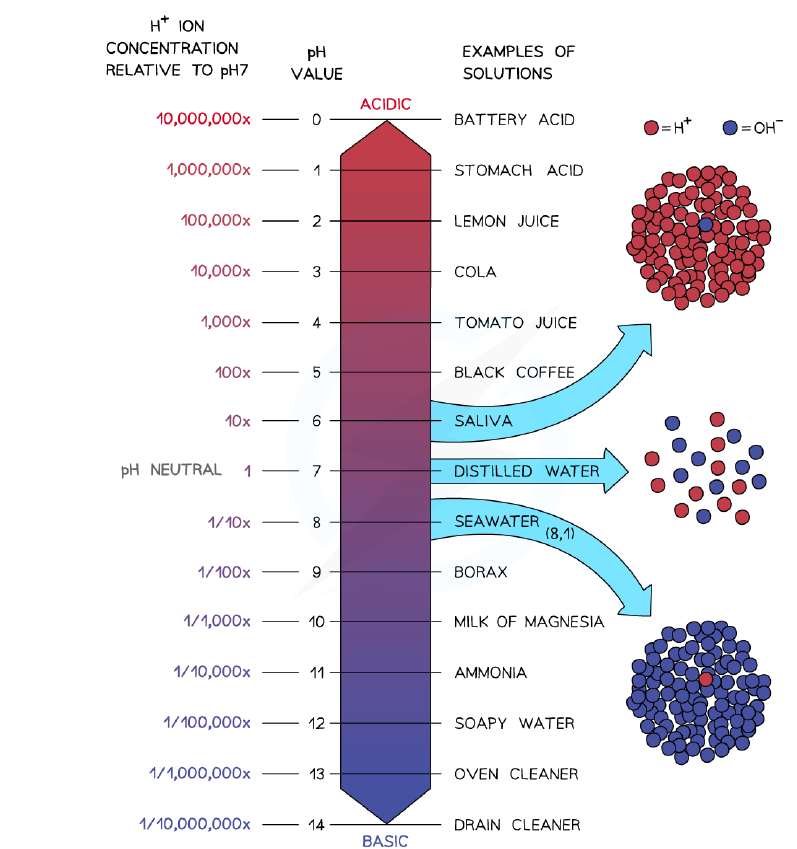
- The pH scale is logarithmic: a change of 1 pH unit = ×10 change in [H⁺].
The pH scale
pH Scale & Hydrogen Ion Concentration
- pH 0–2: strong acid; pH 3–6: weak acid; pH 7: neutral.
- pH 8–11: weak alkali; pH 12–14: strong alkali.
- Lower pH = higher [H⁺]; higher pH = higher [OH⁻].
- Universal indicator gives approximate pH by matching colour to a chart.
H+ ion concentration relative to pH
Classifying Oxides
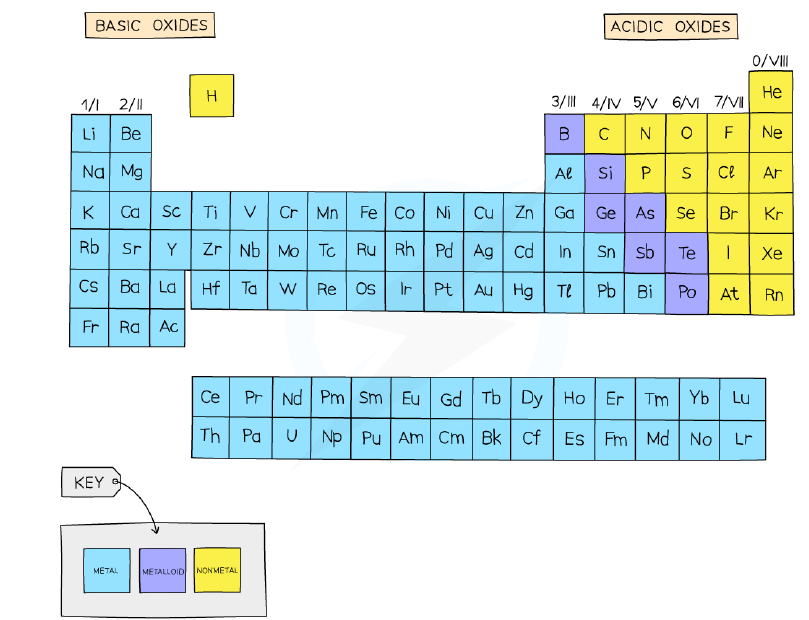
- Acidic oxides (non‑metal + O): react with bases to form salt + water; produce acidic solutions (e.g., CO₂, SO₂).
- Basic oxides (metal + O): react with acids to form salt + water; produce alkaline solutions (e.g., CuO, CaO).
- Amphoteric oxides (e.g., ZnO, Al₂O₃): react with both acids and bases to give salt + water.
- Neutral oxides (e.g., N₂O, NO, CO): do not react with acids or bases.
Metals form basic oxides, non-metals form acidic oxides
स्लाइड्स
Sign up free to view the lesson slides
Step through every slide for this topic — plus flashcards and revision notes — with a free account.
प्रैक्टिस सवाल
फ्री प्रीव्यू — 52 में से 8 सवाल। सभी देखने के लिए साइन अप करें।
1.All bases are soluble in water and are called alkalis.
EasyTrue or false?
2.Which of the following is the correct net ionic equation for the neutralisation of an acid by a base?
Easy- AH⁺(aq) + OH⁻(aq) → H₂O(l)
- BH⁺(aq) + OH⁻(aq) → H₂O₂(l)
- CH⁺(aq) + O²⁻(aq) → H₂O(l)
- DH₂O(l) → H⁺(aq) + OH⁻(aq)
3.State the colour of litmus in an alkali.
Easy4.Complete the sentence about the reaction of acids with metals.
EasyWhen an acid reacts with a metal, the products are a ____ and hydrogen gas.
5.A solution has a pH of 3. How many times greater is the hydrogen ion concentration compared to a solution of pH 5?
Medium- A100
- B120
- C90
- D110
6.Match each oxide to its classification.
Medium- CO₂
- MgO
- Al₂O₃
- Acidic oxide
- Basic oxide
- Amphoteric oxide
7.Name the gas produced when an acid reacts with a metal carbonate.
Easy8.Which indicator is NOT suitable for determining the endpoint in an acid-alkali titration?
Medium- ALitmus
- BMethyl orange
- CThymolphthalein
- DUniversal indicator
Unlock all 52 questions, flashcards & more
इस टॉपिक के हर सवाल, स्लाइड्स, फ्लैशकार्ड और रिवीज़न नोट्स देखने के लिए फ्री अकाउंट बनाएं।