Electromagnetic Effects
खेलकर सीखें
इन सवालों के जवाब देकर एनर्जी कमाएं, फिर मछली पकड़ें और घूमें। कोई अकाउंट नहीं चाहिए।
लेसन नोट्स
Electromagnetic Induction
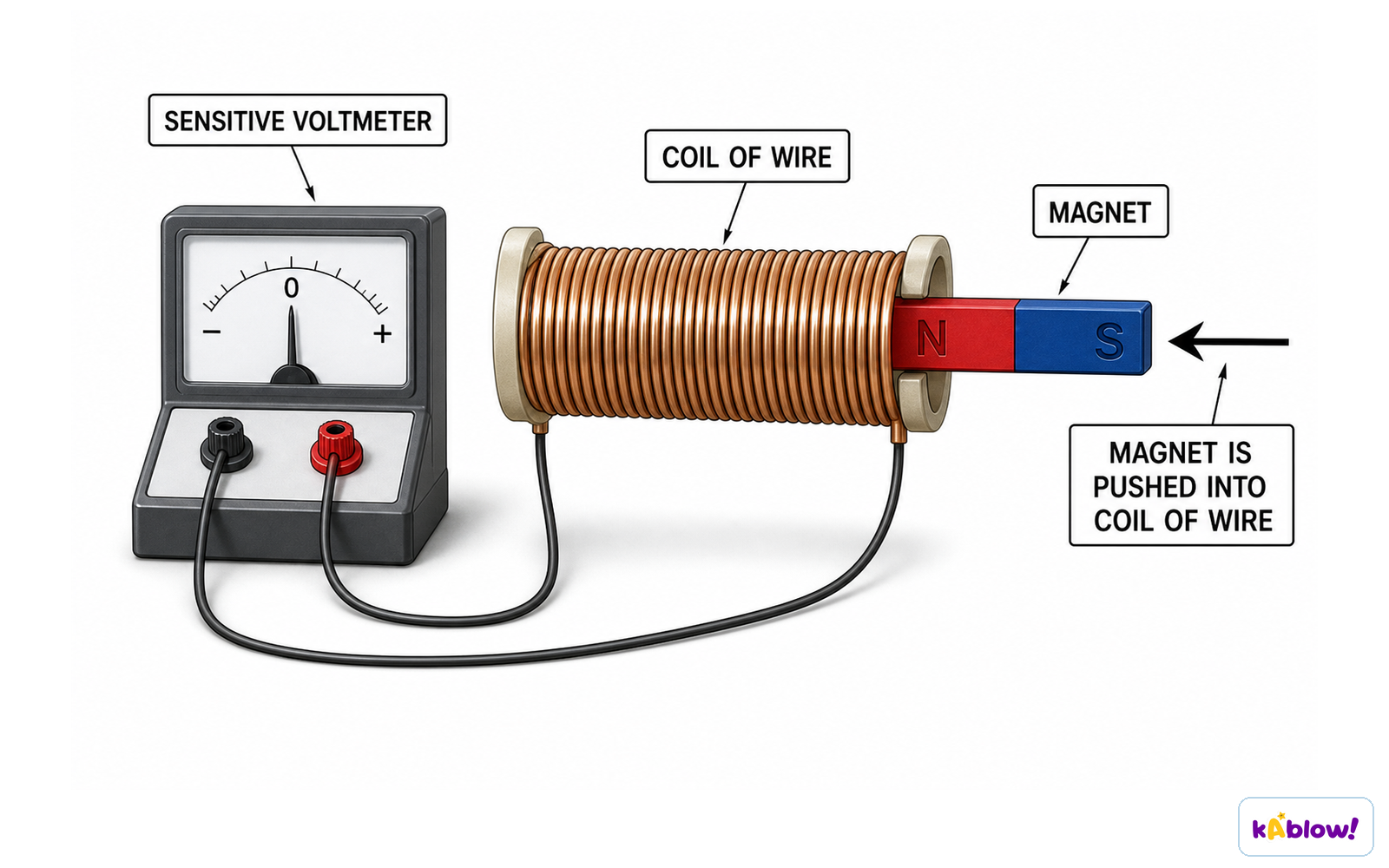
- An e.m.f. is induced in a conductor when there is relative movement between the conductor and a magnetic field.
- The conductor can move in a stationary field, or the field can change around a stationary conductor.
- If the conductor is part of a complete circuit, an induced current flows.
- Factors increasing induced e.m.f.: faster movement, more turns on the coil, larger coil area, stronger magnetic field.
- Reversing the magnet poles or the direction of movement reverses the direction of the induced e.m.f.
Setup for demonstrating electromagnetic induction: a magnet moved into a coil induces an e.m.f., detected by a voltmeter.
The A.C. Generator
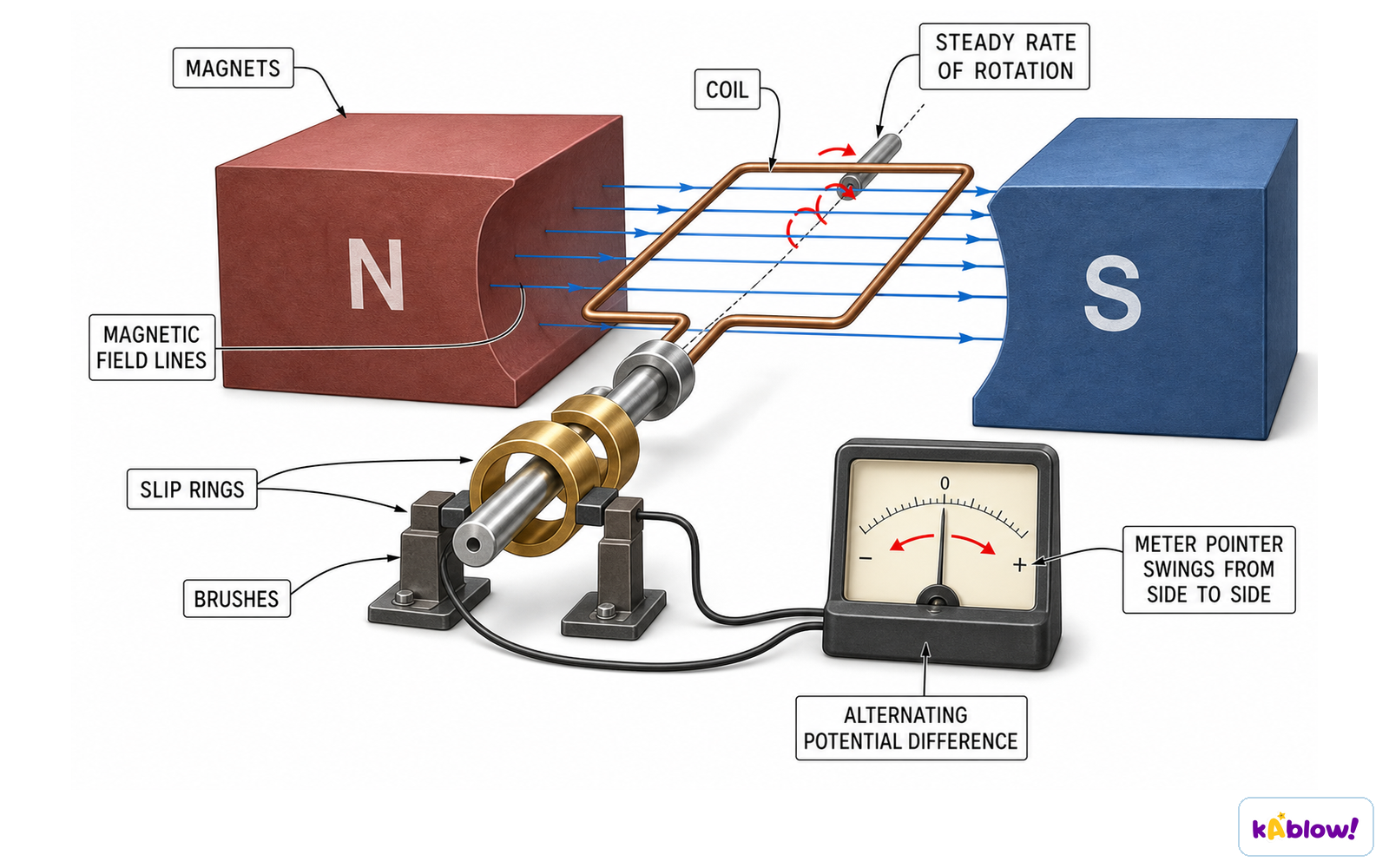
- An a.c. generator converts mechanical energy into electrical energy using a rotating coil in a magnetic field.
- It uses slip rings and carbon brushes to connect the coil to an external circuit.
- The induced e.m.f. is alternating (sine/cosine wave) as the coil rotates.
- Maximum e.m.f. when coil is horizontal (moving perpendicular to field); zero e.m.f. when vertical (moving parallel).
- Output e.m.f. can be increased by: faster rotation, more turns, stronger magnet, soft iron core.
Structure of a simple a.c. generator: a rotating coil between magnet poles, connected to slip rings and carbon brushes.
Magnetic Effect of a Current
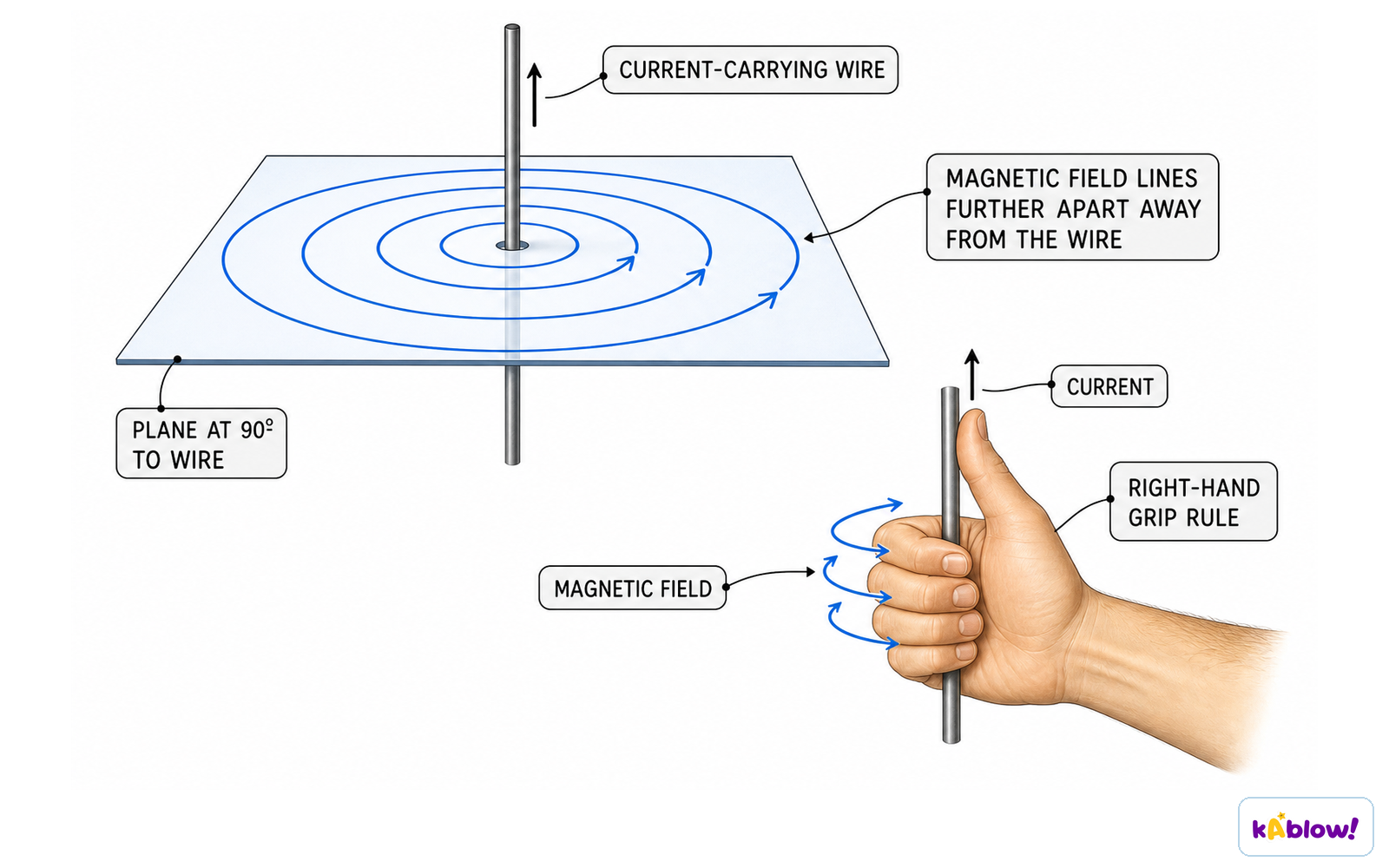
- A current-carrying wire produces a circular magnetic field around it (concentric circles).
- Use the right-hand grip rule: thumb = current direction, fingers = field direction.
- A solenoid (coil of wire) produces a field like a bar magnet with north and south poles.
- Field strength increases with higher current, more turns, or adding a soft iron core (electromagnet).
- The field direction reverses if the current direction is reversed.
The direction of the magnetic field around a current-carrying wire, found using the right-hand grip rule.
Force on a Current-Carrying Conductor
- A current-carrying conductor in a magnetic field experiences a force (motor effect).
- The force is maximum when the current is perpendicular to the field; zero when parallel.
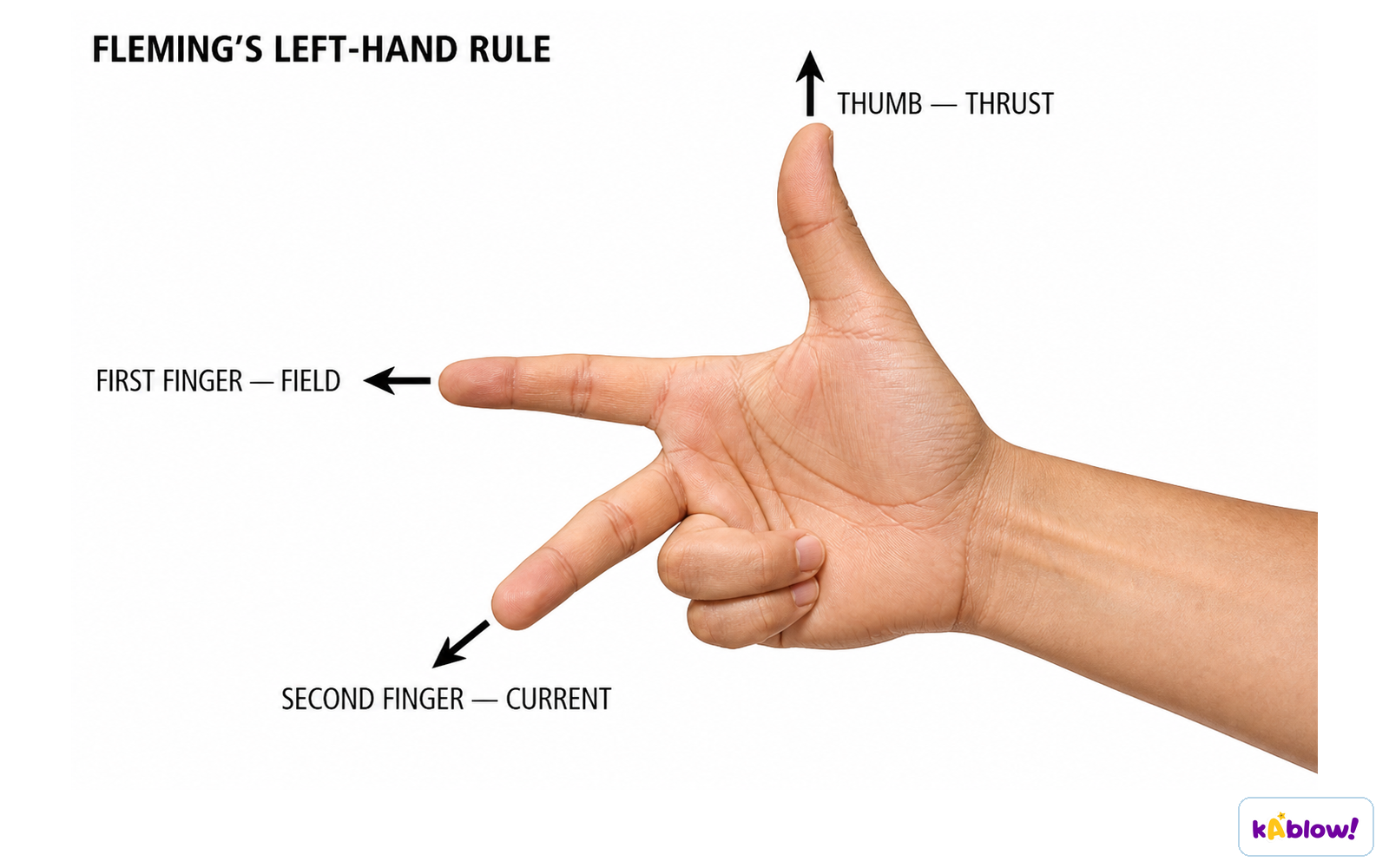
- Fleming's left-hand rule: thumb = force (thrust), first finger = field (N→S), second finger = current (+ to -).
- Reversing either the current or the magnetic field reverses the force direction.
Fleming's left-hand rule: thumb = force (thrust), first finger = field, second finger = current.
Electric Motors
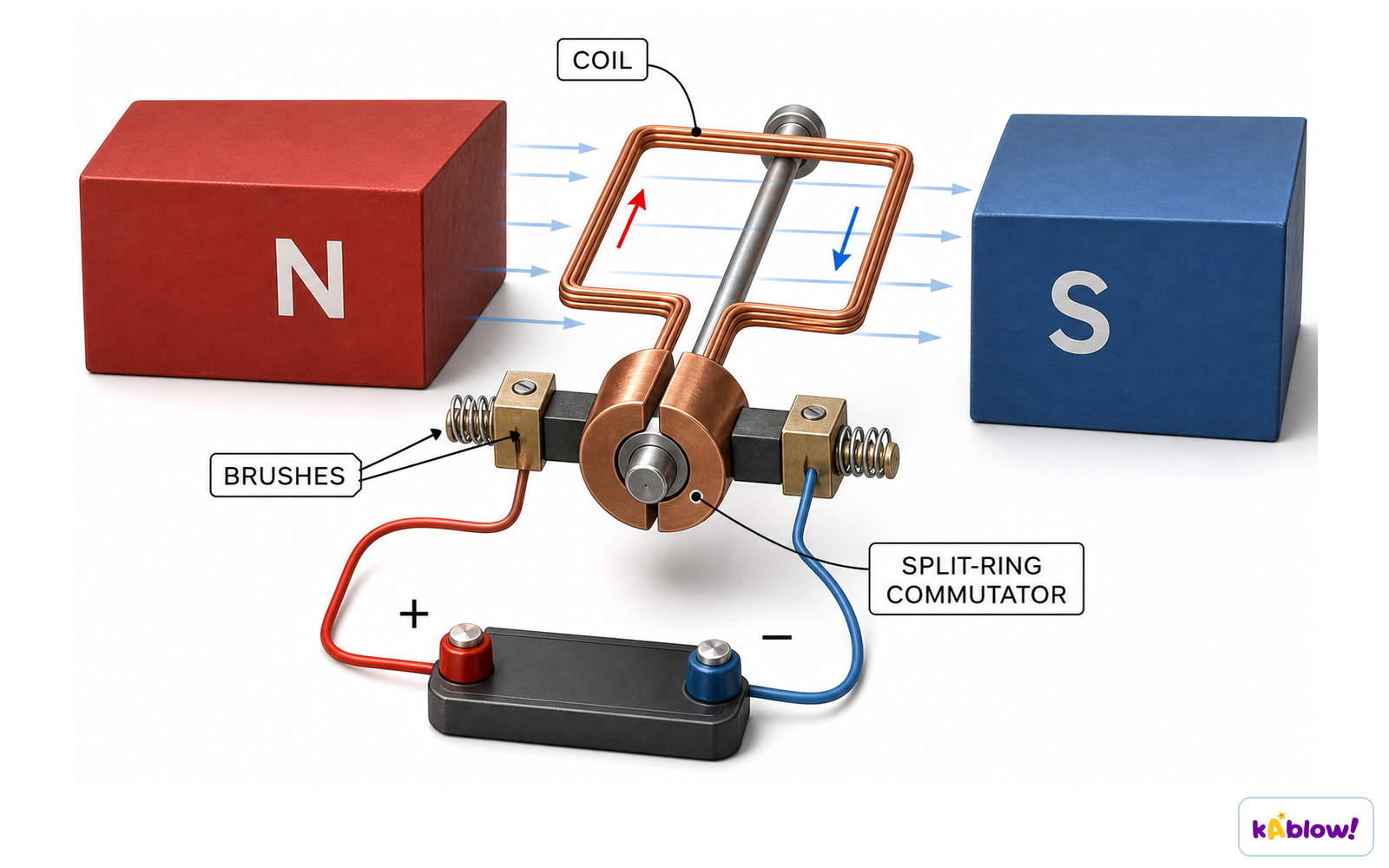
- A d.c. motor uses the motor effect to produce continuous rotation.
- Key parts: coil, permanent magnet, split-ring commutator, carbon brushes.
- The split-ring commutator reverses the current every half-turn to keep rotation in the same direction.
- Turning effect increased by: more turns, higher current, stronger magnet.
- Direction of rotation reversed by reversing current or magnetic field.
Structure of a simple d.c. motor, showing the coil, split-ring commutator, carbon brushes and magnetic field.
Transformers
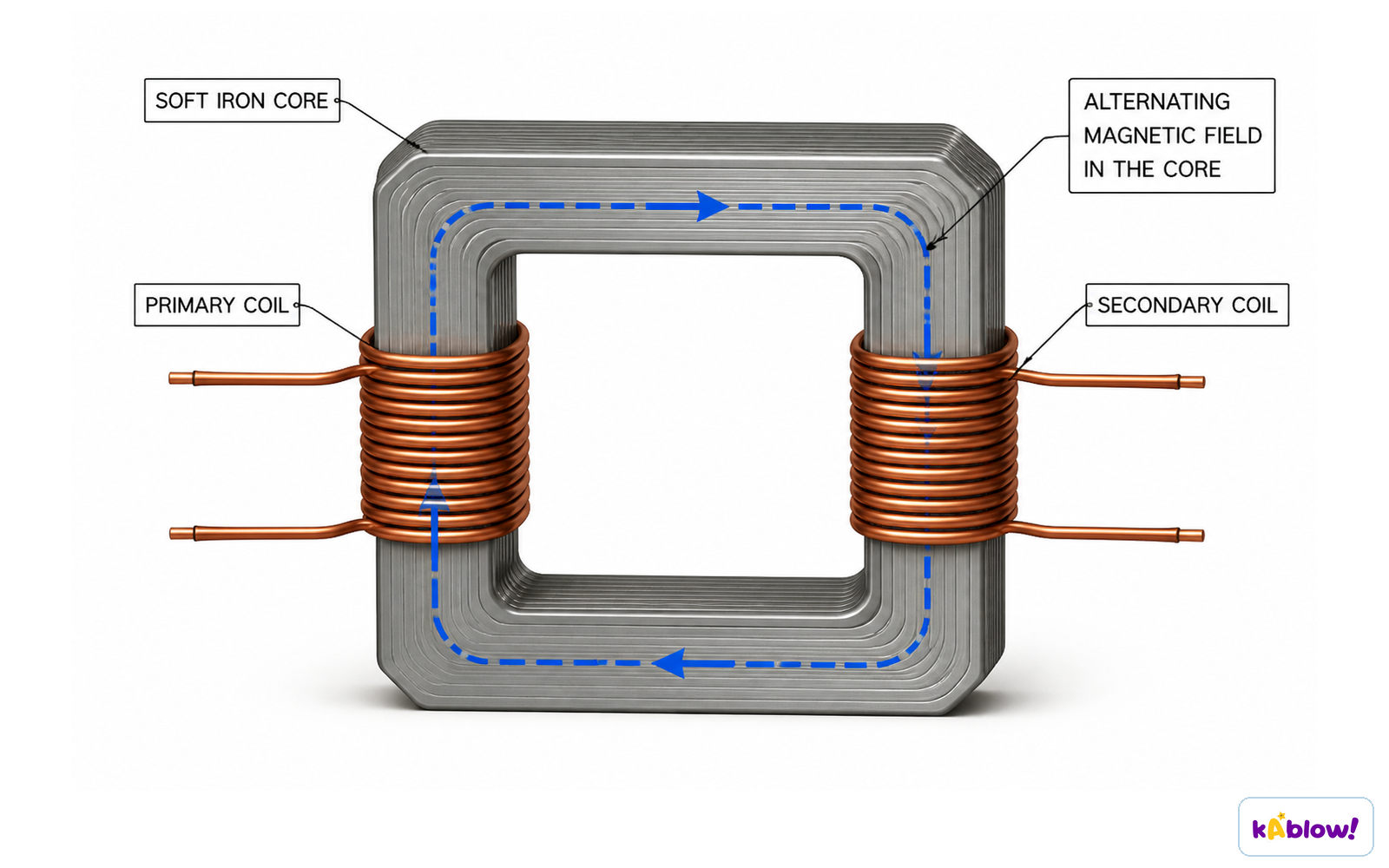
- A transformer changes the voltage of an alternating supply using electromagnetic induction.
- It consists of a primary coil, secondary coil, and a soft iron core.
- A step-up transformer increases voltage (Ns > Np); a step-down transformer decreases voltage (Ns < Np).
- Transformer equation: \frac{Vp}{Vs} = \frac{Np}{Ns}.
- For an ideal transformer (100% efficient): Ip Vp = Is Vs.
Structure of a simple transformer: primary coil and secondary coil wound on a soft iron core.
High-Voltage Transmission
- Electricity is transmitted at high voltage and low current to reduce energy loss in cables.
- Power loss in cables: P = I2 R. Lower current means less heat loss.
- Step-up transformers increase voltage before transmission; step-down transformers decrease voltage for safe use.
- This system improves efficiency of power distribution.
Electricity is transmitted at high voltage via step-up and step-down transformers to reduce power loss in the cables.

स्लाइड्स
Sign up free to view the lesson slides
Step through every slide for this topic — plus flashcards and revision notes — with a free account.
प्रैक्टिस सवाल
फ्री प्रीव्यू — 57 में से 8 सवाल। सभी देखने के लिए साइन अप करें।
1.A coil of wire is connected to a sensitive voltmeter. A magnet is pushed into the coil and the voltmeter needle deflects to the right. What will happen when the magnet is stationary in the centre of the coil?
Easy- AThe needle will deflect to the left
- BThe needle will deflect to the right
- CThere will be no deflection of the needle
- DThe needle will deflect to the left and then to the right
2.State two factors that affect the magnitude of the induced e.m.f. in a coil when a magnet is moved into it.
Medium3.A step-up transformer has more turns on the secondary coil than on the primary coil.
EasyTrue or false?
4.A transformer has 20 turns on the primary coil and 800 turns on the secondary coil. The voltage across the primary coil is 500 V. Calculate the output voltage of the secondary coil.
Medium- A18000
- B20000
- C22000
- D24000
5.Complete the sentence about Fleming's left-hand rule.
EasyIn Fleming's left-hand rule, the thumb points in the direction of the ____ on the conductor.
6.In a simple a.c. generator, the induced e.m.f. is zero when the coil is:
Medium- Ahorizontal and moving perpendicular to the magnetic field
- Bvertical and moving parallel to the magnetic field
- Chorizontal and moving parallel to the magnetic field
- Dvertical and moving perpendicular to the magnetic field
7.Match each component of a simple a.c. generator to its function.
Medium- Permanent magnet
- Slip rings
- Carbon brushes
- Allow alternating current to flow between coil and external circuit
- Provide a uniform magnetic field
- Provide a good electrical connection between coil and external circuit
8.State two ways to reverse the direction of the force on a current-carrying conductor in a magnetic field.
Easy
Unlock all 57 questions & more
इस टॉपिक के हर सवाल, स्लाइड्स, फ्लैशकार्ड और रिवीज़न नोट्स देखने के लिए फ्री अकाउंट बनाएं।