Congruence And Similarity
खेलकर सीखें
इन सवालों के जवाब देकर एनर्जी कमाएं, फिर मछली पकड़ें और घूमें। कोई अकाउंट नहीं चाहिए।
लेसन नोट्स
Congruence
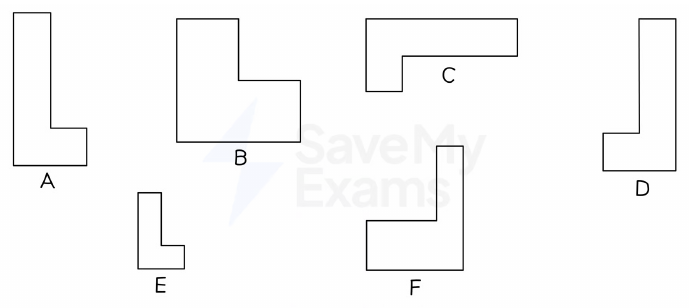
- Two shapes are congruent if they are identical in shape and size.
- One shape may be a reflection, rotation, or translation of the other.
- If one shape is an enlargement of the other, they are not congruent.
- To prove congruence, show that corresponding sides are equal in length and corresponding angles are equal in size.
- Tracing paper can help check congruence if shapes are drawn to scale.
Congruent Shapes
Similarity
- Two shapes are similar if they have the same shape and their corresponding sides are in proportion.
- One shape is an enlargement of the other; similarity does not imply congruence.
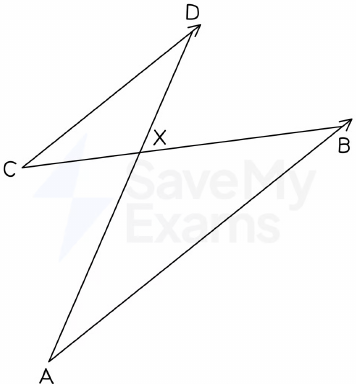
- For triangles, prove similarity by showing corresponding angles are equal (e.g., using vertically opposite angles, alternate angles on parallel lines).
- For non-triangular shapes, show that all corresponding sides are in the same ratio (scale factor).
- If all angles are equal, the shapes are similar (but not necessarily congruent).
Similar Triangles in an Hourglass
Similar Lengths
- Equivalent lengths on similar shapes are linked by a scale factor (k).
- If the second shape is larger, k > 1; if smaller, 0 < k < 1.
- To find k: divide a length on the second shape by the corresponding length on the first shape.
- To find a missing length: multiply the corresponding length by k (if going to larger) or divide by k (if going to smaller).
- Redraw overlapping similar shapes separately to avoid confusion.
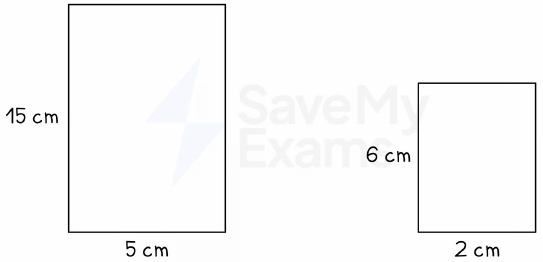
Similar Rectangles
Similar Areas & Volumes
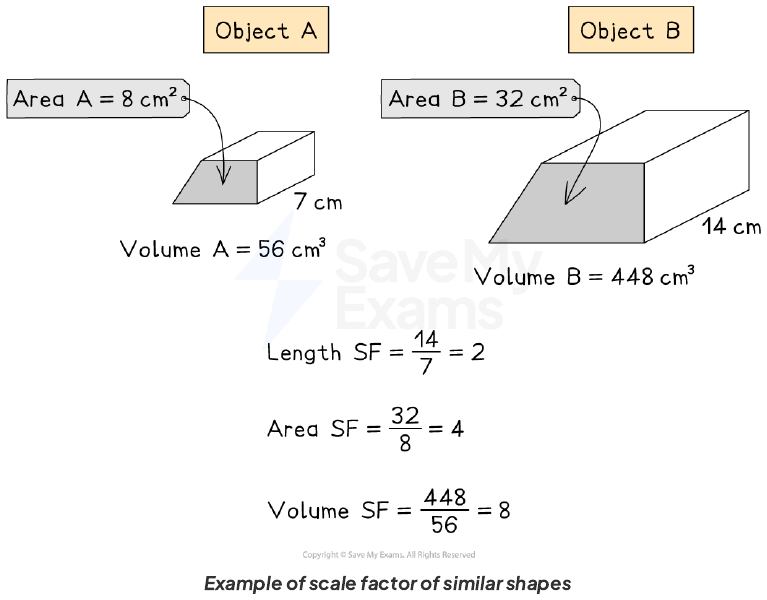
- If length scale factor = k, then area scale factor = k² and volume scale factor = k³.
- Given area scale factor, length scale factor = √(area SF); volume scale factor = (√(area SF))³.
- Given volume scale factor, length scale factor = ∛(volume SF); area scale factor = (∛(volume SF))².
- To find missing area or volume: identify known quantities, find the relevant scale factor, then multiply or divide accordingly.
- Always check whether the result should be larger or smaller than the given quantity.
Similar Solids: Length, Area and Volume Scale Factors
Worked Examples (Lengths)
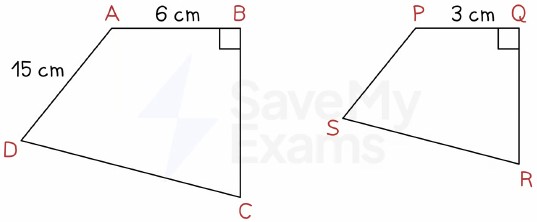
- Example: Two similar rectangles have sides 6 cm and 3 cm. Scale factor = 6/3 = 2 (larger to smaller) or 3/6 = 0.5 (smaller to larger).
- To find missing side: if AD = 15 cm on larger, corresponding PS on smaller = 15 × 0.5 = 7.5 cm.
- Always identify corresponding sides correctly before applying scale factor.
Finding a Missing Length on a Similar Shape
Worked Examples (Areas & Volumes)
- Example: Solid A volume 32 cm³, solid B volume 108 cm³. k³ = 108/32 = 27/8, so k = ∛(27/8) = 3/2.
- If height of A = 10 cm, height of B = 10 × (3/2) = 15 cm.
- For areas: if area scale factor = 4, then length scale factor = √4 = 2.
स्लाइड्स
Sign up free to view the lesson slides
Step through every slide for this topic — plus flashcards and revision notes — with a free account.
प्रैक्टिस सवाल
फ्री प्रीव्यू — 44 में से 8 सवाल। सभी देखने के लिए साइन अप करें।
1.Two shapes are congruent if they are identical in shape and size. Which of the following transformations does NOT change congruence?
Easy- AEnlargement
- BReflection
- CRotation
- DTranslation
2.Triangle ABC is similar to triangle PQR. AB = 6 cm, PQ = 9 cm. What is the length scale factor from triangle ABC to triangle PQR?
Easy- A1.5
- B0.666...
- C2
- D3
3.Two rectangles are similar. The smaller rectangle has width 4 cm and length 6 cm. The larger rectangle has width 10 cm. What is the length of the larger rectangle?
Easy- A15 cm
- B12 cm
- C20 cm
- D8 cm
4.Solid A and solid B are mathematically similar. The volume of solid A is 32 cm³ and the volume of solid B is 108 cm³. The height of solid A is 10 cm. Find the height of solid B.
Medium- A15 cm
- B20 cm
- C12 cm
- D18 cm
5.Two cones are mathematically similar. The total surface area of the smaller cone is 80 cm² and of the larger cone is 180 cm². The volume of the smaller cone is 168 cm³. Calculate the volume of the larger cone.
Hard- A567 cm³
- B378 cm³
- C756 cm³
- D283.5 cm³
6.A model of a car has a scale 1:20. The volume of the actual car is 12 m³. Find the volume of the model in cubic centimetres.
Medium- A1500 cm³
- B1500000 cm³
- C3000 cm³
- D600 cm³
7.Two mathematically similar containers have heights of 30 cm and 75 cm. The larger container has a capacity of 5.5 litres. Calculate the capacity of the smaller container in millilitres.
Medium- A352 ml
- B880 ml
- C220 ml
- D550 ml
8.Two containers are mathematically similar. The surface area of the larger container is 226 cm² and the surface area of the smaller container is 94 cm². The volume of the larger container is 680 cm³. Find the volume of the smaller container.
Hard- A183 cm³
- B150 cm³
- C200 cm³
- D250 cm³
Unlock all 44 questions & more
इस टॉपिक के हर सवाल, स्लाइड्स, फ्लैशकार्ड और रिवीज़न नोट्स देखने के लिए फ्री अकाउंट बनाएं।