Beyond the solar system
खेलकर सीखें
इन सवालों के जवाब देकर एनर्जी कमाएं, फिर मछली पकड़ें और घूमें। कोई अकाउंट नहीं चाहिए।
लेसन नोट्स
The Universe and Galaxies
- The universe contains billions of galaxies.
- A galaxy contains billions of stars.
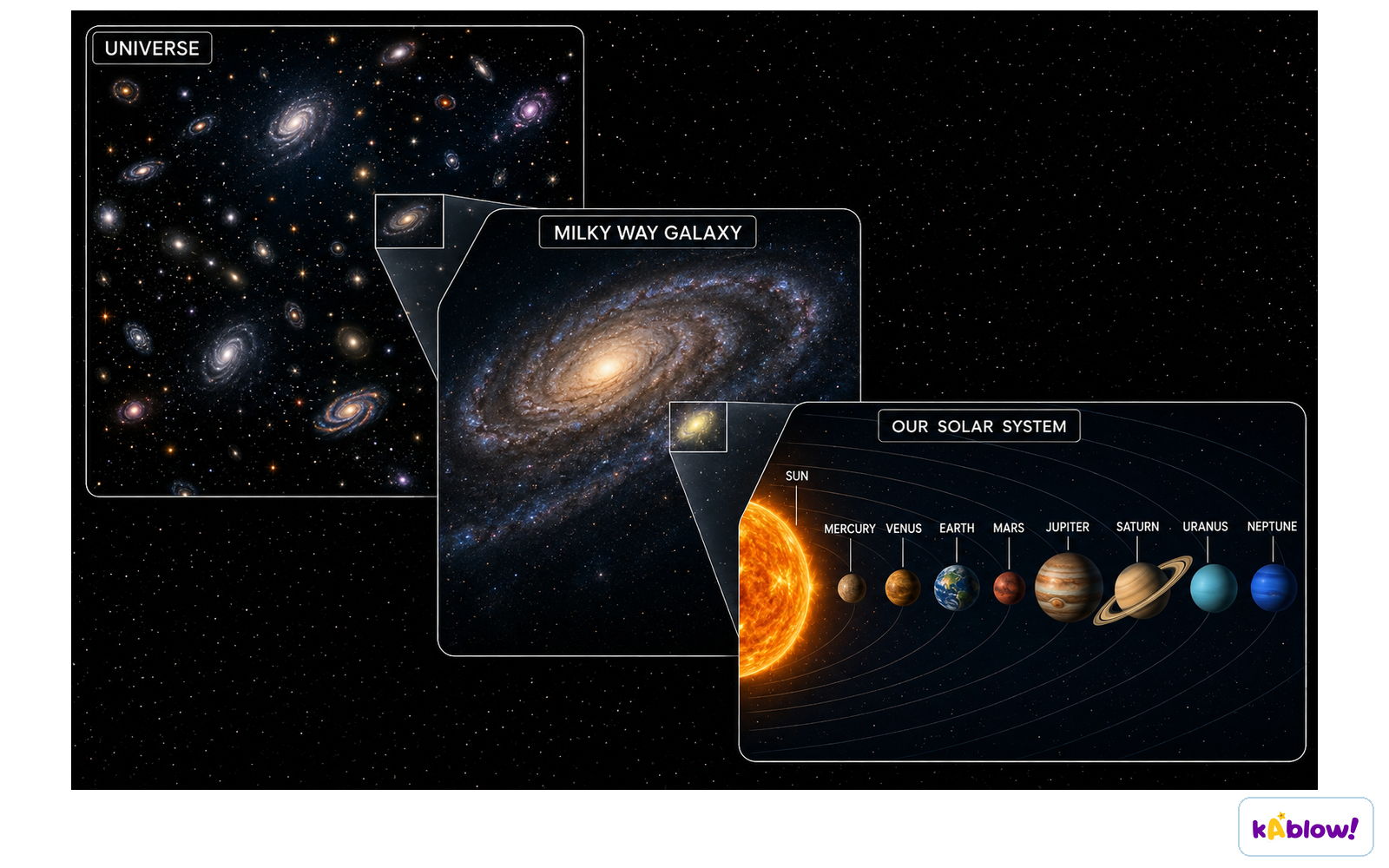
- Our solar system is part of the Milky Way galaxy.
- The universe formed 13.8 billion years ago in the Big Bang.
- Distances to galaxies are measured in light years.
Universe, Milky Way galaxy and Solar System, from largest to smallest scale.
Light Years
- The speed of light is 300,000,000 m/s.
- A light year is the distance light travels in one year.
- One light year equals 9.5 × 10¹⁵ m.
- The Andromeda galaxy is 2.5 million light years away.
Black Holes
- At the centre of the Milky Way is a black hole.
- A black hole forms from the death of a very massive star.
Star Life Cycle: Nebula to Main Sequence
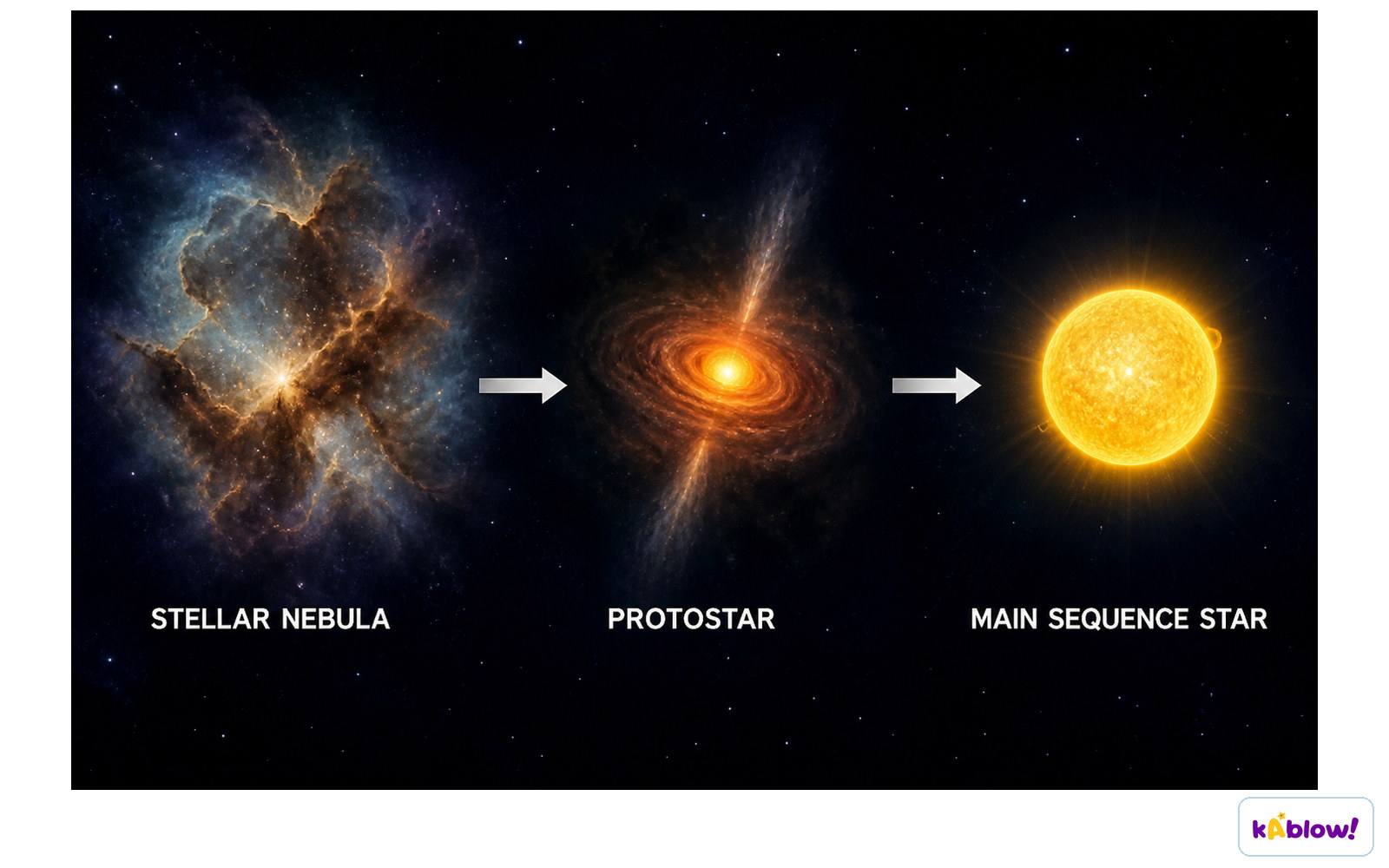
- All stars begin as a cloud of dust and gas called a nebula (mostly hydrogen).
- Gravitational attraction pulls the dust and gas together.
- Pressure and friction cause the temperature to rise greatly.
- A main sequence star is formed.
A nebula contracts into a protostar, which becomes a main sequence (stable) star.
Star Life Cycle: Later Stages
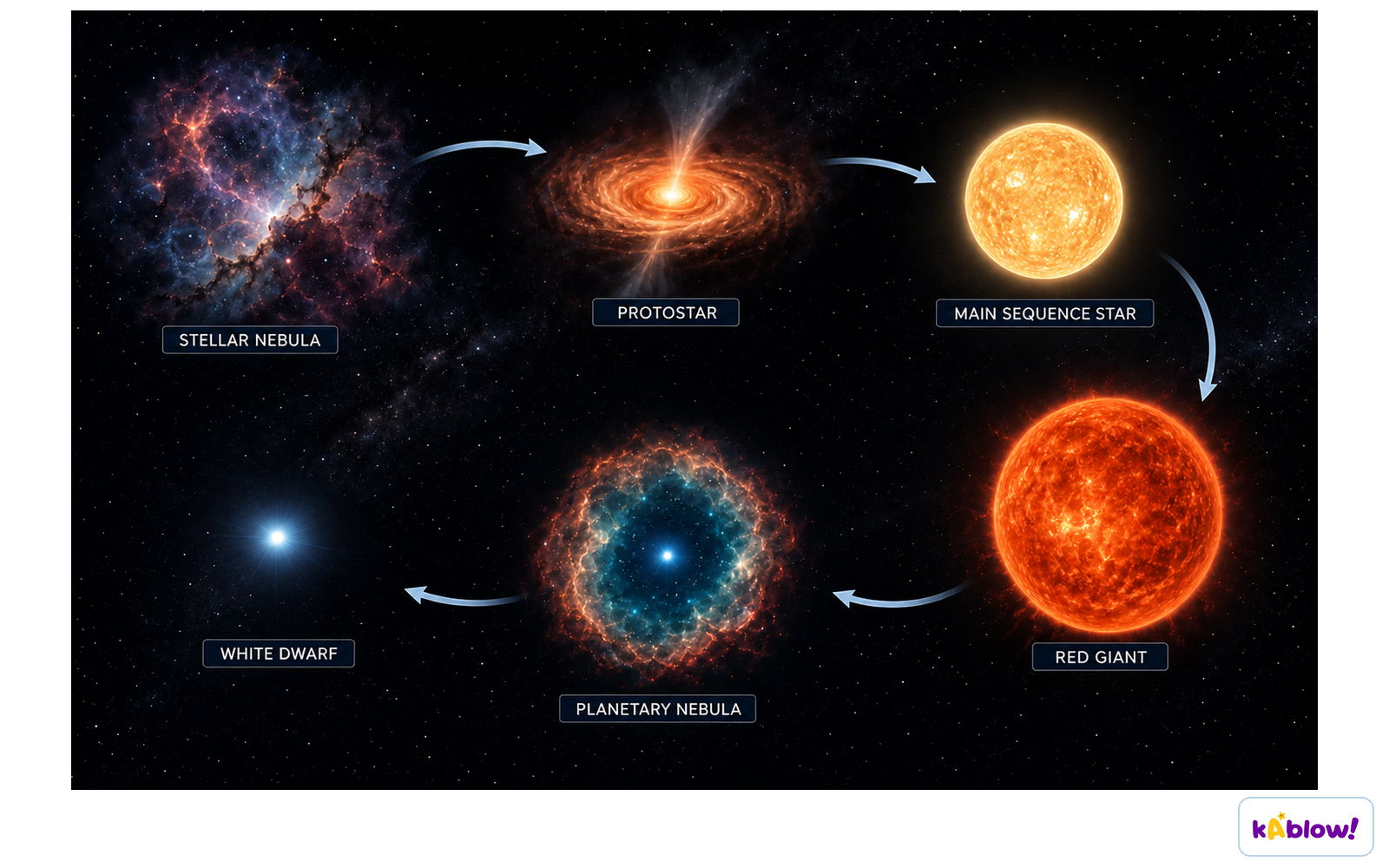
- When hydrogen runs out, stars expand.
- Stars like the Sun become red giants; much bigger stars become red supergiants.
- Red giants leave behind a white dwarf that cools to a black dwarf.
- Red supergiants explode in a supernova.
- The biggest stars leave a black hole; less massive ones leave a neutron star.
Flow diagram showing the life cycle of a star with a mass similar to the Sun.
स्लाइड्स
Sign up free to view the lesson slides
Step through every slide for this topic — plus flashcards and revision notes — with a free account.
प्रैक्टिस सवाल
फ्री प्रीव्यू — 63 में से 8 सवाल। सभी देखने के लिए साइन अप करें।
1.How many galaxies does the universe contain?
Easy- ABillions
- BThousands
- COne (the Milky Way)
- DMillions
2.What is the name of the galaxy that contains our solar system?
Easy- AMilky Way
- BAndromeda
- CSolar System Galaxy
- DBig Bang Galaxy
3.Approximately how long ago did the Big Bang occur?
Easy- A13.8 billion years ago
- B5000 years ago
- C4.5 billion years ago
- D2.5 million years ago
4.What is the speed of light?
Easy- A300,000,000 m/s
- B300,000 m/s
- C3,000,000 m/s
- D30,000,000 m/s
5.A light year is the distance light travels in one year. Which of the following is the correct value of one light year in metres?
Medium- A9.5 × 1015 m
- B9.5 × 1012 m
- C9.5 × 1018 m
- D9.5 × 109 m
6.The Andromeda galaxy is 2.5 million light years away. What does this distance mean?
Easy- ALight from Andromeda takes 2.5 million years to reach us
- BAndromeda is 2.5 million metres away
- CLight from Andromeda takes 2.5 million seconds to reach us
- DAndromeda is 2.5 million times the size of the Milky Way
7.What is at the centre of the Milky Way galaxy?
Easy- AA black hole
- BA neutron star
- CA white dwarf
- DThe Sun
8.What is a nebula?
Easy- AA cloud of dust and gas (mostly hydrogen)
- BAn explosion of a star
- CA small, hot star
- DThe centre of a galaxy
Unlock all 63 questions, flashcards & more
इस टॉपिक के हर सवाल, स्लाइड्स, फ्लैशकार्ड और रिवीज़न नोट्स देखने के लिए फ्री अकाउंट बनाएं।