The human eye
खेलकर सीखें
इन सवालों के जवाब देकर एनर्जी कमाएं, फिर मछली पकड़ें और घूमें। कोई अकाउंट नहीं चाहिए।
शिक्षकों के लिए: The human eye (KS3 Science, Physics) के लिए इस्तेमाल के लिए तैयार लेसन स्लाइड्स, रिवीज़न नोट्स, डायग्राम — इन्हें अपने लेसन में इस्तेमाल करें, या टॉपिक को एक इंटरैक्टिव क्लास एक्टिविटी की तरह चलाएं जिसे आपके शिक्षार्थी लाइव गेम की तरह खेलें।
लेसन नोट्स
The Eye as an Optical Device
- The human eye contains a convex lens that focuses light onto the retina.
- A convex lens is wider in the middle than at the edges.
- Rays of light refract by different amounts depending on where they hit the lens, causing them to converge at a focal point.
- Convex lenses are used in glasses (for farsightedness), magnifying glasses, and telescopes.
Parts of the Eye and Their Functions
- Cornea: Transparent layer at the front; some refraction occurs here.
- Retina: Contains cells that detect light and colour; sensitive to bright light and can be damaged.
- Lens: Refracts light; muscles change its shape to adjust focus for near or far objects.
- Iris: Coloured part around the pupil; controls the amount of light entering the eye.
- Pupil: Dark opening in the centre; light passes through it.
- Nerve: Carries signals from the retina to the brain.
Pupil Size and Light Intensity
- In bright light, the iris closes (constricts) to make the pupil smaller, protecting the retina from damage.
- In dim light, the iris opens (dilates) to make the pupil larger, allowing more light to reach the retina.
Lens Shape and Refraction
- The more curved the lens, the more light refracts.
- A more curved lens has a shorter focal length (distance from lens to focal point).
- Muscles change the lens shape to focus on objects at different distances.
A converging lens brings parallel rays to the principal focus; focal length is measured from the lens to that point.
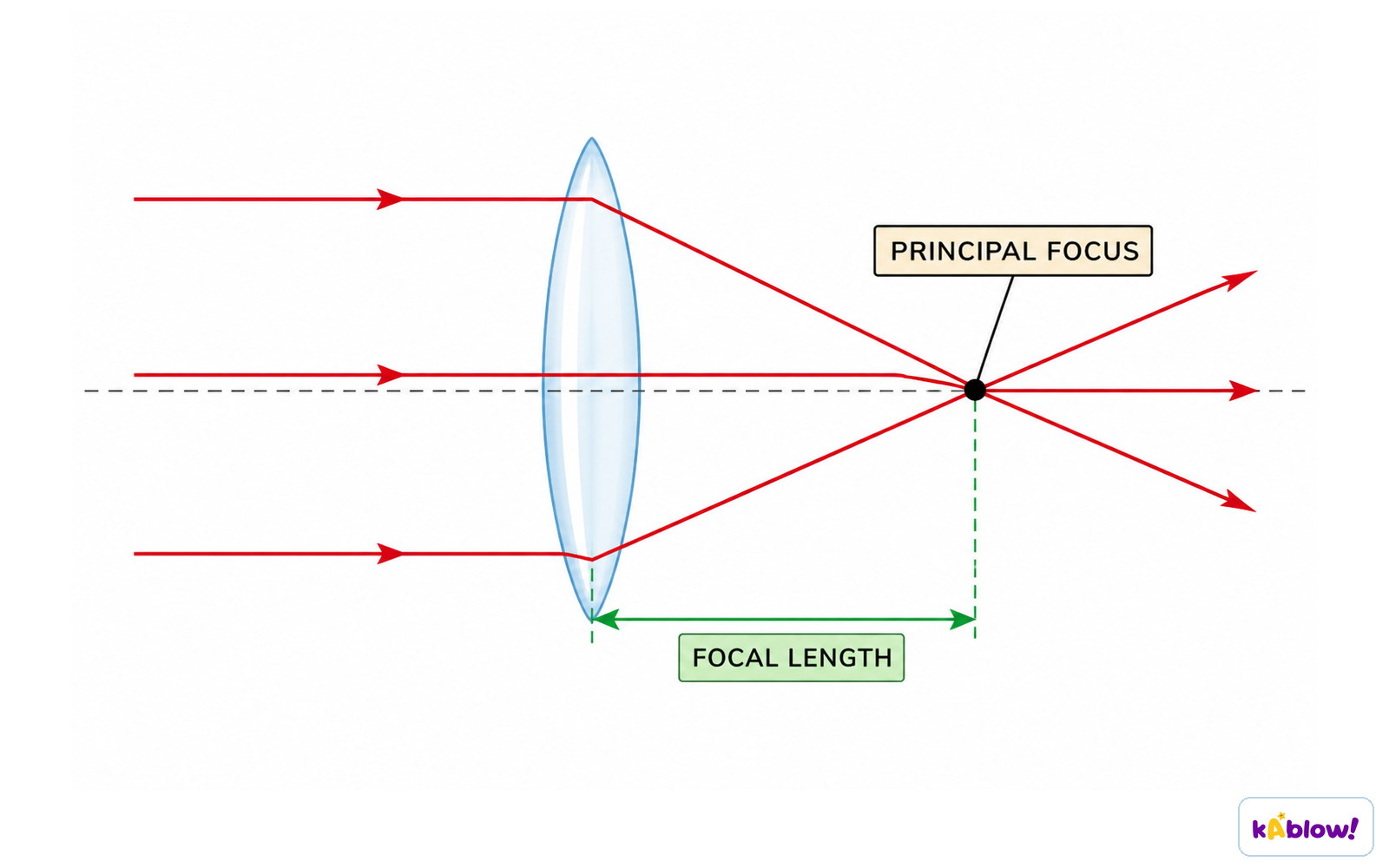
Refraction of light entering the eye: light bends as it passes from air into the cornea/lens.
स्लाइड्स
Sign up free to view the lesson slides
Step through every slide for this topic — plus flashcards and revision notes — with a free account.
प्रैक्टिस सवाल
फ्री प्रीव्यू — 58 में से 8 सवाल। सभी देखने के लिए साइन अप करें।
1.A lens that is wider in the middle than at the edges is called a:
Easy- Aconvex lens
- Bconcave lens
- Ccylindrical lens
- Ddiverging lens
2.The human eye contains a:
Easy- Aconvex lens
- Bconcave lens
- Cboth convex and concave lenses
- Dno lens
3.Which part of the eye contains cells that detect light and colour?
Easy- Aretina
- Bcornea
- Clens
- Diris
4.The coloured part of the eye is the:
Easy- Airis
- Bpupil
- Ccornea
- Dretina
5.Which of the following is NOT a use of convex lenses?
Easy- Aglasses for farsightedness
- Bmagnifying glasses
- Ctelescopes
- Dglasses for nearsightedness
6.What happens to the pupil in very bright conditions?
Easy- Ait becomes smaller
- Bit becomes larger
- Cit changes colour
- Dit closes completely
7.The part of the eye that refracts light and can change shape is the:
Easy- Alens
- Bcornea
- Cretina
- Dpupil
8.A convex lens causes light rays to:
Easy- Aconverge
- Bdiverge
- Creflect
- Ddiffract
Unlock all 58 questions, flashcards & more
इस टॉपिक के हर सवाल, स्लाइड्स, फ्लैशकार्ड और रिवीज़न नोट्स देखने के लिए फ्री अकाउंट बनाएं।
पास्ट पेपर
इस टॉपिक के लिए पास्ट-पेपर प्रैक्टिस जल्द आ रही है।
जल्द आ रहा है