Scale of the solar system
खेलकर सीखें
इन सवालों के जवाब देकर एनर्जी कमाएं, फिर मछली पकड़ें और घूमें। कोई अकाउंट नहीं चाहिए।
लेसन नोट्स
The Solar System: An Overview
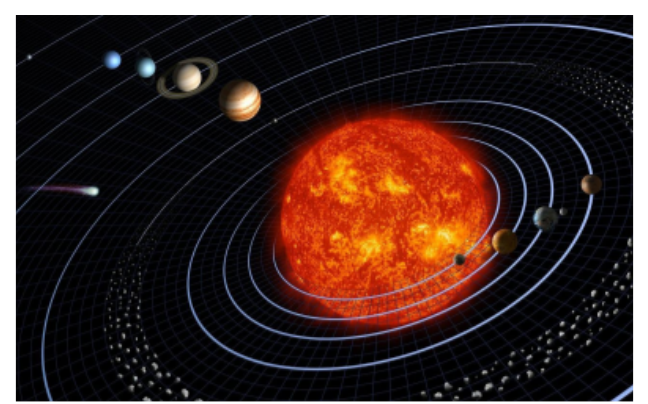
- The solar system is made up of the Sun and everything that orbits it: eight planets, five recognized dwarf planets, asteroids, comets, and hundreds of moons.
- The Sun sits at the center. Its gravity is what holds every other object in orbit.
- The planets, in order outward from the Sun, are Mercury, Venus, Earth, Mars, Jupiter, Saturn, Uranus, and Neptune.
- Comparing the sizes and distances of these objects is hard because they range from a few hundred kilometers across to hundreds of millions of kilometers apart — numbers far bigger than everyday experience.
The solar system
The Astronomical Unit and Planetary Distances
- Distances between planets are so large that kilometers become awkward to write and compare, so scientists use the astronomical unit (AU): the average distance from Earth to the Sun, about 150 million km.
- Written in AU, Earth is 1.00 AU from the Sun and Neptune is 30.06 AU — instantly showing Neptune is about 30 times farther out.
- | Planet | Distance from Sun (AU) | Length of Year (Earth years) | |---|---|---| | Mercury | 0.39 | 0.24 | | Venus | 0.72 | 0.62 | | Earth | 1.00 | 1.00 | | Mars | 1.52 | 1.88 | | Jupiter | 5.20 | 11.86 | | Saturn | 9.54 | 29.46 | | Uranus | 19.22 | 84.01 | | Neptune | 30.06 | 164.8 |
- The table shows a pattern: the farther a planet orbits from the Sun, the longer its year, because it has a bigger orbit to travel and moves more slowly along it.
Modeling the Scale of the Solar System
- The real solar system is too big to show accurately on a poster or a classroom floor, so scientists and students build scale models instead: every real distance is shrunk by the same factor.
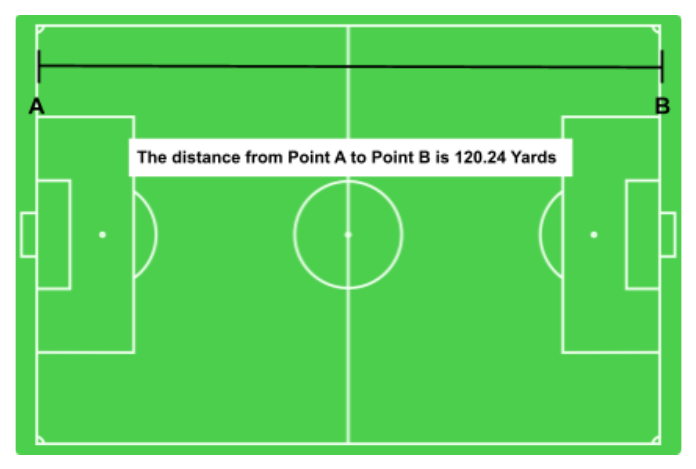
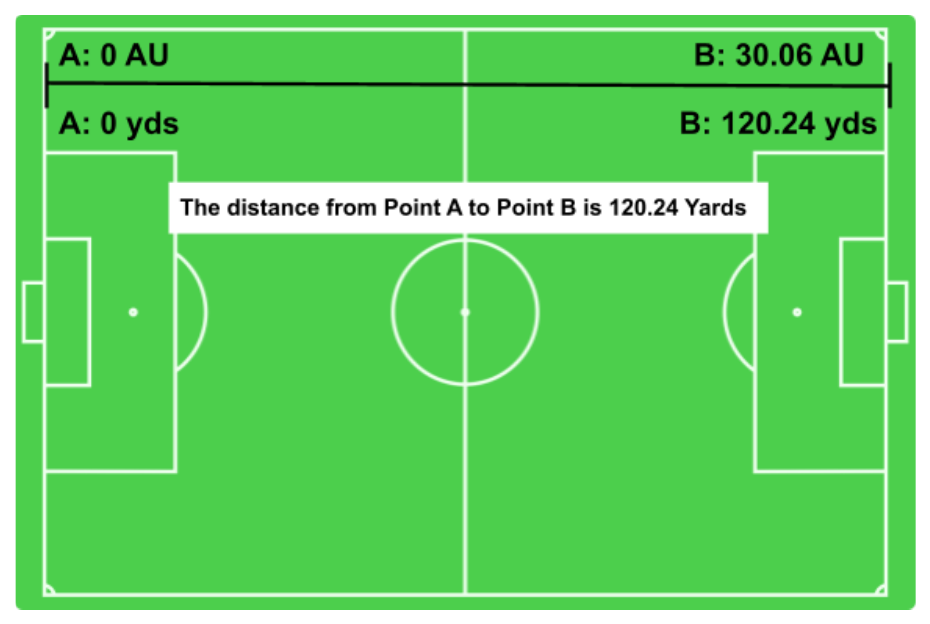
- One classroom activity places the Sun at one end of a 120.24-yard soccer field and Neptune at the other end, with the other planets placed in between according to their real distance in AU.
- For a scale model to be useful, every distance must shrink by the×same×factor — otherwise the model misrepresents how the planets actually compare.
A scale-model field
Calculating a Scale Model
- To turn real distances into model distances, first find the scale factor: divide the model length by the real distance it represents.
- In the soccer-field model, Neptune's real distance (30.06 AU) is placed at the far end of the field (120.24 yards), so the scale factor is 120.24 ÷ 30.06 = 4 yards per AU.
- Once the scale factor is known, any planet's model distance = its real distance in AU × the scale factor. Earth (1.00 AU) would sit 4 yards from the Sun in this model.
The scale-model field labeled
Relative Sizes of the Planets
- Distance is only one kind of scale — the planets also differ hugely in size.
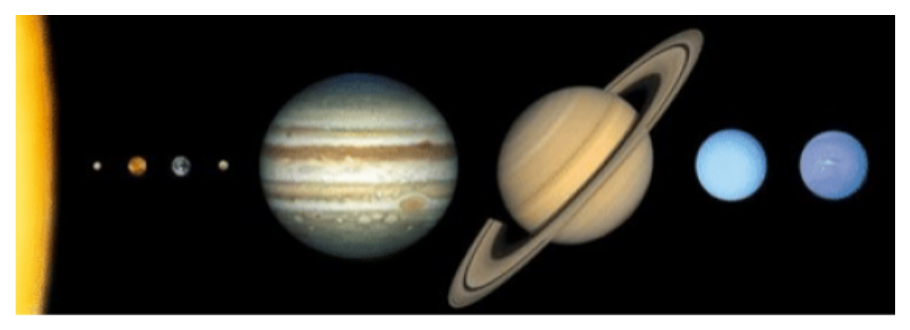
- Drawn at the same scale, Mercury, Venus, Earth, and Mars are all quite small and close together in size, while Jupiter and Saturn dwarf them, and Uranus and Neptune sit in between.
- Jupiter's diameter is about 11.2 times Earth's; Mercury's is only about 0.38 times Earth's — a single image of the eight planets side by side makes that size range obvious in a way a table of numbers does not.
The eight planets to scale
Terrestrial (Inner) Planets
- Mercury, Venus, Earth, and Mars are the four planets closest to the Sun. They are called the terrestrial (rocky) planets.
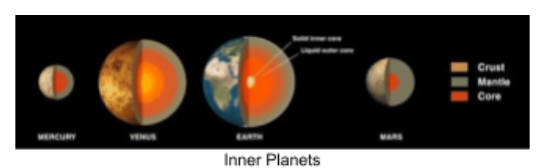
- Each has a solid rocky surface and a layered interior — a crust, a mantle, and a metallic core — though the layers differ in thickness from planet to planet.
- Terrestrial planets are small compared with the outer planets: all four together would still fit inside Jupiter many times over.
- Some terrestrial planets have a thin atmosphere (Mercury barely has one; Venus and Earth have thick ones), but none has rings, and only Earth and Mars have moons.
The inner planets' interiors
Gas Giant (Outer) Planets
- Jupiter, Saturn, Uranus, and Neptune are the four gas giant planets. They are far larger than the terrestrial planets and lie much farther from the Sun.
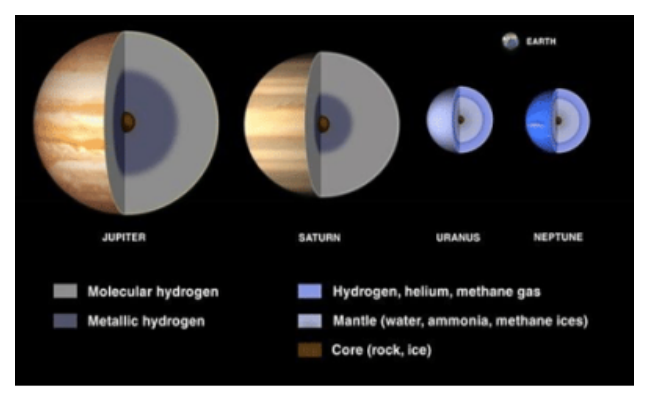
- They have no solid surface a spacecraft could land on — instead they are enormous balls of hydrogen, helium, and other gases and ices, with a hot, dense core thought to lie deep beneath the atmosphere.
- Every gas giant has rings and many moons, though Saturn's rings are the easiest to see from Earth.
The outer planets' interiors
Dwarf Planets, Asteroids, and the Kuiper Belt
- In 2006 astronomers agreed that a planet must (1) orbit the Sun, (2) be massive enough for its own gravity to pull it into a round shape, and (3) have cleared other debris out of the neighborhood of its orbit.
- An object that meets the first two criteria but not the third is a dwarf planet. Pluto was reclassified this way; four other dwarf planets are officially recognized: Ceres, Haumea, Makemake, and Eris.
- Ceres orbits in the asteroid belt, a region of rocky debris between Mars and Jupiter. The other four dwarf planets orbit in the Kuiper Belt, an icy region far beyond Neptune.
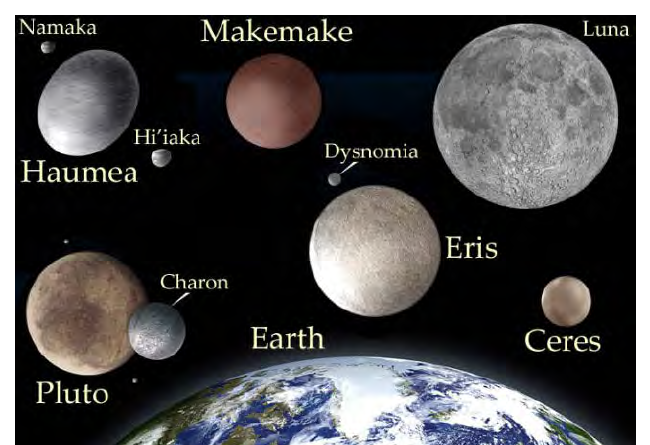
- Even the largest dwarf planets are small on the scale of true planets — every one of them is smaller than Earth's Moon.
Dwarf planets compared with Earth
Moons of the Solar System
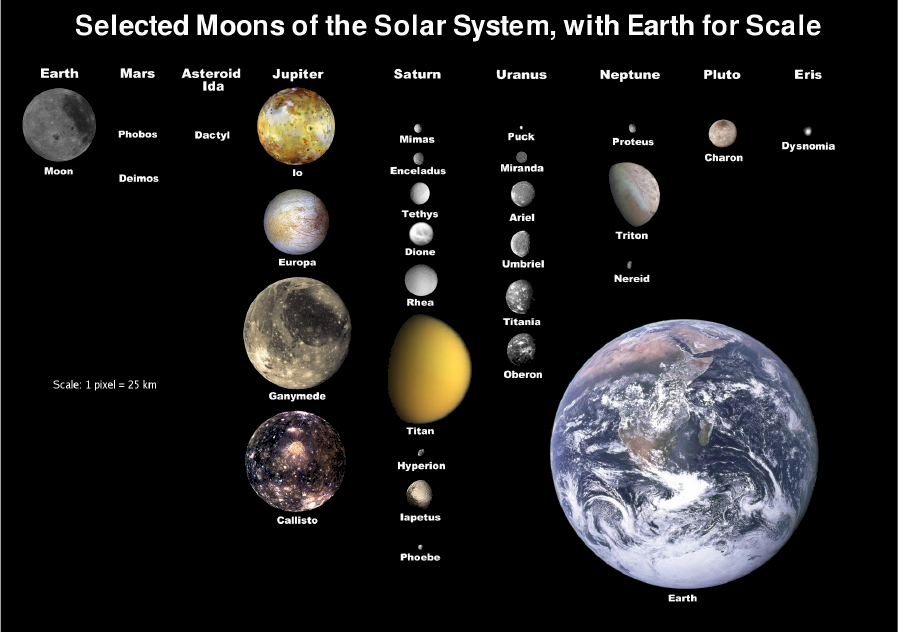
- Most planets have at least one moon, and moon sizes vary just as widely as planet sizes: some are barely bigger than a mountain, while others are bigger than the planet Mercury.
- Jupiter's moon Ganymede and Saturn's moon Titan are both larger than Earth's Moon; Mars's two moons, Phobos and Deimos, are tiny, oddly-shaped rocks only a few kilometers across.
- Comparing moons against Earth on a single to-scale image is the same idea as comparing planets to scale — it turns a list of diameters into something the eye can judge directly.
Moons of the solar system to scale
स्लाइड्स
Sign up free to view the lesson slides
Step through every slide for this topic — plus flashcards and revision notes — with a free account.
प्रैक्टिस सवाल
फ्री प्रीव्यू — 41 में से 8 सवाल। सभी देखने के लिए साइन अप करें।
1.What holds the planets in orbit around the Sun?
Easy- AThe Sun's gravity
- BMagnetic fields
- CSolar wind pressure
- DFriction with space dust
2.The asteroid belt lies between the orbits of Mars and Jupiter.
EasyTrue or false?
3.About what share of the solar system's total mass is contained in the Sun?
Easy- A50%
- B80%
- C99.8%
- D10%
4.The Sun is an average-sized star, even though it is the largest object in the solar system.
EasyTrue or false?
5.What is the main difference in composition between the terrestrial and gas-giant planets?
Easy- ATerrestrial planets are rocky; gas giants are made mostly of gas and ice.
- BTerrestrial planets are made of gas; gas giants are rocky.
- CBoth types are made of the same materials in the same proportions.
- DTerrestrial planets have no atmosphere at all.
6.One astronomical unit (AU) is defined as the average distance between which two objects?
Easy- AThe Sun and Neptune
- BEarth and the Moon
- CThe Sun and Earth
- DEarth and Mars
7.About how many million kilometers is 1 astronomical unit (AU)?
Easy8.| Planet | Distance from Sun (AU) | Length of Year (Earth years) | |---|---|---| | Mercury | 0.39 | 0.24 | | Venus | 0.72 | 0.62 | | Earth | 1.00 | 1.00 | | Mars | 1.52 | 1.88 | | Jupiter | 5.20 | 11.86 | | Saturn | 9.54 | 29.46 | | Uranus | 19.22 | 84.01 | | Neptune | 30.06 | 164.8 | Using the table, which planet takes closest to 12 Earth years to complete one orbit of the Sun?
Easy- AMars
- BJupiter
- CSaturn
- DUranus
Unlock all 41 questions, flashcards & more
इस टॉपिक के हर सवाल, स्लाइड्स, फ्लैशकार्ड और रिवीज़न नोट्स देखने के लिए फ्री अकाउंट बनाएं।