Chemical cells and fuel cells
Belajar sambil bermain
Jawab soal-soal ini untuk dapat energi, lalu memancing dan menjelajah. Tanpa akun.
Catatan pelajaran
What is a chemical cell?
- A chemical cell is a source of electrical energy.
- It is made from two electrodes (usually metals of different reactivity) placed in an electrolyte.
- The electrodes are connected by wires to an external circuit, creating a complete circuit.
- The more reactive metal releases electrons more easily, giving it a negative charge.
- Electrons flow through the external circuit from the more reactive electrode to the less reactive electrode.
- The difference in the ability of the electrodes to release electrons produces a voltage (potential difference).
Factors affecting voltage
- The type of electrode affects the voltage: the greater the difference in reactivity between the two metals, the greater the voltage.
- The electrolyte also affects the voltage because different ions react with the electrodes in different ways.
- Using two electrodes made of the same metal produces 0 V because there is no difference in reactivity.
- You can use the reactivity series to predict the voltage: metals further apart give a larger voltage.
Cells and batteries
- A battery consists of two or more cells connected in series.
- Connecting cells in series adds their voltages together, giving a larger overall voltage.
- For example, three 1.5 V cells connected in series produce 4.5 V.
- Cells produce a voltage only until one of the reactants is used up; then the battery goes flat.
Non-rechargeable and rechargeable cells
- In non-rechargeable cells, the chemical reaction stops when one reactant is used up, so no more electricity is produced.
- Alkaline batteries are examples of non-rechargeable batteries.
- In rechargeable cells, the chemical reactions can be reversed by supplying an external electrical current.
- Reversing the reactions allows the cell to be used again.
- Rechargeable cells avoid the need to dispose of batteries as often, which is better for the environment.
Hydrogen fuel cells: how they work
- A fuel cell is an electrochemical cell in which a fuel donates electrons at one electrode and oxygen gains electrons at the other.
- Fuel cells need a continuous supply of fuel and oxygen (or air) to keep working.
- The fuel is oxidised electrochemically within the cell, producing a potential difference (voltage).
- In a hydrogen-oxygen fuel cell, hydrogen is oxidised and oxygen is reduced, producing water as the only chemical product.
- The overall reaction is: hydrogen + oxygen → water.
- The electrolyte is often potassium hydroxide solution or phosphoric acid, and electrodes are porous carbon coated with a catalyst.
Hydrogen-oxygen fuel cell
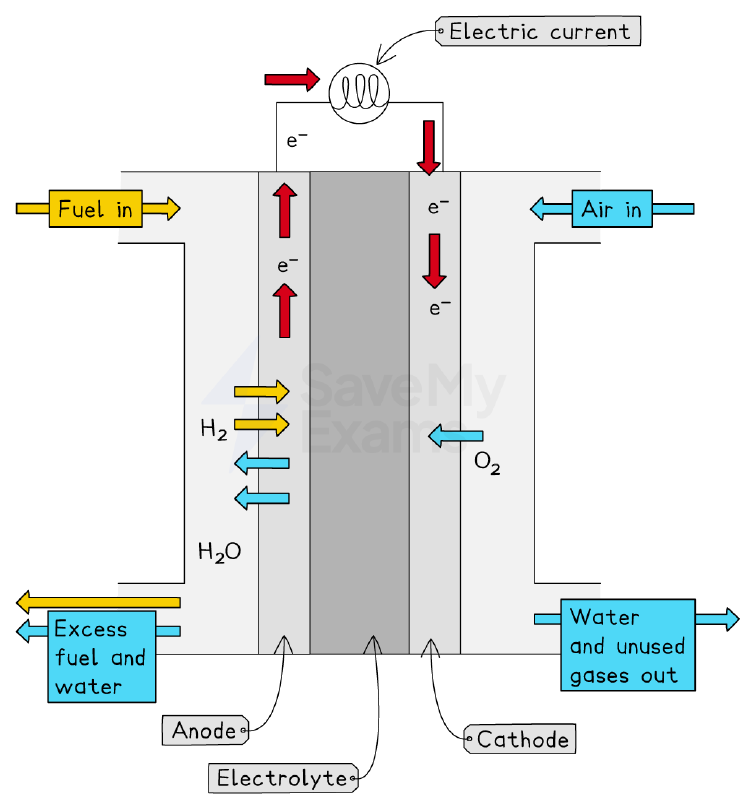
Electrode reactions in hydrogen fuel cells (HT only)
- At the anode (negative electrode), hydrogen is oxidised: 2H₂ → 4H⁺ + 4e⁻.
- At the cathode (positive electrode), oxygen is reduced: 4H⁺ + O₂ + 4e⁻ → 2H₂O.
- The overall reaction is: 2H₂ + O₂ → 2H₂O.
- Electrons flow through the external circuit from anode to cathode, driving an electric motor.
- Remember: the two half equations combine to give the overall equation.
Advantages of hydrogen fuel cells
- They do not produce any pollution: the only product is water.
- They produce more energy per kilogram than petrol or diesel.
- No power is lost in transmission because there are no moving parts, unlike an internal combustion engine.
- There are no batteries to dispose of, which is better for the environment.
- They are a continuous process and keep producing energy as long as fuel is supplied.
- They are quieter, so they cause less noise pollution.
Disadvantages of hydrogen fuel cells
- Materials used in producing fuel cells are expensive.
- High pressure tanks are needed to store hydrogen and oxygen, which are dangerous and difficult to handle.
- Fuel cells are affected by low temperatures, becoming less efficient.
- Hydrogen is expensive to produce and store.
- They are quiet, which can be a danger to pedestrians if used in cars and lorries.
Comparing fuel cells with rechargeable cells and batteries
- Fuel cells need a continuous fuel supply, whereas batteries store energy and run down.
- Rechargeable batteries can be recharged by reversing the chemical reactions; fuel cells cannot be recharged.
- Hydrogen fuel cells produce only water, while rechargeable batteries may contain harmful chemicals that need disposal.
- Fuel cells are becoming more common in vehicles to replace petrol or diesel engines.
- Hydrogen fuel cells offer a potential alternative to rechargeable cells and batteries.
Slide
Sign up free to view the lesson slides
Step through every slide for this topic — plus flashcards and revision notes — with a free account.
Soal latihan
Pratinjau gratis — 8 dari 60 soal. Daftar untuk melihat semuanya.
1.What name is given to the solution that contains ions and allows charge to flow between the electrodes in a simple cell?
Easy- AElectrolyte
- BElectrode
- CVoltmeter
- DAmmeter
2.A simple cell is made using two copper electrodes in sodium chloride solution. The voltmeter reads 0 V. What is the explanation for this reading?
Easy- AThe circuit is not complete
- BThe sodium chloride solution cannot conduct electricity
- CThe electrodes are made of the same metal
- DThe voltmeter is faulty
3.Three 1.5 V cells are connected correctly to form a battery. What is the total voltage produced?
Medium- A1.5 V
- B3.4 V
- C3.0 V
- D4.5 V
4.Which of the following factors affect the voltage produced by a simple cell? (select all that apply)
Medium- AThe type of electrode used
- BThe type of electrolyte used
- CThe size of the voltmeter
- DThe difference in reactivity of the two metals
- EThe colour of the electrolyte solution
5.Which statement about non-rechargeable cells is correct?
Medium- AThe chemical reactions can be reversed by supplying an external current
- BThe reactions stop when one of the reactants has been used up
- CThey can be recharged many times
- DThey produce electricity indefinitely
6.Alkaline batteries are examples of non-rechargeable batteries.
EasyTrue or false?
7.In a hydrogen fuel cell, hydrogen undergoes reduction at the anode.
EasyTrue or false?
8.Match each substance in a hydrogen fuel cell with its function.
Medium- Potassium hydroxide solution
- Hydrogen
- Water
- Electrolyte
- Fuel
- Waste product
Unlock all 60 questions, flashcards & more
Buat akun gratis untuk melihat setiap soal, slide, kartu flash, dan catatan ulasan topik ini.