Properties of transition metals
Belajar sambil bermain
Jawab soal-soal ini untuk dapat energi, lalu memancing dan menjelajah. Tanpa akun.
Catatan pelajaran
Typical Properties of Transition Metals
- Transition metals are lustrous, hard, strong and good conductors of heat and electricity.
- They have high densities and very high melting points.
- They can have more than one oxidation state because they can lose different numbers of electrons.
- They form coloured compounds.
- The elements Cr, Mn, Fe, Co, Ni and Cu are common examples.
- Their compounds in different oxidation states have different colours in aqueous solution.
Uses of Transition Metals
- Transition metals are widely used as catalysts – substances that speed up a reaction without being used up.
- They work as catalysts because they can interchange between oxidation states, forming complexes that donate and accept electrons.
- Iron is used in the Haber Process.
- Vanadium pentoxide (V₂O₅) is used in the Contact Process to make sulfuric acid.
- Nickel is used in the hydrogenation of alkenes.
- They are used in medicine and surgical applications such as limb and joint replacement.
- Titanium is useful because it is the only element that can bond with bones due to its high biocompatibility.
- They are used in dyes and paints, stained glass, jewellery and anti-corrosive materials.
Transition Metals vs. Alkali Metals
- Transition metals are found between Groups 2 and 3 in the centre of the periodic table.
- Group 1 metals form +1 ions only, while transition metals form ions with variable charges (e.g. Fe²⁺ and Fe³⁺).
- Transition metals are harder, stronger and denser than Group 1 metals, which are soft and light.
- Transition metals have much higher melting points (e.g. titanium melts at 1,688 °C; potassium at 63.5 °C).
- Transition metals are much less reactive than Group 1 metals.
- Group 1 metals react with water, oxygen and halogens; transition metals react very slowly or not at all.
- A Group 1 metal tarnishes in seconds in oxygen, while iron takes weeks to rust and needs water.
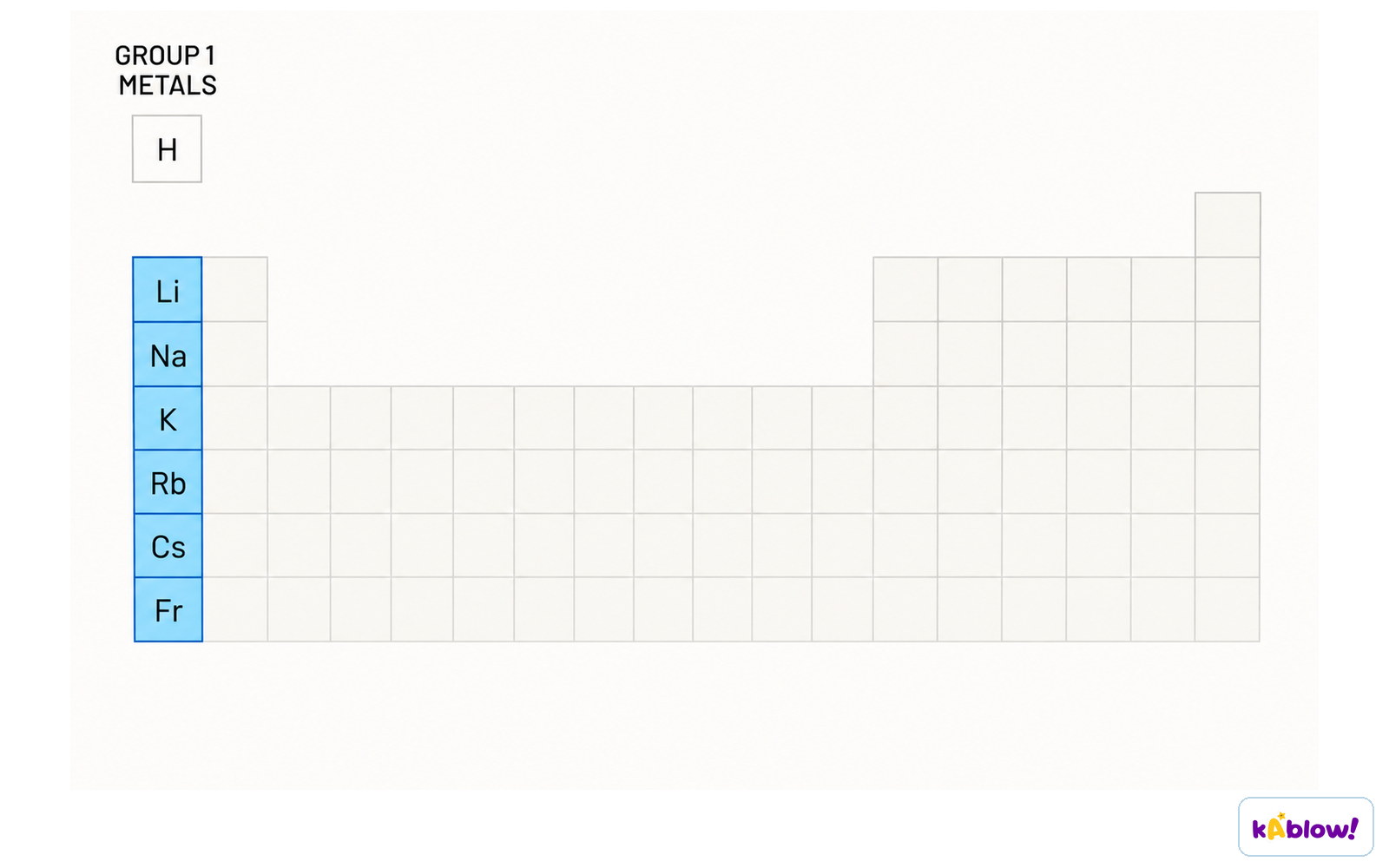
Alkali metals occupy the far-left column; hydrogen is not presented as a Group 1 metal.
Key Points to Remember
- Transition metals themselves are not colourful – it is their compounds that are coloured.
- Scandium and zinc are in the transition metal area but are not transition elements because they do not form coloured compounds and have only one oxidation state.
- You should be able to recall at least two applications of transition elements and explain why they are used.
- Transition metals are not consumed when acting as catalysts.
Slide
Sign up free to view the lesson slides
Step through every slide for this topic — plus flashcards and revision notes — with a free account.
Soal latihan
Pratinjau gratis — 8 dari 61 soal. Daftar untuk melihat semuanya.
1.Where are the transition elements found in the periodic table?
Easy- AIn Group 1
- BBetween Group 2 and Group 3
- CIn Group 0
- DBetween Group 4 and Group 5
2.Which of the following metals are transition elements? (select all that apply)
Easy- ACalcium
- BCopper
- CCaesium
- DChromium
- EChlorine
3.Which of the following properties would you expect manganese to have? (select all that apply)
Medium- ALow melting point
- BUseful as a catalyst
- COnly forms a 1+ ion
- DDull
- EGood conductor of heat and electricity
- FForms coloured compounds
4.Which of the following properties would you expect both sodium (a Group 1 metal) and manganese (a transition metal) to have?
Easy- ALow melting point
- BUseful as a catalyst
- COnly forms a 1+ ion
- DForms coloured compounds
5.Which of the following metals would be most suitable as a catalyst?
Medium- ASodium
- BNickel
- CCalcium
- DAluminium
6.A metal oxide catalyst is used to speed up the reaction between ammonia and oxygen to produce nitrogen and water. Which of the following metal oxides would most likely be used?
Medium- ANa₂O
- BLi₂O
- CAl₂O₃
- DCr₂O₃
7.Which statement about transition metals and Group 1 metals is correct?
Easy- AGroup 1 metals are less reactive than transition metals
- BGroup 1 metals are harder than transition metals
- CTransition metals have lower melting points than Group 1 metals
- DTransition metals are more dense than Group 1 metals
8.Which combination of properties makes transition metals suitable for use in cutting tools?
Medium- AMalleable and hard
- BStrong and ductile
- CNot reactive and high melting point
- DHigh boiling point and conducts electricity
Unlock all 61 questions, flashcards & more
Buat akun gratis untuk melihat setiap soal, slide, kartu flash, dan catatan ulasan topik ini.