The composition and evolution of the Earth's atmosphere
Belajar sambil bermain
Jawab soal-soal ini untuk dapat energi, lalu memancing dan menjelajah. Tanpa akun.
Catatan pelajaran
Composition of the Atmosphere Today
- The atmosphere is mainly nitrogen and oxygen.
- About four-fifths (80%) of the atmosphere is nitrogen.
- About one-fifth (20%) is oxygen.
- There are small proportions of other gases, including carbon dioxide, water vapour and noble gases.
- The proportions of gases in the atmosphere have been much the same for 200 million years.
- Carbon dioxide is present in very small amounts but acts as a greenhouse gas.
The Earth's Early Atmosphere
- The Earth formed about 4.6 billion years ago.
- The surface was molten for millions of years and had no atmosphere at first.
- As the Earth cooled, land masses formed and volcanoes appeared.
- Volcanoes released gases from the Earth's interior, forming the early atmosphere.
- The early atmosphere was mainly carbon dioxide with little or no oxygen.
- It also contained water vapour, nitrogen, and possibly methane and ammonia.
- The early atmosphere may have been similar to the atmospheres of Mars and Venus today.
Formation of the Oceans
- Volcanoes released large amounts of water vapour.
- While the surface was very hot, water remained as a gas.
- As the Earth cooled, water vapour condensed to form the oceans.
- Carbon dioxide is water soluble and dissolved in the oceans.
- This reduced the amount of carbon dioxide in the atmosphere.
- Carbonates were precipitated and later formed sediments on the seabed.
How Oxygen Increased
- Algae and plants produce oxygen by photosynthesis.
- Photosynthesis uses carbon dioxide and water to produce glucose and oxygen.
- The balanced equation is: 6CO₂ + 6H₂O → C₆H₁₂O₆ + 6O₂.
- Algae first evolved around 2.7 billion years ago.
- Over the next billion years, plants evolved and oxygen levels increased.
- Rising oxygen levels allowed more complex life forms to evolve.
- Around 200 million years ago, the atmosphere reached its present composition.
How Carbon Dioxide Decreased
- Carbon dioxide dissolved in the oceans when water vapour condensed.
- Carbonates were precipitated, forming sediments on the seabed.
- Green plants and algae absorbed carbon dioxide during photosynthesis.
- Animals fed on plants, transferring carbon to their tissues, bones and shells.
- When organisms died, their remains formed sedimentary rocks.
- Dead organisms became fossil fuels (coal, crude oil, natural gas), locking up carbon.
- These processes reduced carbon dioxide from high early levels to today's very low levels.
Formation of Limestone, Coal and Crude Oil
- Limestone is formed from the shells and skeletons of marine organisms.
- Coal is formed from the remains of dead plants.
- Crude oil and natural gas are formed from the remains of dead marine organisms.
- These deposits lock up carbon that was once in the atmosphere as carbon dioxide.
- When limestone is heated (e.g. by a meteorite impact), it releases carbon dioxide: CaCO₃ → CaO + CO₂.
Evidence and Theories About the Early Atmosphere
- Theories about the early atmosphere have changed over time as instrumental analysis has improved.
- Evidence is limited because the early atmosphere existed 4.6 billion years ago.
- Scientists use analysis of minerals in the Earth's crust to deduce gases present millions of years ago.
- Historical data is less accurate due to lack of accurate instrumentation and fewer measurement locations.
- Methods to estimate past climate include fossil records, tree rings, and gas bubbles in ice.
- The complexity of the Earth's climate makes it difficult to model links between greenhouse gases and global warming.
Greenhouse Gases and Climate Change
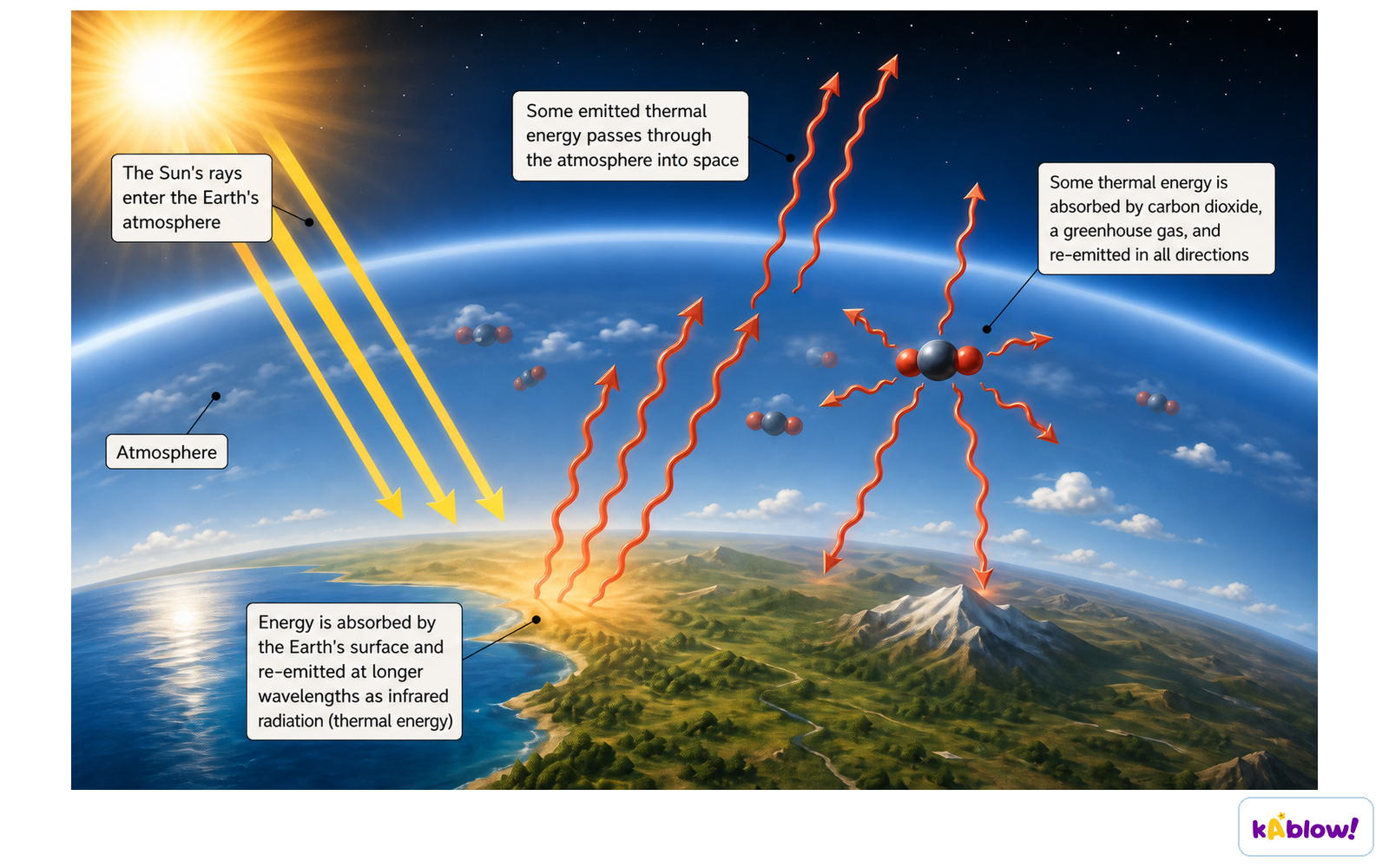
- Greenhouse gases absorb and store energy, trapping infrared radiation from the Earth's surface.
- Carbon dioxide, methane and water vapour are greenhouse gases.
- The greenhouse effect keeps the Earth's mean temperature around 15°C.
- The enhanced greenhouse effect is caused by increasing levels of greenhouse gases, leading to global warming.
- Carbon dioxide sources include combustion of fossil fuels, respiration, and thermal decomposition of carbonates.
- Methane sources include digestive processes of animals, decomposition of vegetation, and bacterial action in swamps and rice paddies.
- Climate change is a shift in worldwide weather patterns; effects include melting ice caps, flooding, and destruction of ecosystems.
Diagram showing how the greenhouse effect occurs
Human Activity and Reducing Emissions
- Burning fossil fuels produces carbon dioxide: fossil fuel + oxygen → energy + H₂O + CO₂.
- Deforestation increases atmospheric carbon dioxide as fewer plants remove it by photosynthesis.
- Increasing agricultural activities raise methane production from animals and decomposition.
- Renewable energy sources (solar, wind) can reduce carbon dioxide emissions.
- Reducing energy usage and our carbon footprint helps lower emissions.
- Mitigating climate change includes flood defences, new farming methods, and better irrigation systems.
- About 97% of climate scientists believe human activity is causing climate change.
Slide
Sign up free to view the lesson slides
Step through every slide for this topic — plus flashcards and revision notes — with a free account.
Soal latihan
Pratinjau gratis — 8 dari 60 soal. Daftar untuk melihat semuanya.
1.Which option correctly shows what has happened to the proportion of each gas during the evolution of the Earth's atmosphere over the past 4.6 billion years?
Easy- AOxygen increased, nitrogen increased, carbon dioxide decreased, water vapour decreased
- BOxygen increased, nitrogen decreased, carbon dioxide decreased, water vapour decreased
- COxygen decreased, nitrogen increased, carbon dioxide increased, water vapour increased
- DOxygen increased, nitrogen decreased, carbon dioxide increased, water vapour increased
2.What is the approximate percentage of oxygen in the current atmosphere?
Easy- A4%
- B21%
- C55%
- D78%
3.What is the main gas in the atmosphere today?
Easy- Aoxygen
- Bcarbon dioxide
- Cnitrogen
- Dargon
4.Which term best describes air?
Easy- AElement
- BCompound
- CMixture
- DSolution
5.Which group of the periodic table is oxygen located in?
Easy- AGroup 1
- BGroup 2
- CGroup 6
- DGroup 7
6.Which of the following are reasons why carbon dioxide levels have decreased since the early atmosphere? (select all that apply)
Medium- ALocked up in fossil fuels
- BTaken in by volcanoes
- CGiven off from burning fossil fuels
- DIt dissolved in the oceans
- EProduced by photosynthesis
7.It is thought that algae evolved around 2.6 billion years ago. They use carbon dioxide and water to produce oxygen. Name the process they use to do this.
Medium- ACombustion
- BRespiration
- CPhotosynthesis
- DDecomposition
8.What was the main source of the gases present in the early atmosphere?
Easy- AVolcanoes
- BOceans
- CTrees
- DSediment
Unlock all 60 questions, flashcards & more
Buat akun gratis untuk melihat setiap soal, slide, kartu flash, dan catatan ulasan topik ini.