Using materials
Belajar sambil bermain
Jawab soal-soal ini untuk dapat energi, lalu memancing dan menjelajah. Tanpa akun.
Catatan pelajaran
Corrosion and Rusting
- Corrosion is the destruction of materials by chemical substances in their environment over time.
- Most metals corrode in the presence of oxygen to form the corresponding metal oxide.
- Rusting is the specific corrosion of iron in the presence of both water and oxygen from the air.
- The word equation for rusting is: iron + water + oxygen → hydrated iron(III) oxide.
- Rust is a soft solid that flakes off, exposing fresh iron underneath, so corrosion continues and weakens the structure.
- Corrosion is a redox process: the metal loses electrons and is oxidised, while oxygen gains electrons and is reduced.
Investigating Rusting
- Both air (oxygen) and water must be present for iron to rust.
- A simple experiment uses three test tubes: one with nail in water, one with nail in boiled water covered with oil, and one with nail in dry air (using calcium chloride).
- Boiled water removes dissolved oxygen; a layer of oil prevents oxygen from dissolving back in.
- Calcium chloride is a drying agent that absorbs water vapour, keeping the air dry.
- The nail in ordinary water rusts; the nail in boiled water with oil does not rust; the nail in dry air does not rust.
- These results show that both air and water are necessary for rusting.
Preventing Rusting: Barrier Methods
- Barrier methods stop rusting by coating the iron to prevent contact with water and oxygen.
- Common barrier methods include painting, oiling, greasing, and electroplating.
- If the coating is scratched or washed away, the iron is exposed and rusting can start again.
- Rust is porous, so once rusting begins, air and water can reach fresh metal underneath a damaged coating, and corrosion continues internally.
- Electroplating coats one metal with a layer of a different metal, often to improve corrosion resistance or appearance.
- In electroplating, the anode is the pure metal used for coating, the cathode is the object to be plated, and the electrolyte is a solution of a salt of the coating metal.
Sacrificial Protection and Galvanising
- Sacrificial protection uses a more reactive metal attached to a less reactive metal; the more reactive metal corrodes first, protecting the other.
- Galvanising is coating iron with a layer of zinc, either by dipping in molten zinc or by electroplating.
- Zinc forms a protective layer of zinc carbonate (ZnCO₃) with oxygen and carbon dioxide in the air, acting as a barrier.
- If the zinc coating is scratched, the iron is still protected because zinc is more reactive than iron and corrodes preferentially.
- Zinc loses electrons more readily than iron: Zn → Zn²⁺ + 2e⁻. The electrons are accepted by iron, keeping it reduced and preventing it from oxidising.
- The electrons donated by zinc can also react with hydrogen ions in water to produce hydrogen gas: 2H⁺ + 2e⁻ → H₂.
- Ships' hulls may have blocks of magnesium or magnesium alloys attached; these corrode instead of the iron hull, providing sacrificial protection.
- For continued protection, the sacrificial metal (e.g., zinc bars) must be replaced before it completely corrodes.
Aluminium and its Oxide Layer
- Aluminium has a natural oxide coating that protects the metal from further corrosion.
- The oxide layer acts as a barrier, preventing contact with water and oxygen.
- This is why aluminium is resistant to corrosion despite being a reactive metal.
Alloys: Structure and Properties
- An alloy is a mixture of two or more metals, or a metal with a non-metal such as carbon; the components are not chemically combined.
- Alloys often have different properties from the pure metals, such as greater strength, hardness, or resistance to corrosion or extreme temperatures.
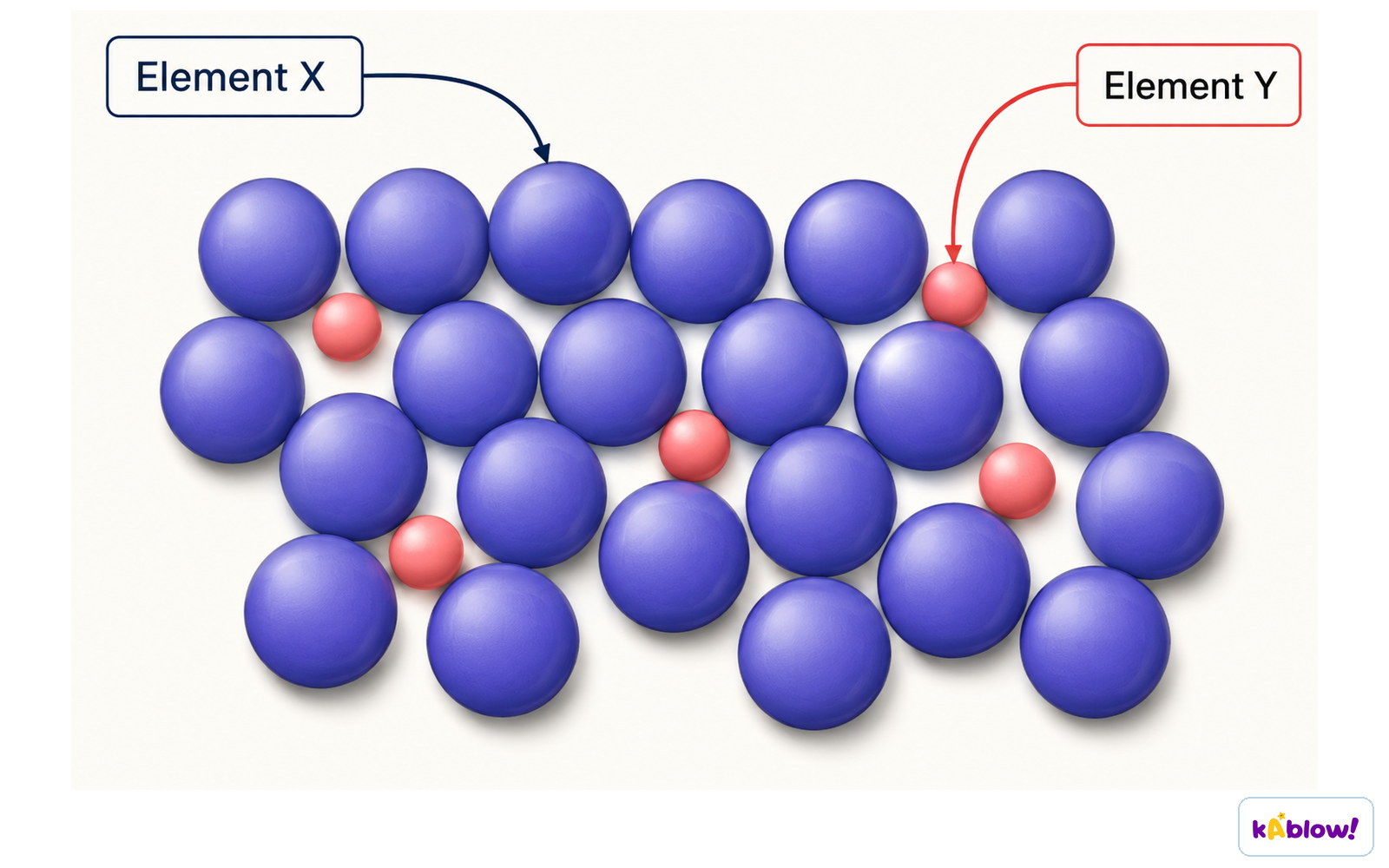
- Alloys are harder than pure metals because the atoms of different sizes distort the regular arrangement of atoms.
- This distortion makes it more difficult for the layers of atoms to slide over each other, so the alloy is less malleable.
- In particle diagrams, an alloy is shown with uneven sized particles and distorted layers.
Structure of an alloy
Common Alloys and Their Uses
- Bronze is an alloy of copper and tin; it is harder than copper and is used for ornaments and medals.
- Brass is an alloy of copper and zinc (often about 70% copper, 30% zinc); it is decorative, corrosion resistant, and used for plumbing and carpentry fittings.
- Steel is an alloy of iron and carbon. High carbon steel is strong but brittle (used for cutting tools); low carbon steel is softer and more easily shaped (used for building frames, car bodies).
- Stainless steel contains iron, chromium, and nickel; it is hard and resistant to corrosion, used for cutlery and cookware.
- Magnalium is an alloy of aluminium and magnesium; it is stronger, lighter, and more corrosion resistant than pure aluminium, used in aircraft and car construction.
- Magnalium with about 50% magnesium is used in fireworks because it is more stable than pure magnesium but still burns brightly.
- Gold alloys are made with silver, copper, and zinc to add strength and toughness; pure gold is 24 carat, and 18 carat gold is 75% gold by mass.
- Carats express the purity of gold: 24 carat = 100% gold, 12 carat = 50% gold.
Transition Metals: Properties and Uses
- Transition metals are hard, strong, lustrous, and good conductors of heat and electricity.
- They have high densities and very high melting points.
- Transition metals can form ions with different charges (multiple oxidation states) and their compounds are often coloured.
- Transition metals are used as catalysts; for example, iron in the Haber process, vanadium pentoxide in the Contact process, and nickel in hydrogenation of alkenes.
- They are used in medicine and surgery, such as titanium for bone and joint replacements due to its biocompatibility.
- They are also used in dyes, paints, stained glass, and jewellery.
Ceramics, Polymers, and Composites
- Ceramics are non-metal solids with high melting points, used in construction and domestic appliances.
- Soda-lime glass is made by heating a mixture of sand, sodium carbonate, and limestone; borosilicate glass is made from sand and boron trioxide and has a higher melting point.
- Clay ceramics are made by shaping wet clay and firing it at high temperatures; they are strong and used for bricks.
- Polymers have properties that depend on the monomers used and the conditions of polymerisation; ethene can form low density (LD) or high density (HD) poly(ethene).
- Thermosoftening polymers have tangled chains with no cross-links, melt when heated, and can be remoulded; used for packaging and bottles.
- Thermosetting polymers have strong cross-links between chains, do not melt when heated, and are rigid; used in electrical plugs.
- A composite is made of two distinct materials: a reinforcement (fibres or fragments) embedded in a matrix (binder).
- Examples of composites include fibreglass (glass fibres in polymer resin), concrete (aggregate in cement), carbon fibre (carbon fibres in polymer resin), and wood (cellulose fibres in organic polymer).
Slide
Sign up free to view the lesson slides
Step through every slide for this topic — plus flashcards and revision notes — with a free account.
Soal latihan
Pratinjau gratis — 8 dari 62 soal. Daftar untuk melihat semuanya.
1.What is the general name for the destruction of materials by chemical reactions with substances in the environment?
Easy- ACorrosion
- BRusting
- CGalvanising
- DSacrificial protection
2.Which two substances are both needed for iron to rust?
Easy- AWater and oxygen
- BWater and nitrogen
- COxygen and nitrogen
- DOxygen and carbon dioxide
3.All corrosion is rusting.
EasyTrue or false?
4.Which method of preventing rusting works by coating the iron with a more reactive metal?
Easy- AGalvanising
- BPainting
- CGreasing
- DElectroplating with tin
5.What is an alloy?
Easy- AA mixture of two or more metals or a metal with a non-metal
- BA chemical compound of two metals
- CA pure metal with no other elements
- DA composite of a metal and a ceramic
6.Alloys are usually harder than the pure metals they contain.
EasyTrue or false?
7.Which alloy is a mixture of copper and zinc?
Medium- ABrass
- BBronze
- CSteel
- DMagnalium
8.Which alloy is used for cutlery because it is hard and resistant to corrosion?
Medium- AStainless steel
- BHigh carbon steel
- CBronze
- DBrass
Unlock all 62 questions, flashcards & more
Buat akun gratis untuk melihat setiap soal, slide, kartu flash, dan catatan ulasan topik ini.