Atoms and isotopes
Belajar sambil bermain
Jawab soal-soal ini untuk dapat energi, lalu memancing dan menjelajah. Tanpa akun.
Catatan pelajaran
Inside the Atom
- Atoms are the building blocks of all matter and are incredibly small, with a radius of about 1 × 10⁻¹⁰ m.
- At the centre of an atom is a tiny, dense, positively charged nucleus, which contains almost all of the mass of the atom.
- The radius of the nucleus is over 10,000 times smaller than the radius of the whole atom.
- Negatively charged electrons orbit around the nucleus, and almost all of the atom is empty space.
- The nucleus contains protons (positive charge, relative mass 1) and neutrons (no charge, relative mass 1).
- Electrons have a negative charge and almost no mass — about 1/2000 the mass of a proton or neutron.
Atomic Number and Mass Number
- The atomic number (or proton number) is the number of protons in an atom; it determines which element the atom is.
- In a neutral atom, the number of electrons equals the number of protons, so the overall charge is zero.
- The mass number (or nucleon number) is the total number of protons and neutrons in the nucleus.
- Number of neutrons = mass number − atomic number.
- For example, sodium has atomic number 11 and mass number 23, so it has 23 − 11 = 12 neutrons.
- Electrons are not included in the mass number because their mass is negligible compared to protons and neutrons.
Nuclear Notation
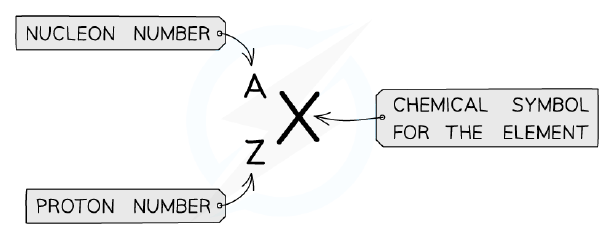
- Atoms can be represented using nuclear notation, where the mass number is written as a superscript and the atomic number as a subscript before the chemical symbol.
- For example, ²³⁸₉₂U shows uranium with mass number 238 and atomic number 92.
- The top number is the mass number (total protons + neutrons).
- The lower number is the atomic number (number of protons).
- From the notation you can work out the number of neutrons by subtracting the lower number from the top number.
Nuclide notation
Isotopes
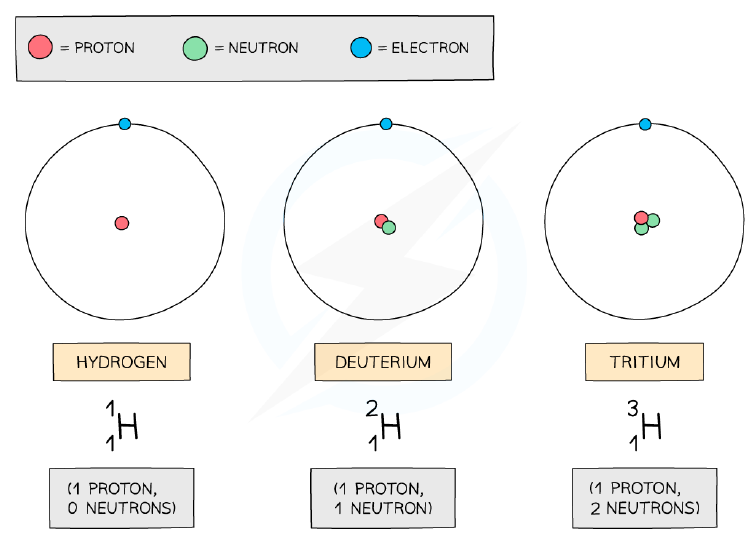
- Isotopes are atoms of the same element that have the same number of protons but different numbers of neutrons.
- Isotopes of an element have the same atomic number but different mass numbers.
- The number of neutrons does not affect the chemical properties (such as charge) but does affect the mass of the atom.
- Different isotopes of an element have the same number of electrons and protons.
- For example, chlorine has two common isotopes: chlorine-35 and chlorine-37, with 18 and 20 neutrons respectively.
- The relative atomic mass of chlorine is given as 35.5 because chlorine-35 is about three times more abundant than chlorine-37.
- Some isotopes are unstable due to an imbalance of protons and neutrons.
Isotopes of hydrogen
Electron Energy Levels
- Electrons orbit the nucleus at specific distances called energy levels (or shells).
- The first energy level can hold up to 2 electrons; the second and third can each hold up to 8 electrons.
- Electrons further from the nucleus have more energy — higher energy levels are at greater distances.
- Electrons can absorb electromagnetic radiation and move to a higher energy level, further from the nucleus.
- When an electron moves back down to a lower energy level, it emits electromagnetic radiation.
- The colours in the visible spectrum are produced when electrons move down energy levels and emit light.
Positive Ions
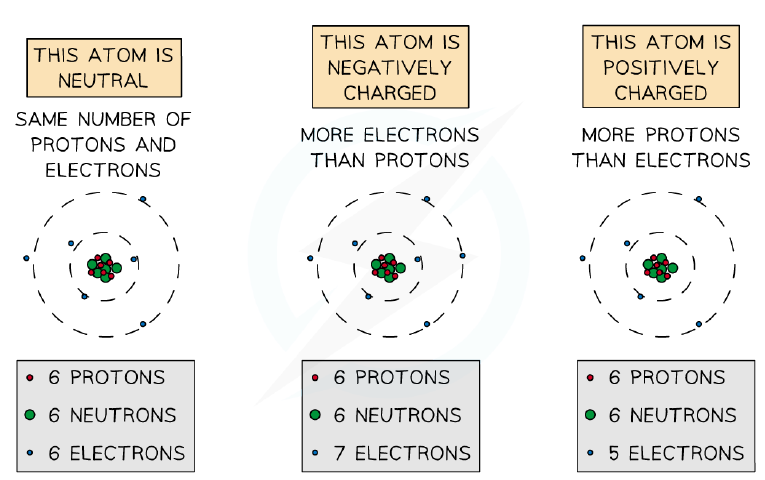
- An ion is an atom or particle with a non-zero charge.
- Atoms become positive ions when they lose one or more outer electrons.
- Electrons can be removed by friction (rubbing), by absorbing electromagnetic radiation, or during chemical reactions.
- When radiation passes close to atoms, it can knock electrons out, leaving the atom with an overall positive charge.
- Ions are often more chemically reactive than neutral atoms because of their positive charge.
- Protons are locked in the nucleus and cannot move between atoms; only electrons can be transferred.
The atomic structure of ions
The Plum Pudding Model
- Before the discovery of the electron, atoms were thought to be tiny, indivisible solid spheres.
- J.J. Thomson discovered the electron at the end of the 19th century and proposed the Plum Pudding model.
- In the Plum Pudding model, the atom is a ball of positive charge with negative electrons embedded in it — like plums in a pudding.
- This model made the atom neutral overall because the positive 'dough' balanced the negative electrons.
- The Plum Pudding model was replaced in 1909 when new experimental evidence from α scattering could not be explained by it.
Rutherford Scattering and the Nuclear Model
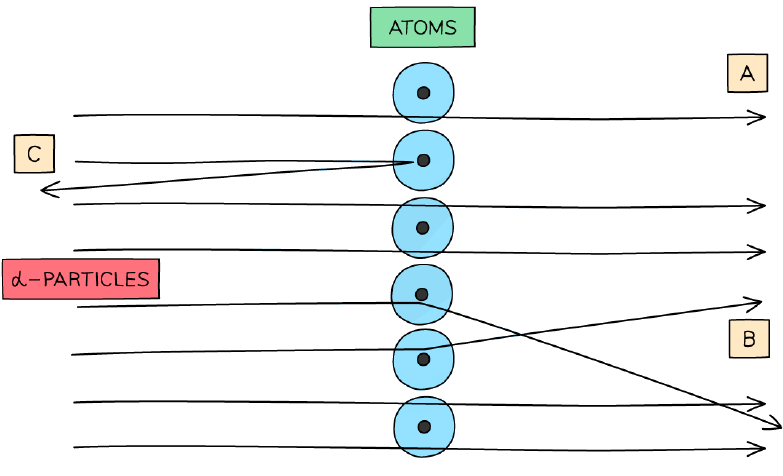
- In 1909, Ernest Rutherford's students Geiger and Marsden fired α particles at a thin gold foil.
- They expected α particles to pass straight through with only small deflections.
- Instead, most α particles passed straight through, some were deflected, and a few bounced straight back.
- The bouncing back could not be explained by the Plum Pudding model, so a new model was needed.
- Rutherford proposed the nuclear model: nearly all mass is concentrated in a tiny, positively charged nucleus at the centre, with electrons orbiting at a distance.
- The nuclear model replaced the Plum Pudding model because it could better explain the experimental observations.
Rutherford's Alpha Scattering Experiment
Bohr's Model and Later Developments
- In 1913, Niels Bohr improved the nuclear model by suggesting that electrons orbit at specific distances called energy levels.
- Bohr's model could explain the absorption and emission of electromagnetic radiation.
- Theoretical calculations from Bohr's model agreed with experimental observations.
- Later experiments showed that the positive charge of the nucleus could be subdivided into smaller particles — protons.
- In 1932, James Chadwick proved the existence of neutrons in the nucleus, about 20 years after the nucleus was accepted.
- The atomic model has changed over time as new evidence from experiments has led to improved models.
Slide
Sign up free to view the lesson slides
Step through every slide for this topic — plus flashcards and revision notes — with a free account.
Soal latihan
Pratinjau gratis — 8 dari 62 soal. Daftar untuk melihat semuanya.
1.What is the name used to describe nuclides which have the same number of protons but different numbers of neutrons?
Easy- AIons
- BIsotopes
- CIsomers
- DAllotropes
2.Which of the following correctly describes the structure of an atom?
Easy- AA positively charged nucleus containing protons and neutrons, surrounded by negatively charged electrons
- BA negatively charged nucleus containing protons and neutrons, surrounded by positively charged electrons
- CA neutral nucleus containing protons and electrons, surrounded by neutrons
- DA positively charged nucleus containing protons and electrons, surrounded by neutrons
3.Which of the following statements about the nucleus of an atom is correct?
Easy- AIt contains most of the mass of the atom and is positively charged
- BIt contains most of the mass of the atom and is negatively charged
- CIt contains very little of the mass of the atom and is positively charged
- DIt contains very little of the mass of the atom and is neutral
4.Which of the following statements about isotopes are correct? (select all that apply)
Medium- AIsotopes have the same number of protons
- BIsotopes have different numbers of neutrons
- CIsotopes have different numbers of electrons
- DIsotopes have the same mass number
- EIsotopes of the same element have the same chemical properties
5.An atom of sodium has an atomic number of 11 and a mass number of 23. How many neutrons are in the nucleus?
Easy- A11
- B12
- C23
- D34
6.Which of the following statements about positive ions is correct?
Medium- AA positive ion is formed when an atom gains electrons
- BA positive ion is formed when an atom loses electrons
- CA positive ion is formed when an atom loses protons
- DA positive ion is formed when an atom gains protons
7.In the plum pudding model, the atom is a ball of positive charge with negative electrons embedded in it.
EasyTrue or false?
8.In the Bohr model of the atom, electrons orbit the nucleus at specific distances called energy levels.
EasyTrue or false?
Unlock all 62 questions, flashcards & more
Buat akun gratis untuk melihat setiap soal, slide, kartu flash, dan catatan ulasan topik ini.