Changes of state and the particle model
Belajar sambil bermain
Jawab soal-soal ini untuk dapat energi, lalu memancing dan menjelajah. Tanpa akun.
Catatan pelajaran
Density and the Particle Model
- Density is the mass per unit volume of a material.
- The equation for density is: density = mass ÷ volume (ρ = m/V).
- Density is measured in kg/m³ when mass is in kg and volume in m³, or in g/cm³ when mass is in g and volume in cm³.
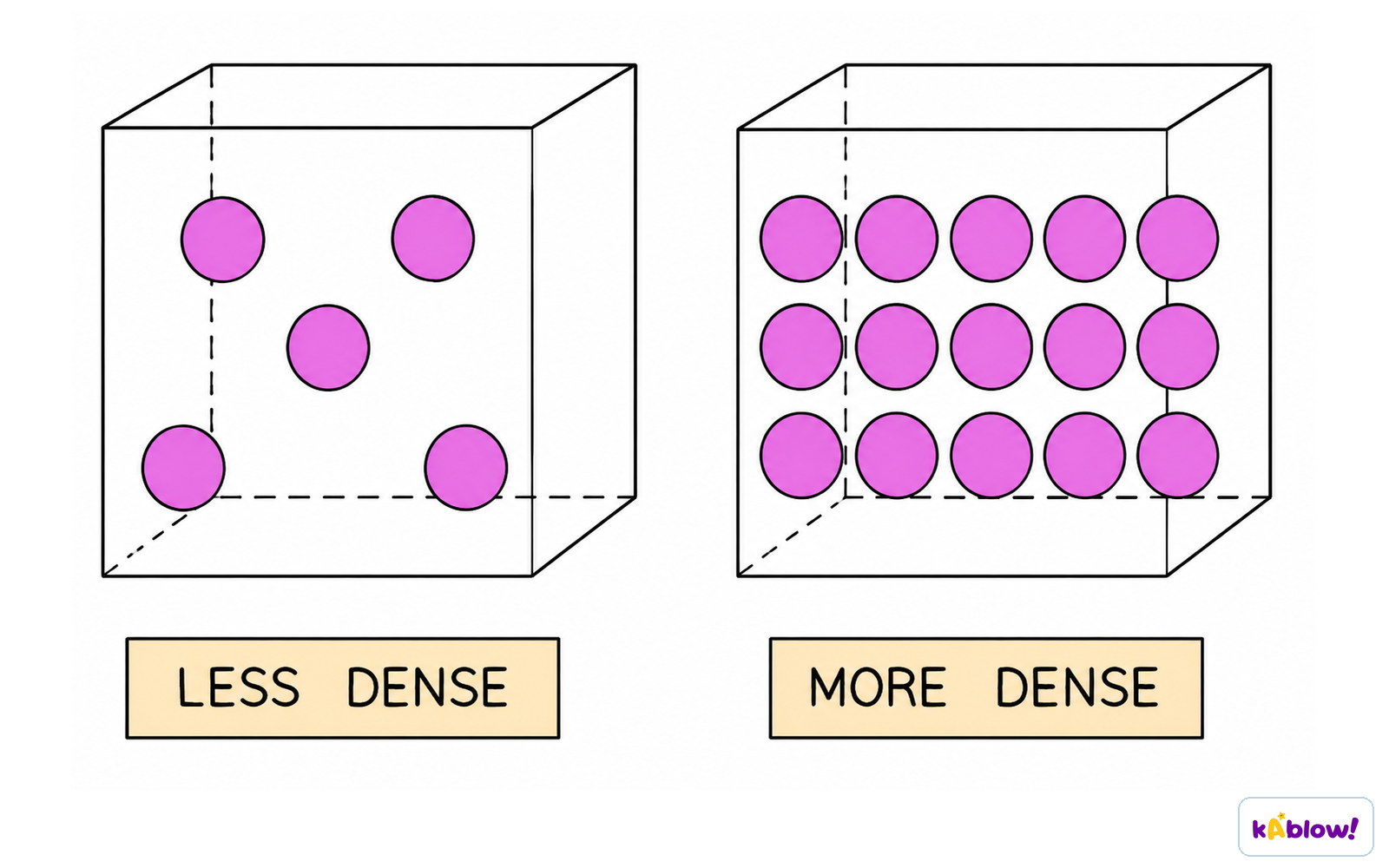
- The particle model explains density: closely packed particles give a high density, while widely spaced particles give a low density.
- Solids have the highest density, liquids a medium density, and gases the lowest density.
- For the same mass, a gas occupies a much larger volume than a solid or liquid because its particles are further apart.
- An object will float if its density is less than the density of the liquid it is placed in, and sink if it is more dense.
Particle Density Comparison
Solids, Liquids and Gases
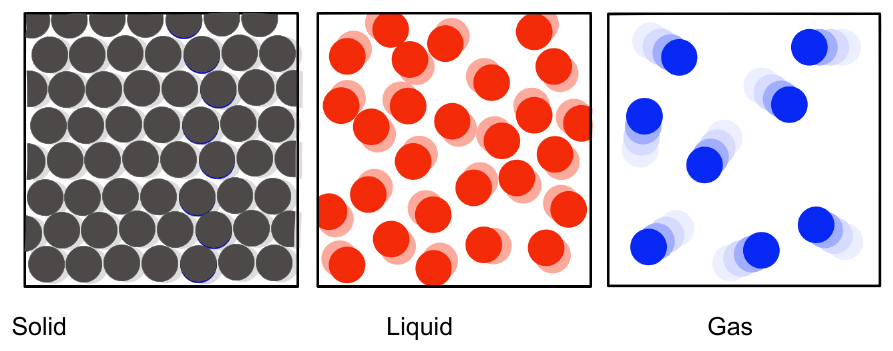
- In a solid, particles are closely packed in a regular arrangement and vibrate about fixed positions.
- Solids have a definite shape and a definite volume.
- In a liquid, particles are closely packed but in a random arrangement; they can flow over one another.
- Liquids have no definite shape (they take the shape of the container) but a definite volume.
- In a gas, particles are far apart and move randomly at high speeds.
- Gases have no definite shape and no fixed volume – they expand to fill any container.
- Gases are highly compressible because there are large gaps between the particles.
Particle spacing in solids, liquids and gases.
Changes of State
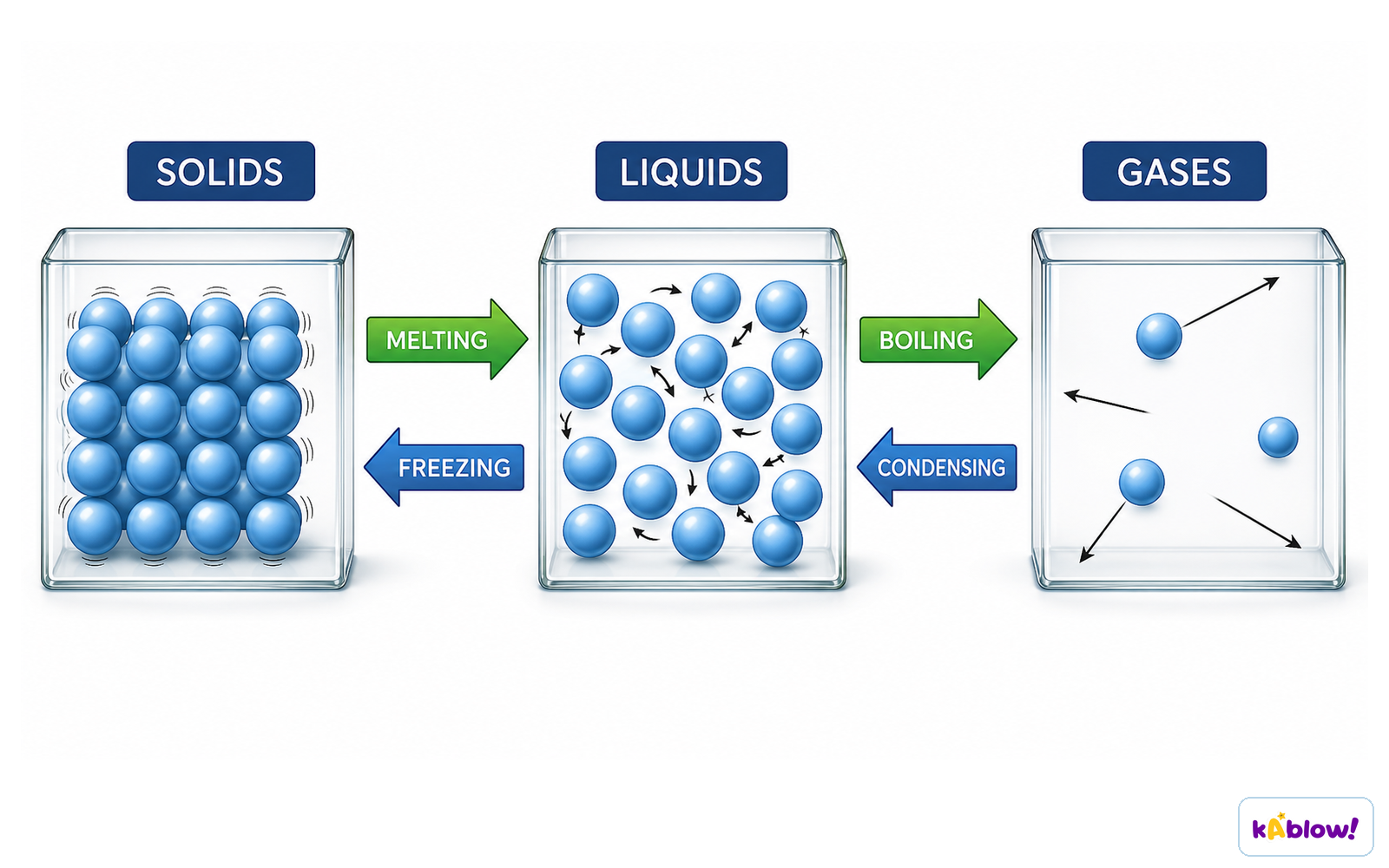
- Melting: a solid turns into a liquid when energy is transferred to the substance.
- Boiling: a liquid turns into a gas when energy is transferred to the substance.
- Condensing: a gas turns into a liquid when energy is transferred away from the substance.
- Freezing: a liquid turns into a solid when energy is transferred away from the substance.
- Subliming: a solid turns directly into a gas when energy is transferred to the substance.
- During a change of state, the number of molecules does not change, so the mass is conserved.
- Changes of state are physical changes – they are reversible and the material recovers its original properties.
Particle arrangement and motion in solids, liquids and gases
Required Practical: Determining Density
- For a regularly shaped solid, measure its mass with a digital balance and its dimensions with a ruler, Vernier calipers or micrometer.
- Calculate the volume using the appropriate formula for the shape (e.g. cube, sphere, cylinder), then use ρ = m/V.
- For an irregularly shaped solid, find its volume by displacement: lower it into a eureka can full of water and measure the displaced water in a measuring cylinder.
- The volume of water displaced equals the volume of the object.
- For a liquid, measure the mass of an empty measuring cylinder, then the mass after adding the liquid; the difference gives the liquid's mass.
- Repeat all measurements and take an average to reduce random errors.
- Handle glassware carefully, zero the balance before use, and never pour water onto an electric balance.
Common Misconceptions
- Particles themselves do not expand when heated – the spacing between them increases.
- Particles do not melt; it is the substance that changes state.
- Mass is conserved during a change of state because the number of particles stays the same.
- A change of state is a physical change, not a chemical change – no new substance is formed.
- Evaporation occurs at the surface of a liquid at any temperature, while boiling occurs throughout the liquid at a specific temperature.
Slide
Sign up free to view the lesson slides
Step through every slide for this topic — plus flashcards and revision notes — with a free account.
Soal latihan
Pratinjau gratis — 8 dari 64 soal. Daftar untuk melihat semuanya.
1.Which of the following is the correct unit for density?
Easy- Akg/m³
- Bkg
- Cm³
- DN
2.Which state of matter has a definite shape and a definite volume?
Easy- ASolid
- BLiquid
- CGas
- DPlasma
3.In which state of matter are the particles arranged in a regular pattern and only vibrate about fixed positions?
Easy- ASolid
- BLiquid
- CGas
- DBoth liquid and gas
4.Which process causes a puddle of water to dry up and disappear?
Medium- AEvaporation
- BBoiling
- CCondensation
- DFreezing
5.Which of the following statements about changes of state are true? (select all that apply)
Medium- AMass is conserved during a change of state.
- BChanges of state are physical changes.
- CThe particles themselves melt and separate.
- DA change of state is a chemical change.
- EWhen a substance changes state, the number of molecules does not change.
6.When a substance changes state, its mass changes.
EasyTrue or false?
7.Evaporation and boiling are the same process.
EasyTrue or false?
8.Match each change of state to its correct description.
Medium- Melting
- Boiling
- Condensation
- Freezing
- Solid turns into a liquid
- Liquid turns into a gas
- Gas turns into a liquid
- Liquid turns into a solid
Unlock all 64 questions, flashcards & more
Buat akun gratis untuk melihat setiap soal, slide, kartu flash, dan catatan ulasan topik ini.