Characteristics of living things
Belajar sambil bermain
Jawab soal-soal ini untuk dapat energi, lalu memancing dan menjelajah. Tanpa akun.
Untuk pendidik: slide pelajaran, catatan ulasan siap pakai untuk Characteristics of living things (MYP Biology, Year 1) — gunakan dalam pelajaranmu, atau jalankan topik sebagai aktivitas kelas interaktif yang dimainkan pembelajar sebagai permainan langsung.
Catatan pelajaran
What makes something alive?
- Big idea: Systems. A living thing is a system: lots of parts working together to keep it alive.
- Related concept: Function. Each life process has a job (a function) that helps the organism survive.
- Global context: Identities and relationships. We ask what it means to be a living thing, and how we are related to every other living thing on Earth.
- An organism is any living thing, from a tiny bacterium to a blue whale.
- Scientists cannot just say "it looks alive". They use a checklist of life processes. A living thing carries out all of them.
The seven life processes
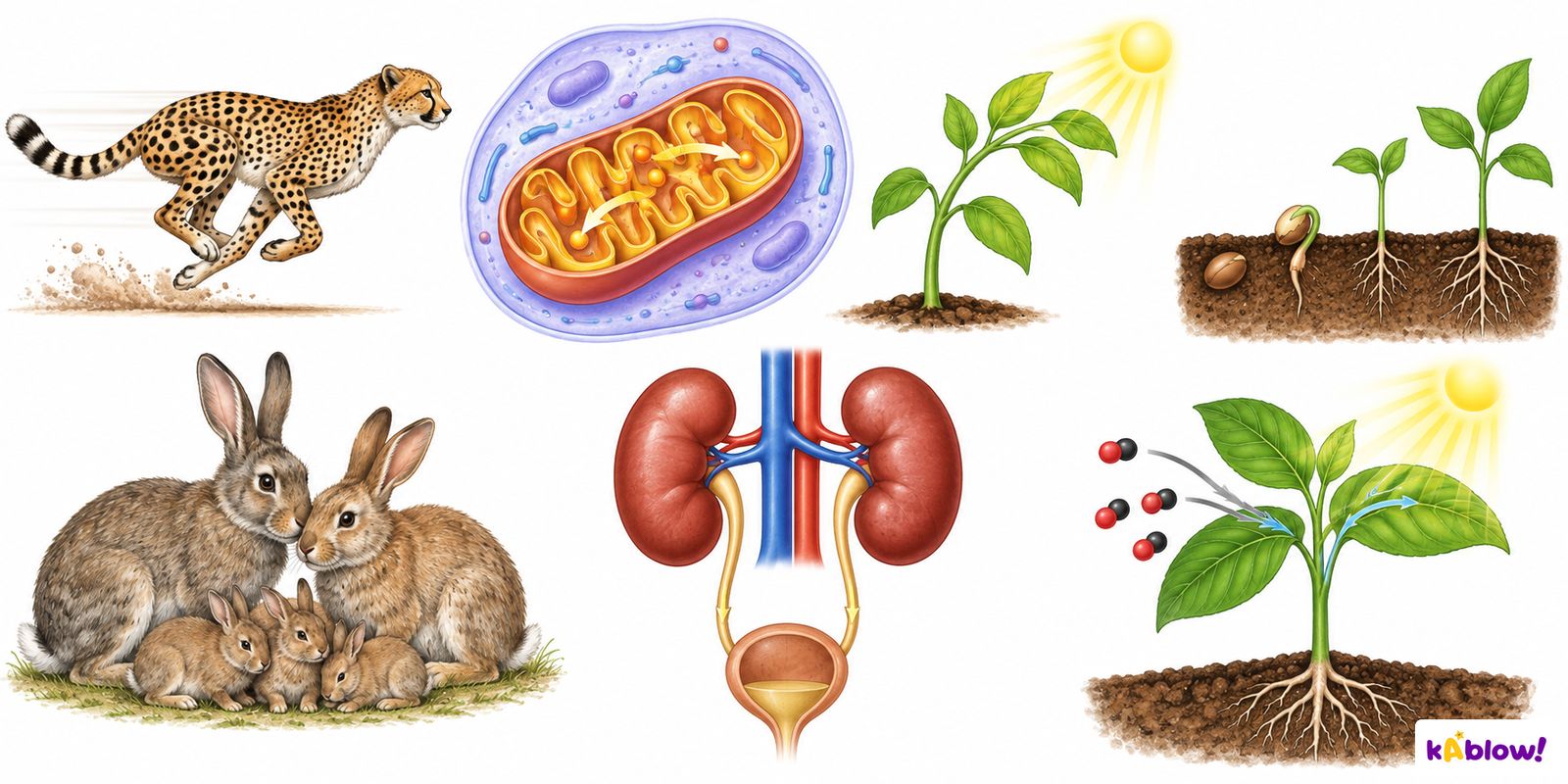
- Remember them with MRS GREN: Movement, Respiration, Sensitivity, Growth, Reproduction, Excretion, Nutrition.
- Movement: living things move their bodies or parts of their bodies. Animals walk, swim or fly. Plants move too, for example a flower opening or a shoot growing towards light.
- Sensitivity: detecting changes in the surroundings (stimuli) and responding to them. Your eyes detect light, and your pupils get smaller in bright light.
- Growth: a permanent increase in size, made by building new material. Eating a big meal does not count as growth.
- Reproduction: making new living things of the same kind. Without it, a type of organism would die out.
The Seven Life Processes (MRS GREN)
Respiration, excretion and nutrition
- Respiration is a chemical reaction in cells that releases energy from food (glucose). Every living cell does it, all the time.
- Respiration is not the same as breathing. Breathing moves air in and out of your lungs; respiration happens inside cells.
- Excretion is removing waste made by the body's own chemical reactions, such as carbon dioxide (breathed out) and urea (in urine).
- Excretion is not the same as egestion. Egestion is getting rid of food that was never absorbed, as faeces.
- Nutrition is taking in or making the materials and energy needed to live. Animals eat food. Plants make their own food by photosynthesis.
Living, non-living and once-living
- Living: carries out all seven life processes now, such as a cat, an oak tree or a mushroom.
- Non-living: never was alive, such as a rock, water, plastic or a cloud.
- Once-living: was part of a living thing but is now dead or made from something dead, such as wood, paper, cotton or a dead leaf.
- Non-living things can do some life-like things. A crystal can grow and a river can move, but they do not do all seven processes.
- To test a seed, see if it grows when given water and warmth. A seed that does is alive, but a seed that never does may be dead.
Edge cases: viruses and fire
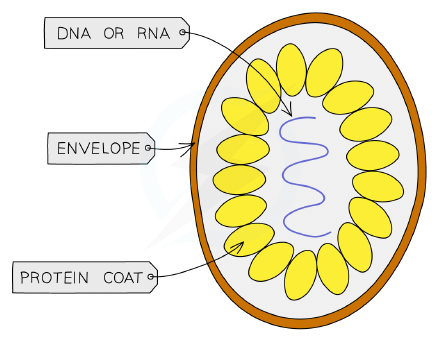
- Scientists still argue about viruses. A virus is a tiny package of genetic material in a protein coat. It is not made of cells.
- A virus can reproduce only inside a host cell. Outside one, it does nothing at all. It does not respire, grow or excrete on its own.
- Because it only shows some life processes, and only in a host, many scientists treat viruses as on the edge of being alive.
- Fire seems to move, grow, use oxygen and give off waste gases. But it is not made of cells, does not reproduce with genetic material and has no sensitivity as living things do.
- Edge cases show that our checklist is a model. Models are useful, but nature does not always fit them.
A virus particle
Think like a scientist: a fair test
- A fair test changes only one thing and keeps everything else the same, so you know what caused any difference.
- The thing you change is the independent variable. The thing you measure is the dependent variable. Everything you keep the same is a control variable.
- Example: to test if light affects how tall cress seedlings grow, the independent variable is the amount of light and the dependent variable is seedling height.
- Control variables here: the amount of water, the temperature, the type and number of seeds, and the soil.
- Repeat the test with several seedlings, then calculate a mean. One seedling could grow tall just by chance.
- Inquiry task: plan a fair test to find out whether temperature affects how quickly seeds germinate (start to grow). Name your three kinds of variable, say how you will measure the result, and say how you will make your results reliable.
Slide
Sign up free to view the lesson slides
Step through every slide for this topic — plus flashcards and revision notes — with a free account.
Soal latihan
Pratinjau gratis — 8 dari 50 soal. Daftar untuk melihat semuanya.
1.What does the letter M stand for in MRS GREN?
Easy- AMetabolism
- BMovement
- CMutation
- DMuscle
2.How many life processes are in the MRS GREN list?
Easy- AFive
- BSix
- CSeven
- DEight
3.Which life process releases energy from food?
Easy- ANutrition
- BExcretion
- CGrowth
- DRespiration
4.What does sensitivity mean as a life process?
Easy- ABeing easily upset
- BDetecting changes around you and responding to them
- CGetting rid of waste
- DMaking new living things
5.Which of these is a living thing?
Easy- AA mushroom
- BA cloud
- CA river
- DA rock
6.Which of these is non-living?
Easy- ASeaweed
- BMoss
- CSand
- DA coral polyp
7.A sunflower turns to face the Sun through the day. Which life process does this show best?
Medium- AExcretion
- BRespiration
- CReproduction
- DSensitivity
8.Which of these is an example of excretion?
Medium- AA dog breathing out carbon dioxide
- BA dog eating its dinner
- CA dog burying a bone
- DA dog having puppies
Unlock all 50 questions, flashcards & more
Buat akun gratis untuk melihat setiap soal, slide, kartu flash, dan catatan ulasan topik ini.
Soal ujian lampau
Latihan soal ujian lampau untuk topik ini segera hadir.
Segera hadir