Biodiversity and conservation case studies
Belajar sambil bermain
Jawab soal-soal ini untuk dapat energi, lalu memancing dan menjelajah. Tanpa akun.
Catatan pelajaran
Big idea: living variety under pressure
- Big idea (key concept): Relationships. Every species in an ecosystem is linked to others by feeding, competition and shelter. Remove or add one species and many other species feel it.
- Related concept: Consequences. Human choices about farming, fishing, forestry and trade have consequences for living things far away from where the choice was made.
- Global context: Globalization and sustainability. Products such as palm oil, fish and timber are traded around the world, so a choice made in a shop can change an ecosystem on another continent. Sustainable use means meeting today's needs without wrecking the supply for the future.
- Biodiversity is the variety of living things. It has three levels: genetic diversity (differences between individuals of one species), species diversity (the number and abundance of different species) and ecosystem diversity (the range of habitats).
- A varied ecosystem is usually more stable. If one species declines, others can often take over its role, and a disease or a drought is less likely to wipe everything out.
- People gain from biodiversity through ecosystem services: pollination of crops, clean water, fertile soil, carbon storage, raw materials, medicines and tourism. There is also an ethical argument that species have a right to exist.
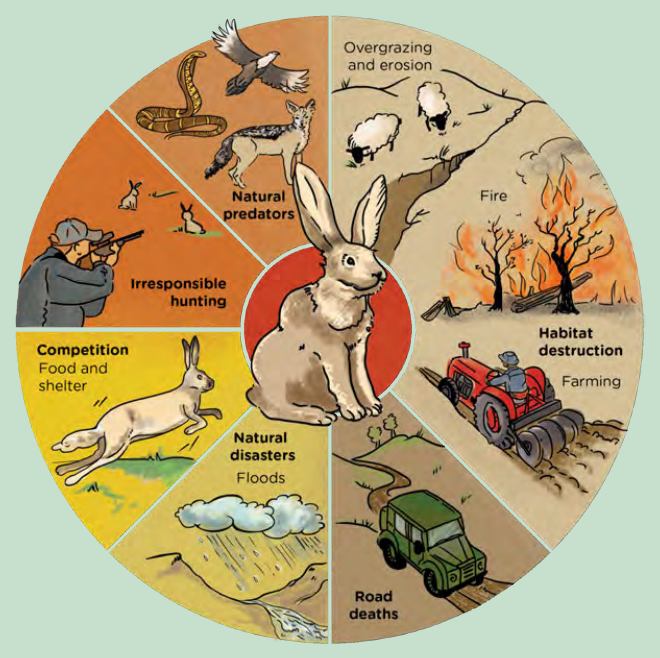
- Threats include habitat destruction, invasive species, overexploitation (taking too many), pollution and climate change. They rarely act alone: the riverine rabbit of South Africa faces predators, hunting, farming, fire, floods and road traffic all at once.
Many pressures on one species: the riverine rabbit
Measuring biodiversity
- Species richness is the number of different species in an area. It is easy to count but ignores how many individuals there are of each.
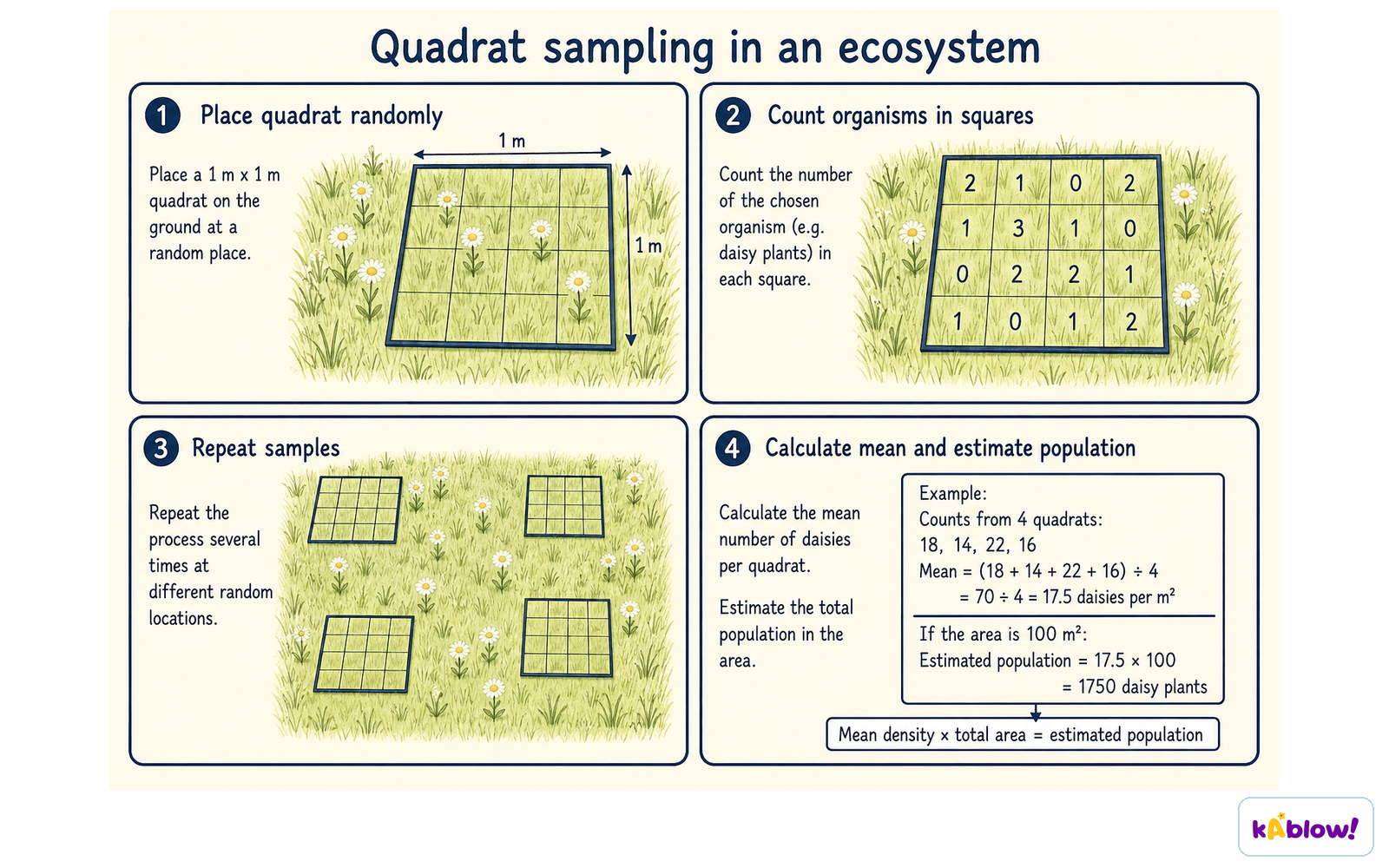
- A quadrat is a square frame (often 1 m by 1 m) placed on the ground. To avoid bias the positions must be random, for example by using random numbers as coordinates on a measuring grid. Count the organisms in each quadrat, repeat many times and calculate the mean.
- Estimated population = mean number per m² × total area in m². This only works if the sample is large enough and the organisms are spread fairly evenly across the area.
- A transect is a line laid across a habitat. Quadrats placed at regular intervals along it show how the community changes across a gradient, such as from the sea shore up the beach.
- Moving animals cannot be counted in quadrats. In capture-recapture, a first sample is caught, marked and released. A second sample is caught later. Population = (number marked in first sample × size of second sample) ÷ number of marked animals recaptured. It assumes the marked animals mix back in and that marking does not harm them.
- An index of diversity uses both richness and evenness. In this course we use Simpson's index: D = N(N − 1) ÷ Σ n(n − 1), where N is the total number of individuals and n is the number of one species. A higher D means more diversity.
- Worked example: a meadow has 8, 6, 5, 4 and 2 individuals of five beetle species. N = 25. Σ n(n − 1) = 56 + 30 + 20 + 12 + 2 = 120. D = 25 × 24 ÷ 120 = 5.0. A field with 20, 3 and 2 individuals also has N = 25, but Σ n(n − 1) = 388 and D is only about 1.5, because one species dominates.
Estimating a population with random quadrats
Case study 1: Yellowstone Lake
- Yellowstone Lake in the USA was home to the native Yellowstone cutthroat trout. Cutthroat trout are food for many predators, including bears, otters and fish-eating birds such as ospreys.
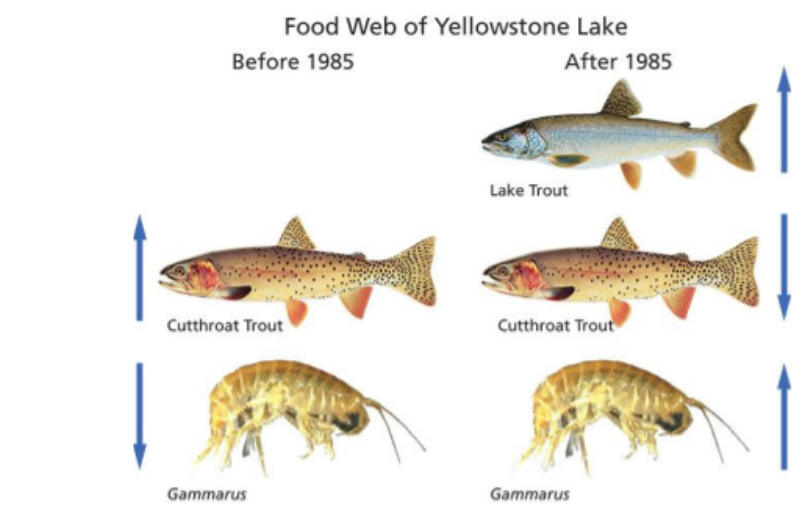
- A non-native predator, the lake trout, was later found in the lake. An invasive species is a non-native species that spreads and harms the native community. Lake trout eat young cutthroat trout. Lake trout live mostly in deep water.
- As the lake trout became established, cutthroat trout numbers fell. The small shrimp-like animal×Gammarus×, which the cutthroat trout feed on, rose because it was eaten less. This is a cascade: a change at one level of the food web passes to the levels above and below.
- Animals that depend on cutthroat trout lose a food source. Because lake trout live in deep water they are much harder for bears and birds to catch, so they do not replace the food that was lost.
- Response: park scientists use gillnets to remove lake trout. This does not need the lake to be drained or poisoned and it protects other species, although some other fish are caught by accident (bycatch). The work must continue every year, which is expensive.
- Lesson: it is much cheaper and more effective to prevent invasive species arriving than to remove them once they are established.
Yellowstone Lake food web before and after lake trout
Case study 2: palm oil and tropical forest
- Palm oil is in food, soap, cosmetics and fuel. The oil palm gives far more oil from each hectare than other oil crops, so it feeds a large global demand. Most is grown in Indonesia and Malaysia, and production rose steeply between 1991 and 2018.
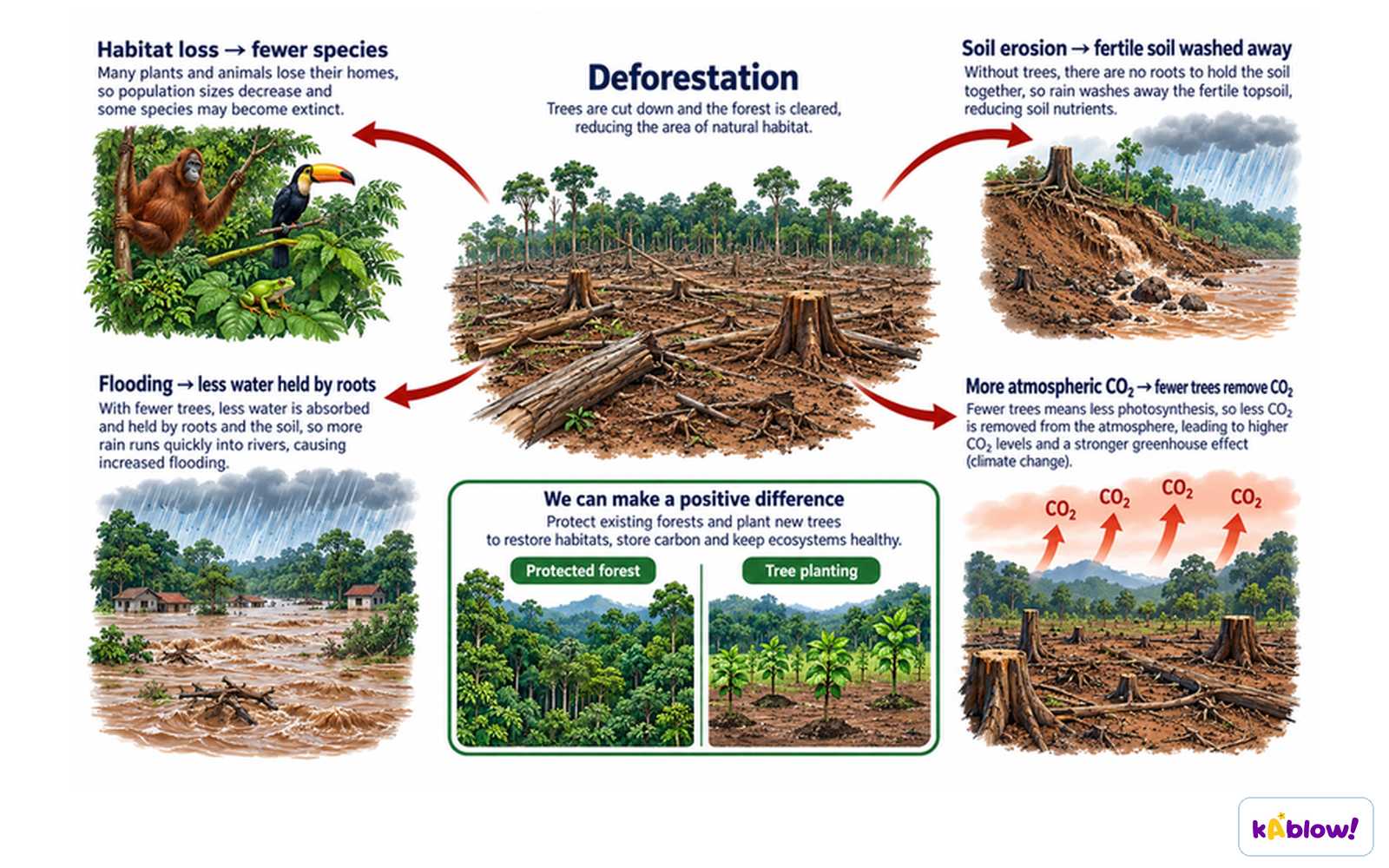
- Much of this land was once tropical rainforest. Clearing it is deforestation. It removes habitat, so species such as the orangutan of Borneo and Sumatra lose their homes and some become endangered.
- Rainforest has thousands of species. An oil palm plantation is a monoculture: one crop species in rows. It offers few food sources and few places to nest, so far fewer species live there and the index of diversity is much lower.
- Other consequences of clearing forest: soil is washed away without roots to hold it, rivers flood more, and carbon dioxide that was stored in the trees is released. Draining and burning peat forest releases very large amounts of carbon.
- Trade-offs. If people stopped using palm oil, other oil crops would be needed, and they give less oil per hectare, so they might need more land in total. Many scientists therefore argue for sustainable palm oil: grow it on land that is already cleared, protect the remaining forest and check the supply chain.
- Different groups have different views: farmers want income, companies want low costs, shoppers want cheap products and conservationists want habitat protected. A fair evaluation weighs all of them.
Consequences of clearing a forest
Think like a scientist: evaluating evidence and planning a survey
- To evaluate a conservation scheme, ask: did the target population or the index of diversity increase? Compared with what? Over how long? At what cost? Who gains and who loses?
- Ex situ conservation protects species outside their habitat: zoos and captive-breeding programmes, botanical gardens and seed banks such as the Millennium Seed Bank in the UK. Animals can be released later (reintroduction), as happened with the Arabian oryx, which had become extinct in the wild.
- Ex situ work keeps genetic diversity safe and can rescue a species with very few individuals left, for example by careful breeding to avoid inbreeding. But it is expensive, cannot save the habitat and released animals need a safe place to go.
- Local people must benefit or schemes fail. Ecotourism, jobs as park rangers and payments for protecting forest give communities a reason to look after wildlife.
- A rise in numbers is not proof that a scheme worked. You need a comparison, such as a similar unprotected area, because numbers might have risen anyway after a good year for food or weather.
- Counts must be made the same way each time (same quadrat size, same number of quadrats, same season, random positions) or the results cannot be compared fairly.
- Short-term success may not last. A species saved by a feeding programme may collapse when it stops. Long-term monitoring gives stronger evidence.
- Different strategies suit different situations. A species with only a handful left may need ex situ breeding as a safety net, while a widespread species with a shrinking habitat is better served by protecting that habitat.
- Use command words properly. Describe means say what happens. Explain means give the reason. Evaluate means weigh strengths and weaknesses and reach a judgement. Suggest means apply your knowledge to a new situation.
Think like a scientist: planning a biodiversity survey
- A school wants to know whether a mown lawn or an uncut meadow strip has more plant species. Here is how to plan it as a fair test.
- The independent variable is the habitat (lawn or meadow strip). The dependent variable is the number of plant species (or the Simpson index) per quadrat. Control variables include quadrat size, the number of quadrats, the time of year and how positions are chosen.
- Choose positions with random numbers so the surveyor does not just pick the interesting spots. Use the same number of quadrats in each habitat, and enough of them (at least 10) so that one odd quadrat does not distort the mean.
- Record the data in a table with units, then calculate the mean number of species per quadrat and the Simpson index for each habitat. Look for anomalies such as a count that is far from the rest.
- Evaluate the method: both areas are in one school, so the result may not apply elsewhere; the survey was done in a single week; it is hard to identify every species accurately. How could each limit be reduced?
- Inquiry task: design a survey of insect diversity on two sides of a hedge. State your variables, how you will sample, how many samples you will take and how you will decide which side has more diversity.
Slide
Sign up free to view the lesson slides
Step through every slide for this topic — plus flashcards and revision notes — with a free account.
Soal latihan
Pratinjau gratis — 8 dari 54 soal. Daftar untuk melihat semuanya.
1.What is biodiversity?
Easy- AThe total mass of all the living things in a habitat
- BThe number of animals that live in a zoo or reserve
- CThe variety of living things in a habitat or ecosystem
- DThe range of different climates found on Earth
2.Which of these is one of the three levels of biodiversity?
Easy- AGenetic diversity within a species
- BThe diversity of weather in a region
- CThe diversity of rock types in a hill
- DThe diversity of buildings in a city
3.A habitat that contains thousands of individuals of just one species has high biodiversity.
EasyTrue or false?
4.Match each term to its meaning.
Easy- Habitat
- Endangered
- Extinct
- Invasive species
- A non-native species that spreads and harms native species
- A species with no living members left
- The place where an organism lives
- A species at high risk of dying out
5.What is an invasive species?
Easy- AAny native species that is found in a very large number of habitats
- BA species that has been moved into a zoo for breeding programmes
- CAny species that lives together in one very large group
- DA non-native species that spreads and harms the native community
6.Why should quadrats be placed at random positions?
Easy- ATo make the survey finish more quickly
- BTo avoid bias in the results
- CTo make sure every quadrat contains plants
- DTo make the mean count as high as possible
7.Complete the sentence about sampling biodiversity.
EasyA ____ is a square frame used to sample the organisms in a small area.
8.Which of these are ecosystem services provided by biodiversity? (select all that apply)
Easy- APollination of crops by insects
- BStorage of carbon in forests
- CPurification of water by wetlands
- DProduction of plastic in factories
- EMaking rocks from sediment
Unlock all 54 questions, flashcards & more
Buat akun gratis untuk melihat setiap soal, slide, kartu flash, dan catatan ulasan topik ini.