Fertility, contraception and reproductive technology
Belajar sambil bermain
Jawab soal-soal ini untuk dapat energi, lalu memancing dan menjelajah. Tanpa akun.
Catatan pelajaran
Big idea: change, development and choice
- Big idea (key concept): Change. The human reproductive system changes through the month and through life, controlled by hormones. Understanding those changes lets us help people who want a baby and people who want to wait.
- Related concept: Development. An egg develops in the ovary, a lining develops in the uterus and, after fertilisation, an embryo develops. Every stage is timed by hormones.
- Global context: Fairness and development. Access to contraception and fertility treatment is very different from one country to another and from one family to another. Who should have access, and who should pay?
- This lesson is factual and balanced. People hold many different views about contraception and fertility treatment, for personal, cultural and religious reasons. Science can explain how these methods work and how well they work, but it cannot decide what any person should do.
- Fertility is the ability to conceive a child. A woman's ovaries release one egg cell roughly once a month. A man's testes make millions of sperm every day. Fertilisation happens when a sperm nucleus fuses with an egg nucleus, usually in the oviduct.
- Four hormones run the female cycle. FSH and LH are made by the pituitary gland at the base of the brain. Oestrogen and progesterone are made by the ovaries. The pituitary controls the ovaries, and the ovaries send signals back to the pituitary. This two-way control is a negative feedback system for some steps and a positive one at the LH surge.
The menstrual cycle and its hormones
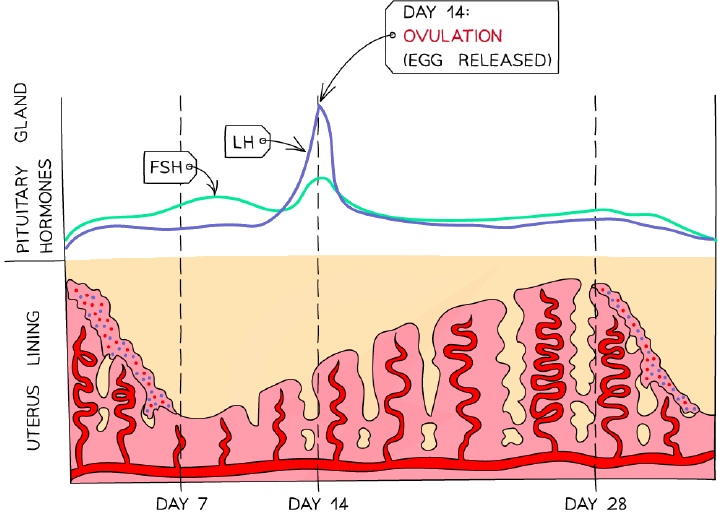
- The menstrual cycle repeats about every 28 days (anything from about 21 to 35 days is normal). Day 1 is the first day of bleeding. During menstruation, usually for about 3 to 7 days, the thickened lining of the uterus breaks down and leaves the body.
- FSH (follicle stimulating hormone) is released by the pituitary gland. It makes a follicle in the ovary grow, with an egg cell maturing inside it. It also stimulates the ovary to make oestrogen.
- Oestrogen is made by the follicle. It makes the uterus lining repair and thicken after menstruation. When oestrogen reaches a high level it inhibits FSH (negative feedback) and stimulates the pituitary gland to release a surge of LH.
- LH (luteinising hormone) shows a sharp peak at about day 14. This LH surge triggers ovulation, the release of a mature egg from the ovary into the oviduct.
- After ovulation the empty follicle becomes the corpus luteum, which makes progesterone. Progesterone maintains the thick lining of the uterus, ready for an embryo, and inhibits FSH and LH so no more eggs mature while a pregnancy might be starting.
- If the egg is not fertilised, the corpus luteum breaks down, progesterone falls, and the lining is shed. That is the start of the next cycle. If the egg is fertilised, the embryo sends a signal that keeps progesterone high (see the next section), so the lining stays.
- An egg survives for about a day after ovulation, but sperm can survive for several days in the female system. This is why pregnancy is possible for a few days before ovulation as well as just after it, and why fertility awareness methods are not very reliable.
FSH and LH levels and the uterus lining across a 28-day cycle
Pregnancy, hCG and why fertility can be reduced
- If a sperm fertilises the egg, the zygote divides as it travels down the oviduct. After several days the embryo sinks into the thick uterus lining. This is implantation.
- The cells around the early embryo make a hormone called hCG (human chorionic gonadotrophin). hCG keeps the corpus luteum alive so that it carries on making progesterone. Later the placenta takes over and makes progesterone itself.
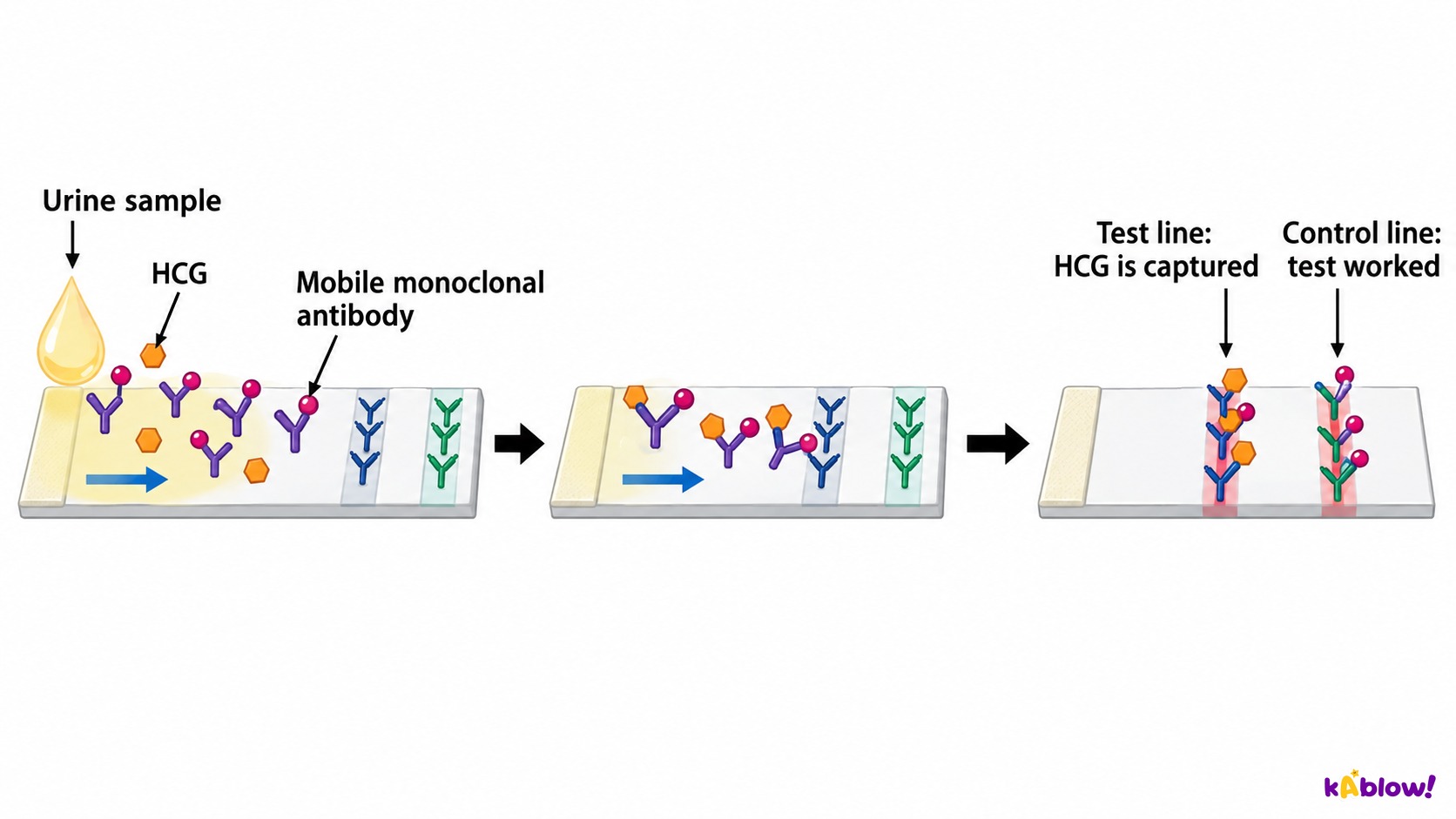
- Because hCG is only made in pregnancy and leaves the body in urine, it is the hormone that a pregnancy test detects. The test strip holds monoclonal antibodies that bind only to hCG. A line appears where hCG has been captured. A separate control line shows that the test worked.
- Infertility means a couple has not conceived after a year or more of trying. It is common and has many causes, found in women, in men and sometimes in both. Many people are affected, and it is not anyone's fault.
- Causes in women include ovulation disorders (for example, hormone imbalance), blocked oviducts and conditions affecting the uterus. Causes in men include a low sperm count or sperm that do not swim well. Sometimes no clear cause is found.
- Age matters. On average, the chance of conceiving in each cycle goes down as a woman gets older, especially after the mid-30s, because fewer eggs remain and they are less likely to develop normally. Male fertility also falls with age, but more slowly.
- Lifestyle factors can reduce fertility in both sexes: smoking, heavy drinking, being very overweight or underweight, and some drugs. Changing these can help, but not in every case.
How a pregnancy test detects hCG
Fertility treatments and IVF
- Treatment depends on the cause. Fertility drugs containing FSH and LH (or drugs that raise the body's own FSH) can stimulate ovulation in a woman who is not releasing eggs. A possible side effect is the release of several eggs at once, which raises the chance of twins or triplets.
- In artificial insemination, sperm are placed in the uterus at the time of ovulation. In IVF (in vitro fertilisation), fertilisation happens outside the body. 'In vitro' means 'in glass', in a laboratory dish.
- The steps of IVF. (1) The woman takes FSH and LH so that several follicles mature. (2) The eggs are collected from the ovaries. (3) The eggs are mixed with sperm in a dish. (4) Fertilised eggs grow into embryos for a few days. (5) One, or sometimes two, healthy embryos are placed in the uterus. Hormones such as progesterone may be given to help the lining.
- If the sperm are very few or weak, a single sperm can be injected into an egg. This is called ICSI. Eggs, sperm or embryos can also be frozen and stored for later use.
- Success is not guaranteed. IVF success depends strongly on the woman's age. As an approximate guide, clinic statistics show about one in three treatment cycles ending in a live birth for women under 35, falling to only a few in a hundred for women over 42. Success is usually reported as live births per cycle or per embryo transferred, so check which one a clinic means.
- Risks and costs. Fertility drugs can overstimulate the ovaries in a small number of women. Transferring more than one embryo raises the chance of multiple births, which carry greater risks for mothers and babies, so many clinics transfer a single embryo. IVF can also be expensive, physically demanding and emotionally stressful.
Contraception: how each method works
- Contraception reduces the chance of pregnancy. Methods work in four main ways: they stop sperm reaching the egg, stop eggs being released, stop sperm surviving or stop an embryo implanting, or they permanently block the tubes that carry gametes.
- Barrier methods. A condom (worn on the penis, or an internal version) and a diaphragm physically stop sperm entering the uterus. Condoms are the only common method that also reduces the risk of sexually transmitted infections (STIs).
- Hormonal methods. The combined pill contains oestrogen and progesterone. These keep FSH low, so eggs do not mature and ovulation does not happen. The pill is taken for 21 days, then there is a break during which the lining is shed. Progesterone-only methods (the pill, an implant under the skin of the arm, or an injection) release progesterone that thickens the mucus at the cervix so sperm struggle to pass, and can also stop ovulation.
- Intrauterine devices. A copper IUD is placed in the uterus. Copper ions are toxic to sperm and also make it harder for an embryo to implant. An intrauterine system (IUS) releases progesterone locally. Both last for years and can be removed by a doctor.
- Surgical methods. In a vasectomy the sperm ducts are cut, so semen contains no sperm. In female sterilisation the oviducts are blocked or cut, so eggs cannot meet sperm. These methods are meant to be permanent.
- Natural methods such as fertility awareness (tracking the cycle, temperature or mucus) have no side effects but are among the least reliable, because ovulation can shift. Not having sex at all is the only way to be sure of avoiding pregnancy, but it is not what most couples choose.
- Failure rate is the number of pregnancies per 100 users in one year. Approximate typical-use figures are: no method about 85, male condom about 13, combined pill about 7, injection about 4, copper IUD about 1, implant under 1. 'Typical use' is higher than 'perfect use' because people forget pills or use a method incorrectly. Methods that do not rely on remembering, such as the implant and IUD, have the lowest typical-use failure rates.
Think like a scientist: IVF ethics and evaluating the evidence
- Benefits of IVF. It has helped millions of couples and single people to have children. Embryos can be tested for serious inherited disorders before transfer (preimplantation genetic testing), so a family with a known risk may avoid passing on a condition.
- Ethical questions. IVF often creates more embryos than are used. They may be stored, donated for research or for other couples, or allowed to perish, and people disagree about the moral status of an embryo. There are also questions about access, because treatment is expensive and funded very differently in different countries, and about how far embryo testing should go.
- Evaluating claims. A statement such as 'this clinic has a 40% success rate' needs checking: success means a live birth or a positive test? Per cycle or per embryo? Which age group? A clinic that treats younger patients will look better without being any more skilful.
- A fair comparison needs the groups to be similar in everything except the factor you are testing. If couples who use method A are older or use it less consistently than couples who use method B, the difference in pregnancies may be caused by those other variables and not by the method.
- Use the percentage formula for any success or failure rate: rate = (number of events / number of people or cycles) x 100. Always show the units and say what the denominator is.
- Inquiry task: a clinic reports that 120 of 400 cycles for patients under 35 and 30 of 300 cycles for patients over 40 ended in a live birth. Calculate both percentages, then write two sentences evaluating a newspaper headline that says 'Clinic A is three times better than Clinic B', where Clinic B mostly treats older patients. Suggest one extra piece of information you would ask for.
Slide
Sign up free to view the lesson slides
Step through every slide for this topic — plus flashcards and revision notes — with a free account.
Soal latihan
Pratinjau gratis — 8 dari 55 soal. Daftar untuk melihat semuanya.
1.Which gland makes FSH and LH?
Easy- AThe ovary
- BThe thyroid gland
- CThe pituitary gland
- DThe pancreas
2.Where does fertilisation usually happen?
Easy- AIn the oviduct
- BIn the vagina
- CIn the ovary
- DIn the bladder
3.Ovulation is the release of a mature egg from an ovary.
EasyTrue or false?
4.In a typical 28-day cycle, on about which day does ovulation happen?
Easy- ADay 1
- BDay 7
- CDay 28
- DDay 14
5.Which hormone causes a follicle to develop and an egg to mature in the ovary?
Easy- AProgesterone
- BFSH
- ChCG
- DTestosterone
6.What is the main job of LH in the menstrual cycle?
Easy- AIt thickens the lining of the uterus
- BIt triggers ovulation
- CIt stops the next period
- DIt keeps the embryo in the uterus
7.Complete the sentence.
EasyAfter ovulation the hormone ____ maintains the thick lining of the uterus.
8.Which hormone does a pregnancy test detect in urine?
Easy- AFSH
- BOestrogen
- CLH
- DhCG
Unlock all 55 questions, flashcards & more
Buat akun gratis untuk melihat setiap soal, slide, kartu flash, dan catatan ulasan topik ini.